Hilary Duff – Author?

Taken at MuchMusic during the taping of Live@M...

Image via Wikipedia

Hilary Duff has signed a multi-book deal with Simon & Schuster Books for Young Readers. 

The first novel, Elixir, will be published in October of this year. 

There is also a nonfiction title in the deal which will be about divorce.  It is due to be published in 2012.

Once again we can hope that a celebrity can actually write.

Reblog this post [with Zemanta]

Windows with Birds

Windows with Birds by Karen Ritz

The cat loved his home.  It had windows filled with birds to watch, hiding places, stairs, and a mouse in the basement.  It also had the boy who filled the water dish and scratched just right.  The cat would wait for him to return from school.  But one day, the boy took the cat to a new home in an apartment building.  The cat was not happy.  He hid, meowed aloud, and avoided the boy but the boy did not take him back home.  The cat was very upset until the morning when he discovered that these windows had birds too! 

This is a book that explores the emotional effects of moving from the point of view of a family pet.  Children will see their own emotions reflected there in a tangible and relatable way.  The illustrations are realistic and filled with loving detail.  Sharp-eyed readers will spot a moving box and the moving van before the move comes.  Ritz has captured the movements and position of the cat perfectly both in action and repose. 

A lovely addition to moving books, this should find its way onto most library shelves.  Appropriate for ages 4-7.

Reviewed from library copy.

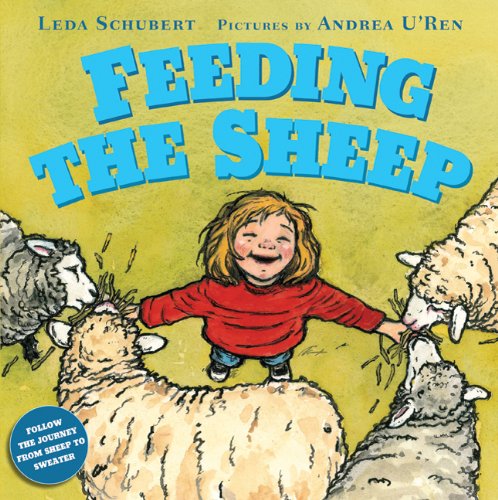
Feeding the Sheep

Feeding the Sheep by Leda Schubert, illustrated by Andrea U’Ren

Follow the process from sheep to sweater through the eyes of a young girl.  The book starts with feeding the sheep corn and hay on a wintry day.  Then it moves on to shearing, washing the wool, drying the wool, carding it, spinning the yarn, dyeing the yarn, and then knitting it.  Each step is done by the little girl’s mother to the refrain of “What are you doing?” The book uses gentle rhymes and repetition to show the steps as well as detailed illustrations where the young girl gets involved too.

This book is ideal for toddlers and preschoolers who will enjoy realizing where their sweaters come from.  The style of writing is approachable and gentle.  Nicely the book comes full circle back to the feeding of sheep, making the point that the cycle of sheep to sweater continues.  U’Ren’s illustrations are filled with homey touches and small details, yet they will work well with a group.  A wonderful touch is the changing of the seasons throughout the book, often glimpsed only out of the window.  This again underlines the cyclical nature of farming.

Short sentences with plenty of rhythm and repetition, make this a friendly choice.  It is also a joy to read aloud.  Appropriate for ages 2-4.

Reviewed from library copy.

Making a Book Cover

Loving this glimpse of a designer at work on the cover of Blameless, the new book by Gail Carriger, due out in September 2010.  The design is done by Lauren Panepinto.

Roly Poly Pangolin

Roly Poly Pangolin by Anna Dewdney

This new book by Dewdney has the same cadence as her Llama Llama books.  Roly Poly is a very small, young pangolin who doesn’t like new things.  Even friendly faces scare him and have him running away.  When he hears frightening noises, he runs, falls and then rolls tightly into a ball.  It takes a lot of courage for him to eventually uncurl and see exactly what frightened him so badly.  But when he does, he finds that it just might be easier to make friends than keep on fleeing in fear.

This is a simple book perfect for a toddler audience.  Dewdney uses rhyme and rhythm as well as repeated phrases throughout the book.  Filled with just enough action and strange noises, this book will appeal to children who may be fearful of new things themselves.  Dewdney’s illustrations are equally welcoming.  There is plenty of humor here in both the text and the illustrations too.  The book ends with a paragraph of information on the pangolin.

Get this into the hands of Llama Llama fans and also to those children who enjoy new, strange animals.  Appropriate for ages 2-4.

Reviewed from copy received from Penguin.

Big Red Lollipop

Big Red Lollipop by Rukhsana Khan, illustrated by Sophie Blackall

Rubina has been invited to her very first birthday party and is elated.  Until she tells her mother about it and her mother insists that she takes her little sister, Sana, or else she can’t go.  Rubina tries to explain that here the kids don’t bring their little siblings to a birthday party, but her mother won’t budge.  Sana is the only little sister at the party, but it isn’t so bad.  Each girl gets a bag of party favors to take home and there is a big red lollipop for each of them.  Sana eats hers right away, and Rubina saves hers in the refrigerator until the next morning.  But when she wakes up eager for a taste, she discovers that Sana has helped herself to it!

A story based on Khan’s own childhood, this book perfectly captures the differences between families of various cultures and backgrounds.  Rubina is simply expected to take her younger sister with her.  And then she is expected to forgive her sister and share her lollipop.  The wonderful piece of the book is when Rubina stands up for her younger sister at the end and helps convince her mother that Sana doesn’t have to bring their even younger sister to her first birthday party.

Illustrated with great style, the Arab-American culture is depicted here with real warmth.  The illustrations have a creamy background color against which the characters and their expressive faces really pop.  The relationships between the characters are strong and interesting.  The final result of Rubina’s kindness rings true and is very satisfying.

This is a beauty of a book with multicultural elements and a strong story and style.  Appropriate for ages 5-7.

Reviewed from copy received from Viking.

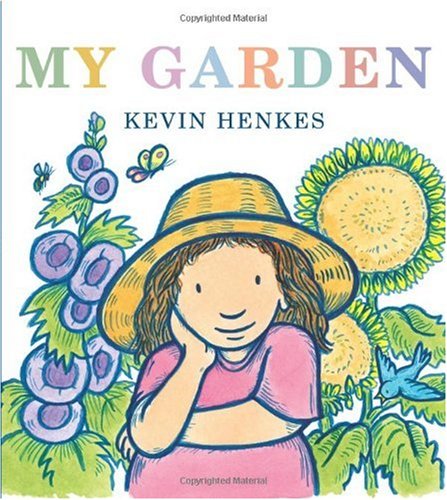
My Garden

My Garden by Kevin Henkes

A little girl helps her mother in her garden.  It is a nice garden, but if the little girl could create her own garden, it would be very different!  There would be no weeds.  No plants would die.  If you imagined the flowers different colors and patterns, they would change.  Rabbits would not eat lettuce, instead they would be chocolate rabbits meant to be eaten.  There would be lots of birds and butterflies, and unique things would suddenly grow.  This beauty of a book will inspire children to dream their own gardens and perhaps plant a seashell to see what will happen.

With his gentle feel, Henkes has created a creative look at gardening that will have a permanent spot in everyone’s spring story pile.  His art is done in ink and watercolors, offering a soft palette perfect for the story.  The flights of fancy in the book are whimsical and wonderful, capturing a welcoming friendly invitation to explore a garden of dreams.

I can see this leading to a craft where children design their own imaginary gardens or write a story about what should be in their gardens.  It is such a springboard for dreams and imagination!  Appropriate for ages 2-5.

Reviewed from library copy.

Also reviewed by Brimful Curiosities.

Reblog this post [with Zemanta]

Spilling Ink: A Young Writer’s Handbook

Spilling Ink: A Young Writer’s Handbook by Anne Mazer and Ellen Potter, illustrated by Matt Phelan.

Two veteran authors take their years of writing, their know-how, and their energy and offer it happily to new authors, both young and old.  What could have been a dry subject is definitely not in their hands.  Simply starting the book will have you hooked and make you wonder why you never wrote that book that you know you have inside you.  Mazer and Potter take on all of your excuses, throw in some great advice, and really inspire you to go for it!  Written with lots of humor, this book has I Dare You sections to get you started, funny stories of both failure and success, and offers a refreshing look at the process of writing.

There are so many parts to love in this book.  It has real information about subjects like metaphors, perspective, setting, and plot.  At the same time it is light-hearted and very personal.  Mazer and Potter have created an invitation to join them in both the success and failure of writing.  Their personal stories make the book a pleasure to read, carrying the information easily to readers.  Once you start reading, you will find it reads as easily as one of their novels, which is rare in a nonfiction book on the writing process! 

Phelan’s art suits the writing well with its organic and natural feel.  The illustrations and the fact that the chapters are broken into small bite-sized pieces contribute to the welcoming feel of the entire book.

Highly recommended, I see this as the ideal book to share with writing classes, to encourage young authors, and to hand to adults who want to start writing for children.  Not only will it offer those adults the tools they need to write, it will also show them exactly what a great book for children should be.

Appropriate for ages 10-14.  (I had to pry it out of my 13-year-old son’s hands to get to finish it.  And only by promising not to touch his bookmark!)

Reviewed from Advanced Reader Copy received from author.

Reblog this post [with Zemanta]

The Dreamer

The Dreamer by Pam Munoz Ryan and Peter Sis

Released April 2010.

Neftali is a boy with the spirit of a poet.  He loves to write series of words anywhere he can, he collects small objects like stones and keys, and he daydreams amazing adventures.  He is also a boy with a father who wants him to focus on the real world and become a doctor or dentist, definitely not a writer.  His father is a domineering force in his world, blowing a whistle to call him to attention and sneering at his scrawny build.  Despite this, Neftali continues to dream and write, eventually becoming one of the most read poets in the world, Pablo Neruda.

Ryan’s prose is profound and exquisite.  She has created here a book about a real person that takes you directly into that person’s mind, allowing a deep understanding.  She has taken some of the seminal events of Neruda’s life and written scenes that sear into your mind with their beauty and importance.  She writes to honor a great poet but also to allow people to understand him on a new level.  Beautifully done.

Combined with Ryan’s prose, Sis’ illustrations exude a simplicity and delicacy that work marvelously with the subject matter.  His illustrations verge on the surreal, taking us into Neruda’s thoughts and dreams.  The illustrations are deceptive in their simplicity, revealing far more than they seem to.  The partnership of these two has created something magical.

The Author’s Note at the end of the book is interesting and important.  I also appreciated the inclusion at the end of some of Neruda’s poems, because readers of this book are sure to want to read his poems.  I know that this book will reconnect me with his writing again.

A moving and beautiful tribute to a poet’s youth and development, this book also shines because of its focus on self-esteem, social consciousness, and individuality.  I can see it being used as a read-aloud in classrooms, though part of its beauty is reading it and savoring it.  Appropriate for ages 9-13.

Reviewed from Advanced Reader Copy received from Scholastic.


Reblog this post [with Zemanta]