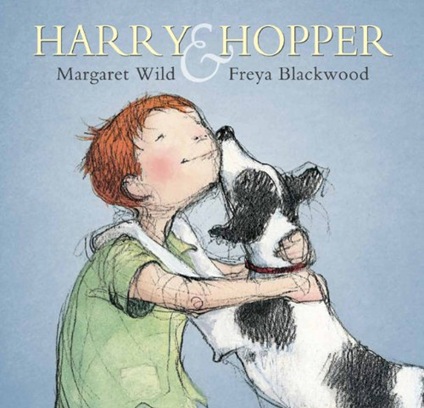
Harry & Hopper by Margaret Wild and Freya Blackwood
Harry got Hopper when he was a jumpy puppy. He taught him to sit, stay and play ball. The two of them were inseparable. Hopper even slept with Harry, moving from the bottom of the bed to the top over the course of the night. But then Harry came home from school and Hopper wasn’t there. His father broke the news of the accident gently to Harry, explaining that Hopper had died. Harry couldn’t sleep in the bed he shared with Hopper, so he started sleeping on the couch instead. At school, Harry couldn’t tell anyone about what had happened. That night, Harry was awoken from sleeping on the couch by a dog leaping by the window. It was Hopper! The two of them spent the night together playing. The same thing happened night after night, but Hopper was getting less solid and less warm. Eventually, Harry had to say goodbye to Hopper.
This book should come with a box of tissues. Sniffle. Wild depicts the bond between boy and dog with a clarity that makes it very tangible and real. The loss comes quickly and without prelude, jarring the reader. As Harry moves through his grief, the return of Hopper brings that process into a similarly tangible state. The slow disappearance of Hopper over the nights, depicts the acceptance of loss. Harry’s grief never comes to full resolution, something that is particularly beautiful about this book and its writing.
This book won the Kate Greenaway medal for its illustrations, and rightly so! Blackwood’s illustrations are done in laser print on watercolor paper with watercolor, gouache and charcoal. They have a charm to them that is emphasized by the use of lines to slow motion. Additionally, the shadows that appear with the grief add to the darker feeling of that section of the book. Through it all, there is a warm light in the darkness, often provided by Harry and Hopper themselves.
A beautiful book of loss and grief, this book deserves a spot in libraries where it is sure to find an audience. Perhaps offer a Kleenex as a bookmark upon check out. Appropriate for ages 4-6.
Reviewed from copy provided by Feiwel and Friends.
Check out a gallery of the illustration on the Guardian website.

