Review: A Butterfly Is Patient by Dianna Hutts Aston

butterfly is patient

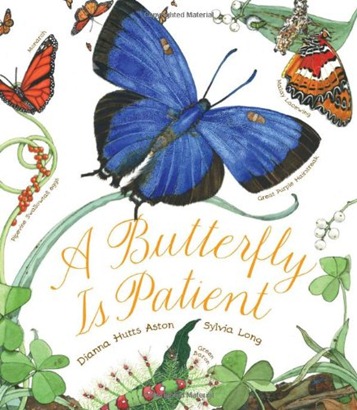
A Butterfly Is Patient by Dianna Hutts Aston and Sylvia Long

This third book in their series together continues the beautiful detail and natural information of A Seed Is Sleepy and An Egg Is Quiet.  Here the subject is butterflies and the book begins with the egg and caterpillars, moving quickly into metamorphosis with the clear knowledge of where exactly children will be intrigued.  The book speaks to butterflies’ roles in pollination as well as their camouflage, drinking, and poisonous capabilities.  Readers will be intrigued with the scaly close-up of a butterfly wing and with the long-travels of the migrating monarch.  This book is full of great details that will have everyone understanding that butterflies are many things as well as lovely to look at.

Aston and Long create books that have readers lingering.  When I share them with my son, we take our time on the pages, talking about our favorite names of the butterflies, our favorite caterpillars, the most lovely butterflies.  He has used the fact about butterfly scales on their wings at least twice in conversations I have overheard since we read this.  When we found a dead monarch in our driveway, he was elated to be able to touch the wing and talked about how it felt “as soft as air” for a long time afterwards.

These are gateway to science books, offering just the right tone and perfectly selected facts.  Add the illustrations that are large, interesting and filled with details.  You now have the ideal package to get children interested in the nature right in their own backyards.

If you haven’t read any of these books, run to your library and get them!  This is one gorgeous and inviting look at butterflies.  Appropriate for ages 6-8.

Reviewed from library copy.

Also reviewed by:
Review: The Cheshire Cheese Cat by Carmen Agra Deedy

cheshire cheese cat

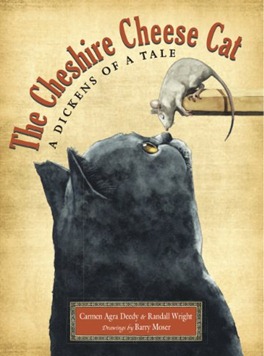
The Cheshire Cheese Cat: A Dickens of a Tale by Carmen Agra Deedy & Randall Wright, illustrated by Barry Moser

Skilley is an alley cat who is down on his luck, he has a broken tail, tattered ears, and has grown used to dodging brooms and wheels.  So when he hears that Ye Olde Cheshire Cheese, a local inn, needs a mouser, he concocts a plan to become that cat.  But Skilley has a horrible, shameful secret that he carries with him: he doesn’t eat mice.  Instead he prefers a good nibble of cheese.  Discovering this, a mouse named Pip strikes up a deal.  The mice of The Cheese will provide Skilley with the cheese he needs in exchange for him pretending to nab them and eat them.  The plan is perfection for a short time, until an evil cat named Pinch enters the inn and more secrets start coming out.  Add some historical British figures and you have an engaging romp of a novel for middle readers.

The authors have created a historical fiction novel that is also an animal novel.  It has figures like Charles Dickens and Thackeray, but mostly focuses on the animals themselves.  It is a novel that explores friendship and accepting yourself even if there are things that you might be ashamed of.  These messages are woven skillfully throughout the story and never become overbearing.

The pacing of the novel is also skillfully done.  There are quieter moments in the novel, but the foreshadowing makes even those uneasy ones.  Once the story really gets going, it reads quickly.  I couldn’t put it down in the last few chapters because I was so caught up in the story.

I’m not a huge animal story fan.  It seems that they tend to be tearful, overly emotive, and generally tragic.  That is not the case here.  Instead readers will cheer on the heroes, worry for their safety, and find themselves in the midst of a grand adventure in Elizabethan England.

Highly recommended, this book is one delicious read with a pleasing mix of sweet and savory.  Appropriate for ages 9-12.

Reviewed from copy received from Peachtree Publishers.

Also reviewed by:

Review: King Jack and the Dragon by Peter Bently

king jack and the dragon

King Jack and the Dragon by Peter Bently, illustrated by Helen Oxenbury

Open this book and you are immersed in a wonderful world of make-believe that you will not want to leave.  There is a timelessness to not only the story here, but the way it is told. 

Jack, Zack and Caspar were making a fort for King Jack out of a large box, a sheet, a blanket, some sticks, broken bricks, some trash bags, and other odds and ends.  Then they spent the entire day fighting dragons and beasts until they returned back to their fort for a celebratory feast.  Unfortunately, after that a giant came and took Sir Zack home.  Then another giant came and took Caspar off to bed.  That left King Jack alone on his throne in his fort.  As darkness fell, he tried to not feel frightened of the noises of wind and the scurrying of animals.  He wasn’t really truly scared until he heard the four footed beast approaching in the dark. 

Beautifully told by Bently, this book reads aloud with zest and style.  The story moves from the building of the fort to the playing of pretend through to the end of the day when reality comes calling for each of the children.  It is a story that speaks to the power of imagination, the ability of children to create worlds that they fall into, and the love of play.  The entire text captures that sense of play, merrily creating tension towards the end of the book without any real fear.

Oxenbury’s illustrations help to strengthen the timelessness of the story.  The sweetness of her illustrations is tempered by the ferocity of the dragons and beasts she depicts.  Yet there is no real danger here, and her illustrations help underline that to the youngest of readers.

Have large boxes and plenty of “swords” ready after you share this book.  It is sure to create some new knights out of any children who listen to it.  Appropriate for ages 3-5.

Reviewed from library copy.

Review: Page by Paige by Laura Lee Gulledge

page by paige

Page by Paige by Laura Lee Gulledge

Paige has just moved with her family to New York City.  She is having trouble relating to her mother and had to leave her best friend behind.  Now she has to find people in the big city who can understand her.  But before she can do that, she has to start to understand herself.  Is she the quiet girl or can she become an extroverted artist?  As Paige struggles to find herself and to find her voice as an artist, readers are treated to an extraordinary look at the process of art combined with the process of finding friends and love.

Gulledge has created a graphic novel where the visuals are powerful and speak volumes.  She turns the comic format into one that is strongly artistic and very visual.  Here we see the emotions of Paige brought to visual life from her self-doubts to her most self-aware.  Paige is a character that readers with artistic interests will relate to easily.  Her yearning to create combined with her doubts and worries make for a book with plenty to inspire other young artists to take the risk of creation.

Get this in the hands of tween and teen artists and step back.  A truly inspiring read.  Appropriate for ages 12-15.

Reviewed from library copy.

Also reviewed by:

Check out the trailer that gives a sense of the great art:

Review: I Want My Hat Back by Jon Klassen

i want my hat back

I Want My Hat Back by Jon Klassen

Published September 27, 2011.

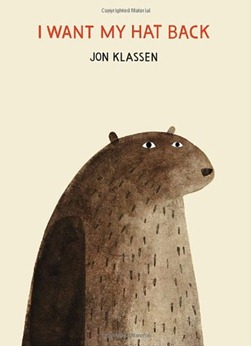
I don’t think I can express how much I love this picture book.  It happily breaks all picture book rules by using a very muted palette with punches of color, not having much action at all, and ending with a dark twist.

The bear, who narrates the book in first person, is searching for his hat.  He asks one animal after the next about his hat and no one has seen it.  The only exception is the rabbit who is wearing a distinctive bright red pointy hat and seems to be protesting too much.  The bear continues past him though and on to several more animals until suddenly he realizes that he HAS seen his hat!  He rushes back past all of the animals until he reaches the rabbit.  And to find out what happens next, you will just have to read this humdinger of a picture book.

The illustrations are subtle, clever and in their understated way, hilarious.  The deadpan of the animals, the grasses and rocks near each of them on a tan page, all add up to the perfect background for this surprising story.

Klassen’s wording is perfection.  Each animal has a straight-forward response except the rabbit, so readers will be sure to notice the frenzied excuses being made.  He also incorporates plenty of repetition into the book which makes it flow like a book for preschoolers, but the humor will be enjoyed by older readers most of all.

Get your hands on this one, it is a clever, funny read with a dark twist.  What more could you ask for?  Appropriate for children ages 4-6, but most appreciated by children 7-12.

Reviewed from ARC received from Candlewick Press.

Also reviewed by:

You can also watch the book trailer:

Review: Little Pig Joins the Band by David Hyde Costello

little pig joins the band

Little Pig Joins the Band by David Hyde Costello

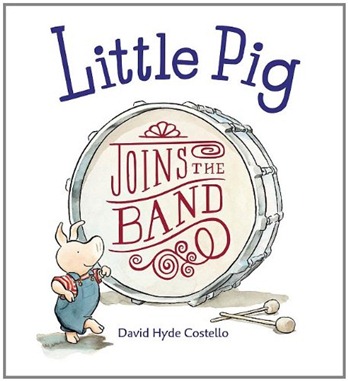
His family all call Jacob, Little Pig, and he is the smallest in his family.  So when his siblings get out his Grandpa’s old marching-band instruments, Little Pig has trouble finding one that fits him.  He’s far too small for the drums, too little for the trumpet and trombone, and don’t even ask about the tuba!  All he can do is watch as his older brothers and sisters march around the room.  But when they come to a crashing stop, Little Pig knows just how he can join the band after all.

This simple story speaks to everyone finding their own niche and value in a family.  Here, Little Pig finds the special place for himself rather than the older children or adults helping him.  It makes for a very powerful message for young children, that not only do they have value but they can discover it on their own. 

Costello writes with simplicity and a solid feel.  His story has small, clever asides that are filled with puns as well.  His art is friendly and cheerful.  Little Pig has an oversized snout, small eyes and expressive ears.  Even the older children are treated as individuals in the art, with one decked out in hat and a boa.  I can see more stories about the children in this family.

A strong story about finding your place and becoming a leader, this book has a cheery feel that is very appealing.  Appropriate for ages 3-5.

Reviewed from copy received from Charlesbridge.

Also reviewed by

Review: The Umbrella by Ingrid & Dieter Schubert

umbrella

The Umbrella by Ingrid & Dieter Schubert

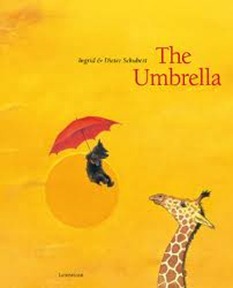
A wordless story told in vivid images, this book will whirl readers into an adventure.  A small dog finds a red umbrella and sails up in the autumn breeze into the air.  He walks on the clouds, visits Africa with its elephants and alligators, yikes!  Off he heads into the air again, carried this time to the expanse of the ocean where his umbrella serves as a boat.  Until that is, he sinks down below the surface only to be blown high from a whale’s spout.  He is carried into the jungle in a strong breeze and then caught by a pelican and lifted higher.  Then down onto the snowy peak to be met with the applause of seals.  His umbrella becomes a sled, sweeping past polar bears and then up into the air again.  Bats join him in flight until down below amid the autumn leaves, his house appears.  He puts the umbrella back where he found it and where a cat who has watched him come and go just might have an adventure too.

There is a wildness to this book that is as refreshing as a strong autumnal wind.  It comes from the wandering of the breezes and the wildlife that the little dog experiences.  The book captures his emotions with great skill from the delight of sledding down snowy hills to the utter exhaustion at the end of his travels. 

This is a book that does not need words.  The images capture the story fully, allowing readers to create their own story from the expanse of world that they get to see.  Children will revel in walking on top of clouds, of meeting elephants, of escaping arrows, and of finding the way back home. 

A perfect read for fall that will inspire imagination, this book opens and closes with gusts of wind and swirls of autumn leaves.  Appropriate for ages 3-5.

Reviewed from copy received from Lemniscaat.

Review: My Name Is Elizabeth! by Annika Dunklee

my name is elizabeth

My Name Is Elizabeth by Annika Dunklee, illustrated by Matthew Forsythe

Elizabeth really likes her name, her full name.  She likes its length, the way it feels when she says it, and also that there is a queen named after her!  But she doesn’t like it when people shorten it to things like Liz, Lizzy, or Beth.  So she announces that her name is ELIZABETH Alfreda Roxanne Carmelita Bluebell Jones.  But you can just call her Elizabeth.  Now everyone has it right, except for one little person, her younger brother.  It’s close enough when he calls her “Wizabef.”

Dunklee captures the joys and pains of having a name that can be shortened in this book.  Children with a variety of names will understand the conflict of having a name they love but that others feel free to change.  My own name, Tasha, is already a shortened version of my full name, so I choose to go by a nickname.  Only the DMV calls me by my full name.  😉

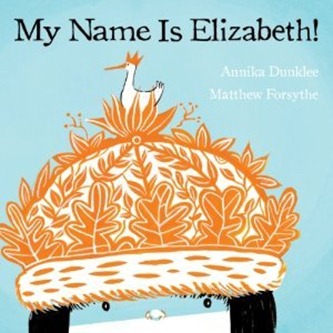
Forsythe’s illustrations give this book a distinctive feel.  He uses a limited palette of blue, orange and black.  Throughout the book, Elizabeth is accompanied by a friendly duck.  The duck is never mentioned in the text, but offers a unique vibe to the book and to the central character.  The illustrations have a vintage feel thanks to the palette, yet the colors are modern and so is the art itself. 

Highly recommended, this book will speak to boys and girls with names that they feel strongly about.  Appropriate for ages 4-6.

Reviewed from copy received from Kids Can Press.

Also reviewed by

Review: A Stranger at Home by Christy Jordan-Fenton

stranger at home

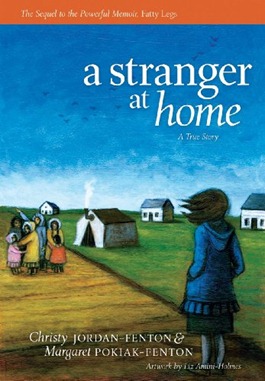
A Stranger at Home: A True Story by Christy Jordan-Fenton and Margaret Pokiak-Fenton, illustrated by Liz Amini-Holmes

This sequel to Fatty Legs takes place after Margaret has spent two years at a residential school.  As Margaret finally returns home to her family, she does not expect her mother not to recognize her or for her transition back into the family to be so difficult.  She can’t eat the food her family eats because her stomach rejects it.  She has forgotten how to speak their language and can only talk in English.  The mukluks hurt her feet and she returns to wearing the canvas shoes she was given at school.  Slowly, she begins learn once again the culture that she had lost.  But then she faces the heartrending choice of whether to return to school with her little sisters or allow them to go alone.  This true story speaks to the tragedy of residential schools on Native peoples, an impact they are still recovering from.

A large part of the success of these books comes in their writing.  It is simply written with large, welcoming print.  The writing is matter-of-fact, not laden with imagery.  It is that straight honest writing that truly captures the loss and the pain.  It doesn’t allow a reader anywhere to hide, nowhere to duck away from the truth. 

The book does deal with subjects that are large and complex.  Yet the writing makes them infinitely readable and relatable.  Seeing the situation through Margaret’s eyes allows it to be personal and very effective.

The illustrations are an intriguing combination of historical photographs and drawings.  Where the photos are often in black and white, the illustrations themselves are done in deep colors that show the beauty of the landscape as well as the conflict within Margaret’s family. 

A strong sequel to the original, this book shows very clearly the lasting damage created by residential schools.  Appropriate for ages 8-12.

Reviewed from copy received from Annick Press.