Review: Stuck by Oliver Jeffers

stuck

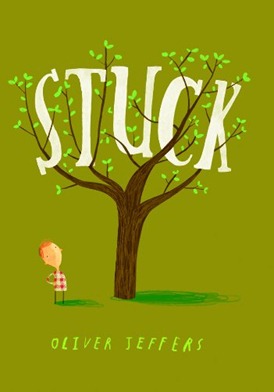
Stuck by Oliver Jeffers

Floyd’s kite gets stuck in tree and what is a boy to do?  Well, he tries to pull on the string and swing on it, but the kite stays stuck.  So he throws one of his shoes up to try and dislodge it.  His shoe got stuck too.  The other shoe didn’t work either.  Now what could he do?  Well, the cat was lingering nearby…  And so begins the wild and very funny story of a boy, a stuck kite, and a tree with an amazing propensity for keeping things stuck.  The story goes wild with what Floyd has thrown into it, never letting up on the joke.  In fact, at the end of the story, which I want you to experience for yourself, the humor is still just as strong as in the beginning and the joke stays true.

Jeffers is one of the kings of picture books.  His books love to stretch reality to almost breaking, creating new worlds that readers long to get lost in.  Here he takes getting a kite stuck in a tree to the extreme, resulting in a very funny book that will have young readers giggling along.  The book will also get readers thinking about what they would throw into a tree, so it becomes a great conversation and creativity piece.

Jeffers art is whimsical, funny, and adds a zany edge to the book.  He plays with colors throughout, with the character, objects and tree all changing colors as well as the background.  It makes for a dynamic read.

This would make a great final book for a storytime, because children will tune back in for the silliness.  I can also easily see it as a flannel board story or a jumping-off point for a creative project.  This is great fun combined with effortless storytelling and dynamic art.  Appropriate for ages 4-7.

Reviewed from copy received from Philomel Books.

Also reviewed by:

Take a look at the book trailer featuring Jeffers reading:
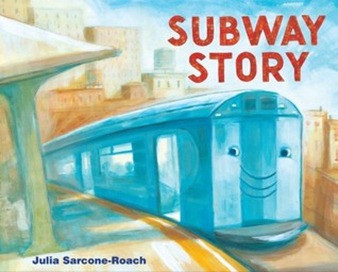
Review: Subway Story by Julia Sarcone-Roach

10969431

Subway Story by Julia Sarcone-Roach

Based on a true story, this picture book follows Jessie, a subway car, from her “birth” until her unusual ending.  Jessie was a New York City subway car that carried people and things around the city.  At first, she was new and shiny, but eventually she was covered in graffiti and then painted red.  She kept on working, running on tracks around the city.  Then she was used only in the winter because her fans could not keep up with the heat, and finally she wasn’t used any more.  But Jessie’s travels and adventures were far from over!  Whatever will happen to her when she is shipped by barge and taken far from land!

Sarcone-Roach has created a picture book that seems to be quiet and then takes a turn into the unexpected.  She begins with a true story and then personalizes it through the eyes of one specific subway car.  It works really well as a technique to make the subject very child friendly and to invite readers in to experience the story.  The writing is clear and Jessie’s perspective is strong and active. 

Her art is also very successful.  The colors are deep and jewel-like, showing the beauty of the city as well as the subway lines.  She plays with perspective throughout, stacking the subway lines like shelves, showing both the outside and inside of the subway cars, and always showing Jessie with her smiling headlights and chains. 

This is a lovely book that works well on many levels.  Use it for an unexpected take on recycling, add to your transportation stories, or just share it to see the children guessing where Jessie is headed on that barge.  They are sure to be entranced by the answer.  I certainly was!  Appropriate for ages 4-7.

Reviewed from copy received from Alfred A. Knopf.

Also reviewed by:

Review: Acorns and Stew, Too by Ruth Orbach

acrorns and stew too

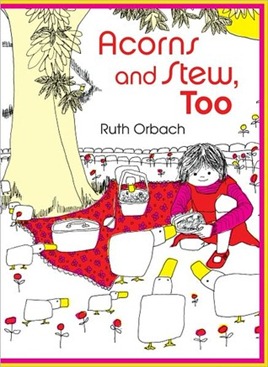
Acorns and Stew, Too by Ruth Orbach

First published 25 years ago, this book has a classic feel combined with a great story.  Lenore loved a lot about her life, but most of all she loved the ducks who lived near the lake.  She visited them every day and fed them bread and other food.  But winter was approaching, so Lenore knew that soon the ducks were going to fly south.  She made them little houses to live in, fed them on stew and acorns, even made winter coats for them.  In the end, the ducks did not fly south.  They stayed with Lenore.

I love the ending of this book, where the ducks stay for the winter.  So often, children in stories are infinitely creative and resourceful, but they don’t create real change.  Here the universe shifted a bit to make room for Lenore and her dreams.  Orbach writes with real joy.  She delights in the small moments of creation that Lenore has, the attachment of the ducks to Lenore is evident too.  She has created a book where emotions are tangible and hard work really makes a difference.

Orbach’s art has a vintage feel.  The illustrations are done in ink on white and then colored with wild bursts of color.  The yellow is warm, the red pops, the pink is beyond bright, and the yellow is neon.  It all makes for an eye-poppingly bright book.  At the same time, the illustrations have a whimsical feel.  The bright colors and the whimsy make for an interesting contrast with one another.

I hadn’t read this years ago, so I’m very happy to find it now.  Here is a sweet, clever and empowering story for children.  Appropriate for ages 3-5.

Reviewed from copy received from Kane Miller.

Review: Waiting for the Biblioburro by Monica Brown

WaitingForTheBiblioBurro

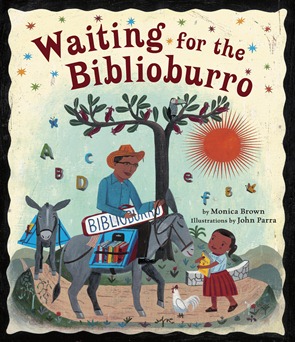
Waiting for the Biblioburro by Monica Brown, illustrated by John Parra

Inspired by a true story, this picture book shows the power of books and reading.  Ana is a small girl who lives in Colombia and adores books.  Her village is very remote though, so there is no library to go to.  Ana has just one book, given to her by her teacher, and she has read it over and over again.  Ana makes up her own stories that she tells her little brother at bedtime.  Then one day a man with two burros comes to their village.  The burros carry a library of books and he invites all of the children to select books to keep until he returns.  As she waits for the librarian to return, Ana creates her own book about him, his burros and his books.

Brown has created a book that is gentle and beautifully written.  Ana’s life is shown as loving and filled with blessings.  It will contrast vividly for American children with their own lifestyle.  Brown also focuses clearly on books and the power of reading and stories.  The story here is told clearly and warmly with sprinklings of Spanish throughout.

Parra’s illustrations have a lovely folk art feel to them.  Done in acrylics on board, they have a texture adds another dimension to the book.  The colors are bright, the storytelling portions filled with wild and amazing creatures, and the entire work makes a complete and unified package.

The entire book sings, revealing a different culture and the power of words (and librarians.)  Appropriate for ages 4-6.

Reviewed from copy received from Tricycle Press.

Also reviewed by:

You can also check out the book trailer:

The New York Times Notable Children’s Books of 2011

On Monday, The New York Times released their list of Notable Children’s Books for the year.  Their list moves from young adult through middle grades to picture books.

Here are the books they feature:

YOUNG ADULT


Between Shades of Gray by Ruta Sepetys

Daughter of Smoke and Bone by Laini Taylor (my review)

Level Up by Gene Luen Yang (my review)

A Monster Calls by Patrick Ness (my review)

The Scorpio Races by Maggie Stiefvater


MIDDLE GRADE


Amelia Lost: The Life and Disappearance of Amelia Earhart by Candace Fleming

Drawing from Memory by Allen Say (my review)

Everything on It by Shel Silverstein

The Fingertips of Duncan Dorfman by Meg Wolitzer


Heart and Soul by Kadir Nelson

Okay for Now by Gary D. Schmidt (my review)

Queen of the Falls by Chris Van Allsburg (my review)


Secrets at Sea by Richard Peck

Seriously, Norman! by Chris Raschka

Wonderstruck by Brian Selznick (my review)


PICTURE BOOKS


Blackout by John Rocco (my review)

Goodnight, Goodnight, Construction Site by Sherri Duskey Rinker

I Want My Hat Back by Jon Klassen (my review)


I Must Have Bobo! by Eileen Rosenthal (my review)

Me…Jane by Patrick McDonnell (my review)

Meadowlands: A Wetlands Survival Story by Thomas F. Yezerski (my review)

My Name Is Elizabeth! by Annika Dunklee (my review)


Over and Under the Snow by Kate Messner

Pomelo Begins to Grow by Ramona Bodescu

Samantha on a Roll by Linda Ashman

Kirkus Reviews’ Best Children’s Books of 2011


Kirkus has posted their Best Children’s books of 2011.  We will have to wait until November 28 to see their best Teen Books.  You can browse the book list in its entirety or nicely, they have also broken the list into themes.  So if you just want to look at nonfiction, you can. 

I see many of my favorites of the year.  Then there are others that I read but didn’t adore.  And happily, there are others that I’ll add to my list to read.

What favorites do you see on the list?

Anne McCaffrey Died Yesterday


The incredible Anne McCaffrey has died at age 85.  Her work has had an indelible effect on the world of science fiction and fantasy.  She created worlds that came to life and were embraced by fans. 

Personally, I have read most of her books.  I loved the Pern books, raced through The Ship Who Sang series, and later discovered the Crystal Singer series and loved that too.  Her books were infinitely readable and shareable. 

Now I have to find some of them and get them in the hands of my teenage son.  I know no better way to celebrate her life than sharing her books with a new reader.

Review: Born and Bred in the Great Depression by Jonah Winter

born bred great depression

Born and Bred in the Great Depression by Jonah Winter, illustrated by Kimberly Bulcken Root

Winter tells the story of his father’s childhood during the Great Depression in this historical picture book.  Through the life of his father, he shows the poverty of the time.  Grandpa Winter searched for work in the area, often unable to find any, which meant that there was no money to help support the family of 8 children.  When he did find work, it was dirty and back-breaking labor.  This is contrasted with the simple joys of childhood as Winter’s father spent time outside exploring the woods and walking the railroad tracks.  The family grew most of their own food, eating lots of produce from the garden and canning excess to eat during leaner times.  There was little ease in their lives, but what they could find they used.  There was time as a family for music, chess and reading books.  There was time to explore the natural world.  This glimpse of history opens our eyes to the way we live today as well.

Winter’s words are compelling, inviting readers into the world of the Great Depression.  He manages to tell the story of the poverty through a lens that children will be able to relate to.  Focusing on the family life, including many people in each bed, there are definite contrasts with today’s economic problems.  Winter does not romanticize the Great Depression, instead he brings it to life through the history of his own family.  There is a lovely simplicity to the story that makes it all the more readable.

Root’s illustrations are done in pencil, ink and watercolor.  They have a softness to them that evokes the past.  The colors are subdued with the focus on telling the story through the images as well as the words.  Root manages to show the Great Depression through images that are beautiful, quiet and rich.

This historical picture book celebrates strength of family and overcoming hardship.  Appropriate for ages 5-7.

Reviewed from copy received from Schwartz & Wade Books.

Better Parents? Or More Books? Or Are They One and the Same?

This Sunday, Thomas Friedman posted an opinion column in The New York Times.  His premise, and one that I wholeheartedly agree with, is that we blame teachers for our children’s lack of success when it is parents who can make all of the difference.

I thought the article was going to be about the way that modern American parents are not as involved as they could be.  But instead it went in a direction that I had not anticipated.  Friedman spoke about the PISA (Program for International Student Assessment) and how American 15-year-olds are not excelling compared to peers in other nations.

The PISA team started to look beyond the exam itself and interviewed 5000 families, comparing their responses with the children’s results on the PISA.  And here, my friends, is what they discovered:

“Fifteen-year-old students whose parents often read books with them during their first year of primary school show markedly higher scores in PISA 2009 than students whose parents read with them infrequently or not at all. The performance advantage among students whose parents read to them in their early school years is evident regardless of the family’s socioeconomic background. Parents’ engagement with their 15-year-olds is strongly associated with better performance in PISA.”

Additionally, it was found that being engaged with your child: monitoring homework, ensuring your child gets to school, rewarding their efforts, and talking about the importance of college are all linked to better attendance, grades, and test scores.

But for me, it’s that reading piece that really shines.  Beautiful really.