Review: I Lay My Stitches Down by Cynthia Grady

i lay my stitches down

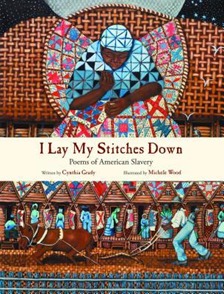
I Lay My Stitches Down: Poems of American Slavery by Cynthia Grady, illustrated by Michele Wood

This collection of poems tell the story of slavery in America from the points of view of many different slaves.  There is the poem of the house slave who breaks some dishes, the story of the Underground Railroad, children being sold away from their parents, whipping, and much more.  Still, Grady manages to also weave into the stories softer moments of learning, art, and music.  They all focus around slavery and its ugliness, despite the beauty that the slaves create.  The message is the same in the illustrations, a wrenching mix of brutality and beauty that speaks directly to the difficult subject matter.

Grady’s poems are built with references in each poem to spiritual, music and quilting.  The poems are brief and powerful, filled with language that soars and lifts despite the horror of the subjects.  This dance of harshness and loveliness makes the poems particularly compelling.  Following each poem is a paragraph or two of explanation about that aspect of slavery or references made in the poem.

The illustrations are done in paint, but directly reference quilts.  Quilt patterns form the ground, walls, water and sky.  The people are woven into the quilts, surrounded by the art form.  It conveys a certain beauty as well as a sheltering feeling that would be missed if the illustrations had a bareness or minimalist nature.

Brutal, beautiful and educational, this book uses poetry to create a memorable book about slavery in America.  Appropriate for ages 9-12.

Reviewed from copy received from Eerdmans Books for Young Readers.

Spring Board Book Round Up

A new crop of board books has popped up filled with spring warmth and wishes:

The Little Gardener by Jan Gerardi

Part of the Teenie Greenies series, this board book focuses on what it means to be a gardener and the responsibilities that come with it.

Told in rhymes, the book has sturdy flaps that little fingers will find irresistible.  Adding to the feel of an environmentally friendly read, the reverse side of each flap is in a raw cardboard.

Filled with color, flaps and plenty to look at and learn about, this is a vibrant board book that is sure to get the littlest ones out in the dirt.

Reviewed from copy received from Random House.


Little Bunny by Lisa McCue

From the Fuzzytails series, this book has a classic appeal with illustrations that hearken back to the Golden Book days.

Fuzzytail Bunny is headed somewhere.  Is he going to the forest?  The playground?  To the pond?  The meadow?  No.  He’s headed back home, to sleep piled up with his brothers and sisters in a snuggly heap.

This book has a jaunty rhythm that ends with a snuggle.  Just right to share with a busy toddler.

Reviewed from copy received from Random House.


Duck & Goose: Here Comes the Easter Bunny! by Tad Hills

Just what we needed to add to our Easter collections: a Duck & Goose Easter book!  Duck and Goose decide that they will hide so that they can see the Easter Bunny hide the eggs.  They try different spots, but the pond is too cold, the tree is too high, and the mud heap is too, well, muddy.  They finally decide on disguises, but are so tired from all the running around that they fall asleep and miss the Easter Bunny.  But not to worry, Easter has come after all.

Filled with Easter eggs and plenty of springtime fun, this book will be a hit with Duck & Goose fans and may bring new ones to the series.

Reviewed from copy received from Schwartz & Wade.

Princess Baby by Karen Katz

A board book version of the picture book first released in 2008, this is another successful reworking of a Karen Katz book.

Here, a little girl is tired of not being called by her real name.  Her parents use cute nicknames for her like Cupcake, Pumpkin, and Buttercup.  But she insists that they should call her by her real name.  She then dresses in a crown, sparkly shoes, a cape, and her parents then realize that the name she prefers is “Princess Baby” and she must be treated like royalty too.

A clever book about names and playing pretend.

Reviewed from copy received from Random House.

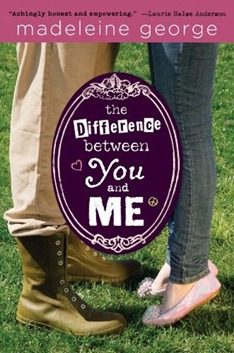
Review: The Difference Between You and Me by Madeleine George

difference between you and me

The Difference Between You and Me by Madeleine George

Released March 15, 2012.

Jesse wears fishing boots every day.  She cuts her hair short and rough with a Swiss Army knife.  She spends her time writing manifestos for her National Organization to Liberate All Weirdos and then papering the high school with them.  Emily is one of the popular girls and vice president of the student council.  She wears her hair in a ponytail, likes sweaters with buttons, and has a boyfriend.  So what in the world could Jesse and Emily have in common?  Just that they like to make out in the bathroom of the library once a week.  Jesse yearns to have a more open relationship with Emily, but Emily is very comfortable in the closet and in denial.   When Jesse gets in trouble at school, she meets Esther, a girl who is also a weirdo and has a lot in common with Jesse.  The two of them start working against a corporation trying to come into their community and school.  Unfortunately, Emily is helping that corporation sponsor the school dance.  Both girls have to decide what is most important to them: principles or love.

George has written a courageous book here.  The characters are deeply felt, beautifully rendered and gorgeously human.  Jesse is a strong lesbian character who also makes mistakes and is caught in a situation where she has to keep someone else’s secret.  The tension that creates tests her relationship with her parents, her best friend, and herself.  Emily is a study in contradictions that she speaks aloud, lives and breathes.  She is a complicated character, awash in a mix of confidence in public and self-doubt in private.  Esther is a surprising character, added after the reader thinks the book is going to focus on two girls only.  She and Jesse have much in common, including mothers who had breast cancer.  That piece of information notches neatly into the two girls’ characters, offering further depth.

Intriguingly, George has chosen to write Emily and Esther’s sections of the book in first person.  Jesse is seen in third person, something that is distancing.  I found the switch from one tense to another disconcerting at times, and wished that I could have known Jesse from inside as well as the other girls.

The world that George has created is populated with unique characters, adults and teens alike.  It is a celebration of people who are different, living lives that are complicated, filled with emotion, and grounded in principles.  I saw people I knew, people like myself, and people I wanted to meet and befriend. 

Perhaps what I loved most about this book is its sensibilities.  The characters are who they are, struggling with issues larger than themselves, but not deterred at all.  It is a book that encourages teens to take action, change their communities, and speak up for what they believe in.  Appropriate for ages 15-18.

Reviewed from ARC received from Viking Books.

Change in Reviewing Policy

2903469528_5621484929

Image from sleepyneko.

After thinking long and hard about my policy of not reviewing self-published books, and looking closely at the changing landscape of publishing and authors, I have decided that I am going to start reviewing self-published titles.

As always, I will review only the books that I enjoy reading.  Frankly, I don’t have time to review all of the books I love, so I don’t have time to spend on books I don’t enjoy.  I know there are people who insist that negative reviewing is an important part of blogging, but after doing this for so many years I know how I prefer to blog and what energy I prefer to put out into the world.

For those who want to contact me about reviewing a book, you can email me at tsaecker@gmail.com.

Happy reading!

Review: Maudie and Bear by Jan Ormerod

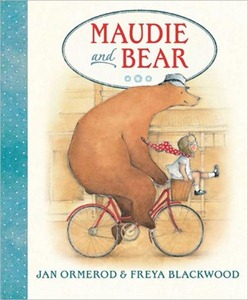
maudie and bear

Maudie and Bear by Jan Ormerod and Freya Blackwood (Link to InfoSoup)

Through five short stories, readers get to know Maudie and her best friend Bear.  Maudie is a little girl who is always planning the next thing for them to do.  She can be bossy, definitely has opinions, and yet has a charm that is hard to resist.  Bear certainly does not resist at all, instead helping Maudie plan their next escapade.  The pair have a series of adventures from a bike ride that is more about fashion than exercise to a very Goldilocks-like encounter to dancing under the stars.  The two are not without friction, having to apologize occasionally for things that go wrong.  They are a cheery pair to read about and one wishes for a Bear of their very own.

Ormerod’s writing is simple and lovely.  She captures stories in a few words, selecting them for impact and ease.  Then she adds a wry sense of humor and a little twist at the end of each tale that add to the appeal of the book.  The friendship of the two is shown as complex yet completely natural.  It works particularly well that the friendship is not perfect or easy, but real.  The stories have just enough action and interaction in them to make them a pleasure to read, but not too long or too short.  Like Goldilocks, these are just right.

Blackwood’s Illustrations are stellar.  She captures the winning attitude of the text, creating a book that is welcoming in its obvious warmth and cleverness.  The largeness of bear makes one want to cuddle up for days and the ever-moving Maudie is a perfect foil.  The two together are the perfect pair, ready for any adventure that comes their way.

Originally published in Australia, this book’s old-fashioned feel combined with its sunny nature is very inviting for young readers.  Appropriate for ages 3-5. 

Reviewed from copy received from G. P. Putnam’s Sons.

2011 Nebula Awards Nominees

sfwa

The nominees for the 2011 Nebula Awards (awarded in 2012) have been announced by the Science Fiction and Fantasy Writers of America.

Here are the nominees for the Andre Norton Award for Young Adult Science Fiction and Fantasy Book:


Akata Witch by Nnedi Okorafor (my review)

Chime by Franny Billingsley (my review)

Daughter of Smoke and Bone by Laini Taylor (my review)


Everybody Sees the Ants by A. S. King

The Boy at the End of the World by Greg van Eekhout

The Freedom Maze by Delia Sherman


The Girl of Fire and Thorns by Rae Carson (my review)

Ultraviolet by R.J. Anderson

Fairytales Are Too Scary?!


A study sponsored by the television channel Watch shows that modern parents are resistant to sharing traditional fairy tales with their children. 

It doesn’t surprise me at all that one in five read modern books rather than Hans Christian Andersen and the Brothers Grimm.  But in the list that follows, the reasons are bizarre to me:

1. Hansel and Gretel – Storyline about two abandoned kids is thought likely to scare children

2. Jack and the Beanstalk – Deemed too ‘unrealistic’

3. Gingerbread Man – Parents uncomfortable explaining gingerbread man gets eaten by fox

4. Little Red Riding Hood – Deemed unsuitable by parents who must explain a girl’s grandmother has been eaten by a wolf

5. Snow White and the Seven Dwarves – The term ‘dwarves’ was found to be inappropriate

6. Cinderella – Story about a young girl doing all the housework was considered outdated

7.Rapunzel – Parents were worried about the focus on a young girl being kidnapped

8.Rumpelstiltskin – Parents unhappy reading about executions and kidnapping

9.Goldilocks and the Three Bears – Parents say it sends the wrong messages about stealing

10.Queen Bee – Deemed inappropriate as the story has a character called Simpleton

Out of the 2000 parents polled, one quarter of them would not “consider reading a fairytale to their child until they had reached the age of five, as they prompt too many awkward questions.” 

Here is where I begin to tear my hair out.  The entire point of fairy tales and folk tales is that they touch on darkness and evil just enough to get a good scare going but not enough to terrify.  A good chase by a giant down a beanstalk and the frantic chopping to save yourself.  Rapunzel’s incredible hair and then the blinding of the prince in the thorny bushes below.   Hansel and Gretel shoving that witch into her own oven and then the final step of latching the oven door. 

I love all of it.  I used to read my book of Grimm’s stories over and over again, and it had stories that were even more strange and alarming that I loved even more.  I adored The Goose Girl with its grizzly ending.  Snow White and Rose Red was another favorite that I loved because of the circular nature of the story and the blooming roses.  The strange Clever Elsie and other tales about wisdom and foolishness, I found captivating.  Thumbelina was one I turned to many times with its enchanting flowers and fairies counterpointed with the mole and darkness.

So what do you think?  Are the stories too dark for our modern children?  Was I just a rather strange young child to adore them so?  And if you too have a love for Grimm and Andersen, what were your favorite stories?

Review: The Camping Trip That Changed America by Barb Rosenstock

camping trip

The Camping Trip That Changed America: Theodore Roosevelt, John Muir, and Our National Parks by Barb Rosenstock, illustrated by Mordicai Gerstein

Teddy Roosevelt and John Muir had little in common growing up except for one thing: they both loved the outdoors and the wilderness.  So in 1903, when President Roosevelt read a book by John Muir that pleaded for people to save the trees, he couldn’t stop thinking about losing all of the trees in the mountain forests.  Roosevelt set out to meet with Muir in Yosemite.  After a few pictures, the two men rode off together with no entourage or photographers along.  Roosevelt got to see the giant sequoias, listen to Muir’s stories, see valleys carved by glaciers, and awaken under inches of snow.  Together the two men dreamed a new dream for the United States and its wild areas, one where they were protected for generations to come.

Rosenstock tells this story with a wonderful joy that permeates the entire work.  She captures the differences between the two men clearly but binds them together through their love of the outdoors.  The natural parts of the story are also captured in imagery and distinct moments where the men connect with each other and with the wilderness itself. 

Gerstein’s illustrations have a depth to them that nicely captures both the men and the natural beauty.  The quiet of Roosevelt’s life is shown in deep colors and stillness.  It contrasts powerfully with the blues, golds and greens of the natural world that is light filled and also full of action. 

This is a celebration of two men and the difference they made in our lives by creating the National Parks.  It is also an invitation to head out and explore the parks for yourself, looking for your own moments of connection to the wilderness.  Appropriate for ages 7-10.

Reviewed from copy received from Dial Books.

Review: The Monster Returns by Peter McCarty

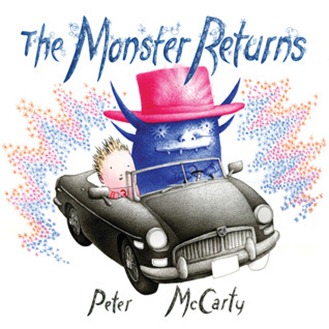
monster returns

The Monster Returns by Peter McCarty

This sequel to Jeremy Draws a Monster continues the story of Jeremy, who is continuing to draw up in his room alone.  Then he got a note from his monster saying that he should draw a compass and a telescope and look out the window.  When he looked through the telescope, he saw his monster!  The monster immediately called on the phone and announced he was bored and headed over to Jeremy’s house.  Jeremy had to think quickly.  He invited all of the children playing outside up to his room, gave them each a fancy pen, and had them each draw their own monsters.  When Jeremy’s monster arrived, he was met with a big SURPRISE!

McCarty turns this book into one about making friends, whether through inviting them over to play or by creating them.  It is also a book about creativity where the act of creation is also one of making friends and connections. 

The delicate lines of McCarty’s illustrations add up to bright colors and plenty of fun.  The mix of the human characters done in one style and the single-color monsters done in a different style make for a clever and memorable combination. 

A stylish and fun book about friends, creativity and monsters.  This will have children drawing their own monsters, so make sure to provide plenty of fancy pens and paper.  Appropriate for ages 3-5.

Reviewed from copy received from Henry Holt and Company.