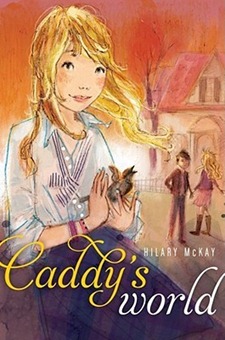
Review: Caddy’s World by Hilary McKay

caddys world

Caddy’s World by Hilary McKay

If you have not yet discovered the artistic, free-spirited, dynamic world of the Casson family, you are in for a treat!  This is the sixth book in the series that started with Saffy’s Angel.  In this book, we return to a time when Caddy, the oldest of the Casson children, was twelve.  She had three best friends and all of them had a role to play in their little group.  But this year, all of them are facing challenges in their lives.  Alison is completely bored with school and longing for something new, so she starts rebelling against school rules.  Ruby has been asked to try for a prestigious scholarship to a private school but she doesn’t want to leave her friends.  Beth is outgrowing her pony and decides to limit her diet. Caddy too has a challenge, a new baby is coming to the family, and her father who usually lives away from the family in London returns to help take charge.  But things are never that easy in the chaos of the Casson family!

McKay has the ability to speak about serious issues like premature babies, growing older, potential bulimia, and chaotic family life without heading into deep drama.  While the subjects are deep and the emotions are real, she keeps a lighter touch on them than most authors.  My favorite example of this is the chaos of this family.  It’s a family filled with love, art projects, failed cooking, and laughter.  But it’s also a family that is often adrift, rudderless, and late for school.  McKay walks the line, demonstrating that there are many sorts of families and that some of them that may look fragmented are actually strong and true.

McKay is also adept at drawing characters.  Here we get to see younger versions of several beloved characters:  Saffy, Indigo and Caddy.  They are all wonderfully true to their older selves, showing interest that later come to full light.  The addition of the three new characters and glimpses of other previous ones make for a book that is fresh but also warmly familiar to fans of the series. 

This sixth book in the series would work as a stand-alone read.  Taking place earlier than the other novels, it will delight fans and should encourage new ones to enter the world of the Cassons.  Appropriate for ages 9-12.

Reviewed from library copy.

Review: Sadie and Ratz by Sonya Hartnett

sadie and ratz

Sadie and Ratz by Sonya Hartnett, illustrated by Ann James

Hannah’s hands are named Sadie and Ratz, and they get into all sorts of trouble.  They like to crunch, squish and squeeze things.  They are especially active when Hannah’s little brother, Baby Boy, does things like going into her room or using all of the markers.  Then Sadie and Ratz try to rub off his ears.  Baby Boy screams for help and Hannah gets into trouble.  But then one day, something strange happens and Sadie and Ratz get accused of drawing on the wall, when they were nowhere near there.  Baby Boy was there, but he tells his parents that Sadie and Ratz were the ones who did it.  Later, Baby Boy blamed Sadie and Ratz for his skinned knee.  He got a cookie and cuddles, while Hannah only got a cookie.  Things were getting out of control, so Hannah sent her hands on vacation so they could no longer be blamed for things they had not done.  After that, she discovered that her pet stick insect, Pin, was missing a leg.  Now that was taking it too far!  Whose busy hands could have done this?

This book is a delight.  It’s going to bother some people that the behavior the children are modeling here is not perfect.  Rather, it is naughty, childlike, and accurate.  This book reflects great parenting on the part of the parents in the book, an openness for creativity, and a welcome zing of real life.  These are children who don’t always tell the truth and have hands that get into mischief. 

The charcoal illustrations by James have a wonderful wild quality as well.  They are rough, often dark, and filled with shadows.  These are not illustrations filled with color, pink and glitter.  All signs point to the fact that this is a different sort of chapter book altogether.  And so it is.

An outstanding addition to beginning readers in libraries, this book will appeal to a certain kind of family and a certain kind of kid.  You know if you are one of those parents and if you are raising on of those kids.  Mine both are.  Appropriate for ages 6-8.

Reviewed from library copy.

Review: My Dad Is Big and Strong, But… by Coralie Saudo

my dad is big and strong but

My Dad Is Big and Strong, But… by Coralie Saudo, illustrated by Kris Di Giacomo

Released May 8, 2012.

Translated from the French, this picture book takes the traditional bedtime story and turns it upside down.  Every night it’s the same thing, Dad does not want to go to bed.  The boy tries to get his father to bed nicely by using logic, but his dad just gets wilder and wilder.  The boy refuses to chase after him, instead offering a quiet story together.  That always works, and the two of them sit together in a chair: the father on the boy’s small lap.  Two stories later, and the boy finally has his father tucked into bed, but the process is not done yet.  The boy can’t head to his own bed yet or his father will ask to sleep with him.  And though his father may be big and strong, he’s also afraid of the dark.

This picture book has a wonderful charm about it that really works.  While there are other books that turn the parent/child relationship around, this one does it with a gentleness and honest joyfulness that is simply lovely.  A large part of this is the tone of the writing.  The sentence structure also works well, showing the skill of the translation.  The book plays with so many of the stereotypes of getting children to sleep that it is a delight to share with children.

Giacomo’s illustrations keep the size of the father and son as different as possible.  As you can see from the cover, the boy is quite small.  It is that size difference that adds so much humor to the illustrations, especially when the father is sitting on the boy’s lap for a story.  Another wonderful whimsical touch is the way the father heads to bed in hat and tie, rather than pajamas. 

Doing a pajama or bedtime story time?  This book would work very well there.  It is also a great pick for bedtime snuggles, though you might find yourself on your child’s lap just to try it out.  Appropriate for ages 3-5.

Reviewed from copy received from Enchanted Lion Books.

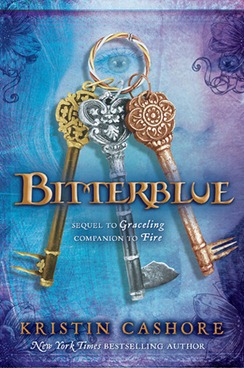
Review: Bitterblue by Kristin Cashore

bitterblue

Bitterblue by Kristin Cashore

Released on May 1, 2012.

A sequel to Graceling, this book takes place 8 years later.  Bitterblue has been queen of Monsea for some time, struggling to undo the evil that her father wrought throughout the country.  Her duties seem to consist of mountains of paperwork, pardoning those influenced by Leck’s powers and the occasional appearance at court.  Spending days at work, indoors with only her aging advisors around her, who seem to go blank mentally when she mentions her father, wears upon her.  So she starts to sneak out and visit her city.  She visits the amazing bridges her father had created.  Underneath one, she finds a story room where there is warmth, drinks and stories are shared.  It is there that she meets Saf and his friend Teddy, two thieves who only steal what is already stolen.  As the queen learns about her city, she discovers strange things, puzzles that add to the questions she already has.  It is this that she has to solve, if she is to be the queen she needs to be.

Cashore brings back beloved characters in this book, including Po and Katsa who are continuing their love affair, their stormy fights, and their wrestling.  In Bitterblue, she has created yet another amazing female character.  Bitterblue has not only the future of her kingdom to decide, but also the terrors of her past to overcome.  She is a survivor rising from the wreckage of her childhood, the manipulation of her father, and the devastating loss of her mother.  Readers get the exquisite pleasure of watching her become a queen and a woman before their eyes.  The growth shown in this book is gradual and organic, beautifully told.

Cashore excels at writing readable books and elaborate worlds.  Her world building is done carefully and consistently, the reader secure in the knowledge that this is a vibrant, strange world, but one that they can count on.  Her characters all make sense, living their lives in the complexity of the political world that Cashore has built.  Even if their actions make no sense at first glance, be sure that Cashore knows more than she is showing at that moment and all will be revealed.  These books are layered, complex and riveting.

I fell hard for Bitterblue and her struggles.  She is the sort of heroine who speaks to me, one who is faced with overwhelming challenges but by staying true to herself and discovering who she is deep inside, manages to come through in the end.  She is immensely human, something that Cashore makes sure all of her amazing heroines are.

If you loved Graceling and Fire, you are sure to love Bitterblue as well.  This book took four years to write, and I’m happy to give Cashore all the time she needs to create her next book too.  Appropriate for ages 15-18. 

Reviewed from ARC received from Dial Books.

YALSA’s Teens’ Top Ten Nominees

YALSA has announced the nominees for this year’s Teens’ Top Ten.  The list is nominated and voted on by teens.  The nominees are announced now, so that teens can read the books this summer and vote on them in August and September. 

Here are the 2012 nominees (so many great titles!):


Abandon by Meg Cabot

Across the Universe by Beth Revis

All Good Children by Catherine Austen


All These Things I’ve Done by Gabrielle Zevin

Ashes by Ilsa Bick

Between Shades of Gray by Ruta Septys


Cinder by Marissa Meyer

Divergent by Veronica Ross

Eona: The Last Dragoneye by Alison Goodman


The Fault in Our Stars by John Green

Hourglass by Myra McEntire

How to Save a Life by Sara Zarr


Legend by Marie Lu

Miss Peregrine’s Home for Peculiar Children by Ransom Riggs

A Monster Calls by Patrick Ness, illustrated by Jim Kay


Page by Paige by Laura Lee Gulledge

Scarlet by A. C. Gaughen

The Scorpio Races by Maggie Steifvater


Shine by Lauren Myracle

Tempest by Julie Cross

This Dark Endeavor by Kenneth Oppel


What Happened to Goodbye by Sarah Dessen

Where She Went by Gayle Forman

Wither by Lauren DeStefano


Do you have a favorite among the nominees?  Any favorite of the year that isn’t nominated?

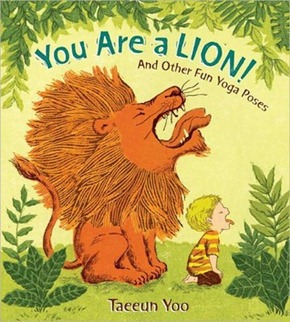
Review: You Are a Lion by Taeeun Yoo

you are a lion

You Are a Lion and Other Fun Yoga Poses by Taeeun Yoo

This is a fun and gentle way for children to learn yoga poses.  The book opens with a Namaste to the morning.  Children then learn about the lion pose, with the pose simply explained and shown.  Readers turn the page to see the child in the pose and the jungle and lion around him.  Other poses follow with the butterfly, dog, snake, frog and cat.  The book ends with the Mountain pose and a group of children hold that pose up on top of the mountain range.  Finally, the children lie down and are still, relaxing in the morning light. 

The short text in the book has quick directions and then a few lines of poem to match that pose.  The rhymes are basic, offering a little more insight into why that pose is called by the name it is.  The entire book has a playful approach that matches the subject matter well.  That playful nature is matched by a gentle spirit and a quietness that work particularly well here.

Yoo’s illustrations were done using linoleum block prints, pencil drawings and Photoshop.  They have a wonderful texture to them, great lines, and a simplicity that is necessary when offering directions.  The children are all different races, making the book all the more inviting.

This is a great pick for introducing young children to some basic yoga moves.  The moves are simple, playful and presented in a fresh way.  Appropriate for ages 3-5.

Reviewed from copy received from Nancy Paulsen Books.

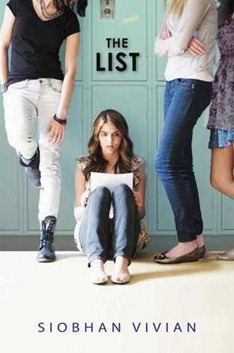
Review: The List by Siobhan Vivian

list

The List by Siobhan Vivian

At Mount Washington High School, the same thing always happens just before homecoming.  The List comes out.  It gives the names of two girls in each grade: one is named the prettiest in that grade, the other the ugliest.  Being on the list can change your life at Mount Washington, and it does for all of the eight girls on this year’s list.   Abby is ecstatic to be on the list as prettiest freshman, especially with her brainy older sister looking down at her all the time.  Danielle, the other side of the freshman pair, sees the list take a toll on her relationship with her boyfriend.  Lauren, prettiest sophomore, was previously homeschooled and finds that the list can help her make new friends.  Candace, named the ugliest sophomore, isn’t unattractive at all, instead it’s her attitude that is horrid.  Bridget, celebrated for losing so much weight, knows that she’s started something very dangerous.  Sarah is a rebel and immediately writes UGLY across her forehead in permanent ink.  And then there are the seniors, two girls who used to be best friends and who now are strangers, one whose path to homecoming queen seems clear and the other who has been on the list as ugliest all four years. 

Vivian sets the wheels of this story in motion and her characters take over.  It is a trick to create eight characters unique enough to read as individuals throughout an entire book, and Vivian does that very well.  She explores the relationship between beauty and self-esteem, beauty and popularity, and the perception of beauty and its impact.  Some of the girls are robbed of that feeling while others have never felt it.   But it’s not just about the “ugly” girls.  The perception of beauty haunts the “pretty” girls as well, creating rifts in friendships, questions about values, and eroding self-esteem in much the same way as being labeled ugly.

Vivian does not shy away from this complexity, instead she embraces it.  This is foreshadowed by the reaction of the principal to discovering the list where she warns the girls that they have all been hurt by being placed on the list. 

Here we have a book that is deep, complicated, and riveting reading.  It’s a book that takes on some “truths” of our society and turns them on their head, in a pretty beautiful way.  Appropriate for ages 14-17.

Reviewed from ARC received from Scholastic Press.

Review: Frog and Fly by Jeff Mack

frog and fly

Frog and Fly: Six Slurpy Stories by Jeff Mack

Six very short stories about a frog and a fly are told here.  Done in comic panels, the stories are all simple and quite funny.  In each story, the frog meets a fly and ends up not really making friends but instead making lunch.  Each story is slightly different and filled with little puns.  The frog manages to cleverly lure the fly closer by talking with it, but eventually just slurps that fly right up.  The arc of the first two stories is very similar.  The third brings in ketchup and a burger.  The fourth has different animals shooing the fly away from them, until the frog welcomes the fly closer.  The fifth story has races between the frog and fly that the fly wins over and over again, until the final one.  The sixth story has the frog get his comeuppance much to the glee of the fly.  Slurp!

Mack has tapped right into the sense of humor of preschoolers with these stories.  The running gag of eating the fly makes the final story all the more satisfying with its twist.  This is the sort of book that my two sons would have loved at that age, laughing along with delight.  It’s one that reads aloud very nicely, and even better, gives you the opportunity to work on a fly voice and a frog ribbit.

Mack’s illustrations are simple and colorful.  The lines are crisp and clean, echoing the thickness of the font used for their dialogue.  They reflect the humor of the entire book, with silly grins and a big pink slurping tongue.

Sure to get laughs at preschool story time, this makes a silly addition to any story time on frogs or flies.  Appropriate for ages 3-5.

Reviewed from copy received from Philomel Books.

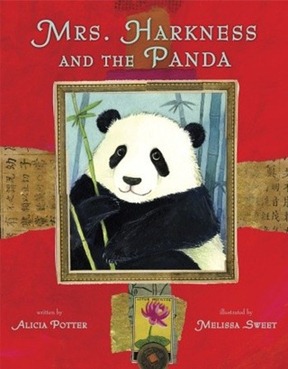
Review: Mrs. Harkness and the Panda by Alicia Potter

mrs harkness and the panda

Mrs. Harkness and the Panda by Alicia Potter, illustrated by Melissa Sweet

In 1934, Mr. Harkness set out to China to bring the first live panda to the United States.  Unfortunately, he did not survive his journey.  So his young widow, Mrs. Harkness decided to set out and complete her husband’s dream.  Mrs. Harkness was not an adventurer; she designed tea gowns.  She knew that the journey would be hard, maybe even impossible.  But she set off for China and met up with Quentin Young, a man who had seen pandas and agreed to help her.  They packed carefully for the journey, even taking baby formula and bottles in case they found a baby panda.  They journeyed deep into China, until they finally found traces of panda activity, but no pandas.  Then they heard a small sound and followed it to a baby panda hidden in a rotten tree.  Mrs. Harkness had completed the mission!

This is a marvelous biographical picture book about an unlikely adventurer who took an amazing risk, especially after her husband’s death.  The story is told with a wonderful richness that helps bring the time period and this woman to life.  I particularly enjoyed all of the people telling her that it was a mistake and the amazing number of things she took along with her on the journey.  Potter takes the time to really create the world and this character, something that can be missing in picture book nonfiction.

Sweet’s illustrations are marvelous.  They incorporate cut paper art, maps, Chinese lettering, postcards, and lots of little touches that make them especially rich and meaningful.  At the same time, there is a sweetness to the illustrations that works particularly well with this story and the main character.  It also works well with the cuddly furry pandas too.

An inspirational story of adventure with an unlikely heroine at its center.  Appropriate for ages 5-7.

Reviewed from copy received from Alfred A. Knopf.