Review: Heroes of the Surf by Elisa Carbone

heroes of the surf

Heroes of the Surf by Elisa Carbone, illustrated by Nancy Carpenter

In the nineteenth century, the Pliny is on its way from South America to New York City.  Aboard the ship are many families, including two young friends Anthony and Pedro, who spend the journey pretending to be pirates.  The boys are having a grand time together until one night when a storm hits.  Even the lifeboats are of no use, as they are smashed by the growing waves.  The night goes silent when the engines stop working, leaving them at the mercy of the storm.  Then the captain sends up a distress beacon.  Soon there are people on the shore and a cannon is aimed in their direction.  Could it be pirates after all?  Instead of a cannonball, a rescue line and buoy are shot onto the ship.  It takes a harrowing zip line to safety until all of the crew and passengers are safe and warm at the Long Branch Life Saving Station, a precursor to the Coast Guard.

Carbone writes with a lot of detail here, exploring this story based on the real disaster of this ship.  Told through the point of view of Anthony, the story stays riveting and thrilling right through to the end.  From the drama of the storm itself to the striking rescue efforts, this book is filled with tension and adventure.  Carbone also carefully builds the world of the 19th century, making sure that readers know where they are in history and how brave the efforts of the rescuers are.

Carpenter completes the historical tone of the book with her own detailed images of the 19th century.  From the clothing to the mannerisms, this book clearly reveals the time and place of its setting.  Carpenter does not shy away from the drama, instead leaning into it with her wild expanses of stormy water, the drama of almost slipping off the deck, and the wonder of the rescue.

A powerful mix of history and adventure, this fictional book will be popular with pirate and nonfiction readers.   Appropriate for ages 5-7.

Reviewed from copy received from Viking.
Review: Waiting for Ice by Sandra Markle

waiting for ice

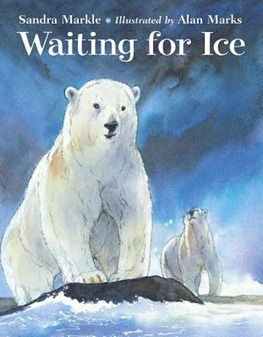
Waiting for Ice by Sandra Markle, illustrated by Alan Marks

This is the true story of an orphaned polar bear cub who has to survive the wait for the ice to return without the help of her mother, who would normally have cared for her for another year or two.  This cub lives on Wrangel Island, far north of Russia in the Arctic Ocean.  She lives there with many other polar bears, but she is alone.  She has to find dead things on the shore to eat, defend her finds from scavengers, negotiate other food from hunting bears, and manage to survive.  Many other cubs die from starvation, but this little cub survives.  She manages to live until the ice floes return.  Even then, she is one of the last to leave the island, unsure of how to live on the ice away from land.  Eventually, she spends more and more time on the ice, and then she is carried off into the ocean where she must learn to survive in a new way.

Markle captures the harrowing and desperate life of an orphaned cub in a very straight-forward way.  The reader knows of the danger that this cub is in and how difficult her life will be.  This white-furred heroine also captures the mind of readers, demonstrating time and again how brave and resourceful she is.  Markle takes care not to humanize the life of the bears, instead they are respected as animals with their own lives.  Few human emotions are spoken about, instead the drama comes directly from the situation and survival.

Marks’ illustrations recreate the cold of the Arctic on the page.  Done in whites, blues and browns, they are chilling, warmed only by the young bear at the center.  Marks draws the movement and feel of polar bears with a confidence and care.  These are solid illustrations that do much to support the book as a whole.

A stirring tale of survival set in the Arctic Circle, this book will be enjoyed by young nonfiction readers.  It is also a nonfiction book that would work well in a story time setting thanks to its inherent drama.  Appropriate for ages 6-8.

Reviewed from copy received from Charlesbridge.

Ray Bradbury Dies


Ray Bradbury has died at age 91 in Los Angeles.  I have vivid memories of discovering and devouring Bradbury short stories over the summer as a young teen.  I read every book I could get my hands on by Bradbury, starting first with Fahrenheit 451 and Something Wicked This Way Comes, and then moving into his short stories, which I enjoyed far more than his novels.  Each story was a world in itself, a place to visit briefly, to immerse oneself in and be transported.  They were stories that were meant to dazzle, amaze and shock.

I can’t think of a better way to spend a hot summer day than some shade, a cool drink and a new Bradbury short story.

Review: The Hueys in The New Sweater by Oliver Jeffers

hueys in the new sweater

The Hueys in The New Sweater by Oliver Jeffers

All of the Hueys are the same.  They are all white ovals with skinny, stick legs and arms.  They even acted and thought the same, until one day when Rupert knitted himself a sweater.  It was a bright orange sweater with zig-zags and it made him stand out from all of the other Hueys.  Rupert was very proud of his sweater, but the other Hueys often reacted in shock and horror at it.  Rupert went to talk with Gillespie, who was also intrigued by being different.  Gillespie knitted himself a sweater just like Rupert’s and that way they could both be different together!  Slowly, the other Hueys started to accept that Rupert and Gillespie were different.  In fact, they embraced it, and everyone knitted themselves orange sweaters just like Rupert’s.  Now everyone was the same again, until Rupert decided to try a hat!

There is something completely winning about these little creatures that Jeffers has created.  So much of this book depends on the images, the style, and the feel.  Jeffers manages to create a community that is completely homogenous but not cult-like or frightening.  Instead it’s a community that has tea, hangs pictures, and seems very friendly.  Even their reaction to Rupert’s sweater is never angry, more one of disbelief, shock and even some tears. 

The writing is light and merry, keeping the entire book positive.  Jeffers has cleverly created a book that speaks to creativity and being your own person, not being afraid of leaving the crowd, but also one about what happens when your idea is taken over by the crowd.  The answer?  Do something else!

A great pick for a bedtime read, the book is a smaller format than many picture books and will not work well with a large crowd.  Appropriate for ages 3-5.

Reviewed from copy received from Philomel Books.

Review: Captain Awesome to the Rescue by Stan Kirby

captain awesome to the rescue

Captain Awesome to the Rescue by Stan Kirby, illustrated by George O’Connor

Eugene’s family has just moved to Sunnyview and he has to start a new school.  Happily, Eugene is very courageous.  He has to be in order to transform into Captain Awesome.  Now if he can just find his cape, before he’s attacked by Queen Stinkypants, also known as his little sister!  When Eugene starts school, his teacher gives him the responsibility of caring for the class hamster, Turbo.  Eugene does a very careful job, until one day he discovers Turbo has been hamsternapped.   It may just take Captain Awesome to reveal what really happened to Turbo and save him from some villainous plot.

This beginning chapter book has the mass appeal of superheroes.  It also has a cheery tone and a light touch.  The humor has the right tone for this age group, and doesn’t push it over the top.  This is a book that parents and children can share together, something you want with first chapter books.  As with all early reading books, the story is simple and the characters are not complex.  Still, there is adventure, plenty of villains, and the making of friends to carry the book well.

While this makes a good choice for reluctant readers, it is also good for children who are reading early as well.  There is no content here to disturb parents of preschoolers who may be reading naturally on their own.

This is a great pick for children who will soon enjoy Captain Underpants but are not quite ready as readers.  Appropriate for ages 5-7, or younger if they are starting to read on their own.

Reviewed from library copy.

Review: The Family Tree by David McPhail

family tree

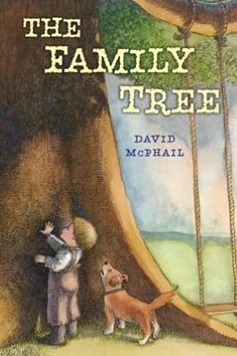
The Family Tree by David McPhail

This is the story of a very special tree.  It was left standing when the rest of the space was cleared to build a house many years ago.  This tree would shelter the little house.  It witnessed many changes over the years as horse and wagon changed to cars.  There were births and deaths on the farm, until finally it was the great-great grandson of the original building of the home who lived there.  The tree still stood, strong and straight.  But then it was threatened as a new road was planned that would run right through it.  The grandson refused to let the tree be cut down, and wild animals join him to keep it from happening.  So the road plans must be changed and the tree continues to grow now by the large bend in the road.

There is something to be said about a picture book that decides to tell the story that feels right, the one that resounds in your bones, rather than the one that would happen in real life.  When I saw the bulldozers in the book, I braced myself for heartache, or for the story to turn into that of growing a new tree from an acorn that originated with this tree.  But instead McPhail told a story for tree lovers of all ages, who wish that there were bends in the big highways to keep huge old trees alive. 

McPhail’s writing is simple and straight-forward.  He tells the story with a great matter-of-fact tone that belies the wildlife appearing and the wonder of the tree standing.  His art is signature McPhail with its fine ink lines and watercolor softness.  It has both the clarity of the modern day and the softness of memories.

Get this into the hands of those who hug trees.  They are guaranteed to love it.  Appropriate for ages 3-5.

Reviewed from copy received from Henry Holt and Company.

Review: The Fairy Ring by Mary Losure

fairy ring

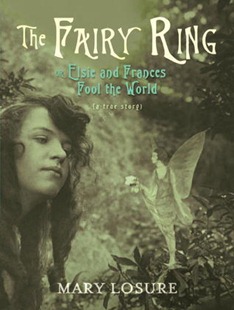
The Fairy Ring or Elsie and Frances Fool the World by Mary Losure

This is the true story of two young English girls who fooled everyone with the photographs they took.  Elsie and Frances were cousins who hadn’t met until Frances moved to England from South Africa.  When Frances, age 9, visited the beck behind their small house, she saw tiny little brown men in green clothes walking about.  But the grownups teased her about seeing fairies, and there was one thing that Elsie at age 15 wouldn’t tolerate and that was teasing.  So the girls set out to take a photograph of fairies that would stop the teasing entirely.  It was all meant to be a little joke, but quickly got out of hand as Sir Arthur Conan Doyle got involved along with international publicity.  It wasn’t until much later that the ruse was finally admitted to.  But in the end, there is still one magical photograph that wasn’t staged by the girls, and you can decide if there are really fairies in it.

This well-researched nonfiction book for children has the appeal of fairies and also the intriguing story of two young people who lied and got away with it for a very long time.  Losure manages to recreate the world that the children were growing up in, but not dwell on overly long descriptions.  It is a brief book, one that looks closely at the truth behind the photographs but also one that keeps one small part open to the wonder of fairies too. 

The girls could have been depicted in a quite different way than Losure handles them here.  They did deceive people and created more images that spread more lies.  But Losure does not show them as calculating at all, rather they are caught in the life that their small prank takes on, unable to admit the truth and unable to stop the insatiable curiosity about the images.  There is an exceptional dignity to the way their story is told here, one that pays homage to both the lie and to the belief.

A very readable nonfiction work that will be enjoyed by children reading the popular fairy series out right now and may lead those fiction readers to find more nonfiction to enjoy.  Appropriate for ages 8-11.

Reviewed from library copy.

Review: Devine Intervention by Martha Brockenbrough

devine intervention

Devine Intervention by Martha Brockenbrough

When his best friend shot him in the head with an arrow, Jerome died instantly.  Now he finds himself in between Heaven and Hell, given a second chance to save himself from eternal torment.  He’s been appointed as Heidi’s guardian angel as part of soul rehabilitation.  Jerome didn’t actually read the handbook for guardian angels, so he’s mostly just winging it.  Heidi has heard Jerome’s voice in her head since she was small.  When she got older, she started to realize that others don’t hear voices like that and that she may be crazy.  So Heidi started to withdraw and kept more and more to herself.  She doesn’t always listen to Jerome’s advice, though he tries to help.  So when she and her best friend head on stage during Talentpalooza and there is a major wardrobe malfunction, Heidi has no one but herself to blame.  But that’s not why she was out on the pond’s thin ice at all.  Though her life (or death) will never be the same after falling through.

Brockenbrough strikes just the write tone in this novel.  While deep issues are dealt with, she keeps the writing light and playful.  It helps that she is a truly funny author, writing with a hilarity that makes reading the novel pure fun.  At the same time, she does fully explore the meaning of life in the book, what death may hold for us, and the importance of family, even dysfunctional ones.  Her lighter tone makes these deeper issues all the more reflective and powerful.

The two main characters are very successfully drawn.  For me, Jerome is the voice of the book.  It is his perspective on life and death that makes the book work so well.  Heidi on the other hand is vital to the book, but doesn’t have the whiz and bang of Jerome.  That said, a book only needs one star of a character.  Heidi makes a grand secondary lead character, offering a different perspective and a lot of action to the book.

This funny teen novel about death and life features juvenile delinquents as guardian angels.  I think that explains a lot about life.  Appropriate for ages 13-15.

Reviewed from ARC received from Arthur A. Levine Books.

Ruth and Sylvia Schwartz Children’s Book Awards

The Ruth and Sylvia Schwartz Children’s Book Awards are given annually to two children’s books: one in the young adult/middle reader category and the other in the picture book category.  The award winner is chosen by two different groups of children and teens. 

Here are the winners:


Young Adult/Middle Readers: The Whole Truth by Kit Pearson

Picture Book: Loon by Susan Vande Griek, illustrated by Karen Reczuch