This Week’s Tweets and Pins

Here are the links I shared on my Twitter and Pinterest accounts that you might find interesting:

You can also check out the tweets and pins I shared on my other blog, Sites & Soundbytes, that focus on libraries, e-books, and social media.

#BeBookSmart Twitter Party on Wednesday, Jul 11 @ 6pm (EST).#bebooksmart http://prsm.tc/CR8Mbz #reading#rif

Before J K Rowling, there was Eva Ibbotson – Telegraph http://buff.ly/QA3P9w #kidlit

Chris Raschka: The Habits of an Artist — The Horn Book http://buff.ly/LJrUMD #kidlit

How Alice Got to Wonderland by Ted Gioia http://buff.ly/LP0n6n #kidlit

John Green on why books beat any iPad app http://buff.ly/LOkr8W #reading

More picture book magic from Philip Stead & a glimpse of the studio he shares with Erin! -| The Book Case http://buff.ly/QASOVr

Peter Clothier: Conscious Living: Children’s Books http://buff.ly/NXrDRn #kidlit #bfyr

Reading in the Twenty-First Century | Children’s books | http://guardian.co.uk http://buff.ly/QzkxWw

Sexing Up the Classics for Teens – The Atlantic Wire http://buff.ly/QwlQ8s #yalit

‘Shadow and Bone’: Author Leigh Bardugo talks her debut novel | Shelf Life | http://EW.com http://buff.ly/LJMBIg #yalit

Shelf Awareness reveals the cover of the upcoming adult novel by JK Rowling http://buff.ly/Rjqp6t

Simon & Schuster to Publish Dystopian Novel by Kendall and Kylie Jenner http://buff.ly/Qyvd7R Ugh… #yalit

Ten Reasons Parents Should Read Multicultural Books to Kids | InCultureParent http://buff.ly/R5jvBM #reading#kidlit

Using e-books and printed books to improve literacy skills http://buff.ly/QBlzRH #reading#literacy #ebooks

Why Libraries Matter: Letters to the Children of Troy, Michigan (From 1971) – Mental Floss http://buff.ly/OlYMKm #libraries

Wisconsin Library Association Summer Reading Brief 2012 http://buff.ly/R5ztvP #reading#libraries

Review: A Bus Called Heaven by Bob Graham

bus called heaven

A Bus Called Heaven by Bob Graham

It all started when the bus with a sign that said “heaven” was abandoned on Stella’s street.  Traffic slowed, people gathered, and Stella took her thumb out of her mouth and suggested that the abandoned bus could be “ours.”  So everyone helped move it out of the street and into Stella’s front yard.  It stuck out a bit into the sidewalk and took up the entire yard.  The next morning when Stella looked out her window, things had changed again.  Now there were people sitting on their front wall, children wrestling in the grassy shade under the bus.  The adults began cleaning things up.  When some boys spray painted the side of the bus one night, they were invited back to paint one of Stella’s designs instead.  The bus had become a hub of activity for the entire community.  But then one Saturday morning things changed again, when a tow truck arrived.  What will happen next to the bus called heaven?

Graham creates books that have a special sort of feel to them, a sense of place and community, but that are also infused with a wonder and magic all their own.  Here he takes one abandoned bus and creates that community in our modern world where it is lacking.  This is not a statement about the problems of our society, but rather a look at what it could be if we were only willing. 

The illustrations are done in his signature style that has lots of details, fine lines, and soft colors that manage to be bright too.  He plays with color here, making Stella almost ghostlike in her paleness.  When she gets excited two dots of pink appear, but she does not ever fully become colored like the other characters.  She is a pale but very solid young character.

This is an uplifting read about the little changes that create a community and the little children that can lead us there.  Appropriate for ages 4-6.

Reviewed from library copy.

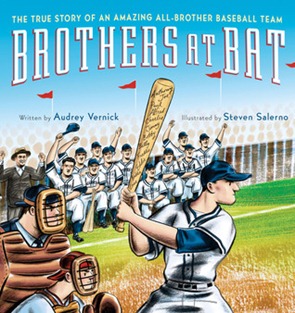
Review: Brothers at Bat by Audrey Vernick

brothers at bat

Brothers at Bat by Audrey Vernick, illustrated by Steven Salerno

In one family from New Jersey, there were 12 baseball-playing brothers: the Acerra brothers.  All of the brothers played high school baseball and their high school had an Acerra on it 22 years in a row!  In 1938, the oldest nine brothers formed their own semi-pro baseball team.  Their father coached the team and they played on dirt fields that were littered in rocks.   Each of the brothers had a different skill set than the others.  Some were slow runners but great players, others posed for the cameras naturally, one was a great pitcher that people still talk about today.  But all of them supported one another.  Then came World War II and the team disbanded as six of the brothers headed off to war.  Happily, all six brothers returned from war.  The brothers played their last game together as a team in 1952.  By that time, they were the longest-playing all-brother baseball team ever.  In 1997, the brothers were honored by the Baseball Hall of Fame.

Vernick shares this story of brothers who played together for most of their lives with a real sense of wonder and amazement at what they achieved.  The story celebrates their strong brotherhood and sense of family as well as the love of baseball.  Vernick offers all sorts of details that really create a vivid picture of the family dynamic and their lives. 

Salerno uses a vintage style for the illustrations that firmly roots this picture book in the time period.  They are colorful and action filled. 

A great non-fiction picture book for baseball fans, brothers, or people who enjoy a little sports with their history.  Appropriate for ages 6-9.

Reviewed from library copy.

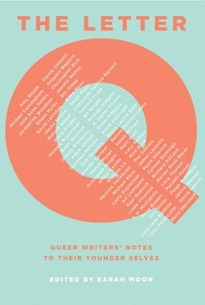
Review: The Letter Q

letter q

The Letter Q: Queer Writers’ Notes to Their Younger Selves edited by Sarah Moon

This was one of those books that I wanted to last forever.  I lingered over it, though I had a problem with not just wanting to read them all in one breath.  The entire book is made up of letters from successful gay and lesbian writers to their younger, usually teen, selves.  They are filled with hope, humor and acceptance for what they themselves thought, felt and lived.  Almost all are love letters to that younger, insecure and questioning person who is often closeted and always queer.  There are names here that teen readers will be familiar with: Malinda Lo, David Leviathan, Bruce Coville.  There are many others to be discovered through this book. 

Though the book is specifically about being GLBTQ, all teens will find it inspirational.  As one letter says, all of us have something that is queer about us.  All teens need to accept themselves, see themselves in that future state, and reach for those dreams.  All teens need to know that their thoughts and feelings are ok, whatever they are.  So I’d share this with straight and not narrow teens as well as GLBTQ teens too, of course. 

This is one of those books that should be in every public library.  It will probably be read in the back areas, the more private tables.  My ARC copy will be donated to a local café that has a GLBTQ club that meets regularly.  This is a book that café should have, since I can’t think of anything nicer to read with a cup of coffee.  Just as long as you are ready to really savor both.

Appropriate for ages 13-18.

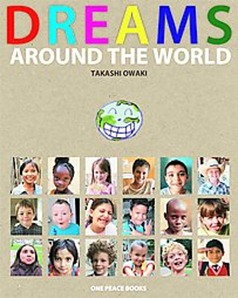
Review: Dreams around the World by Takashi Owaki

dreams around the world

Dreams around the World by Takashi Owaki

Meet thirteen children from around the world who are ready to share their dreams with you!  Photographer Takashi Owaki traveled the world, including 55 countries on six continents and interviewed over 1400 children about what they wanted to be when they grew up.  In this book, he shares the dreams of some of those children.  Each child and their dream is accompanied by photographs, their age, name and country, along with a short paragraph about where they live.  At the end of the book, all of the countries are shown on a world map.  The book is a celebration of our diversity but also our universal dreams.

Owaki’s photographs are the heart of this book, especially the full-page image of each child looking directly into the camera.  The writing itself is simple, speaking to how Owaki met the child and the family they live with.  The smaller images with each story also help give context, showing activities and the environment.  My only quibble with the book is that it would have been nice to have the map done in a smaller way with each child to help with understanding the geography.

Originally published in Japan, this is a book that celebrates our world and the beauty of dreams.  Appropriate for ages 5-8.

Reviewed from copy received from One Peace Books.

Review: The Children and the Wolves by Adam Rapp

children and the wolves

The Children and the Wolves by Adam Rapp

I made it through about the first 30 pages of this book and set it down, packed it in my bag to return it to the library, and started a new book.  But.  I could not get the story out of my head.  I couldn’t leave Wiggins and Frog there, so I finished it and loved it, after all. 

Frog is three years old and being held captive in a basement by three middle schoolers.  Bounce is the mastermind of it all, a wealthy and very intelligent sociopath who decides to kidnap a little girl in order to murder an old poet who upset her.  Orange is the boy whose basement they keep Frog in, his father is confined to a wheelchair and high on painkillers.  Wiggins takes care of Frog, washing her clothes and making sure she takes vitamins.  The three of them take drugs, get into lots of other trouble as well, and take revenge where it suits Bounce.  The book cycles through all of their points of view, including Frog’s.  It is a book filled with so much hate and aching that it hurts to read.  It pushes the limits of teen books, exploring all of the dark places possible while at its heart having something shining with truth.

Rapp doesn’t shy away from anything here.  The book is filled with swear words and not only the four letter ones.  Drugs are seen as ways of release, not things that get you into trouble.  Sexuality is explored in a matter-of-fact way.  Violence is in almost every scene, and even when it’s not there you as a reader are waiting for it with shallow breaths. 

And yet, there is something here beyond the shock value and the clawing desperation.  There is somehow hope.  I’m not sure where it comes from, it’s like a green sprout in the torn-up sidewalk.  Rapp through the vileness of this book also gives us moments that shine.  In any other book they may have been tragic scenes, but here they are light and warmth.  It is all in comparison with the rest, just like the lives of these children.  Victims all.

Stunning, violent, vile and filled with heart wrenching beauty of its own unique sort, this book is one that you can’t turn away from, though you may want to.  Amazing.  Appropriate for ages 16-18.

Reviewed from library copy.

Review: John Jensen Feels Different by Henrik Hovland

john jensen feels different

John Jensen Feels Different by Henrik Hovland, illustrated by Torill Kove

John Jensen lives in Norway.  He lives in an apartment, eats cereal for breakfast, brushes his teeth, and takes the bus to work.  But he feels different than everyone else and knows that people are looking at him because he is different.  He notices that no one else wears a bowtie, so he changes and wears a regular one.  But he still feels different.  John Jensen decides that the real problem is his tail, since no one else has a tail like his.  So he ties it up and hides it, but all that results in is not being able to sit comfortably and losing his balance.  In fact, he loses it so badly that he falls and has to go to the doctor.  Thank goodness that Dr. Field turns out to be just what John Jensen needs, a friendly doctor who is also an elephant.

Told in a deadpan voice, this book is pure delight.  John Jensen is obviously different, since he’s an alligator.  But the book never gives that away except in the illustrations.  Instead, it is told as if he is just another Norwegian on the bus.  The tension leading to the realization builds and is only partly fixed by the appearance of the elephant towards the end.  The book ends shortly thereafter with no sudden realization by John Jensen, just an acceptance that he truly is different.  I loved the fact that there was no culminating event at the end, because it made the book really work as a vehicle to talk about all sorts of differences even if you are a human too.

Kove’s illustrations add to the deadpan humor of it all.  There are marvelous touches like Camus’ The Stranger as bedtime reading, and the fact that absolutely no one on the bus is actually looking at John Jensen.  The illustrations are a large part of what really create the strong Norwegian setting that permeates the book. 

Translated from Norwegian, this is a striking picture book in so many ways.  It will be one of those books that children shout at thanks to the deadpan nature and the lack of reveal, and I love sharing those books with kids.  After all, we all feel different and even a bit green and scaly at times.  Appropriate for ages 4-6.

Reviewed from copy received from Eerdmans Books for Young Readers.