This Weeks Tweets and Pins

Here are the links I shared on my Twitter and Pinterest accounts this week that you might find interesting:

CHILDREN’S BOOKS

Children’s & YA Revenues Up Nearly 41% This Year – GalleyCat http://buff.ly/QjfmZ0

Fuse #8 – Books I’m Looking Forward to in 2013 http://buff.ly/PFWJUy #kidlit

Interview: Lane Smith, Author And Illustrator Of ‘Abe Lincoln’s Dream’ : NPR http://buff.ly/PBEMGA

Interview: Michael Sims, Author Of ‘The Story Of Charlotte’s Web’ : NPR http://buff.ly/R6T13l #kidlit

A Wrinkle In Time, Scholastic, and why kids are the future of comics again | The A.V. Club http://buff.ly/QqVy5Y


E-BOOKS

Newsweek Will Cease Print Publication at End of Year http://buff.ly/RJKCoo

Over 60 Companies Approved for Overdrive’s New Developer Tools | Good E-Reader – http://buff.ly/R3UuH1

Q&A: Random House VP Skip Dye on Ebooks in Libraries – The Digital Shift http://buff.ly/Qe5lxE #ebooks #libraries


LIBRARIES

Man Shocked to Discover "Rather Violent" Gay Manga Sex in His Niece’s Library Book http://buff.ly/QUuhdD

"Perhaps the quickest fix for local stimulus is a public librarian w/a fire in the belly 2 make change" @PatriciaMartin http://ow.ly/er29g

Thrown a Curve: Our Anti-Social Graduates at Work | Peer to Peer Review http://buff.ly/R3UeYm

Why Are Some Publishers So Wrong About Fair Use? | Peer to Peer Review http://buff.ly/R3aoRR


READING

Flavorwire » 15 Scathing Early Reviews of Classic Novels http://buff.ly/R9ZYSY

Science Fiction Sequels and Prequels That We Waited Years (or Decades) For http://buff.ly/QkBn9S

Why the iPad has revolutionized bedtime reading for parents & kids … | The Digital Media Diet http://buff.ly/PBEOhz


SOCIAL NETWORKING

Five thoughts on increasing productivity and efficiency while reducing (or eliminating) email http://ow.ly/ewjIX

How to Maximize Your New Twitter Profile | Social Media Examiner http://j.mp/RAY7GY

Taking it to Twitter: Librarians Debate the Demise of Dewey | School Library Journal http://buff.ly/Qm2z8a


TEEN READS

H. Jack Martin: Your Teen is Reading WHAT? http://buff.ly/Qm1Wvl #yalit

John Green Interview: ‘Fault In Our Stars’ Author Talks Worst Book Ever, Where He Likes To Read http://buff.ly/TmMpMk #yalit

Love ‘Divergent’ by Veronica Roth’? 10 other teen reads you can’t miss | Shelf Life http://buff.ly/PzBH9X #yalit

Stacked: Microtrends in YA Fiction http://buff.ly/R4maeE #yalit

YALSA’s Teens’ Top Ten

teens top 10

The Teens’ Top Ten is a book list where teens themselves nominate and choose their favorite books from the previous year.  You can see the full list of nominated titles here.  But the winners have been chosen now and here are the top ten for 2012:


Abandon by Meg Cabot

Across the Universe by Beth Revis

Cinder by Marissa Meyer


Divergent by Veronica Roth

The Fault in Our Stars by John Green

Legend by Marie Lu

Miss Peregrine’s Home for Peculiar Children by Ransom Riggs


The Scorpio Races by Maggie Stiefvater

What Happened to Goodbye by Sarah Dessen

Where She Went by Gayle Forman

Review: Mossy by Jan Brett

mossy

Mossy by Jan Brett

Mossy loved living at Lilypad Pond.  She spent so much time along the banks that moss and then small plants started to grow on her shell.  She became a walking garden and liked to look at her reflection in the water to see how her garden was growing.  On day, she met a male turtle named Scoot at the pond.  The two were smitten immediately.  But just as they were about to meet, Dr. Carolina, who owned a museum, picked up Mossy and took her away to be the center of a new display.  Mossy spent several seasons at the museum, missing Scoot but being well cared for.  She was a very popular exhibit.  So when Tory, Dr. Carolina’s young niece, noticed how sad Mossy seemed and how lonely, there was a big decision to be made.

Brett’s story speaks to the importance of leaving living creatures in their native habitat to live their own lives.  It is a subject handled delicately here with no abusive storyline at all, just a general sense of sadness, which is perfect for young children.  The book is set at the turn of the century with the clothing and use of horse-drawn carriages giving clues.

As always, Brett’s artwork is simply beautiful.  In each two-page spread, she gives the main image a frame and then has several additional pictures that either add to the story or the setting.  We get to see different plants up close, glimpses of the museum even when it is not in the storyline, and Scoot waiting at the pond. 

This is not a book to be read quickly or with a group, instead it’s one to linger over and see the details of the artwork.  Appropriate for ages 4-6.

Reviewed from copy received from G. P. Putnam’s Sons.

Review: This Is Not My Hat by Jon Klassen

this is not my hat

This Is Not My Hat by Jon Klassen

I never expected to see a sequel to I Want My Hat Back but I am so thrilled that Klassen saw things differently.  This second book has a similar theme to it with a stolen hat, but it has entirely different characters.  This time the story is set underwater with fish playing the major roles.  One little fish has stolen a hat from a big sleeping fish.  He knows it was wrong, but justifies it by the fact the hat looks so much better on him and fits better too.  As he flees to the thick reeds to hide, he thinks to himself about how clever he has been, that the fish would never notice it missing, that he wouldn’t know where to look for the thief, on and on.  And with each sentence, the readers will see that he’s wrong, very wrong.

This sequel has the same understated style of the first and the same wonderful sense of humor that is exquisitely funny.  Klassen maximizes the humor with his flawless ability to tell one story in the words and an entirely different one with the action of what really happens. 

For all the fans of the first book, this is one that works best if you have read the first, but also stands on its own completely.  Appropriate for ages 4-6.

Reviewed from library copy.

Review: Black Dog by Levi Pinfold

black dog

Black Dog by Levi Pinfold

When the Hope family woke up one morning there was a great big black dog outside.  Mr. Hope thought it was the size of a tiger and called the police who advised him to just stay inside.  Mrs. Hope compared it to an elephant and the family shut the lights off so it wouldn’t know they were there.  Adeline woke up and saw a black dog the size of a T-Rex outside the window.  She closed the curtains.  Maurice woke up and thought it was the size of a Big Jeffy, deciding to stay under the covers.  But the littlest member of the family, Small, headed outside to meet the dog.  The dog was huge, the size of a house, and Small knew it could eat her up.  She ran off, telling the dog that it would just have to shrink to follow her.  As she ran, the dog got smaller and smaller, until it was able to fit into the house through the cat flap in the door.  That’s when the rest of the family realized that they had been very silly to be that worried about such a small black dog.

Pinfold manages to capture a certain quirkiness that creates a unique look and feel for this book.  His text builds the tension very high by the time that Small heads outside.  The frenzy of the other characters puts Small’s reaction in stark relief, making it all the more brave and amazing.  Her approach to the enormous dog is also wonderfully strange, running from it and having it shrink to follow her.  It makes a delicious sort of sense while you are wrapped in the spell that this book weaves.

The art is exceptional, filled with tiny details.  Pinfold has offered both smaller sepia toned illustrations that show the outside of the house and the continued reaction of the family, and also larger colorful images that add to the unusual feel of the book.  The size of the dog that Small confronts is astounding.  His eyes alone are her size, his nose the size of a car.  Breathtaking.

Highly recommended, this book is an unusual but very successful book.  Appropriate for ages 4-6.

Reviewed from library copy.

Review: Oh No! by Candace Fleming

oh no

Oh No! by Candace Fleming and Eric Rohmann

A virtuoso picture book by two masters, this is bound to be a new favorite for toddler and preschool story times.  The story begins with Frog falling into a deep hole.  Oh no!  Mouse came along and tried reaching down but she fell in too.  Oh no!  Loris slowly came down from her tree to help, but an allergy made her sneeze and you guessed it, she fell in too.  Oh no!  Sun Bear tried to help, Monkey swung by and fell in, and then Tiger reveals himself fully above.  Sharp-eyed readers will have noticed him lurking from the very end papers right on through.  He’s ready to pounce on this hole full of juicy animals.  But wait!  There’s one more animal headed for the hole!  Oh yes! 

Fleming has written such a simple and yet jaunty text here.  It reads aloud so well, so vividly that there is no other way to read this book.  The text doesn’t rhyme, instead it is filled with so much repetition and rhythm.  There is the chorus of “Oh no!” that meets each animal as they tumble into the hole.  But there are also words that repeat as each animal is introduced. 

Rohmann did the illustrations as relief prints.  They have bold lines, lithe animals, and lots of action.  They also have that wonderful texture of prints that make them such a great choice for children’s books.  The illustrations lift this book even higher.

Get your hands on this for your programs.  I guarantee it will be part of your regular story rotation.  It’s also a great pick for children’s reader theater.  Appropriate for ages 2-4.

Reviewed from library copy.

Review: Machines Go to Work in the City by William Low

machines go to work in the city

Machines Go to Work in the City by William Low

This is an inventive look at machines, combining it with large flaps to open and questions to engage.  Low looks at one machine after another that works in the city and then asks a question about it.  The questions are not simple either, this is not a book that talks down to its young audience.  Instead you have to think a bit.  Do the garbage men go home after picking up the garbage?  Can the crane operator still work when the building grows taller than the crane?  Is the airplane ready to leave when the passengers are on board and the baggage is loaded?  Little listeners get to turn the flap to learn the answer and the reason. The answer is given with a quick explanation and then the book moves on to the next machine. It’s just enough information for a preschooler to really enjoy.

Low has created a brisk pace here, never lingering too long and offering exactly the right amount of information.  This makes the book very readable, something that can be happily shared at bedtime unlike a lot of nonfiction vehicle books.  More information on each machine is offered at the end of the book, complete with labeled parts.  Those are pages that young truck fans will linger on.

Low’s illustrations are richly colored.  The painted textures add to them with some pages having individual bricks done solely in texture alone.  At other times, the sleek metal stands out. 

A great pick for your own little machine fan or for public library shelves.  Don’t let the flaps scare you off, they are large and just as durable as a regular page.  Appropriate for ages 3-5.

Reviewed from library copy.

Review: The Town Mouse and the Country Mouse by Helen Ward

town mouse and country mouse

The Town Mouse and the Country Mouse by Helen Ward

Never has there been such a beautiful example of this Aesop Fable.  This is the classic tale of the county mouse who is happy in the simplicity of the country until his cousin from the city comes to visit with his claims of the wonders there.  The country mouse goes to visit, discovering things like elevators, electric lights, and enormous banquets.  But when they are both chased by a city pet, in this case a little dog, the country mouse realizes that while the city is fast-moving and filled with bright lights, he misses his quiet life in the country.  Merrily, the book ends with an image of the city mouse asleep in a wheel of expensive cheese.

It is the illustrations here that make this such a noteworthy book.  Ward takes special care in depicting the beauty of the countryside and the country life.  She moves between seasons, the apple tree decked in pink blossoms and then hearty with ripe apples.  The two mice are shown without any little clothes or any anthropomorphic touches.  Instead these are two sleek and life-like creatures. 

The illustrations are sumptuous, rich and superb.  They invite you to explore the county and the city and see beauty in both.  They bring you into the cozy winter nest of the country mouse.  They linger on the many blossoms of the country landscape.  They focus you close in from a mouse point of view. 

Highly recommended, this book belongs in library collections for both its beauty and the simple way it is written.  Appropriate for ages 3-5.

Reviewed from library copy.

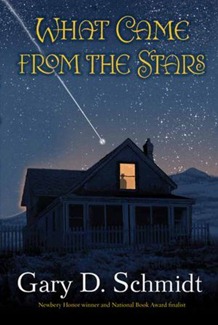
Review: What Came from the Stars by Gary D. Schmidt

what came from the stars

What Came from the Stars by Gary D. Schmidt

Valorim is a world torn by war.  The evil Lord Mondus is threatening everything that they hold dear, but one young man, Young Waeglim, manages to save it all.  He crafts the Chain of Valorim Art and flings it away into space, out of the reach of Lord Mondus and his threatening hordes of O’Mondim.  A young man on earth finds the chain and wears it.  His name is Tommy and his life is changed when he wears the chain, creating a new life from one devastated by the lost of his mother.  He starts to be able to do amazing art by using ‘”thrimble” and making it so lifelike it moves.  He speaks in a strange language, adding words that no one can find in any dictionary.  But most of all, he knows he has to save his home from the development that threatens it.  It was a place his mother loved, and one that means everything to his little sister and his father.  This is a book about loss and grief and yes, the universe too.

Schmidt amazed me here.  It is a book that plays with the motifs of science fiction, brings them to life, creates a world, and then… you just need to read this book.  For me, the ambiguous nature of the story itself as well as the ending means that it has a myriad of possible readings.  It could be just about loss of a parent and coping mechanisms, but I think it is about so much more.  It is about the power of art, the beauty of family, and the wonder of possibilities. 

Perhaps my favorite part of the book is the way that the world of Valorim and the earth world are separated by writing styles.  The earth world reads almost as any other modern children’s book.  It is peppered with Valorim words, but mostly straight forward.  The Valorim sections are flowery, lovely and wild reading.  They remind me most of the Jabberwocky poem from Through the Looking-Glass by Lewis Carroll.   It contains the same adventuresome spirit, the danger, the violence, but mostly the wordsmithing. 

I adored this book.  It would be ideal for classroom discussion because everyone is certain to have taken it in their own unique way.  I’d also suggest it for a perfect book to read on your own and discover.  It’s tremendous.  Appropriate for ages 12-14.

Reviewed from library copy.