Review: Jessica’s Box by Peter Carnavas

jessicas box

Jessica’s Box by Peter Carnavas

Released March 1, 2015

Jessica can’t sleep, it’s the day before her first day of school.  The next day her parents assure her that she will make lots of friends, and Jessica had a plan to make sure that happened.  In a box on her lap, she carried her teddy bear to school, but when she revealed it later in the day, kids laughed at her or just walked away.  The next day, Jessica put something else in her box and headed to school.  But the cupcakes in the box disappeared quickly without so much as a thank you from the kids.  The third day of school, Jessica snuck her dog into class.  Doris was very popular, but dogs weren’t allowed at school.  By the fourth day, Jessica was dejected.  She dragged her box to school empty and then put it over her head.  And that’s when Jessica figured out exactly what she should have had in her box all along, something very special indeed.

Carnavas tells a very successful story here.  I love that the main character is in a wheelchair and yet the story is not about her disability.  It’s a first-day-of-school story and a making-friends story instead.  Also throughout the book she is shown as entirely capable and not needing help, except for a little encouragement of different sorts from her family members that any child would want and need.  The use of the box is smartly done, using it both as a metaphor and also as a way to build suspense for the reader about what is being taken to school that day.

The art is friendly and colorful, also helping build suspense with page turns that lead into the reveal of what’s in the box.  Carnavas shows loneliness very nicely on the page, isolating Jessica clearly on the white background.  He also shows connections in a gentle way, displaying a subtlety that is particularly nice on the page with Jessica and her father being quiet together.

A very inclusive book about school jitters and making friends, this will be a nice read aloud to share with kids about to enter school.  Appropriate for ages 4-6.

Reviewed from digital copy received from Kane Miller.

Review: Last Stop on Market Street by Matt de la Pena

last stop on market street

Last Stop on Market Street by Matt de la Pena, illustrated by Christian Robinson

Take a ride across town on a bus with CJ and his grandmother. Every Sunday after church CJ and his grandmother get on a bus and take a long ride. Along the way, they meet all sorts of people on the bus. There is a man who is blind, a busker who plays the guitar, teenagers who listen to music on their iPods. CJ longs for some of the things he sees, like his friends who have cars to drive places, the iPods the teens have, and the free time his friends have on Sunday afternoons. But his grandmother sees the beauty in the ride, in the other passengers and in the time they spend together. At the end of the ride, they get off in a poorer section of town and head to the soup kitchen which is ringed by a rainbow in the sky. CJ is glad that they made the trip once they are there.

De la Pena is best known for his young adult books.  This is the second picture book he has written.  One would never know that this is not his specialty.  His wording is just perfect for preschoolers, inviting them along on the journey to discover new things on each page. His words form a tapestry of a community, diverse and dynamic. The journey is about more than just seeing new things though, it is also about seeing them differently and in a positive way. From the rain falling to the poor section of town, they are all reframed by CJ’s grandmother into something beautiful.

Robinson’s illustrations are done in acrylic paint and collage.  They are bright, vibrant and filled with people of different colors living happily side-by-side. They capture the busy urban setting with a sense of community that is warm, friendly and fun.

A great journey to take any preschooler on, this picture book celebrates making a positive difference in your community.  Appropriate for ages 4-6.

Reviewed from copy received from G. P. Putnam’s Sons.

Review: The Case for Loving by Selina Alko

case for loving

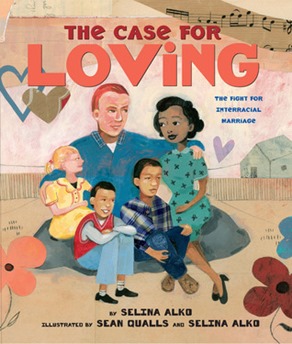
The Case for Loving: The Fight for Interracial Marriage by Selina Alko, illustrations by Sean Qualls and Selina Alko

This nonfiction picture book tells of a history that will surprise modern American children. It is the story of love and one family that was brave enough to stand up to a racist law. Mildred and Richard Loving fell in love in the small town of Central Point, Virginia. They had different colored skin and so they were not allowed to get legally married in Virginia. So they crossed state lines into Washington, DC and got married there. When they returned to Virginia though, they were arrested for violating the state law against interracial marriage. The two moved to Washington DC and raised their children there. Things started to change in the 1960s and the Lovings took their case all the way to the Supreme Court to win the right to marry one another in the state of Virginia.

This book is strikingly beautiful with a rich warmth that flows directly from the story and art. The author and illustrator are a husband wife team who are also interracial. Their passion for this subject shines on the page. Alko explains that subject matter with a vibrancy, offering information on the laws in a way that is suitable for small children. The drama of the arrest is also clearly captured, exposing the ludicrous law to today’s perspective.

The art of the book was done by both Qualls and Alko. Their styles marry into a beautiful richness that fills the pages. They are filled  will playful hearts and flowers that add a lighter note to the images. At the same time they have detailed paintings filled with texture and power at their center. The combination of both has created a stunning beauty of collage and painting.

An important piece of our civil rights history as a nation, this picture book documents one family willing to take up the fight for themselves and others. Appropriate for ages 6-9.

Reviewed from copy received from Arthur A. Levine Books.