Review: Orion and the Dark by Emma Yarlett

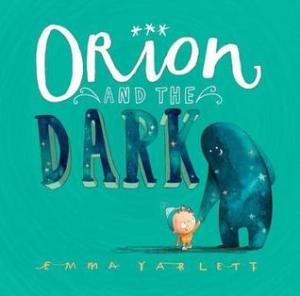
Orion and the Dark by Emma Yarlett

Orion and the Dark by Emma Yarlett (InfoSoup)

Orion is scared of a lot of things thanks to his big imagination, but the thing that he is most frightened of is the dark. He hates bedtime and spends the night watching for monsters and listening for scary noises. One night, he is so upset that he shouts at the dark to just go away! That’s when the Dark outside his window changed and became alive. It entered his room and Orion cautiously greeted him. Then the Dark invited Orion along on an adventure. First, the two explored the darkest and most frightening parts of Orion’s house together and it turned out that those places were a lot of fun. They faced the scary sounds in the darkness together and found out that they weren’t that frightening after all. Finally, they headed out into the darkest place of all, the night sky and there Orion discovered that not only wasn’t he scared of the Dark anymore, but they had become the best of friends.

Yarlett has written a dynamic picture book that does a lot to soothe fear of the dark. First, it turns the dark into a character who is warm, friendly and filled with stars. He’s also rounded and rather like a sparkling stuffed animal. There is certainly nothing to fear there. Then as they explore the dark places and noises together, readers and Orion realize that there is nothing to be afraid of there either. The ending of the book as they fly up into the night is magical and marvelous, offering another way to see the night.

The illustrations are done with plenty of humor. The paper switches as Orion thinks of things or plans to lined paper that makes it more like a school assignment. His ideas also show up in childlike crayon, including the fierce monsters that he imagines are in the closet. A couple of the pages have Dark’s arm as part of them, moving the arm makes the Dark shake hands with Orion, and really allows the Dark to greet the reader too.

Lovely illustrations that embrace the darkness of night combine with strong storytelling in this picture book that will have everyone wishing they too could make friends with the Dark. Appropriate for ages 3-5.

Reviewed from library copy.
Review: The Day the Crayons Came Home by Drew Daywalt

Day the Crayons Came Home by Drew Daywalt

The Day the Crayons Came Home by Drew Daywalt, illustrated by Oliver Jeffers (InfoSoup)

Released August 18, 2015.

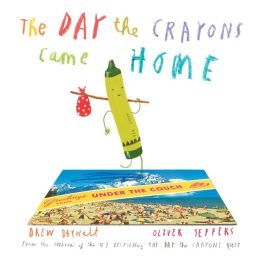
In this companion to the very popular The Day the Crayons Quit, Duncan receives several postcards in the mail, all sent from his crayons, this times ones that have been forgotten, left behind or run away. There is Maroon Crayon who was lost in the couch, broken in half and saved by Paperclip. There is Pea Green, who is aware that no one likes his color so he’s run away to see the world and renamed himself Esteban. Neon Red Crayon has been left behind on vacation and undertakes a long and arduous journey back home, getting his geography all mixed up along the way. There are crayons that melted together in the sun, ones that were eaten and puked up by the dog, ones stuck in sharpeners, left behind in basements, and put in the dryer. All of the crayons want to return home and Duncan has just the solution for them, no matter what condition they are in.

This second picture book about Duncan’s crayons has the same fabulous sense of humor as the first one. The crayons all have their own unique personalities. While the book moves from one crayon to the next in general, a couple of them return several times during the story. So readers get to see what happens when Esteban heads out into the world and also get to adventure along with Neon Red as he makes his long trek homeward. The entire book is merry and funny, filled with puns and jokes. Even the crayons in the worst condition are done with plenty of humor.

The illustrations by Jeffers add to the fun. Make sure to take the glow-in-the-dark crayon page into a dark room to see it glow. Jeffers’ asides by the crayons are wry and silly, creating small conversations outside of the postcard format.  As always, Jeffers’ illustrations are a treat with lots of personality, even with the characters being crayons.

A winning companion book for a popular read, this book is sure to please fans of the first and to find new fans who will happily discover both books. Appropriate for ages 4-6.

Reviewed from ARC received from Penguin Young Readers.

Review: Ask Me by Bernard Waber

Ask Me by Bernard Waber

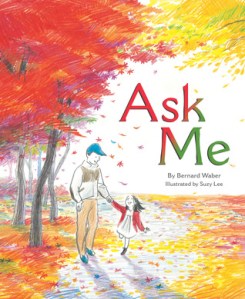
Ask Me by Bernard Waber, illustrated by Suzy Lee (InfoSoup)

A little girl and her father take a walk through their neighborhood. Along the way, the girl asks her father to ask her questions like “Ask me what I like?” and he does, question after question. She finds a lot of nature along the walk to enjoy, from frogs to geese in the air and in the water, bugs, beetles, and flowers. She asks him to ask if she likes ice cream cones and they both happily walk away with cones after she announces how much she loves them. The two talk about trips they have taken together, favorite colors like the red balloon, stories, birds, and much more. Once back home, it’s time to think about her upcoming birthday and then time for bed.

Waber adeptly creates a realistic relationship between father and daughter here on the page. The use of her questions is particularly clever as it gives the book a repeating structure that feels natural and unforced. Parents will also recognize the way children want to be asked questions and have them answered. It is very effective to have this sort of relationship where the girl is saying what she wants out of their conversation and the father is happily agreeing. The entire day spent together is blissful and lovely and is entirely about their relationship with one another. Gorgeously structured and written.

Lee’s art is done in pencil. It dances along with gentle colors until suddenly fall bursts on the page. The deep rich colors don’t seem like pencil until you see the drawing lines on the page. The illustrations celebrate the closeness of this father and his daughter, playing with perspectives and celebrating their day outside in nature together.

Gorgeous illustrations and writing combine into one special picture book that is a dazzling book to share aloud. Appropriate for ages 4-6.

Reviewed from library copy.

Review: Honor Girl by Maggie Thrash

Honor Girl by Maggie Thrash

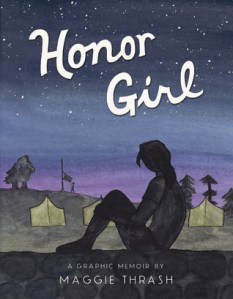
Honor Girl by Maggie Thrash

Released September 8, 2015.

Maggie attends the same summer camp that her mother did and her grandmother did. Camp Bellflower for Girls is one of the oldest camps in the South, and nothing has changed there since it was founded in 1922. Maggie spends her summer with friends she made there previous years. She hates the tether she has to wear to keep herself from sleepwalking at night and she’s really into the Backstreet Boys. Maggie lies the rifle range and finds herself getting better at shooting at least when she can stop herself from thinking too much. That gets a lot harder when she notices Erin, a counselor in the younger girls’ camp. Maggie struggles with her feelings for Erin and though she tries to disguise what she is feeling, other girls at camp notice. Some are supportive while others think that it is very wrong. As Maggie’s summer plays out, she finds ways to deal with the pressure of the rifle range, an angry rival, and also to explore her sexuality.

Thrash’s memoir is told with a broad humor about Christian summer camp and how it feels to be a girl different from most of the others there. At the same time, the humor is never pointed and the girls around Maggie are supportive most of the time and in their own ways. Some want to protect Maggie from her crush, others want to just tease. Yet there is no hate here, which is very refreshing. Thrash also does a nice job of allowing a crush to play out, naturally and tantalizingly. Their feelings for one another are clear even as they themselves feel confused by them. The result is a book about the confusion of being a teen, the tensions of both friendships and attractions with the added dimension of being a lesbian. It is a beautifully done memoir.

Thrash’s book is in full color, but the advanced copy I received is in black and white only. Even with that limited color palette, the illustrations are clear and clever. The characters are unique on the page, which is not easy to do with a camp full of teen girls. Each has a distinguishing feature and it all works so that heroine, her crush, her rival, her friend and others are easily recognized. Throughout the entire book, a river of humor carries through and that same humor is evident in the illustrations. This is a book that could have been heavy and still is emotionally charged. The humor helps that be bearable and makes the book a great read.

A strong and important graphic memoir, this book belongs in every public library graphic novel collection for teens who will enjoy meeting such a strong protagonist. Appropriate for ages 12-14.

Reviewed from ARC received from Candlewick Press.

Review: The Little Gardner by Emily Hughes

The Little Gardener by Emily Hughes

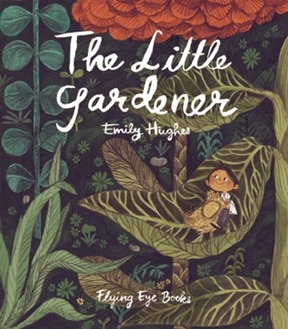
The Little Gardener by Emily Hughes

The gardener loves his garden and he works hard in it, but he’s not that good at gardening. He feels often that he is too small for the job. He does manage to grow one tall red flower that gives him energy and hope. After working so hard, he knows that if something doesn’t change he will soon be out of food, out of a home, and no longer able to live in the garden he loves so much. He falls asleep, exhausted after making a wish that something will happen. Someone notices his flower in the garden and start to work. As the gardener sleeps, the people work on the garden, transforming it into flowers rather than weeds. The little gardener’s flower inspired them to make a change and in turn their work allowed him to live on as the gardener in the place he adores.

Told very simply, this picture book from the author of Wild is about a truly tiny gardener who is smaller than the weeds that he is battling. The writing is simple with a wonderful tone, very understated with the illustrations bringing the real truth to the reader. At the same time, there is a sense of wonder throughout the text that speaks to the power of wishes, the joy of being in just the right place for yourself, and the pleasure of a simple life.

Hughes’ illustrations are phenomenal. She captures the wildness of the weeds, the beauty of a single red flower rising above them, and then the bounty of a newly planted garden. She also captures the size of the little gardener, showing him to be almost fairy-like in his size, dwarfed and protected by the plants around him. That size allows Hughes to focus closely on the plants, creating a jungle out of the garden.

Beautifully illustrated and with a lovely look at a little life well lived, this picture book would be a great addition to gardening story times. Appropriate for ages 3-5.

Reviewed from digital galley received from Flying Eye Books.

Reading to Children – Medically Proven to Change Brains!

for-reading-813666_1280

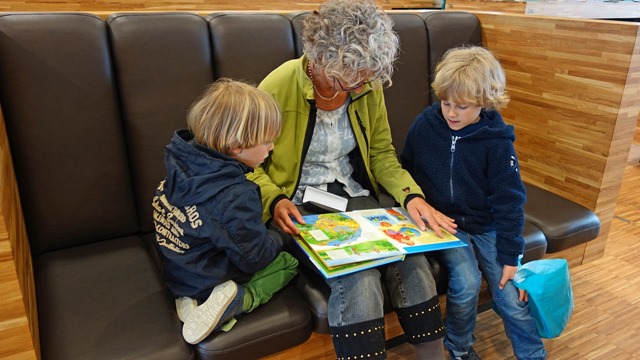
Researchers have conducted MRIs to prove that reading to children sparks changes in their brains. Specifically, reading aloud to preschoolers helps with “mental imagery and understanding narrative” which are both keys to emerging literacy.

Researchers looked at the brains of 19 3-5 year olds using MRI, scanning their brains while they listened to recordings of stories being read aloud. The results showed that children who were from homes where there was more reading had greater activity in the key brain areas than children who did not.

"This is a small and very early study, but the exciting thing it was able to demonstrate is that early reading does have an impact on the parts of the brain that are fundamental for developing literacy early on," DeWitt said. "It’s biological evidence that transcends empirical studies.

Read more at Huff Po and Web MD.

This Week’s Tweets, Pins & Tumbls

Here are the links I shared on my Twitter, Pinterest, and Tumblr accounts this week that I think are cool:

12 Great Animal Sound Books for Toddlers

CHILDREN’S BOOKS

25 Multicultural Chapter Books for Kids http://buff.ly/1eT3hMJ #kidlit #diversity

Cece Bell: how I made El Deafo – in pictures http://buff.ly/1SO3wLI #kidlit

Common Core increasing popularity of children’s history http://buff.ly/1eSRTR2 #kidlit

Hobbies & Crafts 2015: Kids, Unplugged http://buff.ly/1HmOnF9 #kidlit

The Most Anticipated Children’s and YA Books of Fall 2015 http://buff.ly/1KU1Wns #yalit #kidlit

Q&A with children’s author Chris Barton http://buff.ly/1hg0SgS #kidlit #authors

Q & A with Ursula Vernon – Author of Harriet the Invincible – http://buff.ly/1hm3Lgn #kidlit

Banned books socks...love these!

LIBRARIES

Campaigners plan protest at Liverpool town hall over changes to libraries http://buff.ly/1eVtPwR #libraries

Grand Forks leaders seek inspiration from other cities for new… http://buff.ly/1eOg7fb #libraries

How Print-Era Libraries Are Becoming Centers of Digital-Era Community Life http://buff.ly/1eSOTUF #libraries

Libraries need a deeper online presence – The Boston Globe http://buff.ly/1eTNzky #libraries

What’s the Most Visited Part of your Library? http://buff.ly/1IMNJX1 #libraries

TEEN READS

The CW Is Remaking ‘Little Women’ As A ‘Gritty’ Dystopian Series http://buff.ly/1MHUawj #kidlit #classics

Holly Black Inks Deal for Young Adult Trilogy http://buff.ly/1JMykqu #yalit

Sisterhood, Body Image, and Sexual Abuse | Carol Lynch Williams on “Never Said” http://buff.ly/1Dv4eGO #yalit

Top 10 LGBTQ for Youth, by Michael Cart | Booklist Online http://buff.ly/1E8FmPW #kidlit #yalit

Violence in LGBTIQ Fiction for Young Adults, a guest post by Rob Bittner — @TLT16 Teen Librarian Toolbox http://buff.ly/1g58x0D #yalit

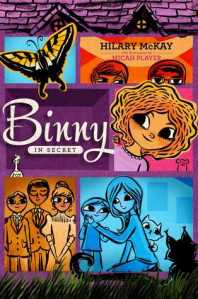
Review: Binny in Secret by Hilary McKay

Binny in Secret by Hilary McKay

Binny in Secret by Hilary McKay (InfoSoup)

This second book in the series about Binny is another charmer. Binny has to start school in her new town now that summer is over. She doesn’t know anyone at all and the only child she has met she managed to knock into and spoil her mother’s birthday gifts while Binny was pursuing a butterfly. When a storm hits their small town, Binny and her family find that the roof of their house has caved in and they have to move to a rental house out in the country. At school, Binny is mercilessly bullied by the girl she knocked into and her friends. They call her “grockle” and make fun of the way she talks and acts. Binny finds herself taking solace in her family, helping her little brother James with his chickens. Then one of the chickens is taken by a “jagular” and Binny discovers a paw print that might lead her to figure out the puzzle of what animal took the hen. Tied together with Binny’s story is that of Clarry, a girl who lived in the house during World War I and who found herself drawn to the natural world in the same way that Binny does. It may just take the two of them together to solve the mysteries that Binny has discovered.

McKay has such a way of writing. It exudes warmth and humor. It’s rather like the cinnamon cake that appears in this book, something to be both savored and lingered over, but also one to be devoured with delight. If I could leave the house with a book like this tucked in my pocket to munch on each day, I’d be very happy indeed. The dual story lines of Binny and Clarry work particularly well. Clarry too is an intriguing character, a girl interested in an education in a time when that simply wasn’t done. Readers find out fairly soon in the book that Clarry lived to be 100 years old, but there are questions about how long others in her story lived which add to the mysteries of the book.

McKay creates characters who are their own people. There is Binny who is complicated both in the ones she loves and her own interests. She finds things on the fly and feels deeply about everything. Her younger brother James is also a delight. His way of greeting people, his vague general statements, his inquisitive nature. They all combine to one little boy with a huge personality. Clem, Binny’s older sister, has depths that are hinted at but not yet revealed. All of the characters are robust and personable. Those who seem one way upon first meeting them develop into intriguing full characters by the end of the book, and even the adults are treated this way.

Another wonderful read by the incredible Hilary McKay. I can’t wait to see what Binny gets up to next! Appropriate for ages 8-11.

Reviewed from copy received from Margaret K. McElderry Books.

Reading and Well Being

Reading Agency Logo

The Reading Agency, a nonprofit in the UK, has released new research from a study they had conducted. The study shows that reading for pleasure can have extended benefits in life.

Among the benefits it finds are improved social capital for children, young people and the general adult population; better parent-child communication and reduction of depression and dementia symptoms among adults.

This is the first part of a larger project that includes reading charities, libraries and education. They hope to create an outcomes reading framework that will allow those organizations to evaluate the impact of the work they do.