Review: So Big! by Mike Wohnoutka

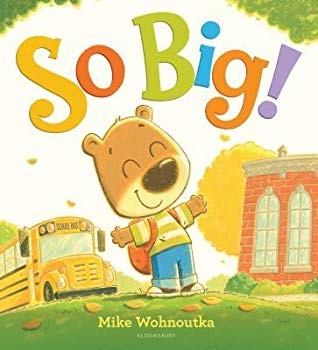
So Big! by Mike Wohnoutka

So Big! by Mike Wohnoutka (9781547600793)

A very positive picture book about first-day jitters when starting school. Bear is “so big,” a refrain that carries through the entire book. He is big enough to get himself dressed. He is so big that he can make his own breakfast too. He packs his own bag, ties his shoes, and heads out to the bus stop. But when the bus gets there, it is so big! The kids around him are big too. So is the large school. Bear is worried and sits down on the steps. There he notices a smaller child hesitating to go in too. The two join hands and head into the big school together where they discover that it’s not too big after all.

Wohnoutka’s story is told in the simplest of words by repeating “so big” and other phrases multiple times. It’s a story about confidence that starts strong, is lost along the way and rediscovered too. The bravery that it takes to try something completely new and then the resilience that is necessary to keep moving forward even when scared is shown deftly in this simple story.

The art is bright and centers entirely on Bear and the other children. Perspective is used very effectively to show how large the bus, the children and the school appear to a small child. Other times when he is more confident, Bear takes up space on the page and the perspective shifts to allow that.

Great for first day jitters, this book is simple and effective. Appropriate for ages 2-4.

Reviewed from ARC provided by Bloomsbury.

Review: Me, Toma and the Concrete Garden by Andrew Larsen

Me, Toma and the Concrete Garden by Andrew Larsen

Me, Toma and the Concrete Garden by Andrew Larsen, illustrated by Anne Villeneuve (9781771389174)

Vincent is staying with his aunt Mimi for the summer. She lives in an urban neighborhood with lots of concrete. Vincent is set for a dull summer where one of the most interesting things is the box of dirt balls that Mimi has from a previous boyfriend. But then Vincent meets Toma, a boy from the neighborhood. The two of them spend time together playing and take the dirt balls and toss them into the empty lot across the road. Soon not only is their friendship blossoming but the empty lot is being transformed by the dirt balls they tossed, dirt balls full of seeds. As the community joins together to care for the new garden, Vincent has to head home, but he will return next year to a neighborhood transformed by nature.

Larsen manages to show an urban neighborhood that is disconnected but still active before the garden appears. There are ice cream trucks, nosy neighbors, and balconies that connect people. Yet it is still a concrete space that needs something. It needs a garden! Told in a gentle tone and at a pace that allows space for the book to grow, this picture book is about transformation and community.

Villeneuve’s illustrations are done in quiet grays, pinks and blues that are almost hazy on the page. They transform along with the garden into vibrant colors of green that anchor the community visually and firmly.

A lovely picture book about the power of nature to create community. Appropriate for ages 3-5.

Reviewed from library copy.

Waking Brain Cells Anniversary

happy-2220481_640

Waking Brain Cells turns 16 years old this week! I am so grateful to have been part of the children’s lit blogging community from the beginning. The changes I have been able to be part of over the years are inspiring and important. The face of children’s and teen lit is becoming more diverse, both in terms of creators and bloggers. I am happy to feature many diverse authors and creators on my blog, doing my small part.

Thank you for reading, for following, for listening. I value all of you and feel so much gratitude for being able to do this year after year.

Review: Where Are You From? by Yamile Saied Mendez

Where Are You From by Yamile Saied Mendez

Where Are You From? by Yamile Saied Mendez, illustrated by Jaime Kim (9780062839930)

A little girl is always asked where she is from. She tries to answer by saying “I’m from here, from today, same as everyone else,” but they simply insist that she tell them where she is really from. So the girl asks her Abuelo where she is from. He closes his eyes and gives her an unusual but important answer. He tells her of the varied places that her people come from. They come from wide open land in the Pampas, from brown rivers that give food, from high mountains where condors fly. She also comes from ocean waters, from hurricanes where rain makes tiny frogs sing. She comes from people who were enslaved for the color of their skin, from plazas filled with sadness. But most of all, she comes from love and from the dreams and hopes of her ancestors.

I must admit that I expected a book about the damage of asking that question of children of color. This book surprised and delighted me as it offers children being asked the question a positive way to see their ancestry whether it makes sense to others or not. The answer from the Abuelo in the book is pure poetry, taking readers on a journey through parts of the world and carrying self-acceptance along as an important theme. There is a sense of shared strength in all of the images of places that is embodied in that child.

The illustrations are beautifully rendered with deep colors that shine on the page. The varied landscapes carry readers forward into the story, inviting them to cool off on mountaintops and slow down to float on ocean waves. It is a book that celebrates our world, our cultures and our histories.

Powerful and poetic, this is one that belongs in all libraries. Appropriate for ages 3-6.

Reviewed from library copy.


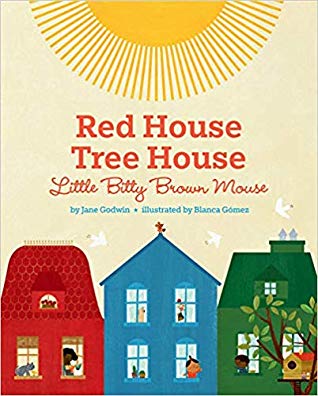
Red House, Tree House, Little Bitty Brown Mouse by Jane Godwin

Red House, Tree House, Little Bitty Brown Mouse by Jane Godwin

Red House, Tree House, Little Bitty Brown Mouse by Jane Godwin, illustrated by Blanca Gomez (9780525553816)

Told in simple rhymes, this book invites the youngest children to explore its pages and engage with the questions asked inside. The book begins with houses, including a little tree house for the tiny mouse. Colors are explored and then there is counting on the next page combined with more colors. The book takes readers on a bus, into the ocean, on all sorts of transportation, and asks engaging questions of the reader along the way. The book ends by inviting readers to look for the mouse hiding in every illustration.

This picture book’s jaunty rhymes are reminiscent of classic children’s books like Go Dog Go! The way that children are invited to engage with the book is wonderful and will help parents new to sharing books with children understand the sorts of questions that can be asked about the images in any picture book. Gomez’s illustrations are full of pure and bright colors that leap from the page, glowing with red, green, blue, orange and pink. The people on the pages are diverse and the urban setting where most of the book takes place is busy and friendly.

Engaging and fun, this book is best shared with only a few children so their perspectives can be heard. Appropriate for ages 1-3.

Reviewed from e-galley provided by Dial Books.

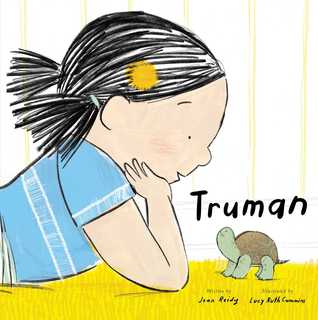
Review: Truman by Jean Reidy

Truman by Jean Reidy.jpg

Truman by Jean Reidy, illustrated by Lucy Ruth Cummins (9781534416642)

Truman is a small urban turtle. He’s about the size of a donut and lives with Sarah high above the busy streets filled with taxis and buses. He is very happy spending quiet time with Sarah. But then one day, Sarah seems different. She is wearing a bow in her hair, a new sweater and has a big backpack. She even gives him some extra green beans as a treat. Before Sarah leaves, she touches Truman and tells him to be brave. And down on the street, Sarah boards a bus for the first time! Truman tries to wait for Sarah to return, but she is gone much longer than she ever has been before. So Truman finds a way out of his aquarium and makes a long journey towards the apartment door. He is being brave and will find Sarah!

Reidy tells a first day of school story from the point of view of a pet left behind by a child. It’s a wonderful answer to what pets do when children leave for school and will also speak to younger siblings being left behind at home when their older siblings head to school. The emotions of Truman are clearly conveyed and his worry is tangible even though readers will know exactly what is actually happening.

Cummins’ illustrations play with perspective nicely as Truman’s point of view is shared as well as views of the busy city street below the apartment. Big and bold, the illustrations show Truman’s limited world grow bigger and bigger as he explores the apartment landscape alone.

A look at bravery and the deep love of a pet, even a small, green one. Appropriate for ages 2-4.

Reviewed from copy provided by Atheneum Books for Young Readers.