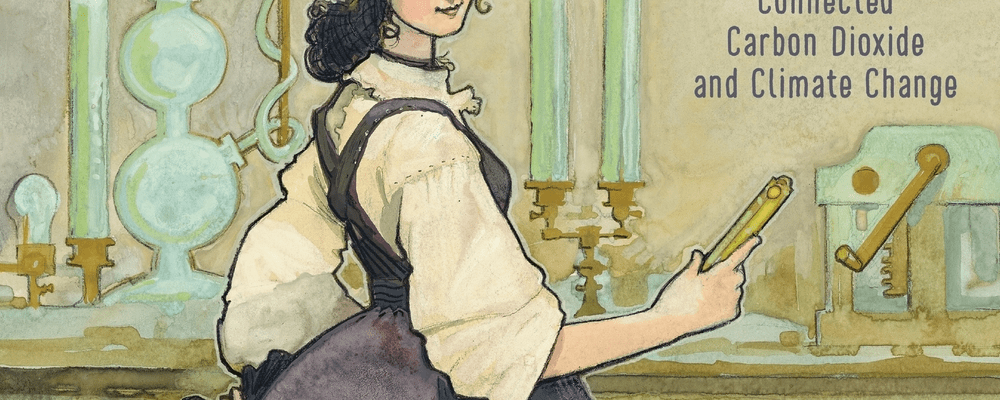
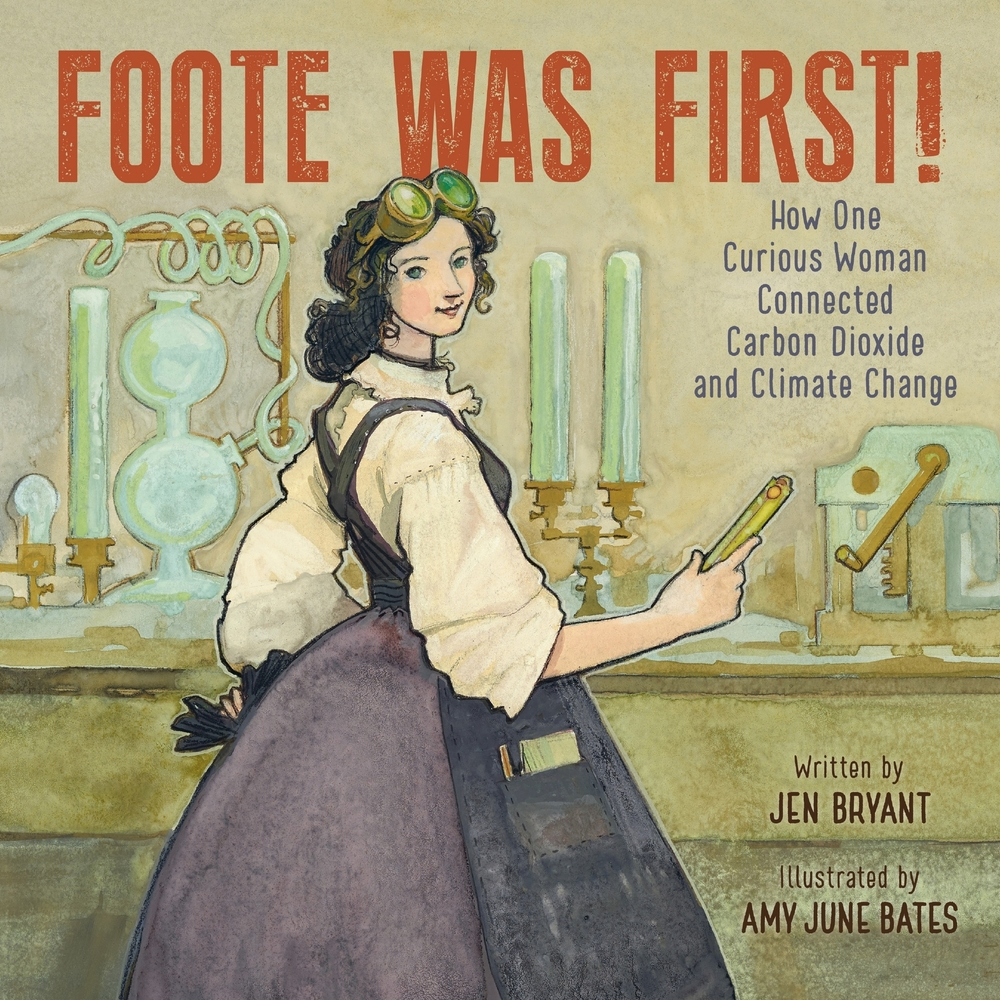
Foote Was First!: How One Curious Woman Connected Carbon Dioxide and Climate Change by Jen Bryant, illustrated by Amy June Bates
- Publisher: Quill Tree Books
- Publication Date: January 13, 2026
- Reviewed from Edelweiss e-galley
- ISBN: 9780062957061
Though an Englishman is credited with discovering that carbon dioxide traps heat, it was actually an American woman, Eunice Newton Foote, who did it first in 1856. Eunice grew up on her family farm and asked lots of questions. At age 17, she was sent to a girls school where she was taught science and able to use a laboratory. She grew up, married and had children and stayed curious. Never a professional scientist, she did science at home, learning about various gasses and their capabilities. When she wasn’t allowed to present her findings since she was a woman, a friend presented them on her behalf. She was the first to tie carbon dioxide to global warming, a foundational learning for our times.
Offering just the right amount of information for young readers, this nonfiction picture book focuses on Foote’s curious mind and scientific studies. The illustrations are particularly striking with Foote in her wide hoopskirts engaged in long walks, scientific experiments and discoveries. They demonstrate how rarely we see women of this period engaged in scientific work.
Inspiring and engaging. Appropriate for ages 7-10.
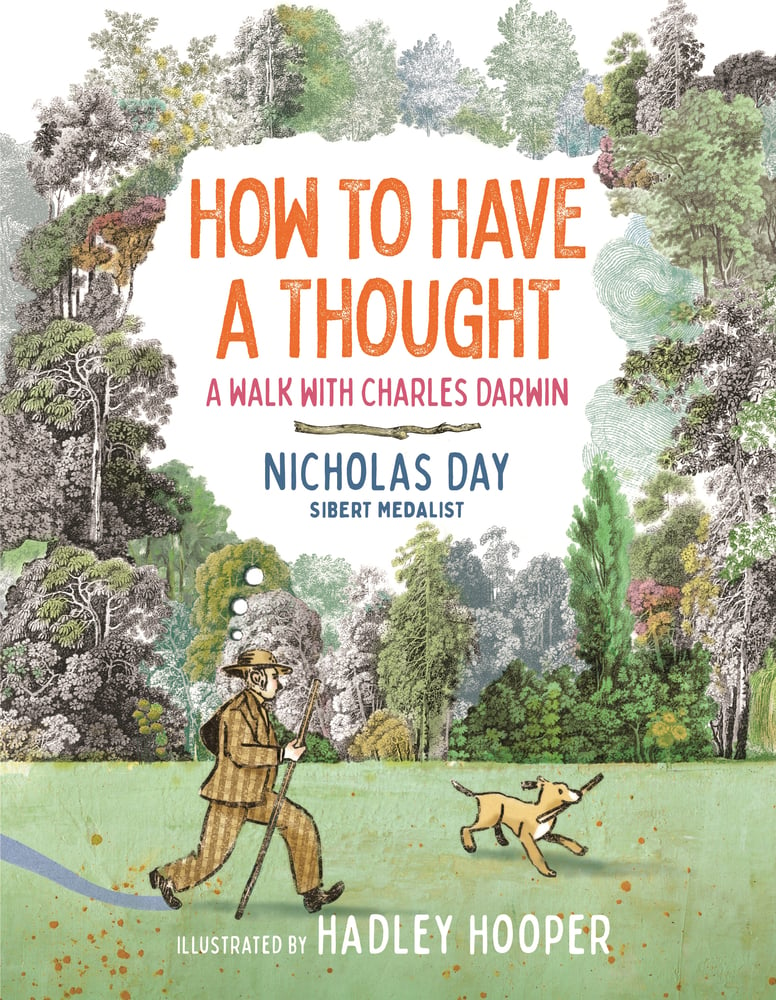
How to Have a Thought: A Walk with Charles Darwin by Nicholas Day, illustrated by Hadley Hooper
- Publisher: Neal Porter Books
- Publication Date: January 13, 2026
- Reviewed from Edelweiss e-galley
- ISBN: 9780823458509
Take a walk like Charles Darwin in this nonfiction picture book that reveals both Darwin’s thinking process and also his scientific discoveries. First find a rock or two, then a walking stick and then find a loop to walk. It could be a loop around the block or a loop around the world, like the one Darwin made on his ship. That’s when he discovered the fossil of a giant sloth, the variety of beaks on finches that lived on the Galapagos Islands, and the bones and skin of a rhea, a bird he’s been seeking but had been served for a meal. Then came the thinking. The why of it all. The walking in loops. The stacking of rocks to count the loops. What will you think of when you take your own walk?
The combination of encouragement to get outside, walk and think with the historical and biographical information on Charles Darwin creates an unexpected treat of a book. The book ends with the author explaining that walks that are celebrated tend to be extraordinary, full of vistas and beauty. That is not the sort of walk we are talking about. These are thinking walks, going the same way every time. And just look at the result. The illustrations play with the dichotomy of the book, sharing historical elements with paintings and offering a light-hearted feel.
A real thinker of a book. Appropriate for ages 5-9.
 Waking Brain Cells