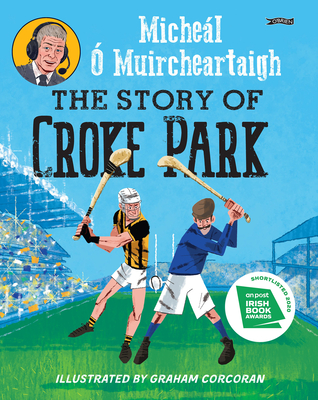
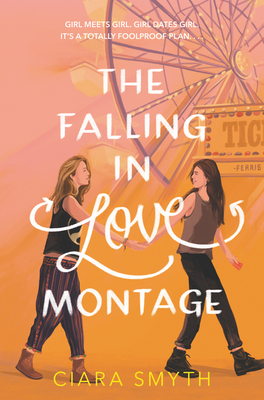
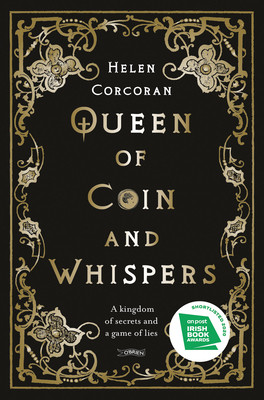
The shortlists for the 2020 An Post Irish Book Awards have been announced. The awards cover a wide range of genres and ages. I’ll focus on the youth and teen awards here, and you can find the entire list on the Irish Times website. Here are the shortlisted titles in the youth and teen categories:
Norma and Belly are squirrels who live in a large tree together. When Norma tries to make pancakes for breakfast, she burns them so badly that not even Belly can eat them. Then they smell something even sweeter coming from a food truck nearby: donuts! They try collecting nuts to trade for a donut, but the man in the truck squirts them with water instead. It’s time for a cunning plan that will need bravery, dexterity, cooking skills and a getaway car! They leave a real mess behind, but also one great idea that inspires a new donut flavor: sweet chestnut.
This graphic novel for elementary-aged readers is a real treat! The entire story is told in dialogue that is minimal and full of silliness. This creates a fast read, speedy and racing ahead of the reader, keeping on great pun in front. The book is full of squirrel ingenuity too and a sense that great ideas can come from anywhere, as well as a skilled getaway driver.
Screamingly funny at times and wildly silly, this graphic novel’s illustrations use white space cleverly. The expressions on the squirrels’ faces are marvelously emotive, their ears and eyebrows moving around, their mouths often open in surprise, and their eyes always thinking of something new to do.
Nutty and sweet, this is a marvelous read sure to appeal to those who love furry critters with their donuts. Appropriate for ages 7-11.
Reviewed from e-galley provided by Random House Graphic.
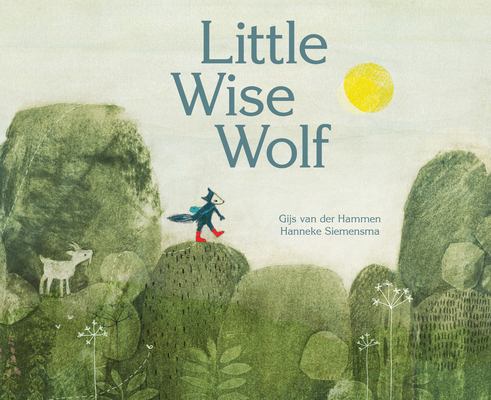
Little Wise Wolf by Gijs van der Hammen, illustrated by Hanneke Siemensma, translated by Laura Watkinson
Little Wolf loves reading lots of books. It’s how he knows so much about the world. All of his neighbors called him Little Wise Wolf and sought him out to answer their difficult questions. But Little Wolf didn’t want to interrupt his reading and kept his door closed. When the king’s crow comes to ask him to help the king, who is ill, Little Wolf refuses at first. After being convinced that he can’t refuse, Little Wolf sets off across the countryside. Along the way, it’s clear that the wolf needs help, but the other animals are busy doing their own things. When he finds himself wet, lost and missing a boot in the dark forest, Little Wolf discovers a camp already set up where he could eat and sleep warmly by a fire. It was all of the animals who had decided to help him after all. Little Wolf continued on his way to the king, asking for help as he needed it along the way. When he had saved the king and returned home, he made sure that he was never too busy to help a neighbor again.
This picture book celebrates knowledge and community. While learning from books is seen throughout the story as very valuable, it doesn’t really make its full impact until it is used to help someone else. Originally published in the Netherlands, this picture book has a delightful European feel. The text is straight forward but with space for interpretation and some dreaming too. The pace of the book is very similar, full of adventure but also time for meandering a bit.
The illustrations are marvelously gauzy, showing a black wolf with a white face and bright red boots on his journey. There are leafy patterns, rounded hills, puddling rain, and much more. The pages have a luminous quality as well as offering a haunting landscape.
A journey worth taking. Appropriate for ages 4-6.
Reviewed from e-galley provided by Kids Can Press.
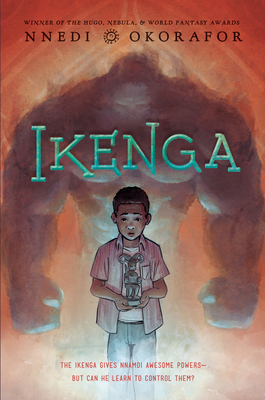
Nnamdi’s father was chief of police in Kalaria, constantly rooting out illegal activity. After his murder, the criminals got more and more bold. Nnamdi had to witness one of the worst criminals, the Chief of Chiefs, attend his father’s funeral. When his father appears to him in a vision, he gives Nnamdi an ikenga, a magical statue. The statue imbues Nnamdi with super powers, transforming him into a fighter for justice, huge like the Incredible Hulk with a deep voice and superhuman strength and speed. Now Nnamdi has the power to continue his father’s work and find who murdered him. But the powers are difficult to control, feeding off of Nnamdi’s growing rage at his father’s death and his family’s poverty and loss. He knows he can use them to do good, sometimes though the powers take control and he ends up hurting people. It’s up to Nnamdi to discover a way to use his powers and solve the murder without losing himself along the way.
Okorafor is the author of the Akata series for teens. This is her first middle grade novel. She does it so well that I hope that she does more. Set in modern Nigeria, the novel gives young readers a glimpse of a country rarely shown in American children’s books. Okorafor crafts a rich setting for readers, really integrating the setting deeply into the story itself. Her plotting and pacing are marvelous too, creating moments of wild rage and action alongside more mundane day-to-day life which is then turned upside down by the magic of the criminals.
Nnamdi is a complex hero. Interested in comics himself, it’s great to see him become his own hero through a thoroughly Nigerian process. While he compares closely to the Hulk when he is transformed, he is also his own being, struggling with control. One of the best parts of the book is that the villainous criminals have layers too, which will surprise readers as they are revealed.
Super heroes, Nigeria, magic and adventure make for a unique and splendid read. Appropriate for ages 9-12.
Take a look at living things and their DNA in this informative picture book. Living things grow in different habitats, some grow quickly and others very slowly. Some grow to only a small size while others become enormous. It is each creature’s DNA that serves as a pattern how it will grow, from nose shapes to eye color. Your DNA also shows who is related to whom and what animals are closest to us genetically. DNA connects us to our ancestors and to other creatures in our world. It is both unique and universal.
Davies presents this scientific information in an engaging mix of details about DNA and how it works and also a marveling at the role that DNA plays in our lives and throughout the generations. That tone makes this book a great pick to share aloud with a classroom that is exploring these concepts. It is a very readable and delightful nonfiction picture book.
The art by Sutton is marvelous, detailed and interesting. From DNA charts and double helix to dinosaur skeletons and all sorts of animals from around the world, the illustrations invite exploration. They also depict a wide variety of people on the pages, diverse and of all ages.
A top notch nonfiction picture book that shows how we are all connected. Appropriate for ages 4-6.
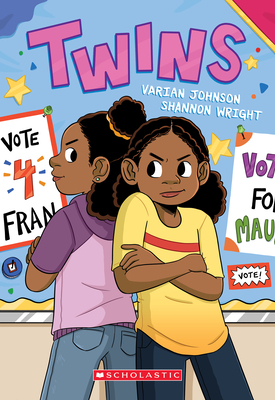
Twins by Varian Johnson, illustrated by Shannon Wright (9781338236132)
Maureen and Francine are twins who have always been in the same classes, participated in the same activities and had the same group of friends. But sixth grade is different. The girls are in different classes and don’t even spend a lot of time together after school any more. Maureen finds herself hanging out with their friends at the mall but not with Francine, who’d rather be called Fran now. Maureen is struggling with marching for the cadet troop she is part of, so in order get extra credit for her grade, she is encouraged to run for a class office. Fran too is planning to run for president. So the battle grounds are set when Maureen decides to run for president too to prove that she can be just as brave and outgoing as Fran. The problem is that she might not be after all!
In this graphic novel, Johnson, himself a twin, captures the dynamics of close siblings perfectly. The two sisters go back and forth between adoration, supportiveness, strife and anger. It makes for a dynamic book that really looks at the differences between twins, the way feelings get hurt and how that can play out in larger decisions. That difference between the two girls is explored throughout the book, giving it layers and eventually showing how differences can make them both stronger for each other too.
I reviewed this from an unfinished galley, so my copy did not have full-color images throughout. The art throughout the graphic novel shows the relationship between the two girls and their emotions clearly. The pages are filled with diverse characters.
Sure to be popular, this graphic novel appears light but has lots of depth to explore about sisterhood. Appropriate for ages 9-12.
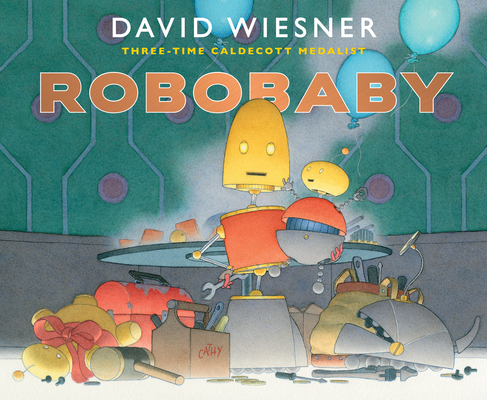
In a world of robots, a family gets a new delivery. Cathode has gotten a new baby brother called Flange. The baby comes in a box, advertising it as a new model. Quickly, Cathode’s parents start to assemble the new baby, but it seems that babies have gotten more complex since Cathode was assembled. The parents call on an uncle to come and lend a hand in building Flange. Though Cathode offers to help, she is pushed to the side as Uncle Manny starts to work. But he doesn’t follow the directions and with some “improvements” and a lack of software updates, it all goes wrong. With help from her dog, Cathode steps in, follows the directions, and does the software updates. Finally, there is a newly assembled baby in the family. But wait, there might be another surprise for this family!
Wiesner has won multiple Caldecott Awards and Honors. This picture book is a bit of a departure from his more serious books, offering a merry look at a robotic land where families are much the same as they are now. Cathode is a great character, undaunted by being ignored and willing to make her own choices. The text is strictly speech bubbles, allowing the illustrations to shine and the pacing to be wonderfully brisk.
The illustrations are done in watercolors that glow on the page, filled with the light of robot eyes and a white glowing floor that lights everything. The comic book framing of the illustrations works well as the action picks up, offering glimpses of what is about to go wrong before it actually does.
An engaging look at robots, STEM and sisterhood. Appropriate for ages 3-5.
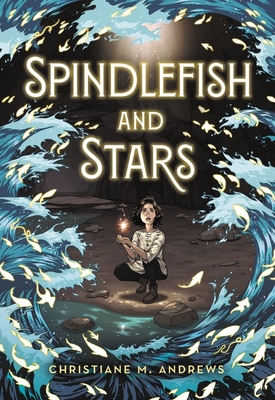
Clo has grown up on the road with her father. They move from village to village, taking small things every time but also repairing and fixing paintings too. When her father doesn’t return one morning, Clo puts their regular leaving plan in action, waiting for him in the woods. But her father doesn’t come, instead sending a boy with a strange ticket and a garbled written message to head to the harbor. There Clo finds she has a half passage aboard a strange ship. They take her to a strange gray island where there are no seasons, no day or night. Clo must wait there for her father to join her. She makes one friend, Cary, on the island where she can’t understand what anyone else is saying except for him. Her grandmother has taken her in, trying to force her to eat a strangely cold and fishy stew that Clo refuses to even try. Her grandmother wants Clo to work, but Clo is busy trying to watch for her father and to figure out the mysteries of the island itself. Clo steadily figures out the mysteries of the island, but it may not be enough to save herself and her father.
Based on Greek mythology, this children’s novel is a marvel of a book. It steadily reveals itself, a puzzle started by an ink-blotched note, a strange transport via ship, and then an even more odd island. One knows there is more going on, but the book holds it back, revealing it to the reader just before Clo herself begins to figure things out. The ties to mythology are dazzling, offering the Fates and Icarus as major characters, though not obvious at first. The pacing here is just right, never losing itself in the grayness of the island nor moving too quickly to resolution.
Clo is a great heroine, braver than many would be in her situation. She is opinionated and stubborn, two qualities that serve her well as she figures out the mysteries of the island and does not bow down to the pressure to conform. Her connection with others serves as a beacon for her to find a way forward, even as it threatens her own existence.
Tantalizing, puzzling and very satisfying, this Greek myth fantasy dazzles. Appropriate for ages 9-12.
Reviewed from e-galley provided by Little, Brown Books for Young Readers.








 Waking Brain Cells