Review: Where Are You From? by Yamile Saied Mendez

Where Are You From by Yamile Saied Mendez

Where Are You From? by Yamile Saied Mendez, illustrated by Jaime Kim (9780062839930)

A little girl is always asked where she is from. She tries to answer by saying “I’m from here, from today, same as everyone else,” but they simply insist that she tell them where she is really from. So the girl asks her Abuelo where she is from. He closes his eyes and gives her an unusual but important answer. He tells her of the varied places that her people come from. They come from wide open land in the Pampas, from brown rivers that give food, from high mountains where condors fly. She also comes from ocean waters, from hurricanes where rain makes tiny frogs sing. She comes from people who were enslaved for the color of their skin, from plazas filled with sadness. But most of all, she comes from love and from the dreams and hopes of her ancestors.

I must admit that I expected a book about the damage of asking that question of children of color. This book surprised and delighted me as it offers children being asked the question a positive way to see their ancestry whether it makes sense to others or not. The answer from the Abuelo in the book is pure poetry, taking readers on a journey through parts of the world and carrying self-acceptance along as an important theme. There is a sense of shared strength in all of the images of places that is embodied in that child.

The illustrations are beautifully rendered with deep colors that shine on the page. The varied landscapes carry readers forward into the story, inviting them to cool off on mountaintops and slow down to float on ocean waves. It is a book that celebrates our world, our cultures and our histories.

Powerful and poetic, this is one that belongs in all libraries. Appropriate for ages 3-6.

Reviewed from library copy.
 

Red House, Tree House, Little Bitty Brown Mouse by Jane Godwin

Red House, Tree House, Little Bitty Brown Mouse by Jane Godwin

Red House, Tree House, Little Bitty Brown Mouse by Jane Godwin, illustrated by Blanca Gomez (9780525553816)

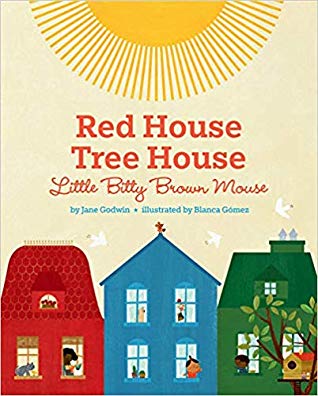
Told in simple rhymes, this book invites the youngest children to explore its pages and engage with the questions asked inside. The book begins with houses, including a little tree house for the tiny mouse. Colors are explored and then there is counting on the next page combined with more colors. The book takes readers on a bus, into the ocean, on all sorts of transportation, and asks engaging questions of the reader along the way. The book ends by inviting readers to look for the mouse hiding in every illustration.

This picture book’s jaunty rhymes are reminiscent of classic children’s books like Go Dog Go! The way that children are invited to engage with the book is wonderful and will help parents new to sharing books with children understand the sorts of questions that can be asked about the images in any picture book. Gomez’s illustrations are full of pure and bright colors that leap from the page, glowing with red, green, blue, orange and pink. The people on the pages are diverse and the urban setting where most of the book takes place is busy and friendly.

Engaging and fun, this book is best shared with only a few children so their perspectives can be heard. Appropriate for ages 1-3.

Reviewed from e-galley provided by Dial Books.

Review: Truman by Jean Reidy

Truman by Jean Reidy.jpg

Truman by Jean Reidy, illustrated by Lucy Ruth Cummins (9781534416642)

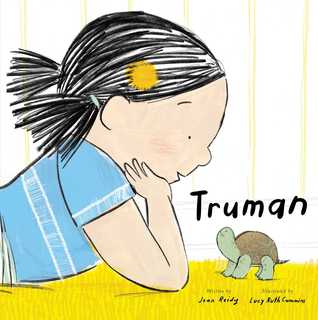
Truman is a small urban turtle. He’s about the size of a donut and lives with Sarah high above the busy streets filled with taxis and buses. He is very happy spending quiet time with Sarah. But then one day, Sarah seems different. She is wearing a bow in her hair, a new sweater and has a big backpack. She even gives him some extra green beans as a treat. Before Sarah leaves, she touches Truman and tells him to be brave. And down on the street, Sarah boards a bus for the first time! Truman tries to wait for Sarah to return, but she is gone much longer than she ever has been before. So Truman finds a way out of his aquarium and makes a long journey towards the apartment door. He is being brave and will find Sarah!

Reidy tells a first day of school story from the point of view of a pet left behind by a child. It’s a wonderful answer to what pets do when children leave for school and will also speak to younger siblings being left behind at home when their older siblings head to school. The emotions of Truman are clearly conveyed and his worry is tangible even though readers will know exactly what is actually happening.

Cummins’ illustrations play with perspective nicely as Truman’s point of view is shared as well as views of the busy city street below the apartment. Big and bold, the illustrations show Truman’s limited world grow bigger and bigger as he explores the apartment landscape alone.

A look at bravery and the deep love of a pet, even a small, green one. Appropriate for ages 2-4.

Reviewed from copy provided by Atheneum Books for Young Readers. 


Looking for Alaska – The TV Show

On October 18th, Hulu will be launching a miniseries version of Looking for Alaska, John Green’s award-winning first novel. Here is the trailer:

Review: Gender Queer: A Memoir by Maia Kobabe

Gender Queer A Memoir by Maia Kobabe

Gender Queer: A Memoir by Maia Kobabe (9781549304002)

This memoir is done in a comic or graphic format. It’s the autobiography of Maia, who uses the pronouns e/em/eir. It tells the story of eir childhood growing up being assigned as a female gender at birth. From loving snakes to peeing outside to taking off eir shirt to go swimming along with the boys, Maia never conformed to gender stereotypes. Eir parents didn’t either, but Maia’s need to not be identified as female ran far deeper. Growing older, Maia had crushes on both boys and girls, and wondered if e was bisexual. Still, Maia had to continue to explore what dating, crushes, love, and sex meant to em until e realized what it meant to be nonbinary and asexual.

Kobabe shares so deeply in eir memoir. It is such a personal journey, filled with moments of deep connection and joy, the agony of pap smears, the constant questioning of identity, and then ending with incredible hope. This memoir was at first written to help eir family understand em, and it will work that way for those wanting to understand being gender nonbinary. It also aids in understanding asexuality and how that impacts relationships. Sex is handled with a refreshing frankness on the pages.

Kobabe’s art is very effective. E does full-page pieces that feature family members and other parts that read as fluid story telling in a more traditional way. These different approaches blend together into a dynamic format that invites readers into Kobabe’s life.

Vital and important, this memoir is tender and impactful. Appropriate for ages 16-adult.

Reviewed from library copy.


Review: Small World by Ishta Mercurio

Small World by Ishta Mercurio

Small World by Ishta Mercurio, illustrated by Jen Corace (9781419734076)

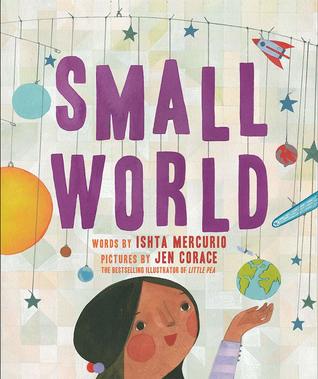
Nanda was born into the circle of her mother’s loving arms. As she grew, her world grew too. It grew to include more circles, branches in trees, blocks, steel, and cogs. Her world got bigger as she traveled to college where she built her own helicopter and then became a pilot. Her world continued to grow as she roared into the atmosphere aboard a space shuttle. She was bigger than she had ever been before when she stood on the moon’s surface and looked at the stars above her and Earth glowing in the sky.

Mercurio’s prose plays with perspective right from the first pages. She also includes shapes and components of engineering into Nanda’s childhood. A girl fascinated with science and engineering becomes an astronaut in this book that offers an inspiring look at a girl who grows up as her world grows around her.

The illustrations play with shapes on every page, from the patterns of trees and their branches to the quilt below plane wings made up of farmland. Even the stars above form circles at the end of the book along with Earth, guiding readers right back to the circle that the book started with.

An inspiring look at a young girl of Indian descent who reaches the stars. Appropriate for ages 3-5.

Reviewed from copy provided by Abrams Books for Young Readers.


Review: Mommy Sayang by Rosana Sullivan

Mommy Sayang by Rosana Sullivan

Mommy Sayang by Rosana Sullivan (9781368015905)

Aleeya lives with her mother in their Malaysian village. She loves spending time with her Mommy, and the two of them do everything together. Mommy also features heavily in Aleeya’s dreams which are filled with flowers and dancing. The two of them plan to always be together like this. But then Mommy gets sick and has to stay in bed. Aleeya is lost without her, but steadily starts to realize that she can be at her mother’s side, just in a different way.

This picture book brings diversity in multiple ways. There is the Malaysian setting that is richly depicted with animals and activity. The family is Muslim and prayers and head-wear are depicted. Then you have the mother get ill. While she does recover by the end of the book, it is rare that you see a mother get bedridden in a picture book and the impact of that loss explored. Here it is fully shown and Aleeya’s response is brave and loving.

The illustrations are rich and filled with color and touching moments between mother and child. Their relationship is at the center of the text and the illustrations. It is not a surprise that the illustrations are captivating, since this is a book in the Pixar Animation Studios Artist Showcase. The talent here really shines.

A lovely look at the impact of a mother, whether she can get out of bed or not. Appropriate for ages 3-5.

Reviewed from library copy.

Review: Look! I Wrote a Book! (And You Can Too!) by Sally Lloyd-Jones

Look! I Wrote a Book! (And You Can Too!) by Sally Lloyd-Jones

Look! I Wrote a Book! (And You Can Too!) by Sally Lloyd-Jones, illustrated by Neal Layton (9780399558184)

A little girl explains to readers what it takes to write a book. First, you need a “Good Idea” that you can get from all sorts of places, including your own brain or staring out of the window. You have to know what you are talking about in your book and also know who you are writing it for. Grandmothers are a very different audience than kids who like dump trucks. Books for babies should not be incredibly scary. Then you must concentrate and create a plan for your book. A good title is necessary too. Start strong and then fill in the middle. The ending comes last. Share the book with friends, revise as necessary. Create a cover and an “About the Author” page. Then start selling your book, perhaps with cookies as an incentive and if that doesn’t work tying a person to a chair. Maybe it’s time for a sequel?

The best part about this book is that it is a combination of complete silliness and also good information about the steps in writing a book. Lloyd-Jones uses zany humor to really get her point across about writing taking time, creativity and a willingness to revise. Still, the book is also about frightening babies, boring grandparents, tying people up, and being interesting along the way.

The illustrations help tell the story with their clever depictions of the little girl’s imaginative stories. Using a mixture of textures and patterns, they also incorporate collage elements as well. The result is a modern and silly mix that suits the book nicely.

Silly and serious all at once, this really is a book about writing a book where you will giggle along the way. Appropriate for ages 5-7.

Reviewed from e-galley provided by Schwartz & Wade. 

Review: For Black Girls Like Me by Mariama J. Lockington

For Black Girls Like Me by Mariama J. Lockington

For Black Girls Like Me by Mariama J. Lockington (9780374308049)

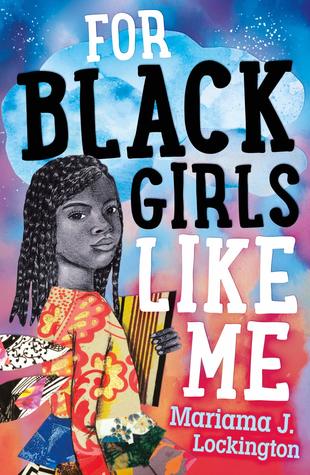
Keda sometimes feels like an outsider in her own family. She is adopted and the only member of her family who is African American. Moving to a new city across the country and to a new school, Keda has to leave behind her best friend who completely understands her. Keda’s parents are both classical musicians, though her mother hasn’t been even practicing her violin lately. She tends to have spells where she can’t get out of bed mixed with other times filled with lots of energy and projects. Keda feels a lot of pressure to take care of her mother, often not sharing the microaggressions she suffers at school or the racist names that others are calling her. When Keda’s mother finds out about the name calling, she pulls Keda and her older sister out of school entirely to be homeschooled. But her mother doesn’t consistently teach them, placing Keda into a girl scout troop for the summer where more racial incidents happen. As her mother’s condition worsens, Keda finds herself often alone with her mother at home trying to figure out how to help and not make things worse.

Lockington vividly tells the story of a tween who struggles to make her personal needs known to a family who doesn’t experience the world in the same way due primarily to race. The book is told from Keda’s perspective which gives it a strong voice and makes the aggression she receives feel very personal to the reader. Just telling the story of an adoptive child who is pre-teen, African-American, and in a loving but struggling home is important. The subjects of microaggressions and racism are told in a straight-forward and unflinching way that will allow readers of all races to understand the impact and pain they cause.

Keda’s character is resilient and smart. She is often struggling with huge issues from racism to mental illness. Yet she doesn’t ever give up. She stands up to bullies and racists, tries to protect her fragile mother from knowing about the hardships happening to her, and then works to care for her mother and protect her father. She is immensely alone in the book and yet always looking for a way forward.

An important and very personal story of adoption, race and strength. Appropriate for ages 10-13.

Reviewed from e-galley provided by Farrar, Straus & Giroux.