Mud Book by John Cage

Mud Book by John Cage

Mud Book: How to Make Pies and Cakes by John Cage and Lois Long (9781616895525, Amazon)

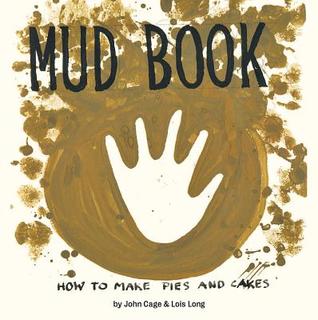
This book dates from the 1950s. Created by avant-garde composer Cage and artist Long, this book looks at mud pies as one of the first creative and maker experiences of children. The book is presented as the simplest of cookbooks. It begins with a recipe for mud pies that involves dirt, water and sunshine. There are tips on what to do if your mixture is too wet too. The book then turns to a much more complicated recipe for mud layer cake that involves pans, rocks and more. Exactly what any youngster needs to design their own pies and cakes into masterpieces.

This book shows the joy of playing in the mud and dirt. The illustrations by Long are filled with dabs and dribbles of muddy color, looking exactly like dirt on the page. There’s a looseness to the illustrations that plays nicely against the instructions which are serious in tone and still inviting for exploration.

This is a joy of a book that is part art and part how-to manual and all fun. Appropriate for ages 2-4.

Reviewed from library copy.
Sophie Someone by Hayley Long

Sophie Someone by Hayley Long

Sophie Someone by Hayley Long (9780763689957, Amazon)

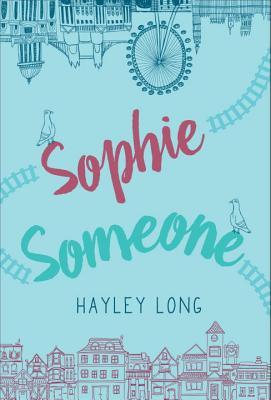
Sophie can vaguely remember leaving England on a train with her mother when she was a small child. Now Sophie is fourteen and her family has been in Belgium since they left England. She attends school, has a best friend and knows how to speak several languages. Her father owns a car service station, she has a new little brother born in Belgium and things seem normal. But her mother won’t leave the apartment and a strange man comes to her father’s shop and calls him by a different name. As Sophie starts to piece things together, she will have to travel back to England to figure the entire puzzle out and find out who she truly is.

Long has written this novel for teens in code as Sophie tries to stop anyone from publishing her story if they find it. The coding is a fascinating layer to the story, creating a puzzle for the readers even as Sophie is unravelling her own. Readers will grow better and better at figuring out the code, allowing the story to shine through the puzzle. The writing beyond this layer is deft and the mystery is incredibly rich. Readers will be able to figure it out before Sophie does, but questions linger that continue the riveting nature of the novel.

Sophie herself is a strong and smart heroine. As she pieces the mystery together, she uses her intelligence but also has a strong streak of optimism and hope as she faces the truth about her family. Her ability to not only face the unknown but seek it out and discover things is noteworthy. Even as she discovers that she is not the person she thought she was, Sophie does not fall apart. She faces the future with a new clarity and understanding.

An unusual and fascinating novel, it grips you right from the beginning and won’t let you loose until the final pages. Appropriate for ages 13-15.

Reviewed from ARC received from Candlewick Press.


2017 Edgar Award Winners

The winners of the 2017 Edgar Awards have been announced. The two award winners for juvenile categories are:

BEST JUVENILE

OCDaniel

OCDaniel by Wesley King


BEST YOUNG ADULT

Girl in the Blue Coat

Girl in the Blue Coat by Monica Hesse


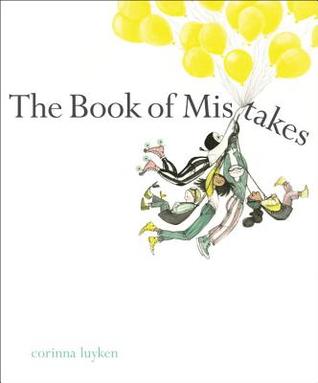
The Book of Mistakes by Corinna Luyken

The Book of Mistakes by Corinna Luyken

The Book of Mistakes by Corinna Luyken  (9780735227927, Amazon)

One mistake in the drawing of a girl leads to new choices and changes. Making one eye bigger than the other was a mistake, so was making the other eye even bigger, but the glasses were a good idea. Other mistakes are covered by elbow patches and a lacy collar. Strange animals are turned into nice rocks. The girl with the long leg looks good climbing the tree. The other girl needs roller skates to fix the spacing with the ground. On and on, the mistakes continue showing the artistic process when you incorporate mistakes into your work rather than giving up, creating something really special.

Luyken demonstrates the way artists of all ages can use mistakes to inform their work rather than starting again or stopping altogether. The text is simple and funny, showing the frank acknowledgement of errors and then showing what good decisions can result out of the oops. The artistic process is on display here, inviting readers to explore their own artistic journeys.

The art plays a central role of course and the art is wonderfully quirky as characters emerge with lanky limbs, big eyes, and helmets. As the story pulls back from the central character, there is an intricate image filled with more children, fabric, ropes, ladders and balloons. The images pull back farther, showing even more of an inventive landscape in an unexpected place.

Creative, inviting and a gorgeous book to explore, this picture book will have everyone trying art even if they make mistakes. Appropriate for ages 4-6.

Reviewed from ARC received from Dial Books for Young Readers.


This Week’s Tweets, Pins and Tumbls

Here are some cool links I shared on my Twitter, Pinterest, and Tumblr accounts this week:

CHILDREN’S LIT

Andrea Davis Pinkney on Connecting the African American and Jewish American Experience – First Book Blog

Board Book Roundup: Spring 2017 Edition — The Horn Book

Jason Reynolds: From Kid Poet to Award-Winning Author

Ludacris Rapped A ‘Llama Llama’ Book And It Was Epic

A Mighty Girl recognizes with 40 Mighty Girl stories about the Holocaust:

TEEN LIT

“I think of ‘Always and Forever, Lara Jean’ as dessert.” Jenny Han on the end of her YA trilogy

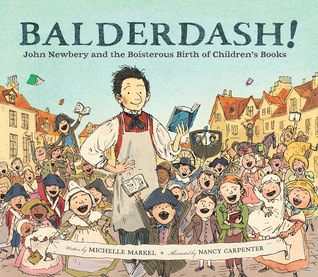
Balderdash by Michelle Markel

Balderdash by Michelle Markel

Balderdash!: John Newbery and the Boisterous Birth of Children’s Books by Michelle Markel, illustrated by Nancy Carpenter (9780811879224, Amazon)

This picture book biography is the story of John Newbery, the man who first created books for children in the 18th century. Books were popular in London at the time, but all of the fun books were for adults. Children had to read poems and fables that were dull and taught them about social niceties. John Newbery grew up to be a publisher and realized that children needed different books. He created a book that was filled with fantasy and games and then he made it very attractive and paired it with a toy. Next came a magazine for children and eventually a novel. The books were written anonymously but all were sold and printed by Newbery himself, the man who created children’s literature.

Markel has captured the feel of the creativity and wildness of someone who decided to make a major change in the world. The text here is celebratory of the new discoveries and new chances being taken in books. Markel points out all of the positives about Newbery’s book and avoids noting that his books don’t bear any resemblance to children’s books of today. Rather, the focus is on the invention, the cleverness of the marketing and the popularity of children’s books from the very beginning.

Carpenter’s illustrations are filled with pizzazz. They have a great energy about them, depicting the bustling streets of London, the desirability of the books, and even showing sad children with real humor. She uses slightly turned pages to show other images underneath along with speech bubbles. The text of the book is also playful, moving through different fonts and text sizes for emphasis.

A glimpse of the earliest children’s books, this historical picture book biography is a pleasure just as Newbery’s were. Appropriate for ages 6-9.

Reviewed from copy received from Chronicle Books.

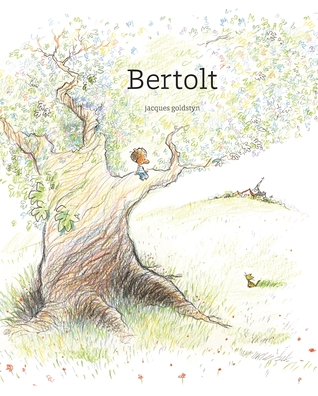
Bertolt by Jacques Goldstyn

Bertolt by Jacques Goldstyn

Bertolt by Jacques Goldstyn (9781592702299, Amazon)

Told in the voice of a young boy who is different from the others around him. He doesn’t mind wearing different colored gloves after he can’t find his lost one. He enjoys being alone most of the time, unlike the others in his town. His favorite place to be alone is in a huge oak tree that is named Bertolt. The boy spends his days up in Bertolt’s branches, weathering storms together, making friends with the animals and birds that live in the tree. The boy looks forward to spring when Bertolt’s leaves will return and become a splendid green shelter again. But when the other trees burst into flower and leaf, Bertolt doesn’t. Eventually, the boy must admit that Bertolt is dead, but what does one do when a tree dies? The boy figures out exactly the right thing.

This is a story of an introverted child who doesn’t mind being on his own one bit. As a fellow introvert, I love seeing the depiction of a child who isn’t longing to be included but instead finds real pleasure in his time spent alone. It’s a story of independence and imagination, showing that quiet time alone can lead to creative solutions even when you have lost something you love. The book is touching, warm and celebratory.

The illustrations are lovely with the huge sweeping oak tree filling the page, the branches thick and strong, the leaves aglow with green and light. The fine-lined images capture the boy almost dwarfed by the space around him and yet eagerly also a vital part of the scene. His acorn cap speaks to his connection to nature and set him apart from the people around him as well.

A lovely look at introversion, imagination and the power of being different and embracing it. Appropriate for ages 5-7.

Reviewed from copy received from Enchanted Lion Books.

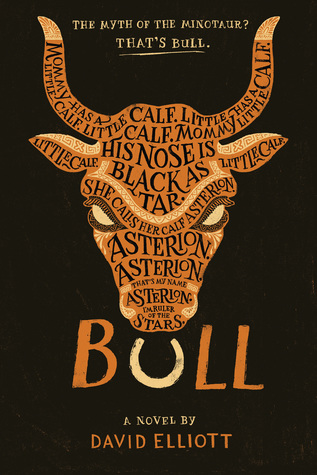
Bull by David Elliott

Bull by David Elliott

Bull by David Elliott (9780544610606, Amazon)

This verse novel takes on the myth of Theseus and the Minotaur. Told with a wild irreverent tone, this novel follows the arc of the original myth faithfully but builds upon it, including points of view from all of the characters. Readers learn about Asterion, the half-bull boy who will become the monster of the labyrinth, in his own voice as he grows up, son of royalty. Poseidon serves as the narrator of the story, taking credit for not only setting the story in motion but also meddling to keep it heading in the direction he wants. Other characters speak too, each in their own poetic form, the structures serving to inform their voice. Even if readers know the myth, this book is impossible to put down as the full story unfolds.

Immediately upon starting this book, the voice of Poseidon demands attention, speaking in a modern vernacular and offering rude commentary, zinging puns, and humor that is shocking and great fun. As narrator, he moves the story along at lightning speed, serving to open the curtain on the play that is afoot, both carnival barker and puppeteer. The use of different forms of poetry is masterful, each serving to show the character as unique. Some are more focused and formal while others wander, only to snapped back by Poseidon and his tale.

Smart, wildly funny and just as naughty as the original myth, this verse novel is no bull. Appropriate for ages 15-18.

Reviewed from library copy.

Me Tall, You Small by Lilli L’Arronge

Me Tall, You Small by Lilli L'Arronge

Me Tall, You Small by Lilli L’Arronge (9781771471947, Amazon)

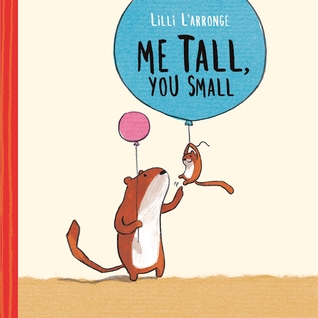
In the simplest of sentences, this picture book shares the special moments of a parent and child as they live their lives together. The two weasels spend time grocery shopping, bathing, eating, playing and sleeping. Throughout, the pair shows a warm love for one another, a playful spirit and a delight in one another’s company. Through these small vignettes, a fuller story is shown, one of parental care and a familial love.

Translated from the original German, this picture book has a distinct European flair that is very appealing. The simplicity of the structure of the book is also a delight, just two pairs of matching phrases such as “Me pause, You pounce” and “You shout, Me shush” and the story is being told. The words are sometimes opposites and sometimes similar. It’s an engaging way to share concepts with children who will immediately recognize their own parents or caregivers in the book.

The illustrations are simple and friendly. Each image shows the two weasels together. Even without mouths to show expressions, the emotions are clear. There is a lovely playfulness about the entire book with the tone firmly set by the illustrations themselves. Who can resist a little weasel with undies on his head?

A warm and lovely testament to family love, this picture book will work well with the smallest of children. Appropriate for ages 2-4.

Reviewed from library copy.