Rules of the House by Mac Barnett

rules-of-the-house-by-mac-barnett

Rules of the House by Mac Barnett, illustrated by Matt Myers (InfoSoup)

Ian loves to follow the rules while his sister Jenny breaks all of them. So when they go on a trip with their father to a cabin in the woods, Ian loves that there is a list of rules on the wall. Jenny though, ignores the rules, breaking each one of them. The final rule is not to open the red door, which Jenny does. Nothing happens. Until later that night, when the mud-tracked bear rug, the dirty bathtub and the empty woodstove come into the children’s room. At first, Ian flees while his sister is captured by the monsters. But he returns to try to help her. But it may mean breaking the rules!

This book is a delight. It’s a riff on classic horror movies as well as Bluebeard with the forbidden door in an isolated house. Barnett keeps the tone light at all times, making sure that the book is just frightening enough to give shivers but not too frightening for young readers. The focus on following rules is turned on its head with the culmination of the story and learning that sometimes rules are meant to be broken in the right circumstances.

The art by Myers is dark and atmospheric. It plays up the horror motif with long shadows, a scratched up red door that looks like things have tried to break in, and objects that look like monsters even before they fully emerge as monsters. The long moment after the door is opened is drawn out even farther by the full double page spread, showing the quiet house. Wonderful timing!

A great just-right scary read for Halloween that is just creepy enough to enchant. Appropriate for ages 4-7.

Reviewed from library copy.
 

They All Saw a Cat by Brendan Wenzel

they-all-saw-a-cat-by-brendan-wenzel

They All Saw a Cat by Brendan Wenzel (InfoSoup)

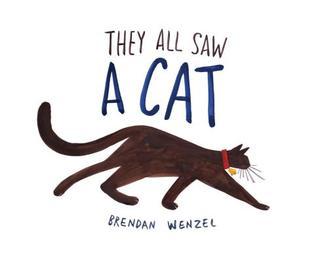
A cat walks through the house and the backyard and is seen by different people and animals in their own unique way. The child sees a very friendly cat, the mouse a terrifying creature with huge teeth, the fish sees a watery figure, the bat sees the space the cat takes up, and the worm sees the vibrations of the cat through the earth. Each creature perceives the cat in a different way. Even the cat itself, as it heads to the water, is about to see itself in a personal way.

This very simple book offers a fascinating look at perception and the ways that each of us sees and views the world around us. The repeating first line of “The cat walked through the world, with its whiskers, ears and paws…” keeps the book clearly focused and adds an important stylistic component. The book also celebrates imagination as children can start to see the unique ways not only they view the world but can imagine the ways that other creatures see the world in such a different way. The idea of perspective is also introduced, particularly from the cat itself, a flea riding in the cat’s fur and the bird flying high above. There is plenty to discuss in this book and it invites investigation and learning.

The illustrations are a critical part of the concept, showing how an insect’s eyes see the world in a very different way. They also capture not only how an animals sees but their relationship with the cat. The dog sees a lean and almost whiplike creature. The fox sees a juicy round animal. This use of both physical perspective and personal perspective is very cleverly and clearly done.

A book to generate discussion, I can see this being used in conversations about differing points of view as well as art classes on perspective. Appropriate for ages 3-5.

Reviewed from copy received from Chronicle Books.


Lucy by Randy Cecil

lucy-by-randy-cecil

Lucy by Randy Cecil (InfoSoup)

Lucy is a dog living on the streets. She has a routine each day where she dashes through the neighborhood and straight to an apartment building with a red door where she waits. Inside Eleanor lives with her father who dreams of being a juggler. Meanwhile Eleanor lowers breakfast on a string to Lucy waiting below her window. Around noon, Lucy settles in for a nap and dreams of the days when she lived in a grand house with her favorite stuffed toy. As the days go on, Lucy’s father tries to perform his juggling before a crowd but gets disastrous stage fright, Lucy continues to gather things to feed her new friend, and Lucy dreams more and more of her past life. As their lives converge together, one thing is certain that one small white dog can change your life!

Cecil’s book comes in four acts, each one building upon the next. The book has a lovely rhythm to it, ordinary days stack upon ordinary days, routines support other routines. It is a gentle way to build a story, a natural progression. And yet this book has a theatrical quality to it as well with each act building on the next, the juggling and subsequent disasters, and the drama of dangling breakfasts. It is a story that is uniquely told in its own time.

The illustrations are a large part of this book with the gangly humans and the compact little white dog that glows on the page. The illustrations have rounded edges, almost as if the reader was looking through a telescope to watch the action. This creates a sense of intimacy in the black and white illustrations.

A very special book about one little dog who seems to have lost everything but still has plenty to offer. Appropriate for ages 4-7.

Reviewed from ARC received from Candlewick.


Home at Last by Vera B. Williams

home-at-last-by-vera-b-williams

Home at Last by Vera B. Williams and Chris Raschka (InfoSoup)

Lester is adopted by Daddy Rich and Daddy Albert, who pick him up with their dog Wincka once the adoption is formalized. They head home, put Lester’s new clothes away. But when Daddy Albert tries to put Lester’s suitcase in the attic, Lester shows them that it is full of his action figures and insists that they have to stay right in the suitcase in his room. Lester is happy during the day, playing with his toys and spending time with his new fathers. At night though, he packs up his suitcase and stands near his fathers’ bed. This happens night after night, despite cocoa and toast, singing songs, and explanations that Lester is safe. Finally, one of the fathers loses his temper with the situation and then Lester really opens up about what he is worried about. A solution to the problem is found by Wincka, the dog, who was listening to Lester’s story too.

This was the book that Williams was working on when she died. Raschka had been involved from the beginning with the book and completed the vision that Williams had shared with him. Williams captures the deep-seated fear that adopted children can have, the understanding at one level of newfound family love but also the change that comes at night where fears become larger. Williams also shows two loving gay men, both delighted to be fathers and each different from the other. The two of them together parent Lester with kindness and concern and deep love.

Raschka finished the book, basing his art on sketches by Williams. His large colorful illustrations have a loose feel that ranges across the page, capturing both the mayhem of a family short on sleep but also the warmth of that family too. His watercolors convey deep emotions from the frustrations of sleepless nights to the power of coming together afterwards. All is beautifully shown on the page.

A tribute to adoptive families, LGBT couples who adopt and the importance of love and patience, this picture book is a grand finale to the many books by Williams. Appropriate for ages 4-7.

Reviewed from copy received from HarperCollins.


Falling Over Sideways by Jordan Sonnenblick

Falling Over Sideways by Jordan Sonnenblick

Falling Over Sideways by Jordan Sonnenblick (InfoSoup)

Claire isn’t having a good year. She is being teased at school by not only a mean girl but by a boy who has been picking on her for years. She loves her dance classes, but her friends are moved into high school classes while she is left behind with the little kids. Her brother is perfect in every way, so Claire has to disappoint all of the teachers that had him once they see her work. Then Claire’s life really turns upside down and sideways when her father collapses at home. Claire is the only one there and has to call 911 and get him help, riding along in the ambulance. Suddenly the father who was always dancing, singing and joking can’t do any of those things anymore. As Claire’s life really starts to fall apart, Claire has to figure out how to see the humor in it all again for both herself and her family.

Sonnenblick has returned with another of his amazing teen novels. As always, it is written with incredible skill. He manages to take tragic scenes and make them very funny, even those in emergency rooms. He also takes great moments of humor and gives them incredible heart as well. Throughout, there are tears and laughter that mix in the best possible way. The writing is intelligent and screamingly funny, giving readers the chance to see the humor in it all long before Claire realizes that it is still OK to laugh.

Claire is a very human protagonist with her own sense of humor and ability to laugh at herself. She is also flawed, sometimes self involved and other times seeming to be selfish just because she is protecting herself from hurt. Her relationships with family and friends are richly drawn in the novel, including those with people she is figuring out how to deal with. While things aren’t magically fixed (thank goodness) Claire herself manages to solve many of the problems herself.

A pure joy of a novel filled with pathos, tears and lots of laughter. Appropriate for ages 11-15.

Reviewed from ARC received from Scholastic.


This Weeks Tweets, Pins & Tumbls

Woo hoo! Broke 11,000 tweets shared on Twitter!

Here are the links I shared on my Twitter, Pinterest, and Tumblr accounts this week that I think are cool:

I tried everything to get to sleep last night. Well, everything except closing…:

CHILDREN’S BOOKS

“Book talking by the stack opens up so many possibilities” – Read more over on the :

Bringing It ‘Home’: Chris Raschka Completes Vera Williams’s Final Book

Disney Announces New Rick Riordan Imprint

Gloriumptious, word-guzzling genius of Roald Dahl

Heathy diet linked to improved reading skills in children

Here Are Some of the 18th Annual Intl Latino Book Awards Winners

How Diverse Is Children’s Literature? This Infographic Tells The Disturbing Truth

My Favorite Read-Aloud Books Right Now: September 2016 – GeekDad

Never stop reading aloud to your kid

Reading Aloud Will Create a Better Reader · Guardian Liberty Voice

Residential school memoir set to become new Canadian children’s classic

Scrumdiddlyumptious to Oompa Loompa: Roald Dahl’s splendiferous words are now in the Oxford dictionary

Temple Grandin Inks Deal With Penguin Young Readers

This Boy’s Dream Of Being A Princess Inspired An Innovative Kids’ Book

Transgender Books for Kids and Teens

‘Trombone Shorty,’ 4 others receive $250,000 Heinz Awards

LIBRARIES

First Woman, African-American Sworn In as Librarian of Congress

How you can help India’s first free public library for the Tibetan exile community

Pew Research Shows Public Libraries Remain Vital to Communities

"Reading forces you to be quiet in a world that no longer makes place for that."…:

TEEN READS

8 Book Recommendations From an Unexcitable Reader

Challenge your perceptions with these 9 groundbreaking YA novels

Graphic novels that grab you — The Horn Book

YA author Amy Zhang: My books are there so people won’t feel they’re alone –

YA Books with a Male Point of View – The Hub

Young adult authors stress importance of strong stories

What a Beautiful Morning by Arthur A. Levine

What a Beautiful Morning by Arthur A Levine.jpg

What a Beautiful Morning by Arthur A. Levine, illustrated by Katie Kath (InfoSoup)

When Noah visits his grandparents, Noah and his grandfather start the day with a song. They head outside with the dog even if its raining, singing all the way. At breakfast they made plans for the day. But lately, Grandpa has been forgetting to ask about making plans. Then one day when Noah woke him from a nap, Grandpa didn’t know who he was. His Grandma explained that sometimes Grandpa got confused and that it was better to focus on what he still had rather than what he lost. So Noah set out to do the things alone that he had done with his grandfather, until he discovered that Grandpa still responded to music and songs. It was a way to start once more having special mornings together.

This book is so beautifully done. It is about the very special relationship that children have with their grandparents, the delight of staying with them, and how each morning can be special just because someone cares for you and spends time with you. It is also about the power of music to connect people and experiences as well as its special quality with those suffering from Alzheimer’s or dementia. Throughout, the character of Grandma is there, at first secondary to the strong relationship between grandfather and grandson and then stepping up to fill some of the gaps left behind. She is warm and loving and very special.

Kath’s illustrations are bright colored and friendly. When Grandpa is confused or feeling separate, she uses a visual device to indicate the change by having his face lose color. If he is particularly confused, the colorlessness spreads on the page, taking up his entire body. In this way, children will see visually the change coming over Grandpa and understand that it is deeply affecting him and his personality.

It is rare that I tear up when reading a picture book, but this book is particularly moving. Have tissues ready. Appropriate for ages 3-5.

Reviewed from library copy.

A Child of Books by Oliver Jeffers

a-child-of-books-by-oliver-jeffers

A Child of Books by Oliver Jeffers and Sam Winston (InfoSoup)

This striking picture books tells the story of a young girl who loves to read, who is “a child of books.” She meets a boy who seems lonely, his father only reading the newspaper and ignoring the sea of words from fiction swirling around them. She leads the boy off on an adventure of stories. Down rabbit holes, up mountains, through dark tunnels, into fairy tale woods, past monsters in castles, into the clouds for bedtime stories, and much more. They return home, to a bright colored house on a gray street, and the boy leaves with a book under his arm trailing words behind him.

My description above doesn’t capture the beauty and wonder of this picture book. Jeffers’ poetry looks deeply into our relationship with fiction. Into the joy of discovering new adventures of heading down rabbit holes that other readers’ feet have merrily disappeared down before yours. He celebrates the shared language of story, the shared settings of tales, and the shared experiences that we have all had, separately but also together.

The illustrations are unique and very special. The merger of the painted characters with amazing typeface art is dynamic and original. It slows you down, naturally asking you to read the words that the mountains, clouds, and forest are made from. If you do, you discover old friends hiding there, beautiful words from classic children’s books. They invite you to read more, to rediscover those books of your childhood or introduce your favorites to your children. By the end of the book, I was slowly reading each word in the illustrations, lingering and sighing contentedly. My day slowed and enriched by memories.

Beautiful and luminous, this picture book is rich and unique. Appropriate for ages 3-5.

Reviewed from library copy.

Wonderfall by Michael Hall

wonderfall-by-michael-hall

Wonderfall by Michael Hall (InfoSoup)

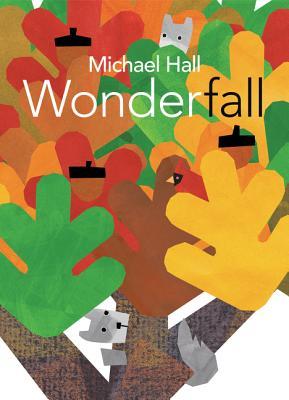
In a series of poems, this picture book celebrates the changing seasons through the experience of a tree. First in the greenness of summer, the acorns start to fall from the oak tree. The yellow school bus arrives and the tree’s leaves start to change. Harvest time arrives, parades march past, and Halloween comes.The leaves start to fall, Thanksgiving comes and children play in the piles of leaves. Wind arrives, taking most of the leaves off the tree and its time to rake. No leaves left, the tree stands bare until snow comes with the new winter season.

Hall celebrates the autumn season with this picture book that encompasses the very beginning signs of autumn all the way through to full winter. The focus on a single tree as the one experiencing the changes works well, particularly with the vivid changes that the tree goes through itself. It is also interesting to see trees as witnessing what humans do just as they watch the activities of the squirrels on the ground and in their branches. The book ends with information on animals seen in the book and how they prepare for winter.

The illustrations are signature Hall with bold shapes done in collage. The leaves are oversized and glorious, full of bold colors and the size of branches. They enliven the page no matter their color, making the winter pages when they are gone all the more cold and barren.

Simple and poetic, this is a great new pick for fall story times and units. Appropriate for ages 3-5.

Reviewed from copy received from Greenwillow Books.