Review: North: The Amazing Story of Arctic Migration by Nick Dowson

north

North: The Amazing Story of Arctic Migration by Nick Dowson, illustrated by Patrick Benson

This poetic look at the amazing Arctic starts with the deep winter and the few animals who survive there year round.  Then spring comes to the Arctic and the sun comes back along with some warmth.  Plants start to appear from under the snow.  Soon more animals will arrive.  The first to head out on their journey are the gray whales, that swim from Mexico to the Arctic Circle.  Birds head north too in flocks.  Herds of pregnant caribou journey north, followed closely by the gray wolves looking for weakness.  Walrus, narwhal, schools of fish, all of this life crowds the Arctic summer until the weather turns cold and brutal again, and once more they head back around the world.

Dowson’s words are poetry in this book.  Not only written in verse form, they also speak to the soul of the Arctic, the beauty of the place and the glory of the creatures who live there.  At the same time, the words are scientific and filled with information about the place and the animals.  It is an elegant combination of poem and fact.

Benson’s art is striking.  He created paintings that are both natural and accurate but also have a sense of artistry.  Much of the art is about the landscape, the place itself and the grand amount of space there.  The illustrations of bitter winter are cold and bleak with dim, gray light.  Then the reader turns the page and it is spring with its lemony light and sprigs of green.  The change is striking to the reader and beautifully captured.  There are moments like this throughout the book.

A striking mix of poetry, art and science, this book will speak to a range of different children looking to understand their world a little better.  Appropriate for ages 5-7.

Reviewed from library copy.

Thomas Locker Dies


Thomas Locker, an author and children’s book illustrator, died on March 9th at the age of 74.  He began his career as a landscape painter in the 60s.  He didn’t start working on children’s books until the early 80s. 

Those familiar with his work will see the continued influence of his landscape painting in his books.

This Week’s Tweets and Pins

Here are the links I shared on my Twitter and Pinterest accounts that you might find interesting:

Bookshelf – Poetry – NYT – some great new poetry books for children – http://nyti.ms/Ap7C4k

Cassandra Clare To Write ‘The Dark Artifices,’ A Fantasy Series Set In Los Angeles http://huff.to/w02Wk8 #yalit

It’s all kidlit now, and that’s just fine – The Globe and Mail http://bit.ly/wwfYp5

My Hunger Name is Blight Nibbleton. I was killed in the 34th Hunger Games by crippling ennui:

hunger game names

‘Hunger Games’ Producer Nina Jacobson on the Journey from Page to Screen http://bit.ly/xvTy6v

Lauren Oliver on Romance, Blogging, “Delirium” & “Pandemonium” : The Childrens Book Review http://bit.ly/yynohn #yalit

Modern children’s books help families explore diversity http://bit.ly/xHcJdr

Parents too busy to read bedtime stories to their kids: Study – Lifestyle – DNA http://bit.ly/ykAksQ

Retweet of My love for Sophie Blackall’s work overfloweth after watching this video: http://vimeo.com/36116772

Pottermore finally vanquishes technical obstacles to open access | http://guardian.co.uk http://bit.ly/zGQ650

Remembering ‘A Wrinkle in Time’ 50 years after it won the Newbery Medal – The Washington Post http://wapo.st/x5Dgq8

Rightsholders Group to Charge Libraries for Reading Books to Kids http://tnw.co/ymhOVO

To Ensure a Bright Future, Your Teen Needs to be Reading – Scoop San Diego: Home & Family http://bit.ly/z1kJt0

Westerfeld’s Uglies continues in manga form: Shay’s Story – Boing Boing http://bit.ly/AkW2LR

What came before "The Hunger Games" – The Hunger Games – http://Salon.com http://bit.ly/wy4kSY

Review: Outside Your Window by Nicola Davies

outside your window

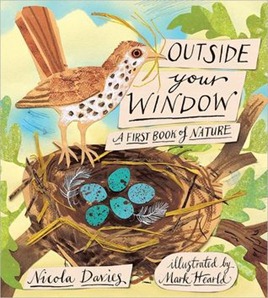
Outside Your Window: A First Book of Nature by Nicola Davies, illustrated by Mark Hearld (InfoSoup link)

Explore nature through the seasons in this lush book of poetry that starts with the first moments of spring with melting icicles and the green shoots of bulbs.  Summer is filled with butterflies, chickens, baby birds and bees.  Autumn comes with leaves, wind, geese and acorns.  And winter ends the year filled with snow, deer and ducks.  The poems range from merry verse with lighter tones to atmospheric pieces that make you stop and think.  It is this range of moods and depth that makes the book so very readable and enjoyable. 

Davies’ poems are all very child friendly, offering new perspectives on familiar things.  Her poem, “Night”, is one of my favorites of the book, though there are many to choose from that are incredible reads.  It capture the movement of the night, the feel of the quiet, and the sense of the world turning beneath you.  It’s quiet, beautiful, and captivating.

Add to these dynamic poems the art of Hearld and you have a real jewel of a book.  Illustrated with collage that combines paper cutout work, layers of texture, and realistic depiction of nature.  This realism emphasizes the beauty of nature, its diversity, and our own place in the world.  These are images that make you dream but also put your feet squarely on the earth and your connection to it.

Gorgeous illustrations combine with vibrant poems, creating a book to treasure.  Appropriate for ages 7-10.

Reviewed from library copy.

Review: Z Is for Moose by Kelly Bingham

z is for moose

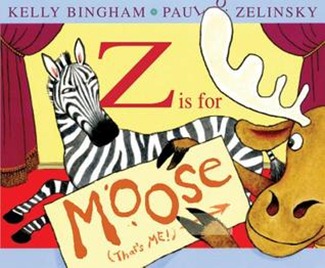
Z Is for Moose by Kelly Bingham, illustrated by Paul O. Zelinsky

If you are looking for an alphabet book with more than a bit of nonsense, this is the one for you!  I happen to be a huge fan of alphabet books that play around, add humor and have plenty of twists.  If you are looking for a straight-forward ABC book, the title alone should be enough to have you looking elsewhere.  For those of you as silly as I am, continue on!  Zebra is in charge of the ABCs happening in the right order on stage.  Unfortunately, Moose doesn’t want to wait his turn.  He enters on D, knocking Duck away, messes up Elephant’s entrance too, gets his head in the way for Hat, pops out of the pocket for Kangaroo, and continues to be silly for Lollipop too.  But the insult truly comes when they decide to go with M is for… Mouse.  Now Moose is upset and rampages through P and Q, drawing scribbles on R and S.  Zebra tries to stop him, but ends up messing things up himself until the happy ending at Z. 

Bingham’s writing is filled with asides from the different animals.  The book is extremely funny, the pacing is brilliant, and the twists are unexpected.  There is a great tension built up as the letter M approaches, and then with the twist, it is pure genius. 

Zelinsky’s illustrations add to the mad gaiety of the book.  Moose is obnoxious but also charming, his emotions clear on his face.  The reaction of Moose as M passes him by is delightful, the rampage of destruction is great fun, and his scribbling is clever. 

It is clear that this is a book that was pure fun to create, since that is apparent on every page.  Impossible to read without laughing and grinning, this is an alphabet book that is sure to delight.  Appropriate for ages 4-6.

Reviewed from library copy.

Review: Moonlight by Helen V. Griffith

moonlight

Moonlight by Helen V. Griffith, illustrated by Laura Dronzek

Rabbit waits for the moon to appear out of the cloudy skies, but leaves a bit too soon to see the moon emerge.  The moon shines its buttery light into space and onto the earth.  It covers the mountains, the trees, enters the water, and even enters Rabbit’s burrow, making his dreams fill with the light.  He wakes up, leaves his burrow and dances in the field with the butter of the moon on his head.  

This picture book is a poetic look at moonlight as butter, continuing the metaphor throughout the book.  While some may quibble about moonlight being as yellow and thick as butter, there are nights where the light is so yellow that it almost has a weight.  Those full moon nights are buttery and rich, filled with that light that is so very different than sunlight.  Griffith embraces the metaphor entirely, enriching moonlight with her buttery idea. 

Dronzek’s illustrations really make the metaphor work in the book.  Readers can see the butter of the light as it coats the entire forest.  They can see it coat Rabbit and his dreams, along with the flowers, grass and the entire world.  She has chosen her yellow with care, selecting a color that skims between butter and moonlight. 

A bedtime book that embraces butter, this book could be used to teach about metaphor or could be used with even very small children as a solid bedtime read.  Expect hunger for buttery pancakes in the morning!  Appropriate for ages 2-4.

Reviewed from library copy. 

Review: The Boy Who Harnessed the Wind by William Kamkwamba

boy who harnessed the wind

The Boy Who Harnessed the Wind by William Kamkwamba and Bryan Mealer, illustrated by Elizabeth Zunon

This picture book version of the nonfiction book manages to translate the story of William Kamkwamba with clarity and inspiration.  When a drought hit his village in Malawi in 2001 and 2002, 14-year-old William and his family were in real danger of starving.  William had always through about machines and even after he was forced to leave school due to the drought, he kept reading books about them.  He thought about what could be done with a windmill in his village, bringing light and water.  So he hunted through the junk yard and found pieces to use.  Built entirely out of scraps, his first windmill and its electric wind brought electricity to the valley.   The afterword gives more details about William’s story and how it took him longer years to bring his dream of pumping water to fruition. This inspirational story speaks to the inventor, the doer, and the dreamer in all of us.

The writing here is lovely.  The imagery is impressive, such as comparing the windmill to a “clumsy giraffe” and giving William’s sorrow at having to leave school a physical sense: “alone with the monster in his belly and the lump in his throat.”  The book carefully captures what life in Malawi was like and what little could be done to make a difference before transforming into a book where dreams create change.  

Zunon’s illustrations are exquisite.  They are a captivating mix of painting and collage.  Filled with texture, the textiles of the clothing come to life and the objects have weight and feel.  The most impressive are the faces of the people, filled with light.  The faces become the place your eyes go first, making the message of the book just that much stronger in a subtle but powerful way.

A luminous picture book version of a compelling real-life story, this book should inspire others to not only dream but to make those dreams happen.  Appropriate for ages 7-10.

Reviewed from copy received from Dial Books for Young Readers.

Gideon by Olivier Dunrea

gideon gideon and otto

Gideon by Olivier Dunrea

Gideon & Otto by Olivier Dunrea

Gideon is the newest fowl in Dunrea’s farmland.  He is a gosling who loves to play, hates to nap, and has a favorite toy, an octopus named Otto.  In the book bearing just his name, Gideon is hard at play and refusing to listen to his mother call him for his nap.  He just keeps racing on to the next thing to play with.  Readers who are paying close attention will notice that he starts slowing down towards the end of the book, just before he falls asleep all on his own.  In Gideon & Otto, Gideon is once again hard at play on land and in the water.  Otto participates happily, listening when books are read aloud, hiding in the leaves, and even bobbing in the water.  When Gideon sets Otto aside to play more, he instructs Otto to stay there.  But in the midst of playing, Otto gets knocked down and then disappears.  Gideon is about to give up when Otto appears again.  Filled with appeal, these books are jolly additions to Dunrea’s menagerie.

Toddlers and their parents will immediately recognize moments out of their own days here.  From being too busy to nap to losing a beloved toy, these moments are what create the tapestry of young lives.  Told with a wonderful humor, zinging with speed and action, these books beg to be shared.  In fact, when I was curled up to read them to myself, my 10-year-old appeared and insisted that he be read them aloud.  There is such charm to just the covers and even more inside the pages.  These are small books that are very rich.

Perfect for busy toddlers who need some time to slow down a bit.  Appropriate for ages 2-4, or for 10-year-olds who need a cuddle too.

Reviewed from library copies.

IBBY 2012 Short List

The International Board on Books for Young People has announced the short list for the 2012 Hans Christian Andersen Award.  The award is given biennially “to a living author and illustrator whose complete works have made lasting contributions to children’s literature.”  The winners will be announced on March 19th at the Bologna Children’s Book Fair.

The Author Finalists are:


Maria Teresa Andruetto (Argentina)


Paul Fleischman (US)


Bart Moeyaert (Belgium)


Jean-Claude Mourlevat (France)


Bianca Pitzorno (Italy)


The Illustrator Finalists are:


Mohammad Ali Beniasadi (Iran)


John Burningham (UK)


Roger Mello (Brazil)


Peter Sis (Czech Republic)


Javier Zabala (Spain)