The Three Billy Goats Gruff by Jerry Pinkney

The Three Billy Goats Gruff by Jerry Pinkney

The Three Billy Goats Gruff by Jerry Pinkney (9780316341578, Amazon)

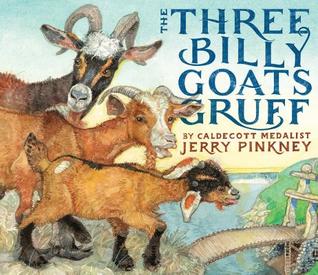
Pinkney continues his foray into classic folktales with this new book. With its focus on fooling a bully, this is a timely tale to tackle. Pinkney uses great skill to whittle the text down to exactly what is needed to carry the story forward. The book is not a reinvention of the original tale, but instead a focused version of the original that will have children cheering the brave goats. Pinkney does add a nice touch to the end with the troll getting harried himself and then rejected in a clever mirror of what he did to the goats.

The illustrations from this Caldecott winning artist are exceptional as always. Pinkney uses pencil and watercolor to create his rich illustrations that have small details, large landscapes and animals. The goats are winsome and courageous while the troll is a vile green with long toenails, tusk-like teeth, and rotting fish and fish skeletons around him.

Another must-have for every library by a master author/illustrator. Appropriate for ages 3-5.

Reviewed from library copy.
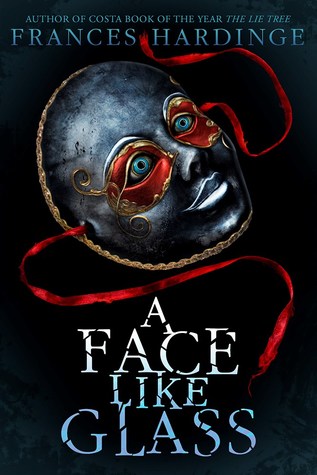
 

A Face Like Glass by Frances Hardinge

A Face Like Glass by Frances Hardinge

A Face Like Glass by Frances Hardinge (9781419724848, Amazon)

Neverfell was discovered as a child in the depths of Grandible’s cheese caverns. She had no memory of where she came from and for the next seven years spent her time solely with Grandible who insisted that if they did have a rare visitor that she cover her face. Neverfell knew she was hideous in some way, so she complied. Then one day, she discovered a way out of Grandible’s caverns and into the larger world of Caverna, a subterranean city whose wealth came from the magical items that could be produced there, like Grandible’s cheeses, perfumes that would make you irresistible and wines that could alter memory. Neverfell found herself in a world of people with faces that were taught and learned and that did not express the emotions they were feeling. Neverfell’s own face though did not do that, her expressions shifted with her feelings, something that made her unique and valuable, but also a threat.

This book was nominated for the Carnegie Medal in 2013 and has finally made its way to the United States. A new book from Hardinge is always a treat with her impressive world building and immense creativity. Entering Caverna is an adventure and the details and wonders found inside are wildly inventive and amazing. There is an intense richness to the writing, one that serves to suck you deep into the caverns and not want to emerge again for a long time. Hardinge mixes so many elements here that it’s amazing that it continues to be a story that not only makes sense but is entirely riveting.

Neverfell is an incredible protagonist and unique in the story. Still it is the world building here that kept my attention throughout the book. From the dark corners of cheesemaking to the green satin of the wealthy of society, from the menace of a master thief to the dominion of those who will retain power at all costs. From the insanity of the man who will not sleep to the slavery of the drudges. It is so complicated and so incredibly well done.

A masterpiece of fantasy writing, this book is rather like the True Delicacies of the novel, something that may change your life forever. Appropriate for ages 11-15.

Reviewed from library copy.

I Got a New Friend by Karl Newsom Edwards

I Got a New Friend by Karl Newsom Edwards

I Got a New Friend by Karl Newsom Edwards (9780399557019, Amazon)

A little girl gets a new puppy and the two of them work to become friends. At first the puppy is scared, but she quickly becomes more friendly. The two play outside together, nap on the chair after making a mess, and sometimes get stinky. The puppy gets lost and then found again. They get dirty and wash up. They make noise and give tons of kisses and hugs.

Edwards uses frank and simple text to tell the story of the two new friends in this book. The little girl narrates the book and tells it from her point of view. The illustrations though show the entire story which is that she is getting just as dirty as the puppy, making just as much noise and eating just as sloppily. This clever twist adds to the pleasure of reading the book and will be enjoyed by young readers.

A warm welcome to a new pet, this picture book is a celebration of newfound friends. Appropriate for ages 2-4.

Reviewed from e-galley received from Edelweiss and Knopf Books for Young Readers.

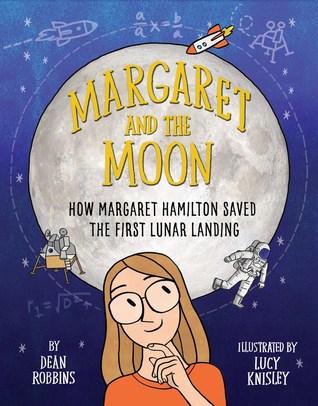
Margaret and the Moon by Dean Robbins

Margaret and the Moon by Dean Robbins.jpg

Margaret and the Moon: How Margaret Hamilton Saved the First Lunar Landing by Dean Robbins, illustrated by Lucy Knisley (9780399551857, Amazon)

This nonfiction picture book tells the story of Margaret Hamilton and her work on computers. When Margaret was a girl in the 1930s and 1940s, she wondered why girls weren’t studying science and math, so she did. She went to MIT and started working on computers back when they required handwriting code and the computers filled entire rooms. She eventually went to NASA where she programmed computers to help astronauts travel to the moon and connect to one another in space. When Apollo 11 came and astronauts were going to land on the moon, Margaret wrote the programs to get them there and back safely. In fact, when disaster struck it was Margaret’s programming that kept everyone safe and accomplished the goal.

Robbins writes with a celebratory tone in this biographical picture book. His appreciation for Margaret’s ability to ask tough questions and figure out answers is clear. Throughout, he keeps the tone playful and light, showing the hard work behind the accomplishments, and her inquisitive nature as the keys to her success.

It is great to see graphic novelist Knisley illustrating children’s books. Her illustrations match the tone of Robbins’ writing, keeping the entire book light and celebratory. The amount of work done by Margaret is staggering and is shown by Margaret next to a pile of papers that showed the length of her code. That same image is repeated as a photograph at the end of the book.

A wonderful example of women in STEM, this picture book speaks to the power of brains and determination. Appropriate for ages 6-9.

Reviewed from e-galley received from Edelweiss and Knopf Books for Young Readers.

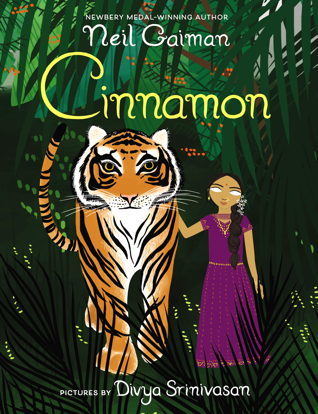
Cinnamon by Neil Gaiman

Cinnamon by Neil Gaiman

Cinnamon by Neil Gaiman, illustrated by Divya Srinivasan (9780062399618, Amazon)

A princess who is blind also doesn’t speak. Her parents, the Rajah and the Rani, offer a place in the palace and other rewards to anyone who can get Cinnamon to talk. Though the kingdom is remote, people journey there to try but no one was successful. The one day a talking tiger came to the palace and offered to help. Though everyone was frightened, Cinnamon’s parents allowed the tiger to try. Using a series of experiences like pain, fear and love, the tiger proceeded to tell Cinnamon stories. The next morning, the princess was able to talk but things don’t quite go according to plan.

Gaiman excels at writing books with a deep ambiguity and no pressure to have a moral or lesson at the end. This book has exactly that and it is why the book works to very well. He embraces the questions, allows the wonder to simply be there, and twists the story away from where traditional tales would end and towards a more shifting place that allows more dreaming.

The illustrations firmly place this book of a mythical India. Filled with rich colors, they have a distinct flatness to them that works well with a folktale subject like this. They are also filled with small details that adds a delicacy and luxuriance to the images.

Great illustrations bring this book previously only available on audio into the world of children and stories. Appropriate for ages 6-9.

Reviewed from library copy.

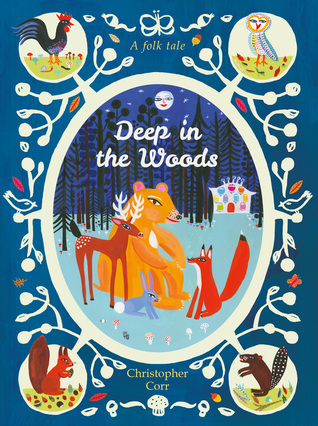
Deep in the Woods by Christopher Corr

Deep in the Woods by Christopher Corr

Deep in the Woods by Christopher Corr (9781847807267, Amazon)

This picture book is a retelling of a classic Russian folktale. In the woods, there stands a little wooden house with nine windows and a red front door. When a little mouse discovers that it would make a perfect home, he is soon joined by several other animals until all of the windows and rooms are filled with happy animals living together. When a bear discovers the house though, he is far too large to even get in the red door. He keeps trying to enter the house and climbs onto the roof which collapses the house and smashes it. What can be done to fix everything?

Corr keeps the text nice and simple throughout the story, creating almost a cumulative tale as one animal after the other joins in the group living in the house. For each animal, there are repeated phrases used and they approach, ask to live there and are accepted one after the other. This repetition is nicely done, not overworked and will make the story work well for very small children. The bear’s approach cleverly breaks the pattern established and signals how different he is from the others immediately. The writing is smart and effective.

The cover of the book does not fully show the brightness of the illustrations inside. They are neon bright and almost light the page with their neon pinks, oranges and reds. The red door of the house is wildly bright as are the animals themselves. The illustrations have stylized elements like the sun in the sky and the different trees in the woods. Toadstools and mushrooms carpet the ground that can be yellow, green, purple or blue.

Wild colors add a modern touch to this traditional tale. Appropriate for ages 3-5.

Reviewed from library copy.
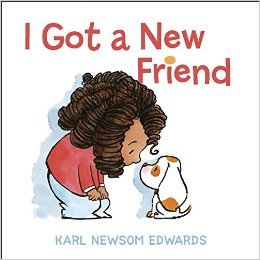
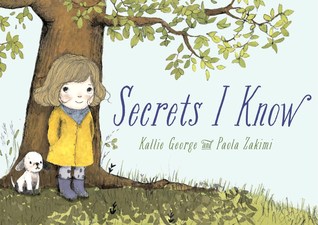
Secrets I Know by Kallie George

Secrets I Know by Kallie George

Secrets I Know by Kallie George, illustrated by Paola Zakimi (9781101938935, Amazon)

A little girl spends a rainy day playing in her backyard and sharing secrets with the reader. She knows lots of secrets like secrets are for whispering and whispers hide in trees. She uses the tree as an umbrella and then her umbrella as a boat for her toys. She and her puppy play in the sandbox and have a tea party there, the sunshine sweetening the tea. A friend joins her and they play dress up and then head outside to the trees once again when darkness falls and the stars come out.

George writes with a poetic simplicity here. In the little girl’s voice, she chains together the different experiences she is having, each one leading naturally to the next. It’s rather like a daisy-chain of a picture book spent outside and having a wonderful time whether on her own or with a friend.

Zakimi’s illustrations are detailed and filled with warmth. The blustery and rainy day is shown as an opportunity to play outside and have fun, not as anything that limits activities. Even darkness can’t stop the little girl from enjoying herself outdoors as stars fill the sky. The use of just one backyard as the canvas for the day shows how large imagination can be and how much fun can be had.

A simple book with lots of big ideas, this picture book shows how any day can be a special one. Appropriate for ages 3-5.

Reviewed from e-galley received from Edelweiss and Schwartz & Wade Books.

The Treasure Box by Margaret Wild

The Treasure Box by Margaret Wild

The Treasure Box by Margaret Wild, illustrated by Freya Blackwood (9780763690847, Amazon)

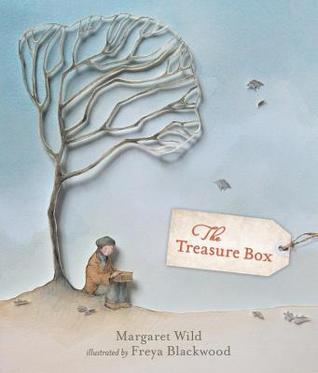
Nominated for the CBCA Picture Book of the Year, this picture book is exceptional. In a time of war, the library is burned and only one book survives. Peter’s father has that book and creates an iron box to keep it safe. When Peter and his father flee their town, they carry the book with them. Peter’s father dies on the journey and he continues to carry the book with him, even leaving behind his suitcase to manage it. Finally, Peter must leave the box behind, but he hides it safely first. Years later, Peter is able to return to the box and rescue the book, restoring it to his hometown and its library.

Wild’s lovely and simple text allows the drama of the story elements to speak for themselves, never injecting more horror into it. That approach allows the reader to feel deeply the loss and pain of losing one’s homeland. Even the death of Peter’s father is subtle and gentle, allowing the grief to permeate more fully. It makes the focus on the importance of the book all the more tangible and vital.

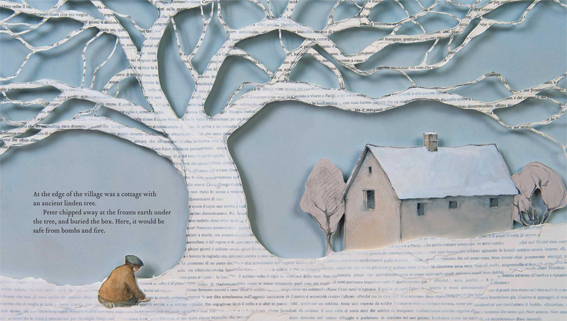
It is Blackwood’s illustrations that truly make this book amazing. She has created layered illustrations that have shadows and depth to them. Throughout the images, there are pages of books shown. They fall as scraps of paper with words of hope on them, dash across the page as rain, and form the smoke of the burning town. They create the landscape and the foundation beautifully.  Here is an image from the book and Blackwood’s blog:

Treasure Box Image

A war-torn book that speaks to the power of history and knowledge along with resistance and resilience. Appropriate for ages 4-6.

Reviewed from library copy.


Blood Family by Anne Fine

Blood Family by Anne Fine

Blood Family by Anne Fine (9781481477734, Amazon)

At age seven, Edward was saved from his abusive stepfather, Harris, when a neighbor saw him peeking out of their apartment through a boarded-up window. He had been shut in with his mother for three years, unable to leave. The only glimpse of the real world that he had was through a series of videotapes that the previous resident had left behind. Thanks to those videos, he was able to learn about the world and mentally escape the horror of his life. After he is rescued, Edward struggles to adapt to real life. He is smart and fascinated by everything, but his peers realize how different he is. When Edward becomes a teenager, he is suddenly confronted by the idea that Harris might be his real father after all. Is there a monster waiting inside him to break free?

Shortlisted for the Carnegie Medal, this novel is heartrendingly realistic.  The book is told in many voices. They include Edward himself and also the adults around him from the social worker who first rescues him from the apartment to the couple who foster him to the family that adopts him and his adopted sister. This is necessary as Edward begins to spiral out of control, so that readers can still view him clearly and better understand the hidden impacts and scars that his tortured upbringing have left on him.

Edward is a strong and interesting protagonist who is vastly human and easy to relate to. Fine uses the videos of a Mr. Rogers like figure to explain how Edward’s mind survived intact. As Edward seems completely fine much of the time, it is his fall into darkness that makes the book believable and allows readers to more fully understand the deep despair that has been lapping at him all along. Fine’s writing allows us hope for Edward’s future, then takes that away, only to restore it once again, showing that all of us have the potential to lose ourselves and find ourselves over and over again.

A powerful read that will be popular with those teens who like A Child Called It. Appropriate for ages 13-17.

Reviewed from copy received from Simon & Schuster Books for Young Readers.