I Am Not a Number by Jenny Kay Dupuis

i-am-not-a-number-by-jenny-kay-dupuis

I Am Not a Number by Jenny Kay Dupuis and Kathy Kacer, illustrated by Gillian Newland (InfoSoup)

Based on the true story of the author’s grandmother, this picture book captures the experience of First Nations people in Canada being sent to boarding schools. Under threat of fines and jail time, First Nation parents were forced to give their children up to the government. When Irene is taken to her new home, she tries to never forget her real home, her parents and their way of life. Irene is called only by a number at the school and told to scrub the brown off of her skin. Her hair is cut off. She is punished when she speaks her native language by a nun burning her hands. Irene is eventually allowed to return home for the summer, where she continues to have nightmares of her time at school. Finally, her parents decide to hide the children rather than sending them back.

This is not a picture book for preschoolers, rather it is ideal for elementary-aged children closer in age to 8-year-old Irene in the story. The horrific treatment of First Nation children is shown with real clarity. The use of Irene’s own voice to tell the story makes it personal and much more painful. While there is a lot of text on the pages, the book reads well and the text is straightforward and necessary to explain the loss of culture and the darkness of the boarding schools.

The illustrations by Newland are almost like painted photographs. They show the family losing their children, the stern nuns, and the punishment scene is carefully captured afterwards in terms of pain and emotion rather than depicting the punishment itself. There is a feeling of constraint and loss in the images of the boarding school and then freedom when the children return home.

A powerful look at Canadian history and First Nation children, this book would work well paired with When I Was Eight by Christy Jordan-Fenton. Appropriate for ages 7-10.

Reviewed from library copy.
 

Freedom Over Me by Ashley Bryan

freedom-over-me-by-ashley-bryan

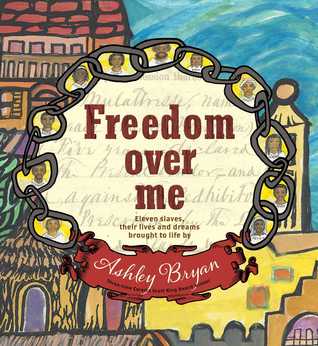
Freedom Over Me: Eleven Slaves, Their Lives and Dreams Brought to Life by Ashley Bryan (InfoSoup)

Based on actual slave auction and plantation estate information, this is a picture book that truly captures the world of enslaved people in the United States. The household has lost its master, who ran the plantation with its eleven slaves. His wife is about to return to England and the slaves will be sold with the rest of the property. The book opens with a poem of the wife and then into the voices of the eleven slaves, each one filled with a refusal to be seen only as a price tag or property, each one celebrating their skills and their lives.

Bryan’s poetry sings on the page, defiant and strong. He writes of the losses of slavery, of families broken up and never seeing one another again, of brutality on the plantation and the auction block, of being taken from Africa and freedom, and of the hardships of life as a slave. Bryan also notes though for each person that there are things that make them far more than any category could put them in, more valuable than their skills, more vital than their age and sex. This is a powerful testament against the inhumanity of slavery done by putting a face to eleven slaves that are impossible to turn away from.

Bryan’s art focuses on the faces of the slaves. He does one portrait almost as a flyer for the auction with their face and price, name and age. Then the page turns and you see their dreams on the page, captured in the same thick paint but no longer framed with words of slavery and now bright with colors and action.

Powerful and unique, this picture book takes on slavery in the most passionate and personalized way possible. Appropriate for ages 7-10.

Reviewed from copy received from Atheneum.

Little Penguins by Cynthia Rylant

little-penguins-by-cynthia-rylant

Little Penguins by Cynthia Rylant, illustrated by Christian Robinson (InfoSoup)

Five little penguin siblings head out into the snow on the first day of winter. There are many snowflakes in the air while they put on mittens, scarves and boots. The snow is very deep by the time they get dressed and outside. They play in the snow and then head back inside where they pull off their winter gear, put their pajamas on, have warm cookies and sippy cups. That night, they are warm in bed but one of them is still looking out the window at winter arriving.

Newbery Award winner, Cynthia Rylant has written this book with exactly the right amount of text for toddlers and young preschoolers. There is a lovely loose rhythm to the words, an excitement of new falling snow that is generated on the page. The rush to get ready, the enjoyment of their time playing outside and the warmth of returning inside to coziness is all nicely captured. Children who love snow themselves will recognize their days in these little penguins.

Robinson’s illustrations make this book very special. His bold colors, strong shapes and use of space create a lot of drama on the page. The way that each little penguin has their own color adds an element that parents and teachers can use to talk about the book. There is also the chance to count to five again and again. The huge flakes of snow are a delight to the eye, creating a feeling of joy and wonder on each page.

A toddler-friendly picture book, this is a cheery book celebrating the coming winter. Appropriate for ages 2-4.

Reviewed from copy received from Schwartz & Wade.


The Bossier Baby by Marla Frazee

the-bossier-baby-by-marla-frazee

The Bossier Baby by Marla Frazee (InfoSoup)

Caldecott Honor winner, Frazee has returned with a sequel to Boss Baby. Unfortunately for Boss Baby, things in his corporation have started to change. His staff isn’t treating him the same way and suddenly there is a new CEO! She first restructures the organization, and then does the seemingly impossible: she’s even bossier than her big brother. She manages to get better perks than he ever got too. Boss Baby has had enough and starts to display outrageous behavior and then he just gave up. But luckily, his new CEO knows exactly how to handle a crisis like this.

All of the wonderful mix of babyhood and the corporate mix of the first book returns in the second. It’s a winning combination where corporate take over feels exactly the same as a new baby in the house. While the first book had a lot of parental perspective, this second one is all about the older siblings and his feelings of displacement. Told with plenty of humor, the book is hilarious and oh so true.

Frazee’s illustrations are exceptional, of course. They have a wonderful mix of page designs from montages of images to full double-page spreads. Each has a specific perspective that heightens the emotional feel of the story as well. Just look at the long shadow thrown by the new CEO, or the disruptive behavior which is sure to get children giggling.

A delight of a sequel, this book is ideal for children who have been the Big Boss in their family but are now dealing with their own takeover. Appropriate for ages 3-5.

Reviewed from copy received from Beach Lane Books.


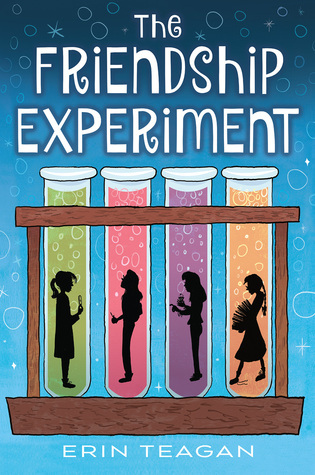
The Friendship Experiment by Erin Teagan

the-friendship-experiment-by-erin-teagan

The Friendship Experiment by Erin Teagan (InfoSoup)

Maddie isn’t looking forward to middle school. Her grandfather died over the summer and they are clearing out his house to prep it for sale. Her best friend has changed schools too. Maddie enjoyed writing Standard Operating Procedures for her grandfather, helping him cope with his dementia as his Alzheimer’s progressed. So she continues to write SOPs in her lab notebook and carry it with her all the time. She brings it to middle school and starts to document ways to cope with middle school and with the kids she eats lunch with. Meanwhile, middle school becomes a mix of good and bad. Maddie is allowed to work in the college’s science lab with her father. But her blood clotting disorder starts to flare up more, though not as much as her older sister’s. Maddie gets into a serious fight with her best friend, and manages to anger the new kids she has just started to become friends with. It’s clear that middle school is going to take a lot more experimenting to get right.

Teagan writes with a solid and consistent tone in this middle grade novel. Her touch is light and filled with humor, offering a way to see past the disasters that Maddie is facing in middle school. She weaves Maddie’s interest in science throughout the story. It is more than a hobby for Maddie, it’s a way of life. From her swabs of bacteria to the way she looks at projects, Maddie faces it all as a scientist.

Maddie is a warm and wonderful protagonist, still she is also entirely human. She makes plenty of mistakes in this novel, managing to lose all of her friends at once through actions all her own. She can be angry, impulsive, and inflexible and still readers will enjoy the time they spend with her and her scientific mind. The topic of hemophilia and the way the disorder is used in the novel is intelligently done, creating yet another source of angst and separation for Maddie.

A strong STEM novel that deftly shows that girls and science mix very well. No experiments needed to prove that hypothesis. Appropriate for ages 10-12.

Reviewed from e-galley received from Edelweiss and Houghton Mifflin Harcourt.


Big Bob, Little Bob by James Howe

big-bob-little-bob-by-james-howe

Big Bob, Little Bob by James Howe, illustrated by Laura Ellen Anderson (InfoSoup)

When Big Bob moves in next door, Little Bob’s mother is happy that he will have a friend so close by. But the two boys are very different in more than just their size. Big Bob likes to roughhouse, play sports, and zoom trucks around. Little Bob likes to spend time quietly reading, play with dolls, and sometimes wears girl clothes. Big Bob teases him for a lot of these things until a new girl moves into the neighborhood and tells Little Bob that boys don’t play with dolls. Big Bob stands up to her and soon the three of them are playing in whatever way they like best, because both girls and boys can play with whatever they choose.

While the message here can get a little heavy handed at the end, this is an important book. It shows that gender norms are a spectrum, that boys who play with dolls don’t have to be given any additional labels unless they identify in a different way. It also embraces that girls too sometimes prefer playing games or choosing toys that are traditionally masculine. There is a broad acceptance here with children being given the space and time to realize that they were viewing the world through a limiting lens.

Anderson’s illustrations are playful and bright. The neighborhood is quirky and welcoming with plenty of place to play separately and together. The use of wild colors adds to the appeal with trees of tangerine and lemon/lime and garlands of flowers and hearts dangling from them.

A book about accepting differences, learning to get along and finding new friends, this picture book is strong pick for library collections. Appropriate for ages 4-6.

Reviewed from library copy.


Three Dark Crowns by Kendare Blake

three-dark-crowns-by-kendare-blake

Three Dark Crowns by Kendare Blake (InfoSoup)

The author of Anna Dressed in Blood returns with a spectacular series opener. On the isolated and shrouded island of Fennbirn, magic still exists. Separated from the mainland, the island governs itself. Every generation triplets are born to the queen, each one heir to their own type of magic. But only one of them can become queen, the other two are destined to die. Katharine is a poisoner and she should be able to feast on poisons that would kill others, but her magic is weak though that fact is hidden. Arsinoe is a naturalist and should have the ability to grow plants and find an animal familiar, but her familiar has never come. Mirabella is an elemental, able to call down enormous storms and dance with fire. She has more power than any elementalist before her. Behind the three girls exists a web of politics and power willing to lie, steal and kill their queen onto the throne. Let the fight begin.

Blake has created a deep tension in this book that plays across the page beautifully. Everything is balanced on a knife’s edge, from the deception of the two weak queens to the unwillingness of the strong queen to kill her sisters. Readers get to see the mechanization behind the throne, the various factions teaching the queens, pushing them into power and punishing them when they fail. For each queen, there is pain, threats and powerlessness despite their station, each expressed in different ways.

The world building here is exquisite from the mist shrouding the island to the vague mentions of the mainland. It is the politics that frame the book, making the horror of the climb to power so immensely readable. The entire novel is riveting with pacing that is skillfully done, the slower sections allowing for the build of despair or horror, love or lust.

A dark delight of a novel that is a rich mix of fantasy and horror. Appropriate for ages 13-17.

Reviewed from library copy.

You can check out the book trailer too!

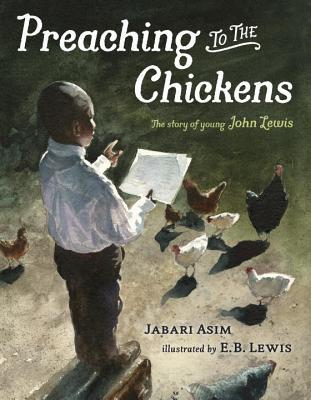
Preaching to the Chickens by Jabari Asim

preaching-to-the-chickens-by-jabari-asim

Preaching to the Chickens by Jabari Asim, illustrated by E. B. Lewis (InfoSoup)

John Lewis, renowned Civil Rights leader and Congressman, dreamed of becoming a preacher as a child. When he was put in charge of the family’s flock of chickens on their farm, he knew it was a great responsibility. John loved going to church on Sunday and took what he learned in church back to his flock. He would sermonize to them, the chickens mesmerized by his voice. He would also baptize them, speak up for them when they needed a voice and rescue them when they needed help. As he preached the words he learned in church, he put those words into action while tending his flock.

Asim beautifully ties together the lessons in church to actions in caring for others. There is a richness to the writing in this picture book biography, capturing both scripture and the beauty of life on a small farm filled with hard work. This is not a fantasy farm, but one where toil is what makes for a successful harvest. Still, it is a place that grew an activist like John Lewis, who learned about using his voice for a cause right there on the farm with his chickens.

The illustrations by Lewis are done in watercolor, capturing the chicken coop and John himself with just enough detail to convey their simplicity but also their stature. Lewis uses the play of light spectacularly in the book, deftly incorporating shadow and light into John’s childhood sermons.

A beautifully crafted picture book biography that speaks of the power of childhood dreams to create activism and a man with a voice to change generations. Appropriate for ages 6-8.

Reviewed from library copy.


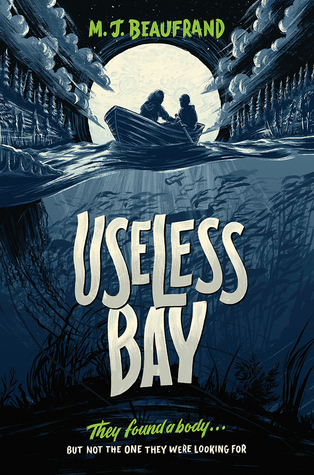
Useless Bay by M. J. Beaufrand

useless-bay-by-mj-beaufrand

Useless Bay by M. J. Beaufrand (InfoSoup)

When a boy goes missing on Whidbey Island, it’s expected that he’s hiding out at the Gray’s house. But Grant isn’t there. Pixie is one of the Gray quintuplets, large kids who seem to have special talents. When Pixie heads out with her scent dog, the best in the state, to find Grant, she discovers something else instead – the body of his mother. Henry, Grant’s half brother, is also part of the search. He knows the attention and problems that come with living in a very wealthy family. His family has staff that travel with them, and it could have been any of them who took Grant and killed his mother. Through the ensuing search, secrets are exposed and powers are discovered in this teen book filled with magical realism.


This book is great fun to read. One never quite knows when something mythical and amazing is going to suddenly happen. Those are mixed in with more mundane happenings like murder and kidnapping to create quite the setting for mayhem. Still, there is a feeling of truth through it all, of teens rising up through difficulty to heroism. There is a sense of fate and of purpose too, of destiny combined with the wonder of magic and myth.

The writing is strong and direct. It is haunted with death and pays homage to the damage of abuse and the strength of family. This book is not simple or easy, it is strung with danger and traps. The entire feel of suspense and the claustrophobic island setting combine to create a feeling of doom laced beautifully with hope and love.

A teen novel that is a compelling and vastly enjoyable read, this is a winner. Appropriate for ages 12-14.

Reviewed from copy received from Abrams.