Piper Green and the Fairy Tree: The Sea Pony by Ellen Potter

Piper Green and the Fairy Tree The Sea Pony by Ellen Potter

Piper Green and the Fairy Tree: The Sea Pony by Ellen Potter, illustrated by Qin Leng

Released August 16, 2016.

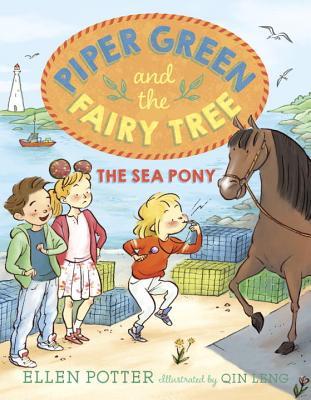
Piper sets off on her third adventure living on her small island home. When she visits the Fairy Tree, she discovers a strange whistle inside. Unfortunately though, Piper doesn’t want a whistle. She wants a pony! And the first pony  just arrived on the island that day. Piper was also hoping to spend time with her big brother who is home from school, but he isn’t feeling well so Piper decides to try to make him the treat that her mother makes her when she is sick. They don’t turn out quite the same way. When Piper’s dad needs help on his fishing boat, Piper leaps to help and discovers two things along the way, one that has her dreaming of riding something other than a pony and the other that will help her family even more than her loud whistle does.

Potter has just the right feel in the books in this series. Piper is wonderfully engaging as a protagonist. She is imaginative, funny and entirely herself. Even as Piper is making silly mistakes, the book does not make fun of her, rather it laughs along with her and looks at the errors we all make in our lives. It’s a book of empathy, humor and the importance of family and community.

Leng’s illustrations offer young readers a refreshing break from the text, giving them just the right amount of space. They are done in a framed style in either half-page or full-page format. The chapter breaks too are done with style, offering stripes to invite readers to turn more pages and follow the story further.

Another winner in this charmer of a series that is just right for children who enjoy Clementine. Appropriate for ages 6-8.

Reviewed from ARC received from Knopf Books for Young Readers.
Little Red and the Very Hungry Lion by Alex T. Smith

Little Red and the Very Hungry Lion by Alex T. Smith

Little Red and the Very Hungry Lion by Alex T. Smith (InfoSoup)

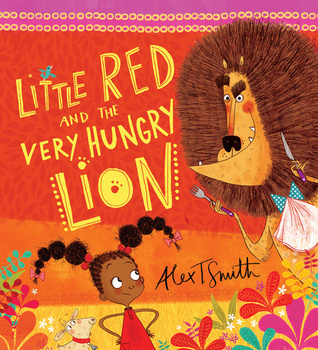
This riff on the Little Red Riding Hood story is filled with humor and twists that will delight. Little Red’s auntie has woken up with spots and so Little Red must cross the Savannah to bring her some medicine and some doughnuts. Little Red makes it past all sorts of animals until she stops in the shad of a tree. That’s when the Very Hungry Lion appears. When he asks Little Red where she is off to, the Lion hatches a plan that involves pretending to be her auntie and then eating both Little Red and her aunt. Little Red though is not fooled at all. So when she sees the Lion in her auntie’s clothes and in her bed, Little Red launches into action. Soon the Lion has a new hairstyle, has brushed his teeth and changed into a ruffled dress. The Lion though has had enough and roars. Little Red does not back down and soon a friendship is starting, with some strict rules in place.

Little Red is a great heroine. She is smart and fearless, facing down a hungry lion with stern warnings. It is also the humor of this book that works so well. The braiding of the Lion’s hair is a wonderful moment as is his changing clothes once again at Little Red’s insistence. It is in those moments that story becomes something new and fresh and where the audience will understand that this is a very different Little Red Riding Hood than in the original tale.

Smith’s art is zany and bright. The look on the Lion’s face is lovely, particularly when Little Red is forcing him to do things. Little Red pops on the page with her red dress and arching braids. She is particularly small next to the huge lion and still manages to hold her own on each page. Filled with humor and color, these are images that will work with groups of children very well.

One to roar about, add this to your twists on well-known tales or in any story time about lions. Appropriate for ages 3-5.

Reviewed from library copy.


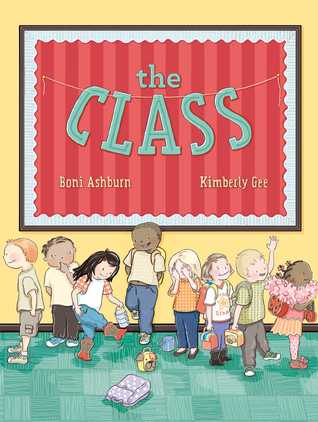
The Class by Boni Ashburn

The Class by Boni Ashburn

The Class by Boni Ashburn, illustrated by Kimberly Gee (InfoSoup)

A group of twenty children prepare for their first day of Kindergarten in this witty and charming picture book. The book starts with the different ways the children wake up from those who are up early to the grumpy ones to those who want to sleep and sleep. Next comes putting on clothes, then brushing and combing hair, and putting on shoes. Breakfast is next with pancakes or cereal or juice. Backpacks are put on, children catch the bus, are driven to school or walk. Emotions run high. And then finally, all twenty are at school and ready to begin!

Ashburn beautifully combines the normal day routines of children filled with teeth brushing, bathroom and breakfast with the unique things about the first day of Kindergarten like backpacks and having to be ready at a certain time. She also intertwines the emotions of the day with some children unable to sleep, others grumpy throughout, and some tearing up on the way to school. This is a way to show all of the different reactions to school but to also assure children that they are more alike than they may think.

The illustrations by Gee are gentle and cheerful. They capture each child and fill the page with diversity. She is also great at showing the mixed emotions of the day and the variety of reactions that children have. The use of lots of white space allows children to see themselves on the page, talk about what they will have for breakfast, about their nerves and more.

A perfect book to share with children heading to their first day of preschool or Kindergarten whether you are a parent or a teacher. Appropriate for ages 3-5.

Reviewed from copy received from Simon & Schuster.


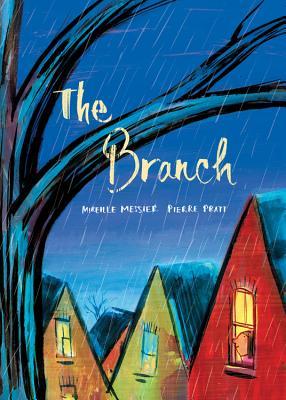
The Branch by Mireille Messier

The Branch by Mireille Messier

The Branch by Mireille Messier, illustrated by Pierre Pratt

Released September 6, 2016.

During an ice storm, a little girl is awakened by a loud sound outside. It turns out to be her favorite branch falling from the tree in her yard. It was the branch she played on, dreamed about and that was a big part of her day. The little girl asks to keep the branch after finding out that it can’t be reattached to the tree and her mother agrees. Her neighbor is next door with his chain saw and the girl stands guard so that no one takes her branch. Her neighbor, Mr. Frank, sees her standing there and asks about her branch. He sees “potential” in it and offers to help her make something with it. It turns out to be just the right solution, one that helps the girl remember the fun she had and looks forward to future happiness too.

Messier conveys the little girl’s emotions very clearly. From the feel of the fallen branch to her attachment to it to the importance of creating something new with it. Each moment echoes with emotions, creating a book that is conducive to discussing feelings with young children listening to the story. The book is also anchored in sensations, the feel of the icy branch in her hands, the noise of the chain saw, the hard work of transforming the branch into something else.

The illustrations by Pratt are filled with deep colors that brighten the pages. The beauty and destruction of the ice storm are captured, each branch encased in ice. The change is seasons is also nicely shown, moving from ice and snow to green in the illustrations.

A book about resilience, connections to nature and its power, and the value of memories, this picture book is full of potential itself. Appropriate for ages 4-6.

Reviewed from e-galley received from Kids Can Press and Netgalley.

Learning to Swear in America by Katie Kennedy

Learning to Swear in America by Katie Kennedy

Learning to Swear in America by Katie Kennedy (InfoSoup)

NASA has called on Yuri, a 17-year-old physics prodigy from Russia, to help save the earth, literally. An asteroid is heading on a path that will directly impact earth in the next few weeks. Yuri joins the team of adults who don’t really listen to him. Yuri’s own research into antimatter has not yet been published, though he expects it to win him the Nobel Prize. Meanwhile, Yuri meets Dovie, a teenage girl who has the life that Yuri never lived. Her hippie family is warm and wonderful, despite many horrible culinary experiments. Despite his focus on the asteroid, Yuri finds himself drawn to Dovie and her American teenage experiences. As Yuri works, he also discovers that the Americans intend to force him to stay, rather than allowing him to return to Russia. Now Yuri has to deal with the asteroid, escaping NASA and teenage love.

Immediately upon starting the book, I was in love with the author’s voice. She writes with a wry tone that broadens at times into full-on farce and humor. The interplay between Yuri and his counterparts at NASA is fascinatingly displayed, often using a mix of both cultural differences and Yuri’s social awkwardness to best effect. The novel is fast paced and yet not breakneck until the very end where it is entirely warranted and great fun. Yuri in an American high school and then at prom are wonderful moments that show the horrors of American schools but also Yuri as a unique character.

The book works because of Yuri himself and Dovie as well as her family. Yuri is a great character, someone who could initially be seen as Sheldon on the Big Bang Theory and then zigs in a different direction, becoming someone who is kind, friendly and horny too. Dovie and her family are the opposite of “typical” Americans, instead living a hippie lifestyle that is lovingly captured on the page. The addition of Dovie’s brother and his wheelchair is far more than a token gesture and he becomes important in Yuri’s growth and choices.

A richly funny and deeply fascinating book that asks big questions about life and death while making you laugh along the way. Appropriate for ages 14-17.

Reviewed from ARC received from Bloomsbury.


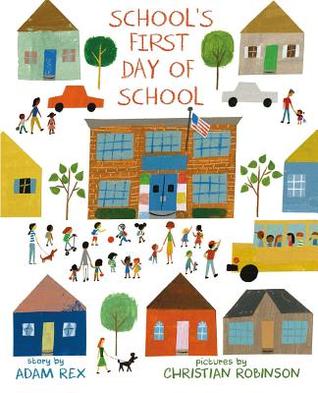
School’s First Day of School by Adam Rex

School's First Day of School by Adam Rex

School’s First Day of School by Adam Rex, illustrated by Christian Robinson (InfoSoup)

Over the summer, a school was built. The school liked its name, Frederick Douglass Elementary. It liked the quiet summer days with just the janitor who warned the new school that soon it would be full of children. But the school wasn’t sure that it liked the idea of children! And when they did arrive, there were so many of them. They went everywhere. Some children didn’t like being at school, and one little freckled girl in particular caught the school’s attention. As the day went on though, the school started to see what he was built for and the children who didn’t want to be there also started to understand why they were there too.

What a clever clever premise for a book! It takes the school building itself and gives it the angst of the first day of school, the wonder about all of the different kinds of things that go on from the play structures to the classrooms and the cafeteria. Steadily with apparently no effort at all, children will be introduced to all of the parts of an elementary school. They will also find that their fears mirror that of the school and that all they need to do is give it the first day and see how that goes. Like the school, they might just be looking forward to the second one!

The illustrations by Robinson are merry and bright. They too add to the calming feeling of the book, creating a look that is friendly and soothing at the same time. The children are from all different backgrounds, creating a dynamic and diverse atmosphere. The school itself somehow exudes personality, even managing to look at little embarrassed about the fire alarm.

A marvelous book for first-day jitters, this picture book will be loved by everyone headed to their own school. Appropriate for ages 4-7.

Reviewed from library copy.

Steamboat School by Deborah Hopkinson

Steamboat School by Deborah Hopkinson

Steamboat School by Deborah Hopkinson, illustrated by Ron Husband (InfoSoup)

A young boy is sent to Candle School by his mother, though the truth was the he was not very excited to go. His older sister Tassie almost has to drag him there, because he wanted to stop and see everything along the way. They headed down into the dark basement of a church where there were no windows. The school was run by Reverend John who shared his own story of being born a slave and then working to earn the freedom of himself and those he loved. Then one day men came to the Candle School and declared it closed since the State of Missouri had changed the law and no children of color could be taught to read or write. The school closed, but Reverend John did not give up and soon had his school floating in the middle of the Mississippi on a steamboat where the Missouri law could not impact them.

This picture book is based on the true story of Reverend John Berry Meachum whose story is given in more detail in the Author’s Note at the end of the book. The picture book is told through the eyes of a young boy who attends Meachum’s school and then works to reestablish it on the steamboat and pass the quiet word of the school reopening. Throughout the book there is a strong sense of purpose, of the importance of learning to read but also the importance of standing up for what is right.

The illustrations by Husband are exceptional. Using muted colors and fine lines, they capture the darkness of the school and the light on the children’s faces. They show the sorry of losing the right to learn and then the joy of growing up educated and looking to the future.

A luminous look at the harrowing life of African Americans even if they were free in the 1800s, this picture book is beautiful and filled with strength. Appropriate for ages 7-9.

Reviewed from library copy.


Hippopotamister by John Green

Hippopotamister by John Green

Hippopotamister by John Patrick Green (InfoSoup)

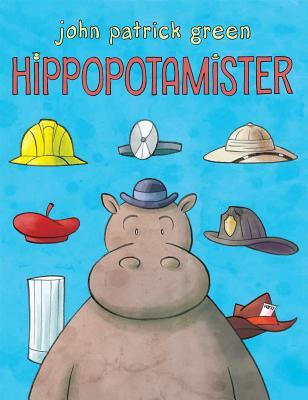
The zoo where Hippo lives is run down and doesn’t get many visitors at all. His friend Red Panda suggests that Hippo join him in the human world and get a job. The two of them put on hard hats and try their hands at construction. Hippo discovers that he is quite good at building, but he doesn’t build the expected skyscraper. The two then try being hair dressers with similar results, though Hippo does find that he’s quite good at it. They put on chef hats and work in a restaurant kitchen where Hippo creates a pasta masterpiece and Red Panda creates a mess. They go on to try being bankers and dentists and many other jobs until they head back to the zoo on one of their day’s off. Hippo decides to returns to the zoo and discovers that he may just have the exact skills needed to help the zoo return in style.

Green’s dismal zoo with limp animals quickly turns into an active story about different jobs, wild and wonderful ways to screw them up, visual gags, and plenty of laughs. The ending of the book is entirely satisfying, even as readers realize where it is headed. It is a pleasure to watch it play out visually and see Hippo come into his own with his myriad of skills.

The illustrations in this graphic novel are welcoming and fun. Filled with bright colors and plenty of action, they have a wonderful feel to them. Especially effective are the images done in series with Red Panda and then Hippo trying hat after hat and job after job. The entire book is filled with a jolly humor.

Funny and lighthearted, this book also has a cheerful depth to it which is immensely satisfying. Appropriate for ages 6-9.

Reviewed from library copy.


The Leaving by Tara Altebrando

The Leaving by Tara Altebrando

The Leaving by Tara Altebrando (InfoSoup)

Six kindergarteners were taken and now eleven years later, five are returned. The six teens who had disappeared have no memories of their captivity or those that took them. Now they are sixteen and seem to be remarkably OK. They have vague memories of one another, but none of them have any memory of the six child who was taken with them. Avery, the younger sister of that still-missing boy, finds it difficult to deal with the others returning but her family being forgotten. Scarlett, one of the teens taken, returns home to find a sober mother with a serious boyfriend, a vast difference from her mother before. Scarlett though feels that she is not able to figure out the person she actually is. Lucas returns home to see his father die in front of him and is accused of being involved in his death. As all of them struggle to figure out what happened to them and what their future is bringing, there are more questions than answers.

This taut thriller of a book takes a daring look at memories, families and what makes us who we are. Readers will have to set aside their incredulity at the memory loss and go along for the ride here, allowing themselves to be part of the whiplash of the riveting plot and the horror of what happened to these children. There is real depth in this novel for teens, looking beyond the bleakness of the kidnapping and into the question of childhood trauma and what makes a normal teen and adult.

The three main characters are well developed and interesting, particularly Avery, who has a unique point of view and intact memories. Her skepticism at the teens’ story of memory loss will echo that of the reader. Her continued concern for her own brother demonstrates the additional victims of the crime, the family members. Scarlett and Lucas are strong characters as well, searching for any clues they can find to unravel what happened to them. The other teens who were returned are less well drawn, with one of them almost disappearing from the novel until much later in the story.

Told through specific points of view, this novel keeps its edge right up to the end. Appropriate for ages 14-17.

Reviewed from ARC received from Bloomsbury.