Review: The Girl Who Could Not Dream by Sarah Beth Durst

Girl Who Could Not Dream by Sarah Beth Durst

The Girl Who Could Not Dream by Sarah Beth Durst

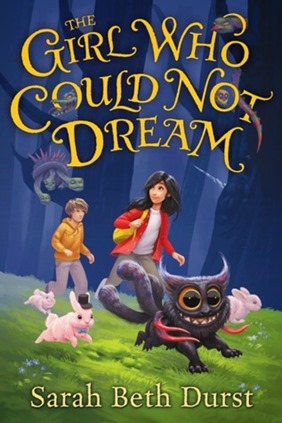
Sophie lives above her parents’ bookstore that is actually much more than a place to sell books. Downstairs below the store is another shop, the dream shop, where her parents deal in dreams harvested from dreamcatchers and then bottled. Sophie never has dreams of her own and she has been forbidden from ever drinking a dream. One day though she tries one and discovers that she has the ability to bring things back from her dreams into real life. That’s how she gets her best friend, Monster, a creature from a nightmare. Dealing in dreams can be dangerous business since it is done on the black market. When the dream shop is robbed and Sophie’s parents are taken, Sophie has to figure out who is responsible and the find a way to free her family that will mean trusting outsiders and breaking family rules.

Durst is a master storyteller. Her flights of fancy here are intoxicatingly original and yet also pay homage to traditions too. Monster is one of my favorite characters, a wise-cracking, fuzzy and loveable creature who is ferociously loyal, brave and hungry. Then there is a snooty pegasus who has his own attitude and speaks harsh truths, not to mention the multicolored ninja bunnies. Durst builds a story that has room for all of them and remains wonderfully clear and focused on the real story going on.

Sophie is a character who is known by classmates as being prickly. It’s difficult to create a character who is embraced by the reader as a hero but faces real issues at school with making friends. Durst does it with real skill, giving Sophie a personality that is by necessity very private but also making her warm and loving to those in her inner circle. The use of that privacy is also used to isolate Sophie, making the adventure all the more harrowing and forcing her to open up to those she would not otherwise trust.

A strong fantasy for elementary readers, this book is filled with smart humor and great characters. Appropriate for ages 8-11.

Reviewed from digital galley received from NetGalley and Clarion Books.

Review: Happy in Our Skin by Fran Manushkin

Happy in Our Skin by Fran Manushkin

Happy in Our Skin by Fran Manushkin, illustrated by Lauren Tobia (InfoSoup)

A picture book all about skin and how important it is to our bodies, this book also celebrates the different colors of skin we all come in. The book begins with the joy of baby skin in all of its sweet colors of cocoa, cinnamon, honey and ginger. It then talks about how skin forms a protective barrier for you, forming scabs when you hurt yourself and growing along with you. The way skin reacts to sun and to cold is also talked about and then the book talks again about how your skin is unique and so is everyone else’s too.

Written in rhyming couplets, this picture book has a jolly galloping feel to it with they rhymes propelling the text along. The book is a wonderful mix of scientific information about skin that is appropriate for very small children and praise for the beautiful variety of skin colors that you see. This is a wonderful book to start discussing diversity with very small children. The urban setting is a delight with people of differing abilities, Muslim families, and children and adults of all races. The book does focus on one family in particular where one of the parents could be any gender, making this book all the more welcoming.

The illustrations by Tobia go a long way to making this book inclusive and diverse. From henna on hands to families of mixed races, these illustrations are celebratory of the vast diversity we have. At the same time, there is a universal nature to all of them, with all of the families loving their children, adoring their infants, and spending the day outside together as a community.

A fresh and lovely look at diversity for the smallest of children, this book will serve as both a mirror and a window for all. Appropriate for ages 2-4.

Reviewed from library copy.

Review: Six of Crows by Leigh Bardugo

Six of Crows by Leigh Bardugo

Six of Crows by Leigh Bardugo (InfoSoup)

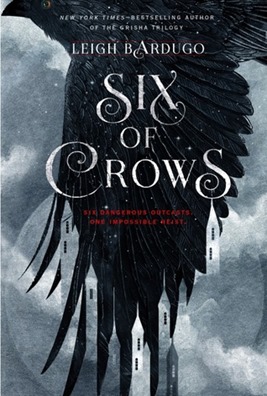
In the slums of Ketterdam, you do anything you can to survive. The Dregs are a gang in the area, up and coming and led by Kaz Brekker, a teen who walks with a cane that can kill and has a ferocious personality to match. When he is offered a remarkably high sum to pull off an impossible heist, he knows just the group of people who can help him do it. The group of six teens from very different backgrounds don’t exactly get along perfectly. Some of them hate one another, others are drawn to one another for romance and still others are completely indifferent to the rest. But each of them has hidden talents that this heist will demand that they use, if they are going to survive at all.

Bardugo is a master storyteller. Here she continues the story of the Grisha world with a new cast of characters. Their world is the mix of danger, thrill and torment of the slums that are also dashed with fakery and glitter. It will take those harsh survival skills for them to pull off the gambit, but it will also take them each wrestling with their past and how they got to Ketterdam in the first place. Bardugo makes sure that we know each of the six intimately, allowing us to see how poverty, war and loss can turn someone to a criminal.

Set in the same world as her previous trilogy, this new series adds even more depth and breadth to an already rich setting. Bardugo makes the world of Ketterdam almost its own character, filling it with villains, rivals and all around bad people. One can hear the cacophony of the streets, the sounds of the gambling, the calls of the vendors. One can smell the sweat, dirty bodies, and desperation. Against all of that, you have these teens who are all unique and fascinating, each driven by something personal to them alone. It’s a beautifully built book.

Rivetingly written, richly drawn and filled with fascinating characters, this book will please fans of the previous series and create new fans too. Appropriate for ages 14-17.

Review: Little Tree by Loren Long

Little Tree by Loren Long

Little Tree by Loren Long (InfoSoup)

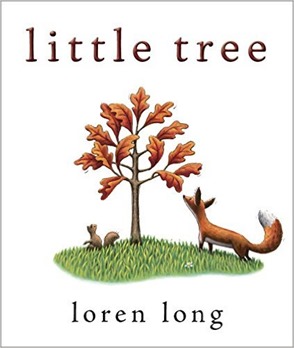
The author of the popular Otis series tells a story about a tree that is heartwarming and encouraging. Little Tree is happy as he stands with the other little trees in the forest. Squirrels play in his branches and a mourning dove stops by. Autumn arrives and the leaves of the little tree change color along with those on the other little trees. The leaves began to fall, except for those on Little Tree. He held onto his tightly. The animals start to ask him why he is holding onto his leaves so long, but Little Tree just holds them even tighter. Spring comes and the other trees are taller and filled with bright green leaves. Little Tree though has only his old brown leaves. The other trees continue to grow around Little Tree, the animals no longer played in his branches, and he just held on ever more tightly. Little Tree would have to figure out how to let go and allow change to happen.

This parable is beautifully told. The parallel between a tree not dropping its leaves and allowing seasons to pass and a human fighting the inevitable changes and progress in life is compelling. Young readers will see clearly how stunted the life of Little Tree becomes and how quickly he loses the very parts of his existence that he loves so much. The writing is simple and straight-forward, making this a very shareable book that could lead to a discussion about what children are holding onto that they may want to release and let go.

Long’s illustrations are luminous on the page. He makes great use of white space, allowing Little Tree to shine on the page in a simple and engaging way. Other pages use double spreads, showing the changing forest as it grows around Little Tree. This too is very effective.

A strong picture book with an important message that is cleverly told, this book encourages young readers to embrace change and the uncertainties of life. Appropriate for ages 4-6.

Reviewed from ARC received from Philomel Books.

Review: Who Done It? by Olivier Tallec

Who Done It by Olivier Tallec

Who Done It? by Olivier Tallec (InfoSoup)

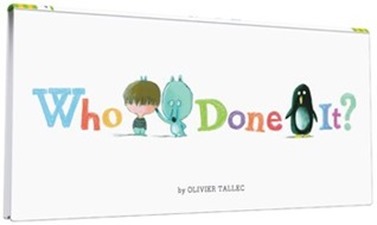
This long narrow picture book opens with the spine at the top, showing two lines of characters in a double-page spread. A question is asked about the characters. Who is in love? Who is wearing a disguise? Who is playing a prank? Then the reader tries to spot the answer among the characters. Some of them are easy, others are more challenging to answer and take some close examination of the illustrations. This is a quieter kind of “I Spy” book with simple art and a focus on emotions.

A French import, this picture book will surely find a lot of fans with the crowd who are a bit too young for more complicated finding books. The focus on emotions is very appealing and will lead to conversations about how you can tell from a picture who is feeling a specific thing. Tallec does a wonderful job of keeping the images clear enough to figure out the answer but also alluring enough that readers will examine almost every figure to see if there are more than one answer.

This is a very appealing picture book that mixes search and find with emotions. Appropriate for ages 3-5.

Reviewed from copy received from Chronicle Books.

Review: Orbiting Jupiter by Gary D. Schmidt

Orbiting Jupiter by Gary D Schmidt

Orbiting Jupiter by Gary D. Schmidt

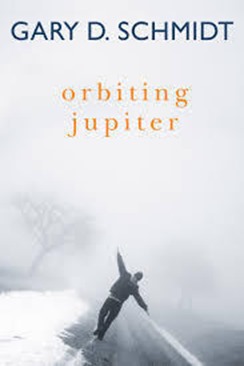
When Joseph joins Jack’s family as a foster child, Jack’s life definitely changes. Joseph is 14 and Jack is 12, both of them end up not going on the school bus the first day that Joseph goes to school, since the bus driver made a comment about Joseph before he even got aboard. So the two boys walk together to school, two miles in the winter weather. As they journey together, they get to know one another better. The dairy farm that Jack’s family owns is also another place where Jack can learn about Joseph. Joseph is immediately accepted by the cows, a good sign in Jack’s opinion. Joseph is desperate to find the daughter he has never met. But it is not simple to do that, even though his life is changing for the better.

Schmidt writes a spare and fierce novel here, one where the biting wind of the winter is tempered only by the warmth of a caring foster family and the love of a dairy cow. The sharpness of the cold is also cleansing, clearing the way for Joseph to tell the truth to Jack and his family. The relationships here are built in a natural and understandable way. It all feels real especially as the story veers into tragedy.

The two main characters are different yet brotherhood grows between the two of them quickly. It happens in leaps and bounds as they both discover that the other will be there for him. Yet that is how brotherhood and friendship works, it is slow until it is fast. This book captures that wonderfully. Jack’s parents are also well rendered, full characters who wrestle with the problems Joseph brings to the family and yet are available and open to see him as he is.

This is a book that speaks to the tragedy of some young people’s lives, the power of love to transform, and the impossible choices that life creates. It is powerful, beautiful and wrenching. Appropriate for ages 10-13.

Reviewed from library copy.

Review: Lenny & Lucy by Philip C. Stead

Lenny and Lucy and Philip Stead

Lenny & Lucy by Philip C. Stead, illustrated by Erin E. Stead (InfoSoup)

This award-winning husband and wife team return with another winner of a picture book. Peter knows that moving to a new house is a bad idea, especially when he sees the dark woods. Their new house is on the other side of a bridge from the woods. Peter and his dog Harold spend a sleepless night watch the bridge to make sure nothing crosses it from the woods. Then they head out and use pillows and blankets to create Lenny, a guardian. Unfortunately, they worried that Lenny might be lonely out there at night all alone, so again they did not sleep. The next day, they took blankets and leaves and created a second guardian, Lucy. That night, everyone slept. And the next day, a visitor arrived, one who shows that despite the scary woods this might be a good place to live after all.

Stead has the beautiful ability to create a story out of leaves, pillows and blankets. This book speaks to all children who have moved and those who have been afraid of other things too. There is a menacing sense from the woods, and Stead combats that with a concrete feel of normalcy but also a strong creativity. This all feels like childhood to me, capturing that wonder mixed with fear that turns into something else all the more powerful.

Erin Stead’s art has a delicacy about it that matches Philip’s tone in his prose. She creates a linear forest, uncluttered and somehow all the more strange and alien because of that. The hulking bodies of Lenny and Lucy are so solid on the page that they combat that feeling just by being there. Readers will immediately see the safety in these creatures.

This is a story of moving but also about wonder and fear. It’s a brilliant picture book, one to finish with a contented smile. Appropriate for ages 3-5.

Reviewed from copy received from Roaring Brook Press.

Review: Tiptoe Tapirs by Hanmin Kim

Tiptoe Tapirs by Hanmin Kim

Tiptoe Tapirs by Hanmin Kim (InfoSoup)

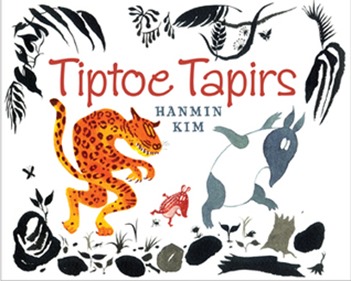
The jungle was a very noisy place with all of the animals making the most noise they can. The elephants went BOOM, the rhinos went BAM-BAM, the hornbill went CAW, and the ape went HOO-HAA-HOO-HAA! But there was one animal that wasn’t noisy at all, Tapir and Little Tapir. They were very quiet, tiptoeing through the jungle silently. When Little Tapir wanted to go to the Great Puddle for her third birthday, the two tapirs moved silently to get there and then enjoyed the lovely mud. Then out of the blue, a leopard attacked the tapirs. The leopard ran after them with loud THUDDING steps while the tapirs ran silently. The tapirs were almost eaten by the leopard when a gun shot rang out. The leopard was terrified, but the kind tapirs had a solution to save them all.

Kim has woven a fable-like story around his love for tapirs. The book is a delight to read aloud from the loud noises of the other animals to the hush-hush of the tapirs and their quiet silence. It’s a wonderful contrast that is great fun to act out. Kim uses repetition and solid writing to create a traditional feel in this story. There is also a lot of humor throughout, the noises are wild, the mud cakes are fresh. The focus on kindness as the solution in the end is also a treat of its own.

The art also has a dynamic mix of traditional and modern feel. Done in watercolor, ink and marker, the illustrations are filled with organic shapes of leaves and trees. Colors range from bright washes of watercolor to the darkest black of ink. The shapes of the animals themselves are delicately done, particularly the tapirs who both hide in the jungle settings and dance on the page.

Whether you are sharing this with a loud or quiet little animal, this book is a great pick to share aloud. Appropriate for ages 2-4.

Reviewed from ARC received from Holiday House.

Review: Double Trouble for Anna Hibiscus

Double Trouble for Anna Hibiscus by Atinuke

Double Trouble for Anna Hibiscus by Atinuke and Lauren Tobia

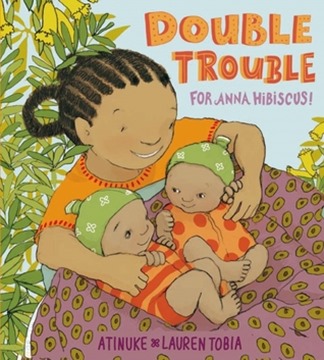
I’ve been a big fan of Anna Hibiscus since the first titles were released. Those books were chapter books and it’s great to see the transition to picture books about Anna continue. In this book, Anna wakes up one morning to discover that her mother has given birth to two baby brothers. Her cousins inform her that baby boys are trouble and Anna Hibiscus quickly sees that that is true. When she wants to snuggle with her mother, she is sleeping. Her grandmother too is sleeping after being up all night helping with the birth. Her uncle is too busy making food for her mother to get Anna her regular breakfast. Her aunts are busy rocking the babies. Finally, it is too much for Anna Hibiscus to take and she starts to yell and cry. After all that fuss though, Anna Hibiscus quickly realizes that while things may take longer now, her family is still right there beside her.

The story deals directly with the mixed emotions that come from having new siblings, from the surprise of their arrival to the lack of attention for the older sibling. These classic emotions are shown clearly here, despite Anna Hibiscus having such a large family around her. Readers will notice that she has lots of support, though she is not noticing it at all. The emotions build quickly and steadily to a breaking point and the resolution of Anna Hibiscus’ outburst is filled with understanding and kindness.

The art work is lovely, clear and clean. The beauty of African life is shown on the page as is the loveliness of the mixed races of Anna Hibiscus’ family.  As always, the warmth of the lifestyle that Anna Hibiscus grows up in is radiantly shown in the images.

Another winning Anna Hibiscus book, perfect for new older siblings who may have double or single troubles of their own. Appropriate for ages 3-5.

Reviewed from digital galley received from Kane Miller.