Review: The Potato King by Christoph Niemann

Potato King by Christoph Niemann

The Potato King by Christoph Niemann (InfoSoup)

A Prussian king named Fritz loved the idea of the potato. It was easy to grow and healthy too and could just solve the hunger problems in his country. So he went to a nearby village and told them about the potato and its benefits and planted some potatoes for them. But people don’t like to be told what to eat, and the village rejected the potato entirely. Then King Fritz had an idea. He ordered his army to go to the village and guard the potato field, telling them to be very lax about it. Suddenly, the people were very interested in a food that they were being stopped from eating and that was valuable enough to guard with soldiers. They snuck into the field and stole the potatoes, planting them in their own gardens. It was a clever use of reverse psychology to create a crop that would end up being a staple of the area.

Translated from the original German, this picture book is told very simply. The book ends with a brief history of the potato and how it came to Europe from South America. It also admits that this tale may be a myth, but that’s part of what makes it all the more fun to tell. Niemann manages to take a moment in history and turn it into a rollicking tale that young children will enjoy immensely and will relate to immediately.

The illustrations in the book are done entirely in potato prints of different colors combined with actual potatoes too. The prints work particularly well when used to create larger scenes of hills of grass and crowds of soldiers. Somehow the crude images have their own personality too, particularly the king himself whose open mouth and bright red color mark his as unique right from the start.

Nominated for a German Youth Literature Prize, this picture book has a wonderful organic charm all its own. Appropriate for ages 4-6.

Reviewed from library copy.
Review: Circus Mirandus by Cassie Beasley

Circus Mirandus by Cassie Beasley

Circus Mirandus by Cassie Beasley

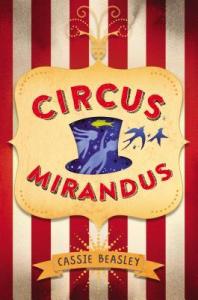
Grandpa Ephraim has been telling Micah stories of Circus Mirandus since he was a small child. It is the story of a circus that is so magical that adults cannot find it, only children who need to. You can’t get in without a ticket, but you never know what form that ticket will take. Once inside, you get to see acts like a flying birdwoman and a man who creates entire worlds in seconds. But now Grandpa Ephraim is sick and probably dying. Micah’s great-aunt Gertrudis has arrived to take care of both of them and that means no disturbing his grandfather and no talk of magic at all. When a talking and thinking parrot appears, Micah knows that the circus is real and then finds out that the most powerful man at the circus promised his grandfather a miracle that his grandfather saved. Now Micah knows exactly how to save his grandfather. He has to find the circus and use that miracle to stop him from dying and he has to do it quickly!

Beasley has written a terrific read one that nods to books like Charlie and the Chocolate Factory in the way that an entire magical world is placed adjacent to our own, one that is just close enough to glimpse at times. She has also created a book which while it pays homage to classic children’s literature also modernizes it and mixes in magic too. The story arc works particularly well here, built on a strong tale that is filled with marvelous and amazing creatures and beings. The result is a book that is very readable and one where you aren’t quite sure what’s going to happen next, in the best possible way.

Micah is a very likable protagonist. He struggles to make friends and when he does their friendship takes time to grow. It feels very organic and the two of them are not natural friends who see the world the same way. Instead it is much more like making a real friend where it is the willingness to be friends that makes a huge difference and a decision to stop arguing when you don’t agree. It is these parts of the book that are so realistic, where the relationships shine, that make the book as strong as it is. Without these clever human elements the book would be too frothy and light. These keep it grounded and real.

A magical book filled with real people alongside the mystical ones, this book for young readers will be enjoyed almost as much as a visit to Circus Mirandus itself. Appropriate for ages 9-12.

Reviewed from ARC received from Dial Books.

Review: Little Red Henry by Linda Urban

Little Red Henry by Linda Urban

Little Red Henry by Linda Urban, illustrated by Madeline Valentine (InfoSoup)

Henry’s family does way too much for him. They dress him. They feed him. They bring him anything he needs. But they haven’t noticed that Henry is getting much more independent and wants to start doing things himself. So Henry starts to insist on doing things entirely on his own. Henry feeds himself. Henry brushes his own teeth. He gets himself dressed, refusing all of their suggestions for things to wear. Then he headed next door to his friend’s house to play. His worried family peers at him from behind trees and other objects, but Henry does just fine on his own. At first Henry’s family doesn’t know what to do with themselves with no Henry to take care of. Slowly though, they start to find their own way again. When bedtime comes, Henry gets himself ready for bed, but he just might still need some help going to sleep.

A perfect story for children in the age of helicopter parenting and a reminder for parents to give their children the space and opportunities they need, this picture book has a snappy tone that is great fun to read aloud. It plays homage of course to The Little Red Hen who asks for help and gets none. Nicely, this book is the reverse and echoes the flip at the end of the traditional story with one of their own as well. It’s a great riff on a beloved tale, modernizing it and changing it so that young readers may not even realize the connection.

Valentine’s illustrations add to the pizzazz of the book. The worried and overbearing family is filled with doting love. Henry is vividly independent, standing on chairs and being entirely himself. There are great moments of activity where Henry tries on different outfits and where the family tries out new activities. This echoing of each other adds to the pleasure of the read.

A modern riff on a classic tale, this picture book is sure to support independent kids and send helicopter parents spinning. Appropriate for ages 4-6.

Reviewed from library copy.

Review: Fell of Dark by Patrick Downes

Fell of Dark by Patrick Downes

Fell of Dark by Patrick Downes (InfoSoup)

This novel for teens is told in two voices, Erik and Thorn. Both boys are mentally ill and struggling with what they see and hear. Erik believes that he is a saint, able to do miracles like having a picked flower that never dies and the sign of a cross formed by his wet body that never evaporates. Erik is silent on the outside but constantly thinking on the inside. His hands bleed with stigmata and he sees things that no one else can. Erik searches for a girl he knows is his destiny. Thorn is haunted by the voices in his head, ones that push him to do things that he would never do otherwise. If he doesn’t submit to the voices, he gets horrible headaches that he barely withstands. As the voices grow more powerful and insistent, Thorn finds that he needs them more and more to make sense of his life. But what he sees as the solution may just be final step in his insanity when his path crosses Erik’s.

Downes has written a beautiful and dark mess of a book where madness lurks everywhere and nothing is quite what it seems, or is it? Woven into it are moments of coherence, times of loving families that turn brutal and cruel eventually. There are moments of love, barely seen through mental illness and still glowing and true. And then there is the insanity itself that winds around, crouches low and threatens everything. It’s impossible to tease apart what is reality and what is delusion until another perspective enters their world and tilts it on its axis.

The voices of the two boys dance together and blur, at times they are indistinguishable from one another and other times they are so distinct that they pierce with individuality. This too is masterfully done, the perspectives are unique and troubling. The two boys are writhing with their inner pain, but in two very different ways. The language is superlative, filled with darkness and horror and also a deep beauty that can’t be mistaken. There are images that dance in that darkness, ones that open it up and let in light and others that close it in so tight you can’t breathe.

Riveting reading, this book is not for everyone. Teens who enjoy a journey into a different haunting perspective will find themselves captured by the writing and the characters in this novel. Appropriate for ages 14-17.

Reviewed from ARC received from Philomel.

Review: Daylight Starlight Wildlife by Wendell Minor

Daylight Starlight Wildlife by Wendell Minor

Daylight Starlight Wildlife by Wendell Minor (InfoSoup)

Explore the world of animals in your own backyard that come out either in the day or at night. Shown in pairs, the various animals are awake at opposite ends of the day. Hawks fly the skies in the bright sunlight while owls glide the skies after dark. Rabbits and their babies are active in the fields and meadows in the day while opossum mothers and their babies come out and forage the same areas at night. Even the butterflies of day are replaced by the moths of night. The book moves from bright page to dark page, each equally lovely and equally celebrated. This is a nice beginning book that looks at animals of all sorts that can be spotted in backyards across the U.S.

Minor provides brief comments on each of the animals that he highlights. He smartly chooses not to make the pairings rhyme, creating instead a natural flow with his prose that makes the book easy to share aloud and a pleasure to explore. His use of only backyard animals makes for an accessible read for young children who will delight in recognizing many of the daylight animals and may be very surprised by some of the nighttime ones.

As always, Minor’s artwork is stunningly lovely. He captures both the sun yellow of the daylight pages but also the glowing blues of night. Both are presented with loving detail and care, each page as lovely as the next. Thanks to his art, this book reads as a celebration of these animals and of the different times of day. Minor’s skill with light and shadow are on full display in this book.

A beautiful look at everyday animals that are active either in the day or the night, this picture book will inspire visits to dark backyards and sunlit ones. Appropriate for ages 3-5.

Reviewed from copy received from Nancy Paulsen Books.

Review: An Ambush of Tigers by Betsy R. Rosenthal

Ambush of Tigers by Betsy Rosenthal

An Ambush of Tigers: A Wild Gathering of Collective Nouns by Betsy R. Rosenthal, illustrated by Jago (InfoSoup)

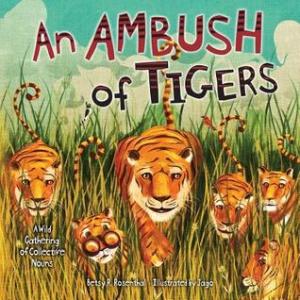
Using wordplay and clever illustrations, this book celebrates the unique and fascinating world of collective nouns used for groups of animals. From a leap of leopards jumping through the trees near a tower of giraffes to a labor of moles working alongside a business of flies, the animals and their respective collective nouns are matched up to maximize both understanding and humor. Children will enjoy exploring these words and will puzzle over why certain animals are referred to in specific ways.

Rosenthal has carefully chosen the collective nouns she highlights in her book. She also has managed to pair them with interesting imagery in her poetry, such as a troop of kangaroos selling cookies and collecting money in their pouches. She uses rhyming couplets to make the book even more fast-paced and jaunty. The result is a book that is both fascinating and educational but also great fun.

The art by Jago takes the imagery from Rosenthal’s rhymes and turns it into pictures which add to the inherent humor. The sleuth of bears is hot on the heels of the murder of crows. His paintings make the collective nouns tangible and real, creating scenarios that are memorable.

A nice addition to the Ruth Heller books that are in most libraries, this book has a fresh tone and lots of humor. Appropriate for ages 5-7.

Reviewed from library copy.

Review: Yard Sale by Eve Bunting

Yard Sale by Eve Bunting

Yard Sale by Eve Bunting, illustrated by Lauren Castillo (InfoSoup)

Callie’s family is moving from their house into a small apartment, so they are having a yard sale. It’s a bright sunny day but Callie is filled with mixed feelings as she sees all of the parts of their lives out in the front yard for sale. Callie has visited their new apartment and seen where she will sleep. It’s even a cool bed that pulls out of the wall. But she is going to miss her friends in the neighborhood and doesn’t really understand why they have to move except that it has to do with money. When Callie sees her red bicycle being purchased by someone she gets upset and then when a friendly woman asks if Callie herself is for sale, Callie gets alarmed. In the end after the sale in their almost-empty house, Callie and her family look forward to a fresh start together as a family.

Bunting beautifully and sensitively captures the mixed feelings of moving and the additional burden of being forced to downsize due to financial reasons. She shows from Callie’s point of view how upsetting it can be. At the same time, she shows supportive parents who work with Callie to discuss her feelings and validate her emotions. The yard sale is a strong image to have at the heart of the book, demonstrating the loss of so many items of property but at the same time strengthening the image of the family who is left strong and resilient.

Castillo has created a neighborhood of friendly people, bright balloons and lots of sunshine that works very nicely here. The deep feelings expressed by the protagonist play against the dazzling day and the contrast makes the emotions all the more real. The three members of the family are clearly a unit from their similar dark hair to the color palette that holds them together as well. It is subtly done, but very effective.

A powerful book about children caught in the impact of the economic downturn, this book is not bleak but rather filled with hope for the future. Appropriate for ages 4-6.

Reviewed from library copy.

Review: The Porcupine of Truth by Bill Konigsberg

The Porcupine of Truth by Bill Konigsberg

The Porcupine of Truth by Bill Konigsberg

17-year-old Carson has moved from New York City to Billings, Montana with his mother to take care of the dying alcoholic father he hasn’t seen in 14 years. When they first get to town, his mother drops Carson off at the zoo to spend the day while she handles the initial contact with his father. At the zoo, Carson meets Aisha and finds himself able to speak to a pretty girl for the first time. Aisha is cool, she doesn’t mind his odd sense of humor, and she is also a lesbian. Carson also discovers that Aisha is homeless, thrown out by her father once he found out about her sexuality. Carson begins to discover that there are secrets in his own family, ones that lead him and Aisha to head out on a road trip to explore what happened to his grandfather and what caused him to leave his family and never return. Carson hopes that the answers to these secrets may be enough to help his father heal, but they also have the potential to hurt him badly as well.

I adored Openly Straight by Konigsberg and I am equally excited about this novel. In both, Konigsberg manages to speak to the gay teen experience but he does it in very inventive ways. The focus here is on Carson, a white straight male, but one who is beautifully and hauntingly damaged. Throughout the book, that damage is explored and exposed. Aisha is an incredible character too, an African-American lesbian character who refuses to be anyone’s sidekick or any novel’s secondary character. This is her journey as well, though the two of them are looking for different things along the same path. Konigsberg also takes a hard look at AIDS and early gay activism in this novel, something that is important for modern teens both gay and straight to understand.

I am rarely a fan of road trip novels since they often meander too much for my liking. That is not the case here where the journey is part of the discovery about the characters. The journey is also a way to give these two teens time to talk about big things like families and faith. It offers the core of the novel, a connection between two very different personalities where both of them discover home in one another. Even better, it’s not a romance book at all even though it has a male and a female in the lead roles. Hurrah!

An important addition to the LGBT collections, this book explores faith, sexuality, and family with humor and depth. Appropriate for ages 14-16.

Reviewed from ARC received from Scholastic.

Review: Woodpecker Wham! by April Pulley Sayre

Woodpecker Wham by April Pulley Sayre

Woodpecker Wham! by April Pulley Sayre, illustrated by Steve Jenkins

In brief stanzas of rhyme, this nonfiction picture book looks at the habitats and lives of a variety of different species of woodpecker. Starting with finding food, the book explores woodpeckers eating insects and sap. Then woodpeckers bathe and preen. They create homes by digging holes in the bark of trees. They hide from hawks. They lay eggs and the chicks hatch, forcing the adult birds to scrounge for food for them. The fledglings start trying to fly and then fall comes and once again woodpeckers are searching for food and shelter to get them through the winter.

Sayre and Jenkins continue their partnership that started with Eat Like a Bear in this new book. Sayre writes with a light hand, creating a sense of exploration and wonder around these backyard birds. Children will learn some things from the brief poetic text and there is a lot more information to be found on the back pages where individual species are identified and all of the subjects are expanded upon.

Jenkins continues to create illustrations that amaze. With his cut paper collages, the illustrations pop on the page as the birds fly, hide, peck, eat and reproduce. I love that the color of the sky changes from one page to the next, creating moments in time rather than one continuous time period. The result are illustrations that stand on their own in terms of beauty and the incredible detail that they offer readers.

Beautiful and informative, this nonfiction picture book will have children gazing out of their windows to try to see the birds in their neighborhood. Appropriate for ages 4-7.

Reviewed from copy received from Henry Holt and Co.