Review: March: Book Two by John Lewis

march book two

March: Book Two by John Lewis, Andrew Aydin and Nate Powell

The powerful second book in the March graphic novel series continues the true story of the Civil Rights Movement. Told by John Lewis in the first person, this book captures the dangers and violence faced by the Freedom Riders as they headed into the deep south. The nonviolent campaign for civil rights faced beatings, police brutality, bombs, imprisonment and potential death. Yet they found a way to not only keep going but to continue to press deeper and deeper into the south. This book is a harrowing read that shows how one young man became a leader of in civil rights and politics in America.

Lewis’ personal story allows readers a glimpse of what was happening behind the scenes. Historical figures like Martin Luther King, Jr. and Malcolm X make appearances in the book, and their own personal perspectives on civil rights and nonviolence is shared. The pushback on the nonviolent aspect of the movement is also shown clearly on the page when new people joined the cause. This shift towards more reactionary tactics threatens to undo the progress that had been made to that point.

Thanks to the graphic novel format, there is no turning away from the violence. Beatings are shown up close and will a frenzy that is palpable. The dangers are not minimized nor overly dramatized, they are shown honestly. There are unforgettable moments throughout the novel, some of them small like a boy being encouraged to claw out a civil rights worker’s eyes.  Other moments are larger from the mattress protests in the jail to the march of the children and the police brutality that followed.

Immensely strong and powerful, this graphic novel series allows us to see how much progress was made thanks to these civil rights heroes but also inspires young readers to make more progress against the continued racism in our society. Appropriate for ages 13-15.

Reviewed from library copy.
Review: Families, Families, Families! by Suzanne Lang

families families families

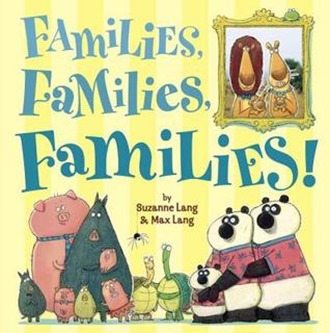
Families, Families, Families! by Suzanne Lang and Max Lang

Released March 24, 2015.

In rhythmic rhyme, this picture book celebrates each and every kind of family there is. Starting with families with lots of siblings, the book quickly moves to embrace only children, families with gay and lesbian parents, single parent families, and children who live with extended family. Then the book moves into other differences like step families, adoption, and parents who may or may not be married. Towards the end, the book gains momentum and speed and rushes merrily through silly types of differences in families, that underline how the most important thing in each of these different sorts of families is the love that is there.

The rhyming text has a friendly bounce to it and that ramping up of speed at the end of the book is a great twist and a grand way to reach the loving finale. The book maintains a great sense of humor throughout, both in its words and its illustrations.

The illustrations are done with cartoon cut outs placed on photographic backgrounds and then mounted as pictures in a photo album. The use of both cartoons and photographs gives this book a fresh approach. The illustrations also use animals instead of people, making it all the more friendly and approachable for small children who will enjoy finding their own kind of family on the page, probably more than once!

Funny, friendly and embracing everyone, this picture book is all about the love within families and acceptance for all. Appropriate for ages 3-5.

Reviewed from digital galley received from Edelweiss and Random House.

Review: Small Elephant’s Bathtime by Tatyana Feeney

small elephants bathtime

Small Elephant’s Bathtime by Tatyana Feeney

While Small Elephant is happy to play in water or drink it, he doesn’t like taking a bath at all. His mother tries all sorts of thing to entice him into the bathtub. She fills it with plenty of toys. She blows bubbles in the air. But nothing works. Small Elephant tries to be too busy to take a bath and gets very mad when his mother insists on a bath. He has a tantrum and then hides from the bath. Then his father gets involved and makes Small Elephant giggle enough to try out the bath after all. But who will be able to get him out when he discovers how much fun he is having?

The author of Small Bunny’s Blue Blanket and other picture books has a winner with this title. Just the right playful tone is set here for toddlers who are also reluctant to stop what they are doing to take baths. The gentle approach of both parents is great to see, offering options towards tantrums and reluctance that are inventive and filled with humor.

As always Feeney’s art has a refreshing looseness about it. Line drawings with splashes of watercolor color, the book has an aesthetic that will appeal to children and adults alike. It uses limited colors to great effect, creating a cohesive and playful feel.

Soapy, sudsy, bubbly fun for small children who will relate to the emotions Small Elephant feels.  Appropriate for ages 2-4.

Reviewed from digital galley received from Edelweiss and Knopf Books for Young Readers.

Review: Red Butterfly by A. L. Sonnichsen

red butterfly

Red Butterfly by A. L. Sonnichsen

Kara was abandoned as an infant and taken in by an American woman living in China. Her Mama never leaves the apartment they share and Kara doesn’t attend school. Kara does get to leave the apartment each day to run errands on her bicycle, her favorite time of day. In China where the one-child limit is in effect, parents leave infants who have physical challenges like Kara who was born with one hand with only two small fingers on it. Mama longs to return to the United States, but she can’t without abandoning Kara, who has no identification papers and has not been formally adopted. When Mama’s American daughter comes to visit, Kara finds their entire lives turned upside down and their secret exposed. Will Kara be able to bring their family back together again?

Told in lovely rich verse, this novel is elegantly written and conceived. It shows the results of the one-child policy in China and the children who were abandoned because of it. Yet it is far from a condemnation of China or the United States. It is a portrait in contrasts and complexity, showing that there is good and bad in both systems. It is also the story of one very strong young girl who has already lost one family and is determined not to lose another.

Kara is the voice of the book with the poems told from her point of view. She is unique in many ways, including being able to speak English better than she Chinese due to her upbringing. Kara’s disability is handled in a matter-of-fact way for the reader. While she is profoundly ashamed of it, her hand and disability do not label her at all in the novel. Kara’s situation is complicated by the politics of adoption and identity. In her journey to a resolution of where she will live, there are episodes in an orphanage and then later in a home in the United States. These are all deftly and clearly drawn, showing both the universal nature of family and love but also the differences in cultures.

Radiant verse and a very strong young protagonist make this verse novel a treat to read. The unusual subject matter of an older orphan from China makes it a unique read. Appropriate for ages 9-12.

Reviewed from copy received from Simon & Schuster Books.

Review: Wolfie the Bunny by Ame Dyckman

wolfie the bunny

Wolfie the Bunny by Ame Dyckman, illustrated by Zachariah OHora

When the bunny family came home, they found a little bundle on their doorstep. It was a baby wolf! Mama and Papa were thrilled to take him in, but Dot knew that the wolf was going to eat them all. Still, the bunny family took Wolfie in. Dot kept an eye on him all night long, and tried again at breakfast to warn her family that they were going to be eaten. No one listened, again. Finally, Dot’s friends agreed that Dot was right and they went to play somewhere else. When she got back, Wolfie would not leave Dot alone. Days went by and Wolfie started to grow and grow. He also started to eat and eat, so Dot was sent to the store along with Wolfie. It was there that Wolfie finally showed his fangs, but it doesn’t turn out in the way that Dot was expecting!

Dyckman has created a very clever little book that shows adoption and new siblings in a fresh way. Dot is convinced from the very beginning that taking in Wolfie is a bad idea and that it will be catastrophic for her family. This feeling of doom is very much what human children feel when a new baby is announced. Wolfie goes through all of the steps of a new sibling, from getting all of the attention to being a pest. Yet through the entire book, Dyckman keeps the focus on wolves and bunnies and how it will all play out, creating a welcome added dynamic to the story.

OHora’s illustrations add to the humor on the page. Done in acrylic, the illustrations have a signature flat feeling to them that is very modern. They capture the cheerful bunny family, the worried Dot, and the adorable Wolfie. OHora also creates a dynamic neighborhood for the story to take place in that makes the entire book feel grounded and real. Or as real as a book about wolves and bunnies can be.

Clever, funny and bright, this picture book captures have a new sibling in a fresh way. Appropriate for ages 3-5.

Reviewed from library copy.

Review: My Name Is Truth by Ann Turner

my name is truth

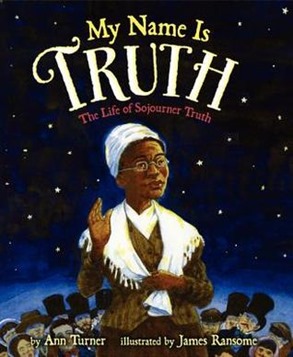
My Name Is Truth: The Life of Sojourner Truth by Ann Turner, illustrated by James Ransome

Told in her own voice, this picture book biography captures the childhood and emergence of Sojourner Truth as an orator and activist. The first pages of the book show the horror of slavery, the loss of family members when they are sold away, and the damage of loss, grief, battery and ownership. Then with her baby in her arms, Sojourner runs away, finding shelter. She eventually fought to get her son back with her, and finding her voice. Moving to New York City, she gains her new name of Sojourner Truth and begins to speak out. From wagon backs to formal lectures and then in print, her words travel and help destroy the institution of slavery across the nation.

Turner weaves Truth’s words into the text, creating poetry that is fiery and honest and burns with indignation about slavery. Using her own voice to narrate the story is a great decision, allowing readers to really see what has built the passion upon which Sojourner Truth draws again and again. The horrors of the loss of twelve members of her family never leaves her and it never leaves the book, as it begins and ends with that focus. The entire book is beautifully drawn and historically accurate. Readers can read the author’s note at the end and teachers will appreciate the book being reviewed for accuracy by experts.

Ransome’s illustrations are luscious and lovely. He shows the hard work, grueling labor of slavery and then with one page of running away, Sojourner Truth expresses freedom in the form of a large bed of her very own, something she has never experienced before. It is an image that is powerful and one that children will understand intuitively. As the book progresses, the images grow in power and strength as she comes into her own.

Strong, poetic and filled with history, this picture book biography of Sojourner Truth will be embraced by schools and public libraries alike. Appropriate for ages 6-9.

Reviewed from library copy.

Review: Such a Little Mouse by Alice Schertle

such a little mouse

Such a Little Mouse by Alice Schertle, illustrated by Stephanie Yue

A little mouse lives in a hole in a meadow under a clump of dandelions. In the spring, he heads out of his home and explores the area around him. He sees a snail, a woodpecker and buzzing bees. He also sees himself reflected in a puddle. And each day he brings home a seed that he stores away in his storeroom. In the summer, the little mouse watches beavers building a dam in the pond, visits a toad, and sees a porcupine. He brings a sprig of watercress home each day and adds that to his storeroom. In autumn, the little mouse watches geese flying, ants marching, and brings home an acorn to his storeroom which is filling up. In winter snow falls and the little mouse can’t see the grass anymore. He heads right back into his hole and stays there, well fed and warm.

This picture book explores seasons and the changes seasons bring in nature from a gentle and cheerful mouse perspective. It captures the natural rhythms by echoing them in the writing.  Little mouse leaves his hole the same way no matter what the season, by counting to three and popping out. Then he explores, discovering three things in nature to pay attention to. Some small and some large. Schertle’s tone invites young readers to take a look at the nature outside their own holes and visit it each day to see the changing seasons.

Yue’s illustrations also show nature as a place to safely visit and explore. The illustrations celebrate nature and its beauty and variety. They also pay homage to classic stories like Peter Rabbit while down in the mouse’s burrow with his homey furniture and then his baking and soup making in the winter months.

A simple story, but one that has a wonderful rhythm and poetry to it that moves it to the top of the large pile of seasonal stories. Appropriate for ages 3-5.

Reviewed from copy received from Scholastic.

Review: The Bunker Diary by Kevin Brooks

bunker diary

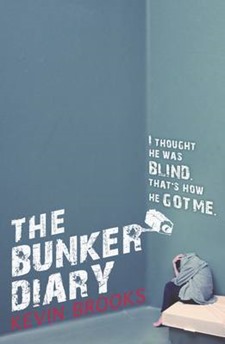
The Bunker Diary by Kevin Brooks

The controversial winner of The Carnegie Medal in 2014 has arrived in the United States. It is the story of Linus, a teenager living on the streets who is kidnapped and placed in a bunker. The bunker has six bedrooms, a kitchen and a bathroom. In the kitchen are six plates, six cups, six sets of plastic utensils. Each room has a Bible and a notebook and pen. There is is no hot water, only cold. Linus is there alone at first but then others start to arrive. Someone is watching them through the vents in the ceiling, even in the bathroom there are cameras and microphones. That someone responds to written requests for food and supplies via notes sent in the elevator. Until someone does something wrong, then the food stops and the real horror begins.

Brooks has crafted an intense and horrific story here. It could have descended into pure hate and the proof that people are inherently evil. But something else happens here. There is hope, there are dreams, there are memories of human connection, and new connections are forged too. At the same time, there is no denying that it is bleak and desperate and frightening. It is a book that asks what you would do in this circumstance, who you would become. It is a book that challenges, that doesn’t offer easy answers and that is beautifully terrible.

While Linus is the narrator of the book with the story told in his own writing in his notebook, the story is also that of the others in the bunker with him. They are all just as well crafted, their responses to their kidnapping entirely personal and appropriate for who they are, and there are at least two of them who are heroes of the story too. They are the ones that imbue it with humanity and make the book worth the endurance needed to finish it.

Powerful, compellingly written and achingly human, this novel is challenging and exquisite but certainly not for all readers. Appropriate for ages 14-17.

Reviewed from digital galley received from Edelweiss and Penguin.

Review: Special Delivery by Philip C. Stead

special delivery

Special Delivery by Philip C. Stead, illustrated by Matthew Cordell

Sadie knows that you can’t just put an elephant in the mailbox, instead you have to go to the post office. So she heads there to see how many stamps it will take to send the elephant to her Great-Aunt Josephine who lives alone and could use the company. It takes far too many stamps and too much money to mail the elephant, so Sadie looks for another solution and decides to fly. But elephants are heavy and the plane sputters out and crashes before they reach their destination. Sadie asks a nearby alligator to guide them down the river and then jumps aboard a train where a group of monkey bandits armed with bananas try to rob them. Sadie and elephant join them and have a great time until they tire of eating beans for every meal. Finally, they board an ice cream truck after purchasing ice cream sandwiches for the bandits and arrive at Great-Aunt Josephine’s. However, she may not be as lonely as Sadie thought!

Stead has written a rich imaginative tale that takes readers on a wild journey. Sadie is undaunted by adversity, simply figuring out what to do next to get them closer to their destination. The entire book is unhindered by logic like pilot licenses and the thought of mailing an elephant.  Instead the world in this picture book is filled with an off-center zing that means each of Sadie’s original ideas are embraced by everyone. It’s a refreshing and fun approach to the story.

Cordell’s illustrations are wonderfully scribbly and loose. They capture the wild spirit of the book, the silliness and the move from one awesome idea to the next. I particularly enjoyed the illustrations of the post office and the great-aunt’s home. Both are simply people standing underneath trees that are shedding their leaves. This cheery openness and connection to nature immediately will have every reader knowing that this is an unconventional book.

A terrific picture book that offers up a cheery, silly and fun-filled journey with an elephant as a companion. Appropriate for ages 4-6.

Reviewed from copy received from Roaring Brook Press.