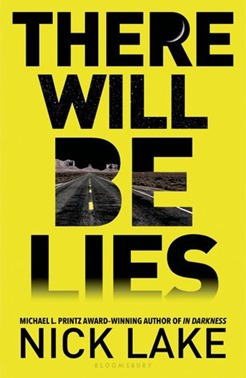
Review: There Will Be Lies by Nick Lake

there will be lies

There Will Be Lies by Nick Lake

Shelby is about to be hit by a car, in four hours.  She lives an isolated life with her mother, one where she is homeschooled and doesn’t really know anyone else outside of the online forums she visits without her mother knowing.  Every Friday they have a day out, one with ice cream for dinner, batting in the batting cage, and a visit to the library.  There’s a cute boy there that Shelby has seen, another thing that her mother doesn’t know about.  But the car is coming, and Shelby’s quiet life is about to change.  After she is hit by the car, a coyote appears to her, warning her that she will be told two lies and then she will know the truth.  Immediately after she is released from the hospital, her mother takes her away in a car, fleeing from dangers that only her mother understands.  As Shelby begins to see her mother in a new light, she also starts leaving real life and spending time with Coyote in The Dreaming, a place where she is responsible for saving the world.  And soon she will have to deal with the truth and that may be a lot harder than dealing with the lies along the way.

Lake has written a book that is a real page turner.  Readers will know immediately upon meeting Shelby that something is wrong with her living situation, though it is vague enough to be almost anything.  I don’t want to ruin at all that exploration of the lies and truth, because it is a large reason the book is so compelling to read.   Lake has also constructed the book so it’s a count down.  First readers know that the car accident is coming.  Then readers will see that the chapter numbers are counting down, one after another towards another impact, one that readers know is coming but can’t avoid or quite understand yet. 

One of the revelations that comes early in the book is Shelby’s deafness.  Written in the first chapters without any acknowledgement, readers will be stunned by the news that Shelby is 90% deaf.  Then they piece together the clues of it, the many gestures used as she communicates with her mother, the subtitles, the way her mother tells her to be careful because she is special.  I appreciated this treatment so much because Shelby is a person first and then her disability is revealed.  Exactly the way it should be. 

Strongly written, compellingly structured, with one strong and very human heroine, this book of family, lies and truths is a riveting read.  Appropriate for ages 14-17.

Reviewed from digital galley received from Bloomsbury and Edelweiss.

Review: A Fine Dessert by Emily Jenkins

a fine dessert

A Fine Dessert: Four Centuries, Four Families, One Delicious Treat by Emily Jenkins, illustrated by Sophie Blackall

Released January 27, 2015.

Follow one recipe through the centuries in this exceptional picture book!  Starting over 300 years ago in England, the book starts with a mother and daughter out picking blackberries.  Once home, the mother skims cream from the milk from their cow and whips it with a bundle of twigs for 15 minutes until she has whipped cream.  That is combined with squashed and strained blackberries mixed with sugar to create blackberry fool.  The fool then needs to be cooled, so they head to the hillside to chill it with sheets of winter ice that they store there.  Then the family enjoys it and the little girl licks the bowl clean.  As readers turn to the next family in Charleston, South Carolina about 200 years ago, they will notice so many changes just not in the recipe itself.  The method of refrigeration changes, the method of whisking the cream and the time it takes, the way they get the ingredients, and the family setting.  Next comes even more changes as the setting turns to a century ago in Boston and then the final family, a modern San Diego father and son.  Each family brings updates to the methods but enjoys the delicious dessert exactly the same way, with gusto!

Jenkins has an author’s note at the end of the book that further explains and points out the changes from one century to the next in the way food is procured and prepared.  Even the use of actual recipes only appears in the final family.  Written in a jolly way, this picture book uses repetition and patterns to make sure that children will see the differences in the way the food is prepared as the time passes.  It is a fascinating look at how food preparation has progressed but also in how very much has stayed the same.

Blackall’s illustrations are playful and clever.  She too uses repetition in her illustrations, showing the joy of licking the whisk or spatula and the final head dive into the bowl after the meal is complete.  There is a simplicity to her art as well, allowing the settings she conveys on the page to speak clearly.  One knows even without the words that you are in a different time and place thanks just to the illustrations.

A joy to read and share, this book has all the delight of a great dessert but is also packed full of historical information and detail.  Appropriate for ages 6-9.

Reviewed from digital galley received from Schwartz & Wade and Edelweiss.

Review: The Terrible Two by Jory John and Mac Barnett

terrible two

The Terrible Two by Jory John and Mac Barnett, illustrated by Kevin Cornell

Miles is moving to Yawnee Valley along with his parents, a place with larger spaces, bigger lawns, and lots of cows.  He had been known in his last school as the prankster, but upon arrival at his first day of school Miles discovers that there is another prankster already at work.  That prankster has put the principal’s car at the top of the stairs to the entrance to the school, blocking it so that no one can enter.  So Principal Barkin is forced to have each and every kid at school climb through his car to enter the building.  Of course, he could also have had them use the back door…  Miles is introduced to Niles, a model student who is assigned as his buddy.  Niles is immensely annoying, perfect in class, kissing up to the teacher.  But NIles is also the prankster who pulled off the car stunt.  As the two become rivals, a pranking war begins, one that involves insects, pie, forgeries, and lots of cake.  Who will reign supreme at the school and will Principal Barkin survive it?

This book, which I assume is the beginning of a new series, will be adored by kids.  It has exactly the right tone and sense of humor.  The two rival boys are a delightful contrast to one another, yet equally likeable and one isn’t quite sure who to root for so you end up rooting for the prank to be great.   And what pranks they are.  Principals may not enjoy the humor here, but it is much more about this one school and a principal who loses his cool regularly than about any real prank being pulled in a real school setting.  The pranks are elaborate enough that no one is going to be taking real cues from this book.

Cornell’s illustrations add to the humor.  I particularly enjoy the cows, the cow facts done as a list, and the rubber chickens.  The book has a wonderful wildness to it, an edginess of a prank about to go wrong, that is also reflected in the zany art.  Reluctant readers will enjoy the breaking up of the text into manageable chunks. 

Get this into the hands of fans of the Diary of a Wimpy Kid books and those who are outgrowing Captain Underpants.  Appropriate for ages 7-10.

Reviewed from ARC received from Abrams Books.

Review: A Poem in Your Pocket by Margaret McNamara

poem in your pocket

A Poem in Your Pocket by Margaret McNamara, illustrated by G. Brian Karas

The third in the Mr. Tiffin’s Classroom series, this book focuses on Elinor, a girl who just wants everything to be perfect.  Unfortunately though, poetry and perfection really don’t work together no matter whether you are talking haikus, concrete poems or rhyming stanzas.  A poet is going to be visiting their school and Elinor desperately wants to impress her with her poetry.  But as the time goes by, the pressure builds and Elinor becomes less and less able to write poetry.  When she finally does start writing, she’s not happy with any of the poems she has written.  Can the kind teacher Mr. Tiffin find a way to let Elinor know that it’s OK to make mistakes?  Maybe this is a job for a poet!

This is a wonderful addition to an already strong series.  McNamara “perfectly” captures the trap of perfectionism for students and the pressure that it builds in a person.  Tying it to poetry was inspired, something that doesn’t work with tension or pressure but instead relies on inspiration and creativity.  Elementary students will see themselves in both Elinor and her classmates who are more relaxed about the entire thing.  Watch for the poem that ties to How Many Seeds in a Pumpkin? for fans of the series. 

Karas’ illustrations continue in his signature style that is playful and friendly.  His drawings add to the accessibility of the entire book and the series as a whole. 

A winning addition to a popular series, this third book will delight during poetry units and may inspire a more relaxed approach to writing too.  Appropriate for ages 6-9.

Reviewed from digital galley received from Schwartz & Wade and Edelweiss.

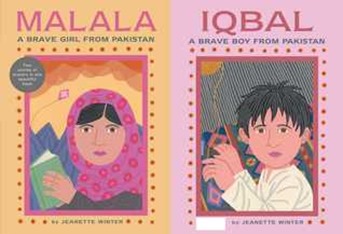
Review: Malala, a Brave Girl from Pakistan/Iqbal, a Brave Boy from Pakistan by Jeanette Winter

malala iqbal

Malala, Brave Girl from Pakistan/Iqbal, a Brave Boy from Pakistan by Jeanette Winter

This nonfiction picture book celebrates the accomplishments of two young heroes from Pakistan.  Told side-by-side, in a book that flips over, the two young people both managed to make real changes in their country.  Malala Yousafzai is a very well-known heroine who fights for the rights of young women in Pakistan to have an education.  Iqbal Masih has also won human rights awards and fought for the end of child slavery in the carpet industry.  Both of them were shot as a result of their efforts to change their country.  Tragically, Iqbal was killed while Malala survived and continues to inspire people around the world.  These are examples of children who created the change their country was desperate for, changing the lives of other children through their efforts.  True heroes in every sense of the word!

Winter begins each of these nonfiction stories with an Author’s Note that explains in detail the life of the young person.  The story parts are told in spare text that shows on every page the ferocious pride that Winter has for their work.  There is an anger on the page, one that is exactly the right tone for what is happening in their stories.  While Iqbal may be lesser known to American children than Malala, their stories are so supportive of one another that the pairing strengthens both their stories.  Readers may pick up the book for Malala and along the way learn of this boy whose efforts were just as amazing.

Winter’s illustrations have the feeling of framed artwork on the page.  Done in strong colors, they have a beauty and straightforward nature that works well with the subject.  There is a directness here that you will also feel in the writing, the two combining to make a book that hits hard at what injustice there is in the world but also at how important children can be in realizing change.

A beautiful and inspiring picture book that adds diversity and true child heroism to your shelves.  Appropriate for ages 5-8.

Reviewed from copy received from Beach Lane Books.

Review: Emmanuel’s Dream by Laurie Ann Thompson

emmanuels dream

Emmanuel’s Dream: The True Story of Emmanuel Ofosu Yeboah by Laurie Ann Thompson, illustrated by Sean Qualls

Emmanuel was born in Ghana, West Africa, with a deformed leg.  His father left the family but his mother continued to encourage Emmanuel to make something of himself.  Emmanuel taught himself to crawl and hop, so he was able to hop the two miles to school and then hop all the way back home at the end of the day.  At school kids would not play with him at first, so he saved up his money to buy a new soccer ball that he shared with the others as long as they let him play too.  Soon he was playing soccer using crutches to get around.  It was at school that Emmanuel also taught himself to ride a bike.  Then his mother fell ill and Emmanuel had to leave school to support his family.  He headed for the big city of Accra where he looked for a job.  It took time, but he started working as a shoe shiner and for a restaurant that also gave him a place to stay.   He sent money home and two years later returned home because his mother’s health was failing.  After her death, he decided to follow his dream to bike around Ghana.  He worked to get help with his dream, becoming a spokesperson in his country for people with disabilities.  He completed his journey of 400 miles in just ten days, an amazing journey that proved that one person’s dreams could deeply change a culture.

Thompson’s writing is in stanzas and moves between feeling like poetry and prose.   This fluidity makes the book very readable, it also lets her make her points with a grace and brevity that is purely poetic.  Thompson’s text shines with her appreciation for Emmanuel and his achievements in life.  Where his culture told him that he was cursed and unworthy, he has become a hero.  It is also a sort of tangible heroism that children will completely understand.  They will know what his achievement is and how difficult it would be to accomplish.

Qualls’ illustrations are incredible.  Filled with beautiful people, strong color, patterns and light, the illustrations let the backgrounds fade to white and black and the people come forward and shine.  Bright colors ripple across skin, fill cheeks, and color the air around people.  There is a sense of life within these illustrations, one that can’t be contained.

A truly inspiring story that shows the creation of a national hero from his infancy through his achievements.  Appropriate for ages 7-9.

Reviewed from digital galley received from Random House and Edelweiss.

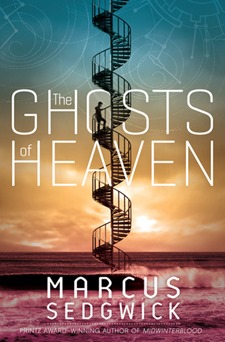
Review: The Ghosts of Heaven by Marcus Sedgwick

ghosts of heaven

The Ghosts of Heaven by Marcus Sedgwick

Sedgwick once again takes readers on a unique journey, this time all bound together by spirals both symbolically and tangibly.  Told in four sections, which Sedgwick explains can be read in any order, the book begins in Paleolithic time with a young girl who has become a woman but not yet borne children being selected to travel to the special caves where someone more important with do the painting on the cave walls.  She is meant solely to climb the walls burdened with his supplies.  But the story twists and turns away from what is expected into a different story entirely.  The second tale is of the witch hunts in England, where another girl is trying to survive after her mother’s death.  Her mother was the cunning woman of the village, caring for the health of everyone.  And the girl has caught the eye of the landowner’s son, but things are not that simple and when a new religious leader comes to town, the girl finds herself at the sharp end of his attention.  The third tale brings readers into the world of a 1920s asylum for the mentally ill where a poet who is incarcerated there is obsessed with spirals and draws a young doctor into his world.  The final story is set in the future, aboard a spaceship where only one person wakes at a time, keeping the ship maintained as it heads on its lengthy journey that will save the human race.  Then things start going wrong.  Four stories, each spiraled with one another into a whole novel that is dark, deep and incredibly engaging.

Each of these stories stands on its own merit, each one more dazzling than the next.  Yet as a whole it is where they are truly powerful, tied together with spirals of time, spirals of power, the spiral of humanity too.  Sedgwick excels at creating tension in each of these stories, each building ever so cleverly and enticingly towards an ending that readers long to arrive and yet dread.  Sometimes you know where they are headed, others you have no idea, and in each there are connections to the others, echoes from one story to the next through time and space.

This is a book that requires strong teen readers.  Some of the stories are less about teens than about adults, yet it is the stories of those teen girls that echo through time, tying the stories into one novel.  It is a book that will be welcomed in high school classrooms, one that insists on discussion, one that will resonate with certain readers who see the world as one enormous spiral too.

Exquisite writing, beautifully plotted and filled with powerful tension, this novel for teens is a great way to start a  new year.  Appropriate for ages 14-18.

Reviewed from digital galley received from Roaring Brook Press and Netgalley.

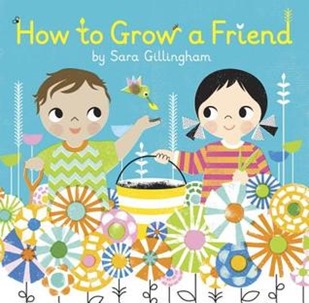
Review: How to Grow a Friend by Sara Gillingham

how to grow a friend

How to Grow a Friend by Sara Gillingham

Growing a friend is a lot like growing a flower as this picture book proves.  Just like flowers, friends need a seed and good soil.  You need space to bloom.  You need to be patient.  Sometimes your friend will bug you, but chase the bugs away together.  Don’t let your friend get stuck in the weeds.  Grow a whole garden of friends and know that there is always room for one more friend.  Along the way, the analogy of gardening strengthens the ties of the friendship, making this a very tight and strong picture book that shows that hard work, patience and time make for a great friendship.

Gillingham writes in a very earnest and straight forward tone here.  This is not a subtle analogy, but one that is presented straight to the reader.  The text of the book speaks about friendship while the illustrations show mostly the gardening aspect though at times it too is all about the human connection.  Young readers are shown clearly that friendship takes work and time.

Gillingham’s bright illustrations add greatly to the appeal of the book.  With an organic feel thanks to the texture of the prints, the illustrations have strong shapes, bright colors, and lots of patterns yet never get too busy or fussy.  They have a jaunty and frolicking feel to them that is very cheery.

Perfect for gardening and friendship story times, this picture book will have us thinking spring early this year.  Appropriate for ages 3-6.

Reviewed from digital galley received from Random House and Edelweiss.

Review: Before After by Matthias Aregui

before after

Before After by Matthias Aregui and Anne-Margot Ramstein

The passage of time is captured beautifully in this wordless book that shows one example after another of before and then after.  The book is a delightful mix of concepts with examples from nature, pop culture and plenty of humor.   An acorn before becomes an oak tree after.  A small ape before becomes King Kong after.  Ingredients become a cake and a few pages later the cake is eaten and left as crumbs.  But what came first, the chicken or the egg.  This book takes a wry and balanced view of that debate by showing both in sequence.  One never knows what the page turn will bring, and that’s part of the appeal in this clever and funny book.

Wordless books are often short, but this book is nice and thick, the entire book offering lots to think about and plenty of chuckles along the way.  While it may seem to be more for preschoolers, older elementary aged children will get more of the references in the book like the chicken and the egg and King Kong.  They will also appreciate the passage of time visually on the page as ice melts to water.  Additionally, some of the images are more complex with a cow becoming milk but also becoming a picture of a cow.  Very meta. 

For children with reading difficulties in elementary school, this would be a great book to start discussions.  It is also a wonderful way to wile away some time looking at an outstanding example of wordless art that delights.  Appropriate for ages 5-9.

Reviewed from library copy.