Review: Sparkers by Eleanor Glewwe

sparkers 

Sparkers by Eleanor Glewwe

Marah lives in a world where the magicians are in power.  She helps out in the market at the book stall and has managed to teach herself many languages in the process.  There she witnesses the brutality of the magicians and knows to fear them.  But it is also where she meets a little girl who doesn’t mind that Marah is a poor Sparker.  Soon Marah is visiting their home, which is much more opulent than her own.  She meets the girl’s brother and discovers that he shares her love of languages.  When a plague hits their city and people whom both of them love are threatened, the key to figuring out the cure is in a forbidden language.  Marah has to find the courage to trust those she fears as well as her own intelligence in order to save the world she loves and those she holds most dear.

Glewwe herself has a background in linguistics, which means that when she writes about languages it all makes sense and really clicks.  The world she has created is complex with almost a caste system of rank within it.  Tied directly to magical ability, the differences are also racial, so the entire story ties closely to our own world’s struggles with racism and bigotry in a variety of forms.  Glewwe has created a story where the children are truly those who save the world.  They cross the barriers of their society and proceed to have the knowledge themselves to create the solution, but only because they worked together. 

The world building here is exceptional.  The society is unique but also frighteningly familiar at the same time.  The central theme of exclusion and privilege and abuse of power makes for a taut novel that will keep readers going.  The mystery of the plague carries the story forward, so that readers will be compelled to read to the end to figure out the extent of the deception and greed. 

A very strong middle grade fantasy that grapples with some of the most difficult of societal issues, this book is a magical and danger-filled read.  Appropriate for ages 11-13.

Reviewed from copy received from Viking.
Review: My Grandfather’s Coat by Jim Aylesworth

my grandfathers coat

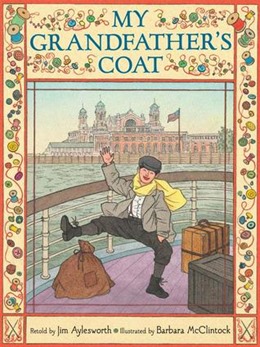
My Grandfather’s Coat by Jim Aylesworth, illustrated by Barbara McClintock

Based on a Yiddish folksong, this picture book celebrates the thrift, hard work and skills of immigrants to the United States.  Told in the first person by the grandchild, this book looks at one man who came to the US and worked hard as a tailor.  He met a woman and they got married and he made his own coat for the wedding.  He wore it everywhere until finally, it was worn it.  So then what did he do?  He made it into a jacket.  He wore that everywhere and eventually wore it out too.  So then he made it into a vest.  He then wore that until it was frayed.  The book progresses through a necktie and finally a stuffed mouse made from the last of the old fabric and even when that is eventually torn apart, a mouse finds it to be perfect for her nest. 

Aylesworth uses a repeating structure throughout this book, first introducing his character of the grandfather and then having him make a garment, wear it out, make another, and start the cycle again.  He uses just the right amount of rhythm and rhyme to hold the story together, making the repetition clear and rollicking.  It reads like a folk tale, filled with a celebration of one man and his skills at reusing things.

McClintock’s illustrations suit this subject matter perfectly.  Her artwork’s vintage feel is right at home here, creating repeating tableaus on the page that reflect the changing time as children grow up and also the process and time of recreating garments from the scraps.  Her art shows the loving family, the shrinking deep blue fabric, and the passage of time.

This story of reuse and recycling takes that modern movement and translates it directly into the frugality of our American ancestors.  Cleverly written, striking illustrated and a great read aloud, this book is appropriate for ages 4-6.

Reviewed from copy received from Scholastic Press.

Review: Beautiful Moon by Tonya Bolden

beautiful moon

Beautiful Moon: A Child’s Prayer by Tonya Bolden, illustrated by Eric Velasquez

On a moonlit night, a young boy realizes that he’s forgotten to say his prayers and hops out of bed to pray.  He notices the beauty of the yellow moon and begins to pray.  As the moon crosses the sky, it shines on the different people that the boy prays for.  He prays for people with no homes and the moon shines on a woman trying to sleep on a park bench.  He prays for wars to end and the moon shines on a man worried about his daughter who is a soldier.  He prays for the sick to be healed and the moon shines into a hospital room.  He prays that everyone has enough food and the moon shines on a family with empty cupboards and also into a food pantry.  He prays for his own family, even his pet turtle.  And back in his bed, he prays that the next night he will remember to pray.

Bolden manages to keep this book solely about prayer and the act of praying for others without defining what religion the boy is.  Her use of the moon as a unifying factor works well, creating a book that flows along in a natural way.  Bolden’s text is done in poetic form, capturing moments of people in need of prayers with a real clarity. 

Velasquez’s art is luminous.  He captures moonlit rooms and places with a cool but also rich light.  He celebrates diversity on the page, the people in the images a rich tapestry of color and ethnicities.  The little boy’s earnest face speaks volumes about the importance of prayer.

A nondenominational book about prayers, need and community support, this book celebrates the power of faith in a way that children will easily relate to.  Appropriate for ages 4-6.

Reviewed from copy received from Abrams Books for Young Readers.

Review: The Princess in Black by Shannon Hale & Dean Hale

princess in black

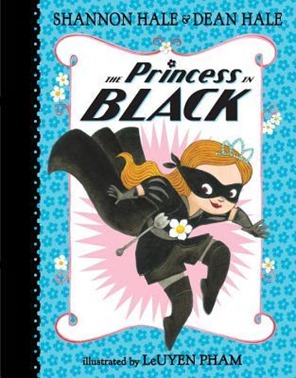
The Princess in Black by Shannon Hale & Dean Hale, illustrated by LeUyen Pham

Princess Magnolia was having hot chocolate and scones with Duchess Wigtower when then monster alarm sounded.  Dressed in along dress of pink with a tiara, no one would expect that Princess Magnolia is actually also the Princess in Black who battles monsters and protects her kingdom.  After all, princesses don’t wear black!  Waiting outside the castle is Frimplepants, the princess’ unicorn, but he is also Blacky, the trusty pony of the Princess in Black.  The two of them galloped off to face the monster who is threatening the herd of goats.  Now the princess has to save the goatherd, battle the monster, and keep her secret identity from the nosy Duchess Wigtower!

Bravo for a princess figure who neither scorns the tiaras and dresses and pink nor is limited by them for the way she lives her life!  This is one amazing young woman who transforms into a hero, but clearly lives her princess life with the same heroism and dedication as she has in her alter ego.  The writing is light and fresh with rather dim-witted huge monsters who just want a meal and remember vaguely that there is a reason they don’t eat the kingdom’s goats.  Happily too, the princess does the fighting, isn’t terrified at all, and routs the monsters from her kingdom.  Clever, strong and brave, she’s exactly the heroine that her kingdom needs.

Pham’s illustrations show a young princess who is not stick-thin or Barbie-like in any way.  Instead, she is strong in her body, built like a young girl actually is, and when she does battle it feels right and she doesn’t come off as weak at all.  The illustrations of the monsters add to the humor, though their size is daunting.

A real treat for young readers looking for a real girl doing real battle whether she is a princess or not.  Appropriate for ages 6-8.

Reviewed from library copy.

Review: 100 Things That Make Me Happy by Amy Schwartz

100 things that make me happy

100 Things That Make Me Happy by Amy Schwartz

This flowing and joyous picture book lists one after another things that make someone happy.  Told in rhyming couplets, the book has a jaunty lilt to it that moves it right along.  Though it could become stagnant, this list of happy things never does.  Instead there are little surprises as the book continues, moments that are funny, others that will have young readers nodding along about how much they too love things like sticky glue or camping trips or double scoops.  Perfect for preschoolers to celebrate what makes them happy too, this book is sure to create smiles.

With all of the attention on gratitude journals and seeing that small things in life are what makes us happy, this book fits right in.  Schwartz taps into moments of universal joy and also ones that will inspire new additions to the list.  She manages to keep each page fresh, listing the things one by one.  The font design adds to the cheerful feel as the words are shown straight, curving, and even wiggling along. 

The illustrations too carry that cheer with their bright color and plenty of movement and motion.  They show people of all races on the page, younger and older children, so everyone will be welcomed to share in the happiness.  The images that go from one large one per page to several at a time.  Those changes in pace make for a more dynamic read and one that never grows sing-songy at all.

A book that inspires smiles and pure joy, this book will have universal appeal.  Appropriate for ages 3-5.

Reviewed from library copy.

Review: Voyage by Billy Collins

voyage

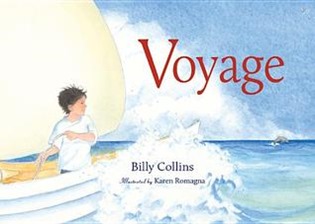
Voyage by Billy Collins, illustrated by Karen Romagna

The former US Poet Laureate wrote this poem in honor of John Cole who is the Director of the Center for the Book in the Library of Congress.  The poem celebrates reading and books, and the voyage of discovery that writing and words can take us on.  In the book, a young boy gets on a boat and travels across the open sea.  When he can no longer see land, the boat turns into a book which he starts to read.  When he finishes the book, he becomes the book.  The moon looks down as the boy returns to shore with his boat and his book.

Collins offers children a book that truly introduces them to poetry.  This is a book that asks children to stretch and understand that there is more to the story than is right on the page in the words.  The poem is about reading, about journeys, about wonder and the way that books can inspire and change us.  That is not there on the page, and yet it is there if you look for it.  This is a great book to introduce children to deeper poetry and how it too is dazzling.

Romagna’s illustrations take a literal look at the poem, offering images of what the words are depicting and also hinting at the depths behind them as well.  Filled with moments of whimsy with a friendly moon and a blowing cloud with a face, the illustrations are friendly and celebratory.

A poetic picture book that will make a great gift for book lovers, those who enjoy Billy Collins, and children who are ready for their own voyage into poetry.  Appropriate for ages 4-6.

Reviewed from library copy.

Review: Once Upon an Alphabet by Oliver Jeffers

once upon an alphabet

Once Upon an Alphabet: Short Stories for All the Letters by Oliver Jeffers

This unusual and equally marvelous alphabet book surprises and delights with its 26 short stories, one for each letter of the alphabet.  From the very beginning at “A” readers will know they have entered a rather quirky and surreal world.  A is for Astronaut, but Edmund is an astronaut whose afraid of heights.  Even climbing the ladder to the rocket is a bit much for him.  B comes right in afterwards with a tale of a burning bridge where Bob and Bernard cannot get along and so burn the bridge between their houses, but oops, one of them is on the wrong side when he does it.  The book continues, one letter after another and one story after another each with funny, intriguing characters and situations that are snapshots of the oddities of this amazing world. 

Jeffers has created some of my favorite picture books for children and this new alphabet book completely revolutionizes the sing-song of other alphabet books for children.  It’s not exclusively for preschoolers, since elementary-aged children will adore these strange little stories and the quick journeys they take you on.  Rather like potato chips, you can’t read just one but find yourself going on and on.  Jeffers also ties in previous stories to later ones.  You have to be watching, because he does it with subtlety, but it’s a lovely touch.  I admit to cheering aloud when the Lumberjack for the Letter L appeared again.

Jeffers’ art has a loose feel that works well here.  He also has a quirk to his art that matches the tone of the story very nicely.  The line drawings combine with touches of color and watercolor.  He also plays at times with the page itself, showing characters turning the page or popping out from behind. 

A delight of an alphabet book, Jeffers has revolutionized the genre with his impressive, surprising and funny work. Appropriate for ages 4-7.

Reviewed from copy received from Philomel.

Review: Cartwheeling in Thunderstorms by Katherine Rundell

cartwheeling in thunderstorms

Cartwheeling in Thunderstorms by Katherine Rundell

Having loved Rundell’s Rooftoppers, I looked forward to reading this book.  I wasn’t expecting such a different read from her first novel.  Will has grown up on her father’s farm in Zimbabwe.  She plays with the boys on the farm, spending her days on horseback, hanging out with her best friend, and exploring the land.  Her days are pure bliss, filled with golden sunshine, fresh air, and freedom.  But that is not to last.  When her father dies and their farm is sold, Will is reluctantly sent to England to boarding school by her grandfather in a plot devised by her new grandmother.  But Will does not fit in with the girls in the school who torment Will because she is different, refuses to comb her hair, and can’t do the schoolwork.  There is only one choice for Will and that is to run away and try to survive on her own in the wilds of London. 

This book moved me over and over again.  First the beauty and the freedom of Will’s life in Zimbabwe is so beautiful and written with a tension.  It’s almost as if it is a bubble that must inevitably break, and it does.  The father’s death scene is one of the most poignant deaths I have experienced in books for children.  Will’s emotions are so strong on the page, that you literally ache for her and for the further changes to come that readers will see much earlier than Will does.  Going from such beauty to such loss is wrenching and masterful.

Rundell grew up in Zimbabwe and London, so Will’s time in England is equally well drawn.  From the bullying students to the kind teacher to the people she meets on the street, Will encounters all sorts of people.  As her situation grows more dire and one thinks she can’t go on, Will draws from the years of golden sun and freedom and continues on.  Through it all, that golden light continues to shine, hope glows even in the darkest of times. 

Will is a strong, wild heroine, a girl that you want to ride bareback with across Africa and one that all readers will fall madly head over heels for.  Appropriate for ages 9-12.

Reviewed from copy received from Simon & Schuster.

Review: A Possum’s Tail by Gabby Dawnay

possums tail

A Possum’s Tail by Gabby Dawnay, illustrated by Alex Barrow

Little Samuel Drew walks along the streets of London pulling his toy dog behind him, headed in one particular direction.  He passes all sorts of people, markets, even Buckingham Palace on his way to London Zoo.  He sees many different animals in the zoo, but it’s the possum family in particular that he’s come to visit.  But when he gets there, they are all hanging upside down by their tails, fast asleep.  So Samuel heads back home again, not noticing that the possum family has woken up and have grabbed hold of the dog’s tail and are all five following along behind.  Once home after creating chaos on the London streets, Samuel serves tea to the possums.  But wait!  How will they get back to the zoo?  Another kind of tail to the rescue.

Dawnay has written this book in rhyming couplets that skip along merrily.  The pacing is brisk and the humor is whimsical and deliciously drawn out as Samuel fails to see the possums until he reaches home.  There is a delightful moment as Samuel returns homeward and passes the same people going the other way.  The text repeats itself again in a lively way, echoing the journey that Samuel made to the zoo.  

Barrow’s illustrations add to the joy of the journeys to and fro.  He first shows the bustling London streets in a straight forward way, then on the return trip the possums cause quite an uproar, though Samuel doesn’t notice at all.  Children will love looking at both sets of pictures and seeing the differences even though the words remain the same.  The illustrations have a vintage feel with Samuel in a sailor suit and the dog on a string that hearkens to books like Madeleine.

A clever cheerful read that explores London with humor and whimsy.   Appropriate for ages 3-5.

Reviewed from copy received from Tate.