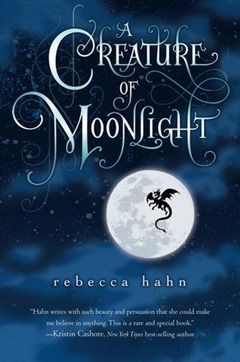
Review: A Creature of Moonlight by Rebecca Hahn

creature of moonlight

A Creature of Moonlight by Rebecca Hahn

Marni lives with her Gramps on the edge of the woods where they grow flowers that the wealthy lords and ladies from the castle come to buy.  The woods is not just a normal woods, it is filled with small creatures and a lady who has sung and knitted with Marni since she was a child.  Marni doesn’t speak with the creatures of the forest anymore, but she had spent many hours as a child with them.  Marni is not just any peasant girl, she is the daughter of the sister of the king, and her Gramps was once king himself.  The current king, her uncle, killed her mother and now may be turning his attentions to Marni.  After all she is not just human, she is half dragon, and her dragon father is expanding his woods to find her.

A large part of the delight of this book is uncovering secrets along the way.  Hahn plays with this in her many-layered story, slowly revealing things that the reader may have guessed at.  Startling readers with revelations at other times, ones that make perfect sense and click into the story with a neat precision.  Told in a series of parts, the book takes place in three distinct locales.  There is the hut that Marni lives in with Gramps and their odd but also stable life together.  There is the king’s court where Marni is not only out of place but also targeted and unsafe.  Finally, there is the world of the dragon, the lure of the woods and its dangerous beauty.

At the heart of all of this is Marni, also called Tulip, who finds herself a princess raised as a pauper.  She is separate from the royal court but not entirely, still connected through her flowers and through her mother and the violent act that killed her.  She is a girl who is strong enough to deny the fairies in the woods what they want, smart enough to survive at court without understanding the politics, and determined enough to find her father when she needs to.  She is one of those heroines who is vulnerable and real but also startling and incredible.

Complex and rich, this debut novel gives us a new voice in high fantasy for teens.  One who is definitely worth exploring and reading.  Get this into the hands of fans of Seraphina.  Appropriate for ages 14-17.

Reviewed from digital galley received from Edelweiss and HMH Books for Young Readers.

Review: Infinite Sky by C. J. Flood

infinite sky

Infinite Sky by C. J. Flood

This book begins with the death of a boy but the identity of the dead person is not revealed.  We are then taken back to the beginning of summer, three months after Iris’ mother has left their family and just as the travelers come to stay in the field near Iris’ home.  She lives with her father and Sam, her brother, who continues to struggle with his mother leaving.  Iris starts watching the travelers in the field and becomes friends with Trick, a boy who is easy to talk to and easy to listen to.  Tensions start to rise as a theft is discovered and the travelers are blamed for it.  The long, hot British summer inexorably leads towards the death of one of the boys, but who is it?  Is it Trick or Sam?

Flood’s writing is beautiful and detailed.  The setting she creates of the British countryside in summer is one that is so finely drawn that you can see it in its entirety.  In fact, you can hear it, feel it, smell it too, so clear and strong are her descriptions.  The book’s structure of starting with the tragedy that defines the story adds a great amount of tension.  Because the boy who dies is not revealed until towards the end of the book, that mystery is a focus.  Yet at times one is also lost in the summer itself, its heat and the freedom it provides.

Flood has also created a complicated group of characters in this book.  All of the characters have complicated family lives, whether it is a mother who left or an abusive father.  Yet these characters are not defined by those others, they are profoundly affected by it, but are characters with far more depth than just an issue.  This is a book that explores being an outsider, falling in love, expressing emotions, and most of all being true to yourself and doing what you know is right.

A perfect read for a hot summer day, this is a compelling mix of romance, mystery and tragedy.  Appropriate for ages 12-14.

Reviewed from copy received from Atheneum Books for Young Readers.

Review: A Mom for Umande by Maria Faulconer

mom for umande

A Mom for Umande by Maria Faulconer, illustrated by Susan Kathleen Hartung

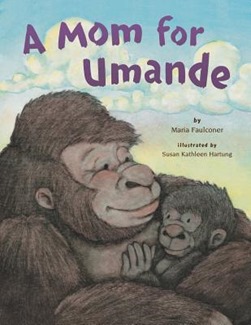
Based on a true story, this picture book tells of how a baby gorilla found a mother of his own.  When Umande was born, his mother didn’t know how to care for him.  So the keepers of the zoo had to step in and help, taking care of his infant needs and later showing him to to play and eat as a young gorilla.  After he was 8 months old, the zoo moved Umande to a different zoo across the country where Lulu, an experienced gorilla mother was waiting for him.  They were slowly introduced to one another, but soon enough they were a pair.  Umande had found his mother!

This story of a baby gorilla makes a wonderful picture book.  Faulconer uses just enough detail about the zoo staff and the efforts they took to raise baby Umande to make it fascinating.  She keeps the pace brisk and the story moving forward, making it just the right length for young readers to enjoy.  The text also reads aloud well, and this would be a nice addition to story times about mothers.

Hartung’s art captures the charm of gorillas on the page.  Even though Umande’s real mother didn’t know how to care for him, the art is carefully done to show that the gorillas are more baffled than mean or careless.  The cautious approach of the new mother gorilla and Umande as they are introduced is portrayed in a touching way on the page as is the final connection of the two gorillas.

This book is sure to speak to adoptive families as well as fans of gorillas and zoos.  It is a great pick for story times on any of these subjects.  Appropriate for ages 3-5.

Reviewed from copy received from Dial.

Review: Following Papa’s Song by Gianna Marino

following papas song

Following Papa’s Song by Gianna Marino

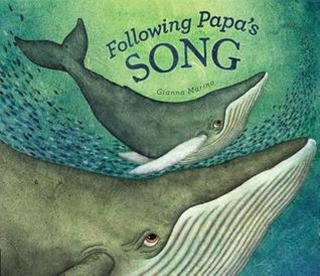
Little Blue and his Papa are traveling farther than they ever have before as they migrate, following the song of the other whales.  Little Blue has lots of the questions and his father encourages him to keep listening for the song.  As they travel, Little Blue learns about the different layers of the ocean.  Then he notices light in the darkness below and just has to head down and see what it is for himself.  He discovers a magical layer of life in the ocean, but when he heads even lower there is darkness and no other creatures are there.  Little Blue tries calling for his Papa, but his little voice doesn’t carry far in the cold water.  Then he remembers that he needs to listen and he hears his father’s call from above.

Marino paints a beautiful picture of father and child care and love.  Her use of whales and their calls is a smart choice that really makes the theme of being lost as a child work well on a higher level.  The advice to stay still and listen will also work for young humans hearing the story.  The book is simply written so that even the youngest of children can enjoy this underwater story.

Marino’s art is filled with currents and colors.  She creates light and water that dances and moves on the page, clearly creating different layers in the ocean.  I particularly enjoyed the use of bright pink to show the layer of the ocean with all of the life in it that tempts Little Blue downward.  The greens and blues of the ocean water truly come to life on the page here.

A lovely story about fathers, children and the importance of listening when you are lost.  Appropriate for ages 3-5.

Reviewed from copy received from Viking.

Review: Naked! by Michael Ian Black

naked

Naked! by Michael Ian Black, illustrated by Debbie Ridpath Ohi

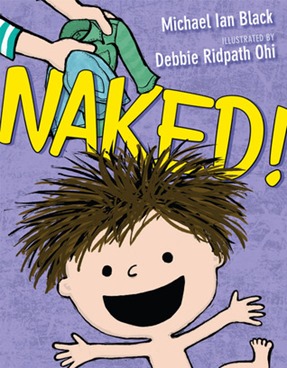
A little boy streaks naked through his house, followed closely by his mother holding a towel.  He leaves a trail of bubbles and puddles behind, shouting “I’m naked!” as he runs.  He even manages to snag a cookie and eat it naked as his mother towels him off.  Then he has a great idea!  He could just dress this way all the time: at school, on the playground, dancing…  But wait!  Capes are cool too.  So then he wears just a cape and manages to be mostly naked but also caped as he runs around.  Finally, he catches a chill and agrees because he is so cold to put on pants, a top, even slippers, though he keeps the cape on.  And it is off to bed, dressed and warm.

This book perfectly captures the joy of a young child in being entirely naked and running around.  Parents will immediately recognize the stage and children will giggle along as the child in the book dreams of all of the places he can go naked.  Perhaps best of all in the book is the mother’s response which is acceptance and then managing to get the little boy dressed without tears or tantrums.  She respects his enthusiasm but also gets him dressed in the end.

Ohi’s illustrations are vibrant and joyous.  She fills the page with the running little boy, moving across the page celebrating just how naked he is.  The illustrations are cute, clear and large format, so they will work with a group.  Beware though, reading this too a group of preschoolers could have wild results!

Silly, happy and great fun, this naked romp is one that fans of No, David! will enjoy.  Appropriate for ages 2-4.

Reviewed from copy received from Simon & Schuster Books for Young Readers.

Review: Brother Hugo and the Bear by Katy Beebe

brother hugo and the bear

Brother Hugo and the Bear by Katy Beebe, illustrated by S. D. Schindler

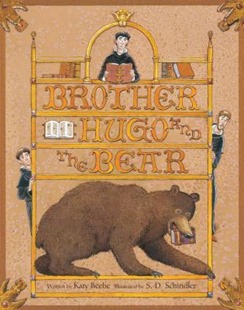
Brother Hugo’s library book is due, but he can’t return it because it was eaten by a bear!  So Brother Hugo is instructed that he must create a new copy of the book.  First, Brother Hugo has to go to the monastery of the Grand Chartreuse where they have a copy of the book.  On the way, he can hear the bear snuffling behind him, but manages to reach the monastery and safety in time.  On his return to his own monastery, he can hear the bear snoring in his sleep, so he hurries back.  Then the real work begins, but he has the help of his fellow monks.  They must get a sheepskin, stretch it and scrape it, get parchment paper, and get them ready to write upon.  Then comes making the pens and inks that will be required.  Finally, Brother Hugo must sit and copy the book word for word.  Finally, the book has to be bound.  As he worked, Brother Hugo could hear the bear and the snuffling.  When the book was completed, the monks offered Brother Hugo a clever way to get to Grand Chartreuse safely despite the word-hungry bear, but even with their help Hugo finds himself face-to-face again with the great beast looking for books.

In this book, Beebe has created a fascinating look at the treasure and value of books and the efforts that it once took to create them by hand.  By inserting the question of the bear into the book, the story moves ahead very effectively, offering a nice plot point in what could have been a much quieter tale of book making.  The bear also offers a touch of humor into the story, for even those of us who agree that books and words are as sweet as honey will be amazed at this bear’s appetite for books.

Schindler’s art incorporates word art that hearkens back to illuminated texts such as the one that Brother Hugo recreates in the book.  Done in fine lines and with precision, the art is detailed and adds much to the story.  I particularly enjoy the scenes of Brother Hugo crossing the countryside, because they clearly evoke a different time and place.

This historical fiction nicely incorporates how books were once made into a tale filled with gentle humor and one hungry bear.  Appropriate for ages 4-6.

Reviewed from copy received from Eerdmans Books for Young Readers.

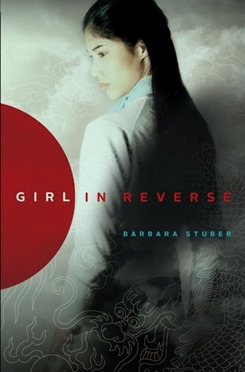
Review: Girl in Reverse by Barbara Stuber

girl in reverse

Girl in Reverse by Barbara Stuber

Lily can just barely remember her “Gone Mom” as she calls her birth mother.  She was adopted by her family when she was three years old.  All she knows is that her mother gave her up for adoption and then disappeared and has never been heard from since then.  With the Korean War brewing, Lily is the target of many “commie” jokes because of her Asian heritage.  Her parents don’t take the targeting seriously, encouraging her to ignore it.  When her little brother finds a box from Lily’s Gone Mom hidden in their attic, Lily suddenly has clues to follow about her mother.  She heads back to the orphanage that she was adopted from and finds one of the nuns who cared for her while she was there.  The nun has one last item from Lily’s mother that she has kept safe for years, which she gives to Lily, a fragile glass slipper.  As Lily and her brother begin to piece together Lily’s past, her present continues to interfere with the racial jokes getting more overt and a boy at school showing real interest in Lily as something more than a friend.  Lily must balance finding out about her past with her dreams for the future and learning to live with parents who lied to her about what had happened.

Stuber very successfully combines historical fiction with diversity in this novel.  Set in the 1950s, Lily struggles with how to react as racism becomes the norm during her school day.  Lily finds support with a janitor at the school while she is serving detention for leaving school grounds after being bullied.  He is a warm and wonderful African-American character who can speak and put words to what Lily is going through. 

The characters in the book are all robustly written and fully explored.  Even Lily’s dysfunctional parents have depth to them, reasons for their deceit, and the ability to learn and change.   Stuber’s prose is lovely, walking us through emotions and moments in a beautiful way.  Here is how she describes Lily’s mother on Page 208:

My father may wear the pants in the family, but Mother wears the perfume – her mood reigns, soaks everything, rules the day, the night, and everything in between.  But at this moment I cannot sniff her mood.

Beautifully written with complex characters, this middle school book takes us into history on a personal level.  Appropriate for ages 11-13.

Reviewed from copy received from Margaret K. McElderry Books.

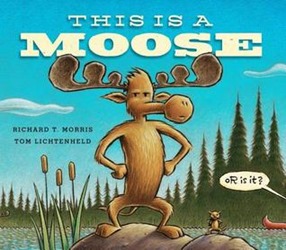
Review: This Is a Moose by Richard T. Morris

this is a moose

This Is a Moose by Richard T. Morris, illustrated by Tom Lichtenheld

A movie director is trying to create a documentary about the Mighty Moose.  You know, the ones that eat plants and drink from lakes.  But instead what he gets is a moose who wants to be an astronaut.  And his grandmother who wants to be a lacrosse goalie.  And somehow a giraffe who wants to be a doctor is also brought into the  movie!  Then there is a grand plan to get the moose who wants to be an astronaut into space.  No matter what the poor director does, no one pays him any attention just doing what they want to do.  There are plenty of more twists along the way too in this hilarious picture book.

Morris writes with an ear for dialogue and yelling.  The book reads aloud perfectly, the tones matching the fonts, the silliness reaching amazing heights.  At first the book is serious with the mighty moose, but that lasts only for a page or two before it becomes pure farce, which will delight young listeners.  They will also delight in the fact that the “adult” voice of the director is ignored for much more fun pursuits as the character join forces to launch the moose into space. 

Lichtenheld’s illustrations add to the laughs as the characters stand up to the structure of the book and completely mess with the system.  Lichtenheld plays with perspective, throws the characters bodily around, and adds plenty of motion to the page.  This is one wild and silly book, a farcical festival.

Got silly kids?  Get this book!  Guaranteed giggles in no time at all.  Appropriate for ages 4-6.

Reviewed from library copy.

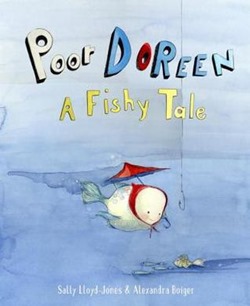
Review: Poor Doreen: A Fishy Tale by Sally Lloyd-Jones

poor doreen

Poor Doreen: A Fishy Tale by Sally Lloyd-Jones and Alexandra Boiger

Mrs. Doreen Randolph-Potts is a very rare Ample Roundy Fish who is headed to visit her cousin who has just had a baby, or 157 babies to be exact.  So Doreen is swimming down the river when she spots what she thinks is a tasty dragonfly, but it is not.  It is actually a lure held by a fisherman, but Doreen does not know that and she gulps it down.  Soon Doreen is lifted into the air and plunked into a basket.  She thinks she is just there for a little rest before she heads on her journey, but she is wrong again.  Instead a Great Heron snaps her up and carries her off.  But as he has her in his jaws, Doreen thanks him for the ride.  She then manages to insult him by asking if he is an egret and when he tries to answer her she falls down, down into the water again.  So that leaves two very embarrassed creatures:  a fisherman and a heron who both lost their catch that day and one rather confused but safe Doreen who makes it to her cousin’s home with a great story to share.

Doreen is a great character, always looking on the bright side of her world though in a rather confused way.  She’s an optimist through and through, one who always sees the best, though sometimes at her own peril.  The book is designed to be read aloud with the fonts leading readers along the way.  It has great pacing for sharing aloud as well as a good amount of humor which always helps.  The language of the writing is also very special.  Here is my favorite line of the book to give you some of the flavor: 

By the water’s edge

a Fisherman wearing a coat the color of the sun

and a Great Blue Heron wearing a coat the color of a stormy sky

with a neck like an S

for SPEAR

are fishing.

Wonderful writing with richness and depth, contrasts and foreshadowing.  It’s simply superb.

Boiger’s art is appropriately done in watercolor for this fishy story.  Doreen pops on the page with her bright scarf and umbrella, both in red.  The action is captured nicely on the page, filled with bubbles, swirls and motion. 

A clever and optimistic book, children are sure to root for Doreen on her great adventure.  Appropriate for ages 3-5.

Reviewed from copy received from Random House Children’s Books.