Review: Hannah’s Night by Komako Sakai

hannahs night

Hannah’s Night by Komako Sakai

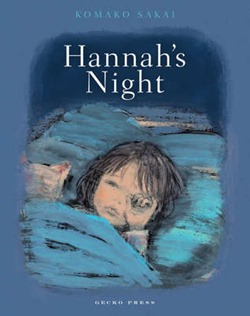
When Hannah woke up one day, she was surprised to find that it was still night.  She tried to wake up her older sister, but she would not wake up.  So Hannah headed downstairs with Shiro the cat.  She checked on her parents and they were asleep too.  Hannah gave Shiro some milk, ate some cherries right from the refrigerator, and no one scolded her.  When Hannah returned to her bedroom, she checked again on her sister.  Then she borrowed her sister’s doll, her music box, and her art supplies and played with them on her bed.  As dawn arrives, Hannah gets sleepy again and falls back asleep.

Sakai has created a beautiful little book filled with the glow of the moon and the delight of the night.  What is done best here is the lack of drama or danger.  Instead it is a story of small mischiefs and safety.  The stealing out of bed itself is enough to drive the story forward and keeps the book moving yet doesn’t make it scary or frightening at all.  The matter-of-fact tone of the writing also adds to the peaceful feel of the book.

Sakai’s art is rich and textured.  Layered and filled with the blues of night, the images have a radiant delicacy.  The combination of rough edges and the detail of sleepy eyelashes create a book that is beautiful to look at as well as a pleasure to share aloud.

A nighttime story, this is one bedtime story that may not keep little wanderers in bed but is worth sharing all the same.  Appropriate for ages 2-4.

Reviewed from library copy.
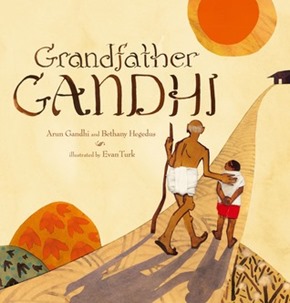
Review: Grandfather Gandhi by Arun Gandhi

grandfather gandhi

Grandfather Gandhi by Arun Gandhi and Bethany Hegedus, illustrated by Evan Turk

When Arun went to stay at his grandfather Mahatma Gandhi’s village, he worried that he would not be able to live up to his famous name.  Arun walked all the way from the station to the village and made his grandfather proud, but he continued to fret that he would not do the right thing the next time.  The village was very different from where he lived before.  Arun had to share his grandfather’s attention with 350 followers who lived there as well.  Arun struggled with his studies and the other kids teased him as well.  He found the meditation and prayers difficult too.  His grandfather urged him to give it time, that peace would come.  However, Arun just found it more and more frustrating.  When Arun finally lost his temper with another boy, he had to tell his grandfather about it, worried that he would be told that he would never live up to his name.  How will Mahatma Gandhi react to this angry young man?

Gandhi relates his own memories of his grandfather, offering his honest young reactions to this amazing yet also formidable man.  The book resulted from Arun recounting childhood stories aloud.  Hegedus emailed him afterwards and asked to work on a book with him, though she felt very unworthy of such a project.  The book is beautifully written and speaks to everyone who has felt that electric anger surge through them too.  Hegedus sets the stage very nicely for the lesson, allowing time for Arun’s anger to build even as she shows the lifestyle of the village and Mahatma Gandhi himself.  It is a book that is crafted for the most impact, building to that moment of truth.

Turk’s illustrations add much to the book.  Using mixed media, he offers oranges, purples, deep pinks and more that show the heat not only of the climate but of Arun’s anger.  Throughout, he also uses fabrics for the clothing, creating three-dimensional depth to the paintings.  When Arun’s emotions flare, the illustrations show that with tangles of black thread that all bring readers back to the image of Gandhi spinning neat white thread.  The contrast is subtle and profound.

Personal and noteworthy, this is a picture book about Gandhi that is entirely unique and special.  Appropriate for ages 5-8.

Reviewed from library copy.

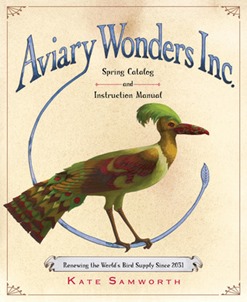
Review: Aviary Wonders Inc. Spring Catalog and Instruction Manual by Kate Samworth

aviary wonders

Aviary Wonders Inc. Spring Catalog and Instruction Manual by Kate Samworth

Birds are steadily going extinct, but Aviary Wonders Inc. has the solution.  Ever since 2031, they have been providing a fun and engaging way to create your own avian companion.  Each bird is made up of high-quality parts that you can put together in unique ways that never existed in nature.  You can keep your bird or set it free.  Teach it to sing and fly.  Assembly is as easy as putting together a book case.  To get started, just select the body type that you want to start with.  After that, you can pick out the beak, tail, legs, feet, wings and crests.  Assembly instructions are included in the book as are directions for feeding and caring for your pet bird.  This clever and creepy look at a potential future for birds serves as a warning for all.

Samworth marries a warning about loss of habitat and food for birds with a catalog that hearkens back to turn of the century catalogs and the wonders they contained.  There is definitely a strange and frightening factor on every page.  While the beaks, tails and wings are beautifully drawn, the images of the beakless birds turns it all odd and stomach-twisting.  It is that interplay of disturbing and lovely that makes the book very effective.

The art in the book is a large part of its success.  Samworth honors the variety and beauty of birds while also making them firmly her own with the wild colors, naming of the different styles, and hawking of her “wares.”  The image of the sepia-toned beakless, legless and featherless bird resting on a pillow is profoundly wrong in just the right way. 

Full of black humor, creepy sales pitch jargon and a message of how close we are to truly losing entire types of creatures, this book is beautiful, moving and frightening.  Appropriate for ages 8-12.

Reviewed from library copy.

Review: Dare the Wind by Tracey Fern

dare the wind

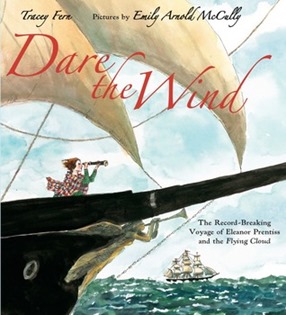
Dare the Wind: The Record-Breaking Voyage of Eleanor Prentiss and the Flying Cloud by Tracey Fern, illustrated by Emily Arnold McCully

Ever since she was a little girl, Eleanor Prentiss dreamed of being at sea.  Her father had a trading schooner and though others thought he was a fool, he taught his young daughter how to steer it.  Most importantly though, he also taught her what few sailors and only some captains knew, how to navigate.  Ellen quickly learned how to navigate and started using her new skills on her father’s schooner every chance she got.  As she grew older, Ellen married a captain and served as his navigator.  Then the two of them acquired a clipper, The Flying Cloud.  It was a fast boat, one that could make them bonus money if they could make the trip from New York to San Francisco around Cape Horn in the fastest time ever.  It would be down to the innate speed of the Flying Cloud and to the navigating skills of Eleanor.  Sea journeys are never simple, especially ones done at high speed through stormy waters.  Take an incredible ride with the amazing Eleanor Prentiss, who proved that women can be right at home at sea.

Fern writes with a dynamism that matches this heroine.  She has an exuberant quality to her writing and a tone that invites you along on a wild adventure.  At the same time, she makes sure that young readers understand how unusual Eleanor Prentiss was at the time with the way she was raised and the knowledge she built and life she led.  The book reads like fiction particularly on the journey itself where a series of misfortunes plague their maiden voyage.  Even without the race against time, the journey would be harrowing, add in that pressure and you have a nail-biting read.

McCully’s art ranges in this book.  She captures Ellen both on land and at sea, her body strong against the roll of the waves.  She also paints water with a love for its greens and blues and the depth of color.  The storms are violently dark, the harbors a shining blue, this is water in all of its glory.

I grew up in a house named after the ship Flying Cloud and am so pleased to read a picture book about the ship’s history and learn more about the woman who navigated her.  This is one dynamic and well-told biographical picture book.  Appropriate for ages 6-9.

Reviewed from copy received from Farrar Straus Giroux.

Review: Cat Says Meow by Michael Arndt

cat says meow

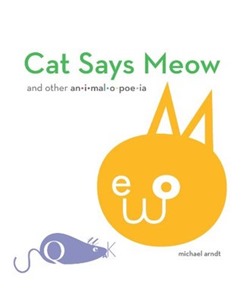
Cat Says Meow by Michael Arndt

A fresh new take on animal noises in a picture book, this is a clever and artistic reinvention.  Blending animals with a typological representation of the animal and its noise, this book is pure font bliss.  The book offers 25 animals that pop against the white background. 

Simple in the extreme, this picture book explores the curves and zig zags of letters, turning them into tongues, feet, ears, whiskers and tails.  The words are sometimes obvious in the drawings but others take a bit more squinting and thinking to make out.  The art becomes a visual puzzle and makes the entire book a joy to explore and decrypt. 

Get this into the hands of art teachers and writing teachers who will adore the creativity that it displays and the way it engages on many levels.  Appropriate for ages 3-8.

Reviewed from copy received from Chronicle Books.

Review: The Story of Owen by E. K. Johnston

story of owen

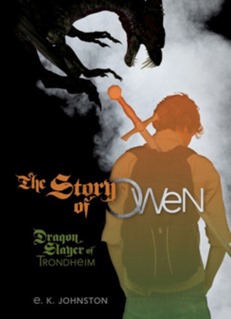
The Story of Owen by E. K. Johnston

When the world saw Lottie Thorskard fall from a girder, everyone wondered what she would do next.  No one expected her to move to the tiny town of Trondheim and start slaying dragons there with her wife, her brother and his son.  But that is how Owen started attending the same school as Siobhan.  Siobhan is not a popular student, but she gets good grades and loves to play and write music.  None of this should have made her even noticeable by Owen, whom everyone wanted to know better.  Somehow though Siobhan with her biting wit gets invited over to Owen’s home for dinner and Owen’s family including the famous Lottie have a plan that involves Siobhan.  They want her to be Owen’s bard.  Which will involve being nearby when they fight dragons.  So Siobhan must train to defend herself with a sword, learn more about different types of dragons, and she becomes an important piece of Owen’s story herself.

This is one of those books that surprises right from the beginning.  Somehow I didn’t realize that this is a modern-day dragon tale set in Canada.  In this book, the world has always had dragons and they form the heart of literature and song going back into history.  Johnston takes the time to rewrite the lives of famous people for the reader, building her world so successfully that it all makes perfect sense that dragons are here and have always been. 

The juxtaposition between the two main characters is brilliantly done.  But perhaps the very best part is that this is not a romance.  Yes, a male and female main character but no sparks, no kissing, no sex.  Instead they are busy trying to save their community together.  Siobhan and Owen are both vibrant and intelligent.  They have the sort of brilliant dialogue that one would expect from a John Green book.  Except they do it while fighting dragons!  Amazing.

A completely incredible debut book, this takes fantasy and turns it on its head with a thoroughly modern take on battling dragons and extraordinarily deep world building.  This is one of the best and most unique fantasy novels I’ve read in years.

Reviewed from digital galley received from NetGalley and Carolrhoda Books.

Review: Half Bad by Sally Green

half bad

Half Bad by Sally Green

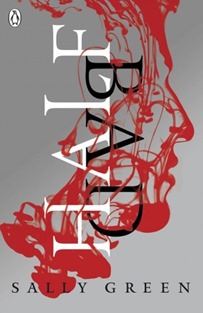
I always approach fantasies that are supposed to be the “Next Big Thing” with a lot of caution.  But this one is a wonderful surprise.  Nathan lives in a cage outside of the house where the woman paid to keep him lives.  He is let out of his shackles at dawn, forced to run for miles, train in combat, and kept close to home by wristbands filled with acid that will detonate if he goes too far.  Nathan is a witch.  But that is not why he is in a cage.  He is in a cage because he is a mix of white witch and black witch and worse, he is the son of the most notorious black witch of all time.  The white witches who keep Nathan imprisoned are training him to kill his father.  Through a series of flashbacks, Nathan’s childhood and the abuse he suffers from the white witches is exposed.  The question quickly becomes who the bad guys really are and how Nathan can survive in a world where no one trusts half of him.

Set in an alternative England where witches are real and in a constant battle for power, Nathan is trapped not just in a cage but also in between the two powerful factions.  The writing here is wonderfully clean and clear, even when it turns to violence which it does often.  Thanks to the quality of the writing, the moral questions shine on the page, clearly linking this witch world to the various moral questions at play in our own world.  Yet this does not become overbearing at all, since the world is compellingly built.

The characters are also well done.  While the “white” and “black” labels designate the factions, the question of good and evil goes much deeper.  Nathan is an exceptional protagonist.  He is complex and both in his character and the world, nothing is simple.  As he learns the truth about his parents, his family and himself, his reactions are honest, violent and superbly done.

This book is worthy of all of the fanfare it has received, but the reason to read it is to enter the violent world of witches where everyone is at least half bad.  Appropriate for ages 15-18.

Reviewed from copy received from Viking.

Review: Monday, Wednesday, and Every Other Weekend by Karen Stanton

monday wednesday and every other weekend

Monday, Wednesday, and Every Other Weekend by Karen Stanton

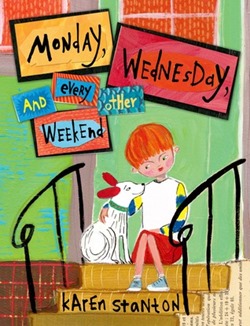
Henry and his dog, Pomegranate, live in two different houses.  On Mondays, Wednesdays and every other weekend, he lives with his mother on Flower Street.  On Tuesdays, Thursdays and every other weekend, he lives with his father two blocks away on Woolsey Avenue.  The two houses are very different.  They smell different, look different, sound different and even taste different.  Pomegranate though is never truly happy at either house.  He wants to be somewhere else.  Then one day, Pomegranate gets out and runs away.  Henry and his father head to Flower Street to see if he is with Henry’s mother, but no Pomegranate.  Then Henry realizes where Pomegranate must be and heads straight to the house where his family used to live all together.  Now a little girl lives there and she has Pomegranate with her! 

This book has such a strong heart.  Stanton clearly shows the differences between the two homes that Henry lives in.  The different neighborhoods, the different foods, the different sounds.  Both homes are beautiful, both are filled with love for Henry.  Stanton’s clever use of Pomegranate as the expression of the emotions involved in a divorce is well done.  She manages to allow Henry to be well adjusted and happy while still dealing with the complex emotions that divorce elicits.

The art is charming and wonderfully loud.  Done in collage mixed with painting, the colors shine on the page.  She makes sure to show the elements that make up life in each house, showing again the differences but also the similarities in the homes.

A memorable book on divorce for children, even children who have not experienced divorce themselves will enjoy this engaging title.  Appropriate for ages 3-5.

Reviewed from copy received from Feiwel & Friends.

Review: Anna Carries Water by Olive Senior

anna carries water

Anna Carries Water by Olive Senior, illustrated by Laura James

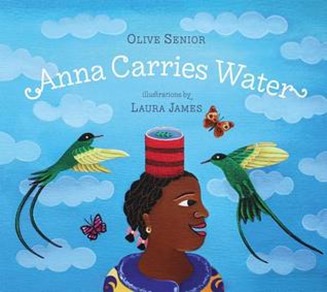
Anna wishes that she could carry water on her head the way her older brothers and sisters do.  Her family does not have running water in their home, so the children walk to the spring and back every day toting water.  Her siblings carry the water in different types of containers balanced on the top of their heads.  But Anna with her smallest container can’t do that.  Anna tries, but only manages to dump water down herself and have to refill the coffee can.  Then she carries it in her hands instead.  Anna’s oldest sister reminds her that when she is old enough to balance the water, it will just happen.  But can Anna wait that long?

This Caribbean picture book is a treat.  It not only offers a glimpse into a different way of life but also gives a gentle reminder of the importance of patience and perseverance.   Written in simple language, the book uses repetition very nicely to give it a sense of traditional folktale while being firmly set in the present day. 

The illustrations tell much of the story and also have a traditional feel mixed with modern content.  They are bright colored, vibrant and help make sure that readers know that they are in another part of the world.

A bright and vivid book, this is a great pick for sharing aloud and would make an unusual but great addition to any story time or unit on water.  Appropriate for ages 4-6.

Reviewed from library copy.