Review: Again! by Emily Gravett

again

Again! by Emily Gravett

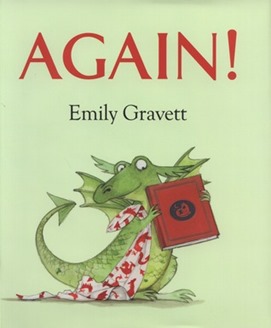
It’s nearly bedtime and that means a bedtime story.  Mama dragon and little dragon curl up together to share the story of the bright, red dragon Cedric who has never gone to bed.  When they finish, the little dragon asks for it “Again?”  Mama dragon agrees and readers will see another full page of the book that tells more about Cedric and his not sleeping.  Mama reads it one more time before falling asleep herself.  Readers will notice the little dragon getting redder and redder just as Cedric in the story is turning back to green.  But this little dragon has a burning desire for one more story that leads to a fiery ending.

Gravett cleverly reaves two parallel stories together here.  There is the main story of the little dragon who wants to be read to over and over again.  Then there is the story of Cedric in the book that Mama dragon reads.  The two play off of one another, with tension in one ebbing as the other picks up. 

The art is just as clever.  Towards the end, the little dragon shakes the book in disgust and the characters take a tumble across the pages.  This leads to the surprise of the ending, which is sure to delight young readers. 

A perfect ending for a story time, this book is one that young children (and dragons) will want to read AGAIN!  Appropriate for ages 4-6.

Reviewed from library copy.
Review: The Loopy Coop Hens Letting Go by Janet Morgan Stoeke

loopy coop hens letting go

The Loopy Coop Hens: Letting Go by Janet Morgan Stoeke

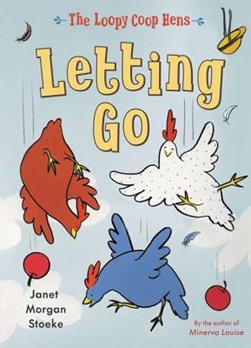
This is the third Loopy Coop Hens book and it continues the silly adventures of these three goofy hens.  Here the question is why apples fall.  The hens think that it is probably the fox hiding in the tree and throwing apples at them.  They try to get Rooster Sam to help them, but he is so traumatized by the falling apples almost hitting him, that he runs away.  The hens know that it is up to them, so Dot volunteers to climb up the ladder to see what is going on and whether it is a fox or not.  Dot heads to the top of the tree and discovers two things:  why apples fall and how gorgeous the view is that high up.

Stoeke has a real touch for the absurd and silly.  In her flighty hens, she demonstrates how even the silliest can also be the brave ones.  Her art is simple-lined and really tells a lot of the story along with the words.  The book works well as a read-aloud and the pictures are large enough to work well with a group. 

This is a simple chapter book in the guise of a picture book, inviting beginning readers to give it a try.  Even better, it ends with chickens falling out of trees!  A perfect addition for fall and apple story times and units.  Appropriate for ages 3-5.

Reviewed from copy received from Dial Books.

Review: On a Beam of Light by Jennifer Berne

on a beam of light

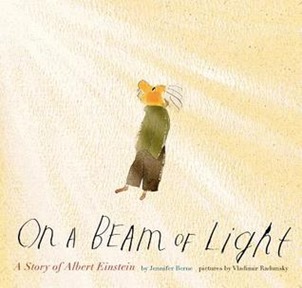
On a Beam of Light: A Story of Albert Einstein by Jennifer Berne, illustrated by Vladimir Radunsky

The author of Manfish: A Story of Jacques Cousteau (my review) returns with this picture book biography of Einstein.  It follows the story of Einstein from birth through his series of amazing discoveries about the universe.  The book begins with pages where Einstein as a small child does not speak until he is inspired to ask questions thanks to a compass which is given to him.  Einstein is also inspired by picturing his bicycle riding on beams of light, racing through space.  So he began to study science and numbers and after graduating from college wanted to be a teacher.  Instead, he found a job working in a government office where he had extra time to think.  That time to think turned into incredible discoveries about science and the nature of the universe until scientists and professors were seeking Einstein out to come and work with them.  The end of the book celebrates Einstein’s eccentricities as well as the discoveries that he made.  This is an inspiring look at a scientist who broke all the rules and decoded the universe.

Berne’s writing truly celebrates this amazing thinker.  The pacing is brisk, but the tone allows readers to linger and think if they wish to.  When she focuses on his odder behaviors, they are seen through a lens of what they meant for his genius rather than just being peculiar.  And who wouldn’t want to not wear socks and have ice cream too! 

Radunsky’s illustrations are done on textured paper that adds a soft yellow glow to the entire book, something wonderful to have in a book that speaks about rays of light.  His drawings are rough and have a wonderful sense of playfulness. 

A great read about a great man, this picture book biography should be welcomed by young scientists as well as in science classrooms.  Appropriate for ages 6-9.

Reviewed from library copy.

Review: The 13-Story Treehouse by Andy Griffiths

13 story treehouse

The 13-Story Treehouse by Andy Griffiths, illustrated by Terry Denton

Andy and Terry live together in an amazing 13-story tree house.  It has a bowling alley, a secret laboratory, swinging vines, a see-through swimming pool and even a man-eating shark tank.  Unfortunately, all of these fun things around them are distracting them from finishing the book that is due in to the publisher!  They have barely started and it needs to be finished quickly.  But what are you supposed to do when there are flying cats, giant bananas, an evil sea monster, gangs of rampaging monkeys, and burp-filled bubblegum bubbles around you?  You will just have to read the book to find out how Andy and Terry managed to finish their book in time.

Wildly funny and perfect for children who enjoy books like Diary of a Wimpy Kid.  The author and illustrator worked together beautifully, creating a hilarious world that is a pleasure to visit.  The book has illustrations throughout, black and white line drawings that add to the silliness of the story.  Do not read this one looking for logic, just enjoy the giggles!

A great pick for reluctant readers who will appreciate the silly storyline and funny illustrations that effectively break up the text.  Get this into the hands of your Wimpy Kid fans!  Appropriate for ages 6-10. 

Reviewed from copy received from Feiwel and Friends.

Review: Rosie’s Magic Horse by Russell Hoban

rosies magic horse

Rosie’s Magic Horse by Russell Hoban, illustrated by Quentin Blake

Rosie collects popsicle sticks that she finds on the ground, creating a collection.  But the popsicle sticks miss their cold sweet ice and wish that they were something more than just discarded sticks.  Maybe they could be a horse!  Meanwhile, Rosie’s parents are worried about bills and how they will pay them.  That night Rosie and the popsicle sticks head out on an adventure together as the popsicle sticks join to become a horse, Stickerino.  Rosie wants to find treasure and first the horse takes her to a mountain made of popsicle ice, but Rosie wants real treasure.  You know that that means pirates!  This story is a true flight of imagination, or perhaps a gallop!

Hoban and Blake are quite a team in this book.  Hoban writes in mostly dialogue here and throughout has a focus on brevity and clarity.  It works well against the wild imaginative nature of the book, making the text a firm foundation from which to launch.  Blake’s illustrations are quintessentially his with their jaunty lines and loose watercolor tones. 

Perfect for inspiring bedtime dreams of popsicles and horses, this book requires you to just go along for the ride.  Appropriate for ages 4-6.

Reviewed from library copy.
Review: Ribbit! by Rodrigo Folgueira

ribbit

Ribbit! by Rodrigo Folgueiro, illustrated by Poly Bernatene

One morning, the frogs in the pond woke up to discover a very pink visitor among them: a little pink pig.  They tried to ask the piglet why he was there, but all he would say was “Ribbit!”  The other animals soon heard about the unusual pig and hurried to the pond to see him.  All of the animals except the frogs found the entire situation hilarious, but the frogs were getting more and more angry.  The animals went in search of the wise old beetle to ask his advice, but when they returned the pig was gone.  All of the animals began to wonder what the pig had wanted all along and it wasn’t too late to find out!

Folgueira has created a book with the feel of a traditional folktale but one that also has the humor and feel of a modern story.  Told in a clear voice, the book invites readers to wonder about what is actually happening in the book.  Happily, the ending ends the questions, but until then there is plenty to think about.

Bernatene’s illustrations have bright tones and fine lines.  The watercolor texture of the pages and the pictures add a welcome rustic warmth to the story that suits it well.  She has also created one of the most engaging little pigs, with a merry grin and closed eyes formed out of just a few curved lines.  Pink perfection.

This is a look at friendship and also at cultures and what happens when someone steps out of their own comfort zone and begins to explore new things.  In the end though, it’s a delight of a read aloud that children will enjoy for just the story alone.  Appropriate for ages 3-5.

Reviewed from copy received from Knopf Books for Young Readers.

Review: Look Up! by Robert Burleigh

look up

LookUp! Henrietta Leavitt, Pioneering Woman Astronomer by Robert Burleigh, illustrated by Raul Colon

Henrietta had loved the stars ever since she was a little girl and spent hours gazing at them.  When she studied astronomy, she was one of the only women in her class.  After graduating, she worked at an observatory though she almost never got to look through the telescope.  Instead the women were there to do the calculations, to work and not think.  But Henrietta continued to study and to think, she was especially interested in a group of stars that seemed to dim and glow.  She discovered some new blinking stars that no one had ever found before.  As she studied, she found a pattern in the dimming and brightening of these stars: the blink time allowed her to measure the true brightness of any blinking star in the sky.  Her discovery led to a deeper understanding of the vastness of the universe and her life demonstrated that women are thinkers and scientists.

Burleigh’s writing is almost poetic here.  He speaks of the connection Henrietta felt to the stars: “Sometimes she felt the stars were trying to speak, to tell her what they knew.”  He writes with deep amazement at the vastness of the universe and also speaks of Leavitt’s discoveries in thrilled tones, giving her credit for the hard work and patience it took to find the patterns in the stars.  The book ends with several pages that outline her discoveries, names of other female astronomers, and also have a glossary and bibliography. 

Colon’s illustrations are simply gorgeous.  Done in watercolors and pencil, the illustrations are luminous, glowing with the light of the stars and with the light of the heroine herself.  Textured with swirling lines, the illustrations have a great depth to them as well.

This picture book biography invites children to follow their own passions and get involved in science as well.  Appropriate for ages 6-9.

Reviewed from library copy.

Review: War Brothers by Sharon E. McKay

war brothers

War Brothers: The Graphic Novel by Sharon E. McKay, illustrated by Daniel LaFrance

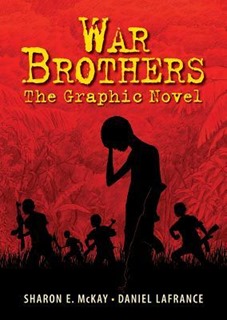
This is the graphic novel version of McKay’s teen novel of the same title.  Based on interviews with child soldiers, this novel pulls no punches when telling the story of Jacob, a Ugandan boy taken by the Lord’s Resistance Army (LRA) as a soldier.  Jacob is a teenager who is headed to a boy’s school.  Knowing the danger from Joseph Kony and his LRA, Jacob’s father provides additional armed guards at the school.  But it is not enough, Jacob and his friends are taken as child soldiers.  That begins a story of brutality, murder, starvation, and survival.  But this story is not without hope and resilience and heroism that flies in the face of the desperate and violent situation the boys find themselves in.

McKay warns readers right from the beginning about the violence of the storyline.  Through a letter from Jacob, the book warns of the brutality of what happens, ending with “There is no shame in closing this book now.”  McKay does not try to lessen that brutality, showing how child soldiers are indoctrinated into the LRA and broken.  Jacob struggles with having to commit atrocities himself, despite the food that is promised for him and his friends.  One of his friends does become a soldier, well fed and cared for, but with his spirit entirely decimated by what he has done.  It is an impossible choice, kill others or die yourself. 

LaFrance does an admirable job of showing violence but without adding drama to an already volatile and horrific situation.  He does not shy away from showing the brutality, often using close ups and unique lighting to show what happened without becoming too bloody.  It is a fine line to walk, demonstrating that this is real and actual, while leaving it powerful enough to speak on its own.

Highly recommended, this is a story that is riveting to read as long as you are brave enough to continue turning the pages.  The fact that this is based on true stories of child soldiers adds to the compelling nature of the tale.  Appropriate for ages 14-18.

Reviewed from copy received from Annick Press.

Review: Destiny, Rewritten by Kathryn Fitzmaurice

destiny rewritten

Destiny, Rewritten by Kathryn Fitzmaurice

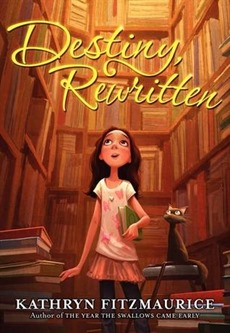
From even before she was born, it had been decided that Emily’s destiny was to be a poet.  Named after Emily Dickinson when her mother was inspired at a bookstore, Emily’s entire 11-year life has been documented in the margins of a first edition copy of Dickinson’s poems.  When Emily discovers that her mother wrote her father’s name in the margin of one of the poems, she rushes to read the book but a mishap sends it off to be donated to Goodwill.  This begins a search of several used book stores for the book and it quickly becomes apparent that destinies will not be rushed and that there is no way to force them.  But along the way, new friends are made, great books to read are found, and destiny is eventually changed.

Fitzmaurice writes with a wonderful mix of light tone and richness.  She carefully builds her story, creating additional storylines that serve as different strings in the story that are tied together by the end.  Another source of the richness is the way she describes things in the story.  Chapter 4 begins with “So I headed down the hall that Saturday morning with a hopeful feeling that came only on days I was opening a new box of Cheerios…”  This is such a universal image and universal feeling.  The Cheerios play into more of the story along with the prizes in their box.

Emily is an engaging character who struggles with learning patience and the frustration of being so close to the truth and then unable to grasp it.  She comes off as a multidimensional person, again thanks to the richness of the world that Fitzmaurice paints for the reader.  The secondary characters are also well drawn and solidly written.  It is a pleasure to also see poems by Dickinson and her life tied so closely to the lives of modern-day children and families.

Fresh and joyful, this is a novel where storylines click into place like a puzzle.  It will delight children who enjoy reading.  Appropriate for ages 9-12.

Reviewed from copy received from HarperCollins.