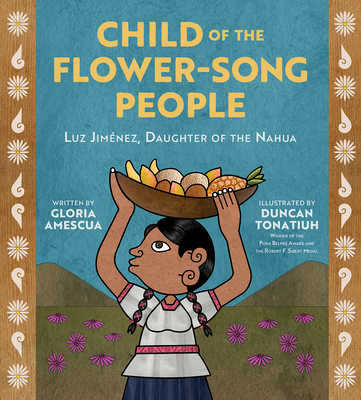
Child of the Flower-Song People by Gloria Amescua

Cover image for Child of the Flower-Song People.

Child of the Flower-Song People by Gloria Amescua, illustrated by Duncan Tonatiuh (9781419740206)

Luz Jiménez was a child of the flower-song people, the Aztecs. She had listened intently to the stories told by the elders about their sacred mountains and streams and also about how the Spaniards had taken their lands away. Luz learned how to do the traditional work of her people, grinding corn on a metate, twisting yarn with her toes, weaving on a loom. She learned about the plants around her and what herbs were medicine. Luz longed to go to school, but it was forbidden for native children. Then the law changed and required schooling in the ways of the Spanish. Luz was a good student and learned much, still keeping the traditional tales alive as she shared them with the other students. At age 13, Luz was forced to flee the Mexican Revolution and live in Mexico City. There Luz became a model for artists, sharing her traditions in paintings and photographs. She longed to be a teacher, but was denied that opportunity. Instead she taught in a different way, through modeling, sharing her tales, and being a living link to the Aztecs.

This beautiful picture book pays homage to Luz Jiménez, a humble woman who became the face of her people. Amescua’s lovely Author’s Note shows the detailed research that went into this biographical picture book. That research is evident in the lovely prose she uses to share Luz’s story with a new generation. Her writing uses metaphors and evocative phrases to really show the impact that Luz’s presence has had as well as her strong connection to her heritage.

Tonatiuh’s art is always exquisite. Done in his own unique style, his illustrations mix modern materials with a folkloric feel. They work particularly well for this subject.

A stellar biographical picture book of a true teacher and heroine. Appropriate for ages 7-10.

Reviewed from e-galley provided by Abrams Books for Young Readers.

Moon Pops by Heena Baek

Cover image for Moon Pops.

Moon Pops by Heena Baek, translated by Jieun Kiaer (9781771474290)

On a very, very hot night, everyone had their fans rattling and their air conditioning whirring. It was too hot to sleep even with a refrigerator door open. That’s when something started dripping. It was the moon melting. Granny ran out of her apartment with a bucket to catch the moon drops. She decided to make frozen moon pops out of the liquid moon. Then the power went out. It was dark everywhere, everywhere but Granny’s apartment that glowed. Granny handed out the glowing moon pops to everyone. They were icy and sweet and made the heat go away so that they could sleep. That’s when the two moon rabbits showed up and Granny had to figure out how to rebuild their moon home using the last drops of the moon.

This is the first book by Henna Baek that has been translated into English. She is an internationally acclaimed Korean children’s book author and illustrator and has won the Astrid Lindgren Memorial Award. This picture book puts a modern spin on a classic Korean folktale of rabbits that live on the moon. The entire book is marvelously crafted with a languid slowness of the heat at first and then the drama of the melting moon. The intelligence of Granny and her willingness to share and help make for an unusual folktale of community both nearby and far.

The illustrations are done in dioramas that are photographed. Baek lights them with glowing touches of the moon, lemony yellow lights that illuminate the darkness and provide comfort and connections. The paper figures are various animals who all live together in a crowded apartment building with their own interesting apartments to look into as well.

Intriguing, haunting and beautiful. Here’s hoping we see more translations of Baek’s work. Appropriate for ages 3-5.

Reviewed from e-galley provided by Owlkids.

Blackout by Dhonielle Clayon, et al.

Cover image for Blackout.

Blackout by Dhonielle Clayton, Tiffany D. Jackson, Nic Stone, Angie Thomas, Ashley Woodfolk, and Nicola Yoon (9780063088092)

In New York City in the heat of summer, there is a sudden blackout citywide. Caught in the darkness are several groups of Black teens who all find themselves heading to the same party. There are couples who have already broken up and find themselves the only safe way to get back home. There are pairs who are not yet together but find themselves trapped on the stopped subway system. There are people in one relationship and longing for a new one that is right there. Told in loosely-linked short stories, these stories all tell the joyous tale of young Black love in the dark.

Written by six award-winning Black female authors, these stories are a summer delight to read. The authors have their own unique voices that all come together into a single book that really sings. Cleverly, one story bridges across the entire book, following one couple’s long walk across the city together. Each story shows romance in a different light and different stage, showing how even waning romance can be the beginning of something new and amazing.

In all of the stories, the characters are interesting and well written. They have personalities that stand out against the crowd of characters, taking the spotlight for a time and then allowing it to move on. The writing throughout is skilled, creating a book that is romantic, funny and a tribute to New York City herself.

A testament to the talent of the writers, this book is a great summer read. Appropriate for ages 13-17.

Reviewed from library copy.

Noah’s Seal by Layn Marlow

Cover image for Noah’s Seal.

Noah’s Seal by Layn Marlow (9781536218510)

Noah is waiting on the beach, wondering when he and Nana can take a sail out to see the seals. Nana needs to fix the boat before they go, so Noah must amuse himself on the beach instead. He looks out to see to check for seals, but they don’t like to come in to shore. So Noah digs in the sand while thinking of seals. Suddenly, he notices the pile of sand behind him looks a lot like the body of a seal. Noah steadily works to make the sand look even more like a seal, giving it shape, speckles, whiskers, and eyes and mouth. The two lie on the beach together until Nana calls him because a storm is coming. The two take shelter in the boat under a tarp, but the sand seal is washed away. Nana tells him that the boat is fixed and they can head out to see the seals tomorrow, and that is when Noah sees his seal alive and near the beach. Surely they must take the boat out right now!

A delightful mix of wishful fantasy and the beauty of a day spent on the beach making something, this picture book is a summery joy. The relationship between Nana and Noah is evident right from the beginning, full of warmth and support, but also offering Noah plenty of space to amuse himself. The text is just right, offering a clear view of the setting while moving ahead as quickly as an ocean breeze.

The illustrations are just the right mix of sunshine colored sand and teal sea wave. Noah and his grandmother are Black characters. Noah’s seal is depicted in a way that makes sense for a child to have designed and built it. It’s simple and effective.

Perfect reading for a summery day, whether on the beach or not. Appropriate for ages 3-5.

Reviewed from copy provided by Candlewick Press.

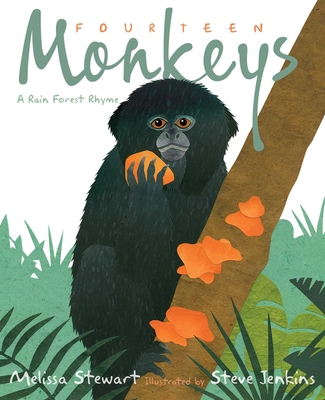
Fourteen Monkeys: A Rain Forest Rhyme by Melissa Stewart

Cover image for Fourteen Monkeys.

Fourteen Monkeys: A Rain Forest Rhyme by Melissa Stewart, illustrated by Steve Jenkins (9781534460393)

This picture book explores the fourteen species of monkey that all live together in Manu National Park in Peru. They all live in the rainforest together and survive successfully near one another thanks to their different diets, different heights for their habitats, and different body sizes. The day begins with the red howler monkeys who climb to the very tops of the trees to bellow. The spider monkeys live high up as well, searching for their favorite fruits. Down near the ground, sakis race and jump. Each monkey is shown with Jenkins’ detailed illustrations, their space in the rainforest documented, and their activities and diet explored. It’s a look at an entire community of monkeys all living happily as neighbors.

Stewart’s writing is clear and concise. She has a knack for sharing fascinating details about each monkey, such as how long the howlers rest each day (18 hours) and that capuchins will eat anything they can catch. The book offers layers of text, including basic text that could be shared aloud while the more detailed information is also there for those who want to explore it. Even more information is available at the end of the book along with additional resources.

As always, Jenkins’ illustrations done with paper art are phenomenal. He can make paper look furry, smooth, veined and fruity. He’s a master at the craft, creating animals that are realistic and artistic.

This book doesn’t monkey around, providing great information in a gorgeous format. Appropriate for ages 5-8.

Reviewed from copy provided by Beach Lane Books.

The Dire Days of Willowweep Manor by Shaenon K. Garrity

Cover image for The Dire Days of Willowweep Manor.

The Dire Days of Willowweep Manor by Shaenon K. Garrity, illustrated by Christopher Baldwin (9781534460874)

Haley loves Gothic romances and has turned in four English papers on Wuthering Heights. So when she sees someone drowning in the river, she knows just what to do. After rescuing the drowning man, Haley awakens to find herself in Willowweep, a manor filled with characters who are Gothic novel tropes. There is the housekeeper who looms and lurks, the three brooding brothers, and even a ghost who haunts the manor. But there is more happening in Willowweep. The external features of the manor hide the fact that this is a pocket universe, created to keep two larger universes from colliding: a universe full of evil and Earth. Willowweep’s defenses are beginning to crack and crumble, allowing the evil to enter the Gothic world. It is up to Haley to figure out how to use her deep knowledge of Gothic novels to stop the evil invasion.

This uproariously funny graphic novel plays beautifully upon Gothic tropes. Haley serves as the voice of the reader, exclaiming as each new trope becomes apparent. The twist of being in a decaying pocket universe works really well with the Gothic overlay. The clockwork style of the universe’s inner workings are a delight as is the solution worked out in the ending. Add in that all beings must stay in the Gothic style, and the evil monk who arrives is perfection. It’s all a very funny yet great adventure with a well-read smart heroine at its center.

The illustrations are a delight as well, leaning into the Gothic elements like the looming housekeeper, the ghost only Haley can see, and the three brothers. The green glowing eyes of those taken in by the evil add to the marvelous joy of the book.

A delight of a graphic novel that mixes Gothic and science fiction into something new and wonderful. Appropriate for ages 12-16.

Reviewed from copy provided by McElderry Books.

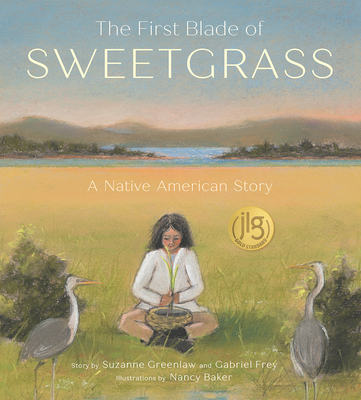
The First Blade of Sweetgrass by Suzanne Greenlaw and Gabriel Frey

Cover image for The First Blade of Sweetgrass.

The First Blade of Sweetgrass by Suzanne Greenlaw and Gabriel Frey, illustrated by Nancy Baker (9780884487609)

Musqon accompanies her grandmother to the salt marsh where they are going to pick sweetgrass. The salt marsh is where the river meets the ocean. Her grandmother explains that she helped her own grandmother pick sweetgrass as a girl to weave into baskets and use in ceremonies. To Musqon, all of the grasses look the same, so her grandmother shows her what to look for to find sweetgrass among all the other grasses. She explains that they never pick the first blade of sweetgrass that they see, to make sure that sweetgrass continues to the next generation. When her grandmother tells her that sweetgrass has a shiny green tassel and blades with a purple stem and that it is easy to pick, Musqon is confident she can find it on her own. It isn’t until Musqon takes her time, thinks about what she is there to do, and really sees the salt marsh that she can find sweetgrass herself.

Written by a citizen of the Houlton Band of Maliseet Indians and a citizen of the Passamaquoddy Nation, this picture book is a gentle story of Native traditions shared with a new generation. The text of the book shares Passamaquoddy-Maliseet words in the dialogue of the characters. It takes the time, slowing us all down, to explain the importance of sweetgrass and how to find it. The moment when Musqon takes her own time and gives herself space is beautifully created.

Baker learned about sweetgrass for this book also the landscape in which it grows. She shows a delicacy with both in her illustrations, celebrating sweetgrass itself and also showing the beautiful landscape where the river meets the ocean.

A rich and vital look at sweetgrass and heritage. Appropriate for ages 4-7.

Reviewed from e-galley provided by Tilbury House.

Ergo by Alexis Deacon

Cover image for Ergo.

Ergo by Alexis Deacon, illustrated by Viviane Schwarz (9781536217803)

This philosophical picture book explores one chick’s world. Ergo wakes up not realizing she is inside an egg and thinks that she has discovered her entire world. She has eyes to see, toes that wiggle, wings that flap, a beak to peck and legs that kick. Perhaps, she thinks, she is the world and she had found everything. That’s when she discovers the wall of the egg around her. She pushes the wall, rolls the egg over, and realizes that she can move the entire world! That’s when she feels the bumps coming from outside the egg and realizes that she is not the entire world. Now she must decide whether to leap (or peck) her way into the unknown or stay safe in her small universe of the egg.

Deacon and Schwarz follow I Am Henry Finch with this picture book that plays with Plato. The book works on multiple levels, allowing adults to recognize the philosophy while also really working well as a picture book for young children that asks big questions about our world and our place within the universe. The use of the little chick and an egg serve a clever purpose here. Ergo asks the big questions while the simple style of the writing supports the ideas being shared.

The illustrations are simple and bold. Done in a sunshine yellow, Ergo fills the page. Often surrounded by a cool blue-gray, the illustrations show Ergo and her world, egg-sized and then larger.

Clever and inquisitive, this book will egg on children’s thinking about the world. Appropriate for ages 2-6.

Reviewed from copy provided by Candlewick Press.

I Am the Subway by Kim Hyo-eun

Cover image for I Am the Subway.

I Am the Subway by Kim Hyo-eun, translated by Deborah Smith (9781950354658)

Told from the point of view of the Seoul subway itself, this picture book takes readers deep into the city and introduces them to the various people who use the subway. With a steady ba-dum ba-dum, the subway rattles and rumbles over its tracks reaching stop after stop. At each stop a different character enters the story, from the business man running to make his train to a mother with two children who is also late to a man who repairs shoes for a living to a student so tired she is almost falling asleep. Each person offers their story, glimpses of their past and plans. As the train car fills up, the light shines in showing the beauty of each person and their journey.

This Korean import is beautifully written with a dazzling combination of simple prose that moves to a poem for each of the people entering the train. The poems are set apart from the prose, offering a full story of that person in just a few lines. The bustling urban setting is brought to a personal level as each human is highlighted and given space to shine. There is space here for transformation in each person’s life, the subway used as a huge metaphor for life and growth.

The illustrations are done in ink and watercolor. The humans are shown as more faceless at first but as they are introduced to the reader, they are shown in brighter colors in the crowd rather than the gray people around them. Each person’s story and poem are shown with the bright colors from the bluest of sea water to the bustle of the city itself.

A gorgeous celebration of Seoul and its people. Appropriate for ages 4-7.

Reviewed from copy provided by Scribble.