Review: One Cool Friend by Toni Buzzeo

one cool friend

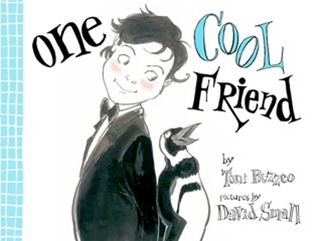
One Cool Friend by Toni Buzzeo, illustrated by David Small

Elliot was a very proper boy, dressed in his tuxedo and bow tie.  When his father asked if he wanted to go to the aquarium one day, he went along despite worries about loud kids.  When they got to the aquarium, his father sat down to read and sent Elliot off to have some fun.  Elliot went past the jellyfish, the saltwater display, and the hands-on tide pool and discovered the penguins!  He immediately connected with the birds and then asked his father if he could have one.  His father glanced at a poster for plush penguins and agreed.  But Elliot did not have a plush penguin in mind.  Instead, he brought home a real penguin.  Once back home, Elliot wasted no time in creating a perfect penguin habitat.  But after days of happy living, what in the world would his father say when he discovered the penguin?

This book has its own wonderful feel.  From the dapper lad in the lead role to his couch-loving, slow-moving father, it has the feel of a classic book but also one that is delightfully modern as well.  Buzzeo’s writing is fresh and funny, creating a book that is both inviting and compelling.  It also has great twists throughout where you never know what will happen next.  In other words, it’s a stellar read.

Small’s art is what provides a large part of the feel of the book.  His tuxedo wearing kid, the splash of green that is the father, and the busts of other colors throughout.  The use of primarily blacks and whites to tell the story pays homage to its subject and also gives it the marvelous stylized feel that works so well.

The great librarian character at one point doesn’t hurt the book one smidge either!  This is a dapper, dazzling read that is creative, funny and a delight.  Appropriate for ages 4-6.

Reviewed from copy received from Dial Books for Young Readers.

Review: Secrets of the Garden by Kathleen Zoehfeld

secrets of the garden

Secrets of the Garden: Food Chains and the Food Web in Our Backyard by Kathleen Weidner Zoehfeld, illustrated by Priscilla Lamont

Alice loves it when spring arrives and they can start planting the garden.  Her dad gets the soil ready for planting and then she and her brother start putting the seeds in.  It seems like a long time before the seeds finally sprout.  Then other seedlings are transplanted from pots and potatoes are sown.  Lettuce and radishes are ready to eat first, and Alice spots a rabbit munching on them too.  She also thinks a mouse might be eating the fallen corn.  Hawks hunt in the garden and there are plenty of insects too.  Autumn nears and harvest begins, and the food cycle of the garden is complete for another year.  Throughout the book, the chickens offer commentary about the cycle itself with information about herbivores and carnivores, compost, worms and much more. 

This is an outstanding example an information book for children.  The chickens give the book a lighter tone, even though they are the ones offering the hard science.  The story celebrates gardening, the food cycle, and having a place connects one with nature.  Zoehfeld’s writing is breezy and cheerful, setting just the right tone of exploration, wonder and science.

Lamont’s illustrations add to the delight.  They have a similar feel to Michael Rosen’s with the friendly characters.  The colors tend towards the subtler side, inviting close inspection and learning.

This is a choice book for units on the food cycle or for children looking for information that they will enjoy learning.  Appropriate for ages 5-8.

Reviewed from copy received from Alfred A. Knopf.

Review: Little Bird by Germano Zullo

little bird

Little Bird by Germano Zullo, illustrated by Albertine

Released April 1, 2012.

Winner of the 2011 Prix Sorcieres for illustration, the French Caldecott medal, this book is an impressive example of the magic of illustration and only a few select words.  A man drives his red truck up to the edge of a cliff and opens the back, releasing several amazing birds.  When he glances into the truck, he sees one bird left behind.  The man tries to tell the bird where to head and that it should fly, but the bird just looks at him.  The two sit together and the man shares his sandwich with the little bird.  The man shows the bird again where to head and how to fly, landing on his face.  The bird spreads its wings and flies away, joining the other birds the man had let go.  The man watches the bird fly off, heads back into his truck and drives off.  What seems like the end of the story is actually just the beginning.

Zullo has chosen his words carefully, letting the story really be told via the illustrations.  The words offer a touch of guidance to the depth of the work, the deeper meaning of the simple story.  They speak to the importance of noticing small things and how those small things are the true treasures in life.  It’s a message that will speak to children and adults alike, in very different ways.

Albertine’s art is wonderfully bright and filled with playful moments.  From the sunny yellow ground, the robin’s egg blue sky and the red truck, there is plenty of zing in these pictures.  As the story is told in the illustrations, the relationship between bird and man is also shown just in pictures.  The looks, the moments of connection, the departure, all add up to moments that lead to the magical conclusion.

An impressive picture book that is modern, fresh and will have readers looking for tiny treasures in their lives too.  Appropriate for ages 5-adult.

Reviewed from copy received from Enchanted Lion Books.

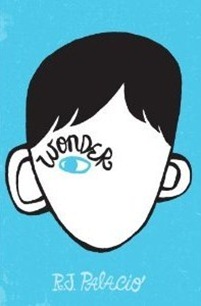
Review: Wonder by R.J. Palacio

wonder

Wonder by R.J. Palacio

Auggie has never been to school, instead he’s been homeschooled his entire life.  It made it easier to work his schedule around his many surgeries for his facial anomaly.  Auggie was born looking differently than the rest of the world due to several genetic abnormalities coming together in one moment, something that only has a one in 4 million chance to happen.  But it happened to Auggie, and now he is getting ready to start 5th grade in a private school.  Auggie knows that he is just a regular kid hidden behind an uncommon face, but the question is whether his classmates will ever figure that out.

It’s amazing to think that this is Palacio’s first novel.  She writes with a natural flow and skill that makes the book read effortlessly.  It’s one of those books that gets into your head and won’t let go, that not only tells a story but asks things about you the reader.  It has you exploring your own relationship with beauty, the extent of your own kindness, and the truth behind being human. 

Auggie is such a rich character and such a winning one that I was surprised when the book first changed perspectives.  I had assumed that we would see through Auggie’s eyes for the entire novel.  But the different perspectives also show depth to all of the other characters in the book.  We get to see Auggie through his older sister’s eyes, ones that are loving but also despair at being paid enough attention by her parents.  The perspective shifts again and again to classmates, his sister’s ex-friend, and even his sister’s boyfriend.  Then we return to Auggie for the end of the book. 

This use of multiple perspectives works particularly well given the arc of the story, it all comes to a satisfying close that is built from those many perspectives and those many characters.  Things are not sugar-coated here.  People respond naturally to Auggie’s face, even those who had been informed about it beforehand.  There are bullies, friends who are true and those who come in and out, there is middle school drama.  There is also a real family portrayed here, struggling to give their exceptional son an honest life, trying to pay attention to both of their children, and consistently showing love and caring for one another laced with real humor.

I adored this book, wept at times, ached in the heart a lot, and laughed too.  It’s a book worth sharing, worth passing along, and one that will crossover effortlessly to adult readers.  This is a powerful, uplifting, luminous book.  Appropriate for ages 10-13.

Reviewed from library copy.

Review: The Humming Room by Ellen Potter

humming room

The Humming Room by Ellen Potter

When Roo’s parents are murdered, it’s her ability to hide that saves her, as she retreated to her favorite spot under their trailer.  There she can look at the items she has “collected” or stolen, and she can press her ear to the ground to hear the tiny movements of animals, worms and roots.  After spending some time in foster care, Roo is taken to live on an island with her wealthy uncle who looks very similar to Roo’s father but with none of the carefree spirit her father had.  The island is on the St. Lawrence and the house used to be a tuberculosis sanatorium.  Now Roo is left there with little attention from her often-away uncle, and two servants.  The island is filled with life, including tantalizing glimpses of a wild boy who seems to live on the river.  Roo has to discover the truth of the strange house and the many secrets it holds.

Potter has stated that this is a novel inspired by The Secret Garden, and readers familiar with that work will definitely see it woven into this story.  At the same time, this book stands on its own beautifully.  It is a delightful blend of character and setting.  Roo is a prickly child, one who would be difficult to relate to except for her connection to nature.  That small piece of her character alone makes her human and accessible for the reader.  She is also prickly for very good reasons, including her parents’ death but also her misery of a life before their death.  The reader understands Roo deeply.   The secondary characters are all quirky and fascinating as well, especially the wild boy.

Then there is the setting.  Potter brings the St. Lawrence, the island, and this house to life.  This story could not be set anywhere else, as the setting is so closely married to the story.  The river is a large part of the book, including Roo’s growing understanding of its moods and the isolation of the island.  The house is central to the story as well, brooding and huge, its very walls hiding secret doors to wonders.  Then there is the garden itself, because of course there is a secret garden, and its rebirth that echoes Roo’s. 

Haunting and lovely, this book unfolds like the petals of a flower as each new discovery is made.  Environmentalism permeates the book in a gentle, green way that leaves readers wanting to connect with nature and preserve it without ever being preached to about the issue.  This is a delicate, wondrous read that is sure to be a hit with fans of The Secret Garden or those of us who are already fans of Ellen Potter.  Appropriate for ages 9-12.

Reviewed from copy received from Feiwel & Friends.

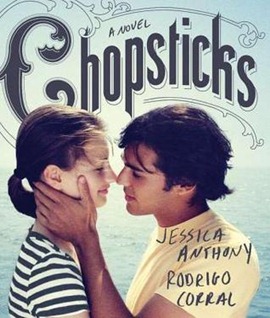
Review: Chopsticks by Jessica Anthony

chopsticks

Chopsticks by Jessica Anthony, illustrated by Rodrigo Corral

Told only in photographs, this book is the story of Glory, a piano prodigy.  After her mother dies, Glory’s music continues to soar, leading her to play sold out programs at places like Carnegie Hall.  Her father is a large force behind her success, driving her forward with his high expectations for her future in music.  Then Glory meets Frank, a neighbor, and falls in love.  As her connection with Frank grows and she immerses herself in his art, things begin to change.  Soon the young prodigy becomes obsessed with the song “Chopsticks” and is unable to play anything else.  Now it is up to the reader to piece together the truth of Glory’s life as the frightening picture comes together into something entirely different than it first appeared.

I was unable to put down this book and devoured it in a single sitting.  The intriguing use of full-page photographs alone and then the wild twists of the story make it compulsively readable.  Anthony’s story reads like a movie, in pictures.  The building tension of the story, the budding romance, and then the truth that hits like a cold wave of ice water, all combine to form a riveting read. 

The photographs work to add to the story.   They use intriguing angles, photos of documents, different amounts of light and dark, different focus amounts, and play with a combination of home photographs and professional feel.  You never know what you will see on the next page. 

I immediately thought of reluctant readers, especially those interested in art or music as a perfect audience for this book.   It will appeal to many teen readers.  There is one caution for librarians to be aware of and that is that there are some female nudes in the book.  This moves it from being a book for younger teens into one for a slightly older audience, so I’d say the book is appropriate for ages 16-18.

Reviewed from copy received from Razorbill.

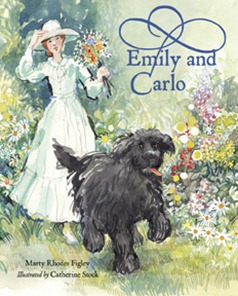
Review: Emily and Carlo by Marty Rhodes Figley

emily and carlo

Emily and Carlo by Marty Rhodes Figley, illustrated by Catherine Stock

When Emily Dickinson was 19 years old, she was lonely in the big home in New England since her siblings were off at school.  So her father bought her a puppy that she named Carlo.  The quiet and reclusive poet was an odd match with her bounding, huge Newfoundland.  Carlo gave Emily more courage to be out and about, visiting others.  He was with her always, a large drooling dog.  They explored Amherst together with its woods, meadows and ponds.  Their time together inspired her poetry, as shown in this book through stanzas that she wrote.  This friendship with a dog makes this literary figure much more human and approachable for children.  It’s a very special way to see an author.

Figley truly found the key to Emily Dickinson’s personality for children.  All it took was a large messy dog to break through into Dickinson’s quiet, contemplative world.  Interspersing the verse with the story also makes this a friendly window into Dickinson’s work.  The book maintains a fresh, light tone throughout, showing the two friends aging together.

Stock’s art is a radiant mix of playfulness and contemplation, matching the subject matter beautifully.  It shows the deep connection of woman and dog, the natural world they explored, and pays homage to the verse that is embedded in the book. 

A simply lovely look at Emily Dickinson through her love of a pet, this book should be used with anyone working with Dickinson’s poetry and children as a lens through which to view the person and her writing.  Appropriate for ages 6-8.

Reviewed from copy received from Charlesbridge.

Review: Penny and Her Song by Kevin Henkes

penny and her song

Penny and Her Song by Kevin Henkes

Joining the beloved Chrysanthemum, Lilly, Owen and Wemberly is a new mouse character from the incredible Kevin Henkes.  This mouse is named Penny and she has a song to sing.  Unfortunately when she gets home, the babies are sleeping and she’s not allowed to share her song with her mother or father.  Later, she tries to share the song during dinner, but her parents ask her to wait until they are done eating to sing.  Finally, after dinner, Penny shares her song.  Her parents sing it too, they dress up in costumes, and the babies have a surprise reaction too!

Done in short chapters, this is more a beginning reader than a picture book.  Penny is a delight of a character, who when told she has to wait does not complain but tries to find new solutions that will let her sing without breaking the rules.  The final scenes with her parents happily joining in singing demonstrates the love that comes with rules and structure without any harshness being needed.  The illustrations are done in Henkes’ signature style, which is sure to delight all. 

A happy welcome to Penny as she joins this beloved mouse family.  Appropriate for ages 4-6.

Reviewed from library copy.

Review: Ellen’s Broom by Kelly Starling Lyons

Ellens Broom

Ellen’s Broom by Kelly Starling Lyons, illustrated by Daniel Minter

After slavery ended, Ellen’s parents’ marriage would finally be recognized by law.  Until then, no slave marriages were seen as legal.  The broom had always hung over the fireplace mantel in their home and all of the children knew the story of their parents jumping the broom and becoming man and wife.  When the family set off to make the marriage legal, all four children came along and Ellen was honored to carry the broom.  As their parents were about to be married, Ellen and her sister ran outside and decorated the plain straw broom with flowers and her mother carried the broom as a bouquet.  When her parents were married, Ellen knew that the ceremony wasn’t complete until they had once again jumped the broom together as a couple. 

This lovely picture book looks at Reconstruction, a period not often featured in picture books.  The depiction of a loving family who have survived slavery and are rejoicing in their new rights and freedoms is the center of the book.  Lyons does not shy away from showing the lingering shadows and effects of slavery, though they are shown more as memories and concerns, making them appropriate for the young audience.

Minter’s illustrations have such a delicate line that at first they do not seem to be block prints, but they are.  The bright colors and play of light and shadow make for a vivid read.  The wood grain of the walls alone are a masterpiece of line and color.

This picture book embraces family, tradition and looks to the future.  It is a gorgeous book that addresses a time in history that is often overlooked for young readers.  Appropriate for ages 5-7.

Reviewed from copy received from G. P. Putnam’s Sons.