Review: The Camping Trip That Changed America by Barb Rosenstock

camping trip

The Camping Trip That Changed America: Theodore Roosevelt, John Muir, and Our National Parks by Barb Rosenstock, illustrated by Mordicai Gerstein

Teddy Roosevelt and John Muir had little in common growing up except for one thing: they both loved the outdoors and the wilderness.  So in 1903, when President Roosevelt read a book by John Muir that pleaded for people to save the trees, he couldn’t stop thinking about losing all of the trees in the mountain forests.  Roosevelt set out to meet with Muir in Yosemite.  After a few pictures, the two men rode off together with no entourage or photographers along.  Roosevelt got to see the giant sequoias, listen to Muir’s stories, see valleys carved by glaciers, and awaken under inches of snow.  Together the two men dreamed a new dream for the United States and its wild areas, one where they were protected for generations to come.

Rosenstock tells this story with a wonderful joy that permeates the entire work.  She captures the differences between the two men clearly but binds them together through their love of the outdoors.  The natural parts of the story are also captured in imagery and distinct moments where the men connect with each other and with the wilderness itself. 

Gerstein’s illustrations have a depth to them that nicely captures both the men and the natural beauty.  The quiet of Roosevelt’s life is shown in deep colors and stillness.  It contrasts powerfully with the blues, golds and greens of the natural world that is light filled and also full of action. 

This is a celebration of two men and the difference they made in our lives by creating the National Parks.  It is also an invitation to head out and explore the parks for yourself, looking for your own moments of connection to the wilderness.  Appropriate for ages 7-10.

Reviewed from copy received from Dial Books.
Review: The Monster Returns by Peter McCarty

monster returns

The Monster Returns by Peter McCarty

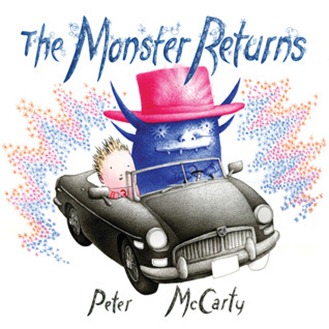
This sequel to Jeremy Draws a Monster continues the story of Jeremy, who is continuing to draw up in his room alone.  Then he got a note from his monster saying that he should draw a compass and a telescope and look out the window.  When he looked through the telescope, he saw his monster!  The monster immediately called on the phone and announced he was bored and headed over to Jeremy’s house.  Jeremy had to think quickly.  He invited all of the children playing outside up to his room, gave them each a fancy pen, and had them each draw their own monsters.  When Jeremy’s monster arrived, he was met with a big SURPRISE!

McCarty turns this book into one about making friends, whether through inviting them over to play or by creating them.  It is also a book about creativity where the act of creation is also one of making friends and connections. 

The delicate lines of McCarty’s illustrations add up to bright colors and plenty of fun.  The mix of the human characters done in one style and the single-color monsters done in a different style make for a clever and memorable combination. 

A stylish and fun book about friends, creativity and monsters.  This will have children drawing their own monsters, so make sure to provide plenty of fancy pens and paper.  Appropriate for ages 3-5.

Reviewed from copy received from Henry Holt and Company.

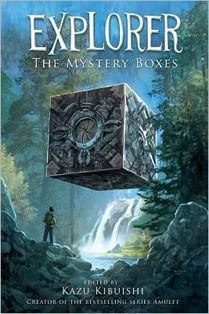
Review: Explorer: The Mystery Boxes by Kazu Kibuishi

mystery boxes

Explorer: The Mystery Boxes by Kazu Kibuishi

Released March 1, 2012.

Kibuishi is the author of the Amulet series of graphic novels as well as the anthologist for Flight.  Here he has created an anthology for children that has seven short stories in graphic format that focus on a single subject: opening a mystery box.  The seven stories all take very different approaches to the focal subject, some of them approaching with humor, others with drama.  The differences deepen when the drawing style is factored in, some creating almost real images and others looking more like mainstream cartoons.  They all add up together to a whole that works well, the entire book rather like a mystery box since you never know what story is coming after the next turn of the page.

Kibuishi’s skill in anthologies is apparent here, weaving the seven individual stories together into a flow that works well.  Many of the stories focus on the boxes showing the characters more depth to their world than they ever knew existed.  There are dolls that come to life, spiritual worlds in modern suburbia, magicians searching for magical objects, war, aliens and treasure too.  Just like textual short stories, these are focused stories that get to the point and end up surprising and delighting thanks in part to their brevity.

This is a great addition to library collections and will offer glimpses of rich worlds to graphic novel fans.  Appropriate for ages 9-12.

Reviewed from ARC received from Amulet Books.

Review: Goldilocks and the Three Bears by Gerda Muller

goldilocks

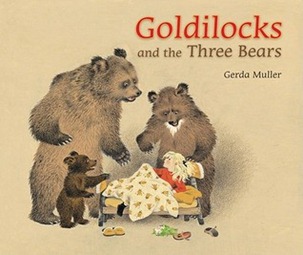
Goldilocks and the Three Bears by Gerda Muller

I’m always on the look out for accessible versions of traditional tales.  Muller’s version of the three bears adds a delightful mix of tradition and the modern day.  The structure of the story remains the same, but Goldilocks is a girl who lives in a caravan and her family travels with the circus.  She’s a not a child who understands about knocking on doors!  And so she walks into the woods and discovers the home of the three bears.  From there, the traditional story picks up.  Yet this Goldilocks is innocent of any real wrong-doing and certainly doesn’t understand that she shouldn’t be there.  This innocence and naiveté works well in the book, taking her character from a naughty urchin to a young explorer. 

Muller’s illustrations are done in an understated color palette with dashes of vivacious reds.  The bears’ home is wonderfully traditional with a Dutch door, carved wooden chairs, and matching comforters on the beds in different colors but all with a bee motif.  No one will wonder why Goldilocks enters and stays.  It is all so very inviting and cozy.

This is a cheery and slightly modernized version of the traditional story that will be welcome in library collections or as a great bedtime pick.  Appropriate for ages 3-5.

Reviewed from copy received from Floris Books.

Review: Into the Outdoors by Susan Gal

into the outdoors

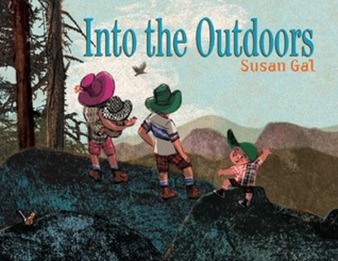
Into the Outdoors by Susan Gal

Learn your prepositions in the fresh air with this book that takes us up into the mountains and down into the forest.  A family heads out on a camping trip.  Along the way they go over a bridge and under the trees.  Once they reach the woods, they head out on a hike, following a trail around the lake, across a stream, and between some large rocks.  They return to their campsite and the fire, where the animals they saw on their hike have followed them back.  The entire book is playful and fun.

Gal has managed to structure a fine little story out of her prepositional phrases.  The family moves through their day, exploring the natural world.  While the book would be of use with prepositions and prepositional phrases, it is also a gem of a short read all on its own. 

Gal’s illustrations lift this book up, giving it a modern freshness that is not without whimsy.  From the very friendly and approachable animals, to the grin of the baby riding in its sling, this book has a merry and jaunty feel that one gets outdoors.

An enjoyable prepositional outdoor hike, this cheerful title will be embraced as a learning tool but also as a great bedtime read.  Appropriate for ages 3-5.

Reviewed from copy received from Alfred A. Knopf.

Review: May B. by Caroline Starr Rose

may b

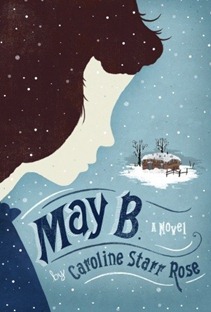
May B. by Caroline Starr Rose

May has grown up living out on her family’s homestead on the Kansas prairie.   When money gets tight, she is sent to become live-in help for other homesteaders, but just until Christmas.  May finds herself in a small sod house fifteen miles away from her own.  The young wife, who is almost May’s age, is unhappy on the prairie and runs away.  The husband heads after her and neither return.  May is left alone on the prairie where at first the days are lovely, sunny and warm and she enjoys the freedom.  Then winter comes, and May is alone on the prairie with a dwindling food supply, just a little wood for heat, and only the prairie itself for company.  This book written in verse is a look at the dangers, hardship and courage of homesteading.

Rose has written a book that pays homage to the Little House on the Prairie books and reads a lot like The Long Winter.  At the same time, it also has a stark reality about it that makes it gripping.  The format of a verse novel works particularly well here as most of the story is May’s reaction to her situation.  What could have been lengthy treatises on loneliness instead are verses that speak to the harrowing nature of abandonment. 

The book also deals with May’s dyslexia which makes her almost unable to read.  She had one teacher, shown in flashbacks, who treated her with respect and worked with her.  But after that, another teacher arrived who used shame to try to get May to learn to read.  It is the story of an obviously bright and very resourceful girl with dyslexia.  Her struggles to read strike a delicate balance in the book, showing an inner battle that plays against the external forces at work.

A taut, frightening novel of solitary confinement set in wide-open spaces, this book would work well with reluctant readers or as a classroom read.  Appropriate for ages 9-12.

Reviewed from copy received from Schwartz & Wade Books.

Review: Extra Yarn by Mac Barnett

extra-yarn-cover

Extra Yarn by Mac Barnett, illustrated by Jon Klassen

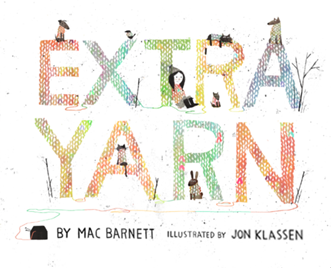
In the bleakness of winter when the town was all white from snow and black from chimney soot, Annabelle found a box that contained yarn of every color.  She knit herself a sweater and still had more yarn, so she knit a sweater for her dog too.  There was still yarn, so she started knitting sweaters for everyone or hats for those who didn’t want sweaters.  Still there was more yarn, so she knit sweaters for all of the animals around.  She still had not run out of yarn, so she started knitting for objects that don’t wear sweaters, covering houses and mail boxes with yarn.  That’s when Annabelle attracted the attention of a vain archduke who wanted the unending box of yarn for himself.  When she refused to sell it to him at any price, he stole it from her.  But we all know the rules about magic things, and soon the box was back in Annabelle’s hands.

This book is filled with magic and not just in the form of the unending yarn.  Barnett’s storyline is a combination of gentle storytelling and subtle humor.  It manages to be both fresh and also pay homage to traditional tales. 

Klassen’s art has the starkness of his previous book, I Want My Hat Back, but the brightness of the yarn adds an entirely new dimension.  It glows in all of its color and texture against the rest of the illustrations, bringing not only color but also a robust life into the images.  His use of digitally scanned textures to create the knit effect is ingenious. 

A delight of a picture book that references the traditional while creating something completely new and magical.  Appropriate for ages 3-5.

Reviewed from library copy.

Review: Tom the Tamer by Tjibbe Veldkamp

tom the tamer

Tom the Tamer by Tjibbe Veldkamp, illustrated by Philip Hopman

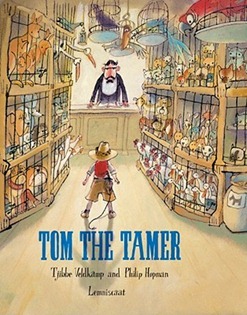
Tom may be able to train snails to jump on a trampoline and squirrels to swing from trapezes in the trees, but he can’t convince his father to go outdoors.  His dad is too frightened of all of the animals out there.  So Tom sets out with a plan to bring the animals in to his father.  He starts by heading to the local pet store and buying a polar bear.  He trains the polar bear in the park and by that evening, the polar bear is pretending to be their new furry white chair in the house.  Tom’s father loves the new chair and never notices that it is actually a polar bear.  The next day, Tom heads out and gets even more animals from the pet store, training them all to act like different pieces of furniture.  Soon the entire living room is filled with animals, and Tom’s father loves all of the new “furniture” too.  But what will happen when he finds out that Tom got all of these new things at the pet store?

Veldkamp has created a broad comedy that stretches the imagination in a most wonderful way.  It also takes the parent/child relationship and merrily turns it on its head.  Tom is a very creative young man, seeing the world in his own unique way and definitely not in the way that his father does. 

Hopman’s illustrations add to the fun, from the crowded shelves of the pet store to the graceful curve and smile of a polar bear chair.  The illustrations have a certain wildness but also a friendly style that makes sure that everyone knows this is pure fun.

An exuberant book that is full of zany fun, this Dutch import would be a great addition to an animal story time.  Appropriate for ages 4-6.

Reviewed from copy received from Lemniscaat.

Review: Dragonswood by Janet Lee Carey

dragonswood

Dragonswood by Janet Lee Carey

After the death of the king, the royal treasure was stolen and has not been recovered.  Tess lives in a small village and has troubles of her own, including an abusive stepfather and the recent death of her infant brother.  When the witch hunter comes to town, Tess is accused of being a witch.  Tess is able to see the future in fire sometimes and loves going into the wilds of Dragonswood even though it is forbidden.  When she is tortured, she breaks and gives up the names of her best friends as also going into Dragonswood with her.  Sent to trial, Tess escapes with the aid of a dragon and flees her home along with her two friends.  The three of them must survive in the wilds, disguised as lepers and never revealing their identities.  But when one of their husbands is tortured too , the situation changes and they must risk their own safety to save him.  As the story continues, more of the magic of Dragonswood is revealed along with who took the royal treasure.  This is one amazing read, filled with fey and dragons.

Carey writes with the confidence of a long-time storyteller.  Here, she weaves 12th century England and its witch-hunting into a story filled with ancient magic.  The setting of Wilde Island and Dragonswood is particularly effective, itself filled with creatures of magic and the dangers as well.  The story’s pacing is well done too, gripping and fast-paced in the beginning, it slows a bit in the middle to allow the story to develop, and then picks up the speed again in the end as all of the pieces fit together at last. 

The characterization is also particularly well done.  Tess lacks self-confidence from her years of abuse and seems unlikely to become the heroine of the story.  When she breaks under torture, it is written particularly well, and shows the violence of torture and the coldness and calculating nature of it as a tool.  The other characters are also well-rendered, with secondary characters returning later in the story and becoming more fully developed. 

This book sparkles with magic, dragons and fey, but also is striking because of its human characters living in fear and darkness.  Beautiful writing and a remarkable setting lift this fantasy on dragon wings.  Appropriate for ages 14-17.

Reviewed from copy received from Dial Books.