Review: Caveman, A.B.C. Story by Janee Trasler

caveman

Caveman, A.B.C. Story by Janee Trasler

Take a prehistoric trip through the alphabet in this funny picture book!  This book tells the story of a caveman’s adventures solely through pictures and a few alphabetical words.  It starts with an acorn that both the caveman and a squirrel are after.  They are scared by a bear into a cave where a dinosaur was living.  A bit later, the caveman makes friends with an odd little creature who had been trapped in some ice.  Unfortunately, the big green dinosaur appears again and chases them around, forcing them to leap onto vines and swing away.  But the book can’t end before one final uproarious slapstick moment which leads all the way too the Zzzz at the end.

This story is told only in 26 words, so that means that the illustrations are what really make this book work so well.  Filled with a zany cartoon style, the pictures are action-filled and great fun.  The huge green dinosaur may pursue the caveman in the book, but readers will notice the rounded teeth and the big smile long before the caveman does.

A fast-paced and funny alphabet book that will do well with young dinosaur fans.  Appropriate for ages 2-4.

Reviewed from library copy.

Also reviewed on Jen Robinson’s Book Page.
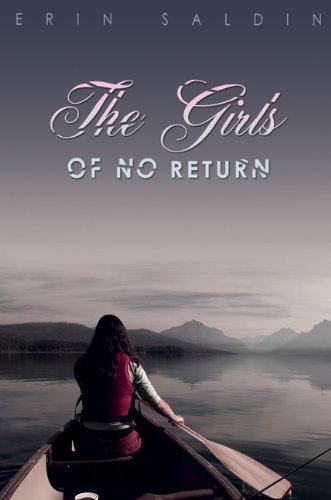
Review: Girls of No Return by Erin Saldin

girls of no return

The Girls of No Return by Erin Saldin

Released February 1, 2012.

A tense, riveting tale told in flashbacks, this book hints from the beginning about terrible things that aren’t fully revealed to the reader until the very end.  The result is a book that is tinglingly tantalizing and has you jumping at shadows. 

Lida has been sent to the Alice Marshall school where troubled girls are sent to try to rehabilitate.  It’s located at the Frank Church River of No Return Wilderness Area in northern Idaho, where the students are surrounded by nature and removed from the temptations of modern life.  They live in cabins with bunk beds.  Lida lives with several other girls, including Boone who is something of a legend as she terrorizes the new students.  There is also Jules, who is so sweet and friendly that Lida can’t guess what she could have done wrong to be there.  And finally the luminous Gia, whose friendship is addictive and elusive.  Lida refuses to talk at first, drawing more and more deeply inside herself, but slowly she starts to reveal herself to the other girls and to the reader.  As the tension in the story mounts and secrets are revealed, readers are caught in the web of truths, lies, and betrayals.

Saldin’s debut is a book that mixes juvenile detention with nature, combining it all with a swirl of illicit drugs and alcohol.  The characters are all complex, especially when the reader thinks they have that character pegged, they will reveal even more of themselves.  The setting is gorgeously described from the lake to the mountains.  It serves as an important plot device throughout the book with its isolation. 

Saldin does the near impossible here, not revealing the horrible truth of what happened until the very end of the book.  Twenty pages from the end, the tension was so thick that my eyes could not read the words quickly enough.  Yet at the same time, I didn’t want this exquisite read to end.  Even better, the ending really works, offering no easy solutions to the complexity of the storyline.

The writing is vibrant and creative, the plot inventive and revealing.  This book is a stellar read that would make a great book talk.  Appropriate for ages 14-17.

Reviewed from ARC received from Arthur A. Levine Books.

Review: Wee Granny’s Magic Bag by Elizabeth McKay

wee grannys magic bag

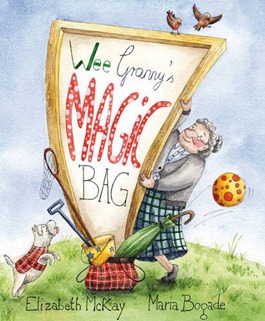
Wee Granny’s Magic Bag by Elizabeth McKay, illustrated by Maria Bogade

Emily and Harry are looking forward to heading out to the park with Wee Granny, but most of all they hoped that she would bring along her amazing tartan bag.  They had seen magical things come out of that bag!  Last Christmas, she had pulled out a lamp-post (fully lit) to help Harry see his carols.  Then in the summer, she pulled out chairs for them to sit on the beach.  Emily and Harry tried to see inside Wee Granny’s bag, but she closed it too quickly.  Then they tried asking her what she had in there, but she only said she had brought her phone.  When her phone rang, the children were amazed to see her pull an entire phone booth out of the bag and answer it!  It was their mother calling, asking them to make more cupcakes for the fair.  And that is when Wee Granny really pulled amazing things out of her bag!

Originally from Scotland, this book celebrates grannies, tartan and magic.  McKay writes with a cheerful tone and the entire book awaits the magic that everyone knows is coming!  The pacing is nicely done, dancing along happily.  The story has a gentleness to it as well that is warm and friendly.

Bogade’s illustrations are done in ink and watercolor.  They have a merriness to them as well, filled with bright colors and playing up the effect of pulling huge items from a small bag.  The humor of the entire work is well reflected in the images.

For children too young for Nanny McPhee, this picture book introduces an equally magical Wee Granny who is sure to fill their bedtime dreams with magic.  Appropriate for ages 4-6.

Reviewed from copy received from Floris Books.

Review: No Two Alike by Keith Baker

no two alike

No Two Alike by Keith Baker

Starting with the fact that no two snowflakes are alike, though they almost are, this book merrily explores the snowy woods.   Things are found in pairs, and pointed out to be different from one another.  No two nests are the same, no two tracks in the snow.  Branches and leaves are all different from one another.  Throughout nature it’s the same.  Even the two very similar little red birds who accompany the reader on the trip through the snow are shown in the end to be different from one another, “Almost, almost… but not quite.”

Just right for toddlers, this book looks at things that may seem the same but upon closer inspection are actually different.  Baker’s writing is simple and effortless, gliding through the story with just enough support to carry the book.  The rhythm and structure of the book also help make it a great read aloud.

His illustrations are equally light and cheery.  The two red birds are merry companions for young readers as they explore the snowy woods together.  Readers can stop and take the time to see the differences between things for themselves. 

This book could be used in several ways.  It could be used to explore differences in objects or for walks in nature to explore how each object is different.  It can also be used as a gentle way to enter conversations about how we as people are all different too in many ways. 

This sweet, jolly book makes is worth a warm snuggle on a wintry day and a walk in the winter weather to look up close at nature.    Appropriate for ages 1-3.

Reviewed from library copy.

Review: I See the Sun in Afghanistan by Dedie King

i see the sun

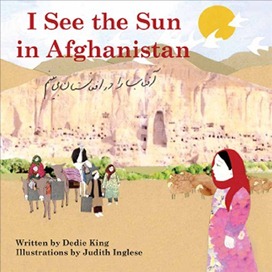
I See the Sun in Afghanistan by Dedie King, illustrated by Judith Inglese

Looking for an ideal book to use with children about Afghanistan?  See Afghanistan and its culture through the eyes of a young girl in this book.  Follow her through one day from waking when it is still dark to fetch water.  Listen to the sounds she hears, see the chores she does, visit her school, and see how her family is impacted by the war and takes in extended family members.  Told in the first person, this book invites readers to see themselves as part of this country with its strong traditions and culture.

Using the device of a first person story told by a child, this book works quite well.  It explains many of the small things about life in Afghanistan, leaving the larger issues in the background.  While war is definitely a part of the story, this book does not take sides or express political opinions.  Rather, this is a book about everyday life and about the impacts of war on one family.  The tone is quiet and evocative, using sensory information to create the setting.

Inglese’s illustrations are a mix of painting and collage.  This works particularly well with the textiles, allowing the fabrics to really splash.  The collages also include occasional photographs which also pop against the browns of the landscape. 

I do have two issues with the book.  One is the whiteness of the skin of the characters, though this seems more of a stylistic choice than a statement of any kind.  It is used in other books in the I See the Sun series.  The other is that religion has been removed from the book, which is an odd choice for a book about a culture.

This look at the culture of modern Afghanistan is in picture book form, but will work best for slightly older children.  With the dearth of books on this subject for young readers, this would make a good addition to any library collection.  Appropriate for ages 6-9.

Reviewed from library copy.

Review: Beneath a Meth Moon by Jacqueline Woodson

beneath a meth moon

Beneath a Meth Moon by Jacqueline Woodson

Released February 2, 2012.

Laurel survived Hurricane Katrina, but unfortunately her mother and grandmother died in the storm.  With her father and little brother, they moved away from the destruction and loss to start a new life.  Laurel made new friends, joined the cheerleading squad, and hooked up with one of the coolest boys on the basketball team, T-Boom.  T-Boom was the person who introduced her to meth.  The meth erased all of Laurel’s needs, all of her grief.  Before she knew it, she was addicted and she had lost her friends and family.  Laurel is alone on the streets, begging for cash to support her habit when readers first meet her.  This is a story of loss, the destruction of addiction, and what must happen to return from that abyss. 

Woodson has written a raw and painful book that does not shrink away from any of the emotions, torment and horror of drug addiction.  At the same time though, the book is filled with hope and chances for change.  It reveals the dark truths but is never without some light.  At times I read the book without being able to breath deeply, the tension and tightrope of Laurel’s life was so tangible.

Woodson’s writing is glorious even as it speaks about addiction. Here is a passage from early in the novel, Page 18, where Laurel is walking in the snow after taking meth:

Something warm and wet was surrounding me, and I laughed at the heat inside the snow.  The hurt of wanting to moon was gone now, replaced by something heavy.  Not heavy.  Light.  Free.  I was free.  Tears.  The warm thing wasn’t snow.  Where were the tears coming from?  Who was crying on me?  I stopped walking and wiped at my eyes, but whoever was crying on me kept on crying.

As we see Laurel disintegrate before our eyes under the influence of the drug, we also see why the drug is luring her to use it, understand the pull of this beauty.  Laurel is a character filled with emptiness and need, yet she is able to put into words the grip of the drug and its power. 

This book is short, powerful, and wrenching, yet at the same time it is filled with incandescent writing.  Appropriate for ages 14-17.

Reviewed from ARC received from Penguin Young Reader’s Group.

Also reviewed by:

Review: Moving House by Mark Siegel

moving house

Moving House by Mark Siegel

Foggytown had such thick fog that people couldn’t even see where they were walking!  Chloe and Joey wished that they could see the stars from their house, but it was far too foggy for that.  One foggy day when they returned home, their parents announced that they were moving.  As they went to bed, the two children thought about everything they would miss about this house: the warm spot on the kitchen floor, the long hallway to run down, and their secret spot upstairs.  Then suddenly, their room moved and they were wiggled around.  Their house had sprouted arms and legs and was walking down the road!  It took them to a hill above the fog where they could see the stars and look over the world for miles.  After visiting with other buildings, the children got tired and headed back to bed.  What will they see when they wake up in the morning?

This clever take on books about moving adds a large dose of fantasy.  The story stays true to the emotions of moving even though it is fantasy.  The children think about their current home with great affection, worry about where they will live, and soon learn that things can be even better in a new location. 

Siegel injects the entire book with humor.  My favorite part is the series of panels at the beginning of the book with one person after another running into objects in the fog.  The series goes on long enough for it to be a great running gag.  That broad humor slows down as the book moves forward, pacing it much like a bedtime story.

A book about moving to share with children who enjoy a touch of whimsical fantasy, some sweetness, and plenty of humor in their picture books.  Appropriate for ages 4-6.

Reviewed from library copy.

Review: The Lions of Little Rock by Kristin Levine

lions of little rock

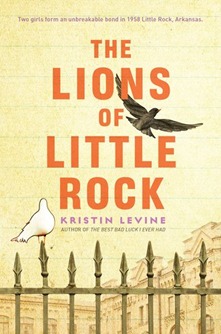
The Lions of Little Rock by Kristin Levine

Little Rock in 1958 was a divided city at the forefront of the integration battles.  Marlee finds herself at the crossroads of that battle when the high schools in Little Rock are closed and her sister is sent away to go to school in another town.  Marlee is a quiet person, often unable to speak up even when she would most like to.  When she meets Liz, a new girl in her class, the two girls become fast friends with Liz helping Marlee find her voice.  The two girls work together on an oral project but before they can present it, Liz is discovered to be passing as a white girl to go to school there.   Marlee has to find a way to continue being friends with the best friend she has ever had, despite the dangers.  Otherwise she’s lost another person that she can actually talk to.  She has to find her voice and learn how to use it to make a difference.

Levine’s setting is one later than most books about Little Rock.  This book takes place a year after the Little Rock Nine enrolled at Little Rock Central High School.  It explores the effect of their courage on the community and also the way that the problems were not solved in that year alone.  The passions on both sides of of the segregation debate are shown clearly, as is the toll that it took on the Little Rock community.  The most important piece of the book is the courage of the ordinary citizen in taking on larger forces and winning for the good of everyone.  These are lessons that are vital for our children to learn.

The title of the book refers to the lions in the Little Rock Zoo.  Marlee lives close enough to the zoo to hear the lions roaring at night before she goes to bed.  The zoo is also the place that she sometimes meets with Liz.  This gives the book a strong level of symbolism that will give young readers something to relate to and discuss as the book progresses.

The character of Marlee is especially well drawn.  She is shy, nearly silent, and underneath that is brave, a good friend, and passionate.  She has trouble communicating with her own mother, rarely speaking, and yet she is inspiring and has a large impact on her mother and others.  There is a strength to her character that is more subtle than most, but also more steely.  She’s an incredible heroine and one that will inspire young readers.  The other characters are equally well done.  Liz, the best friend, is complex and interesting, battling her own problems with being too out-spoken.  Marlee’s parents are both teachers, watching their livelihood and professions being slowly destroyed in Little Rock. 

This powerful book is ideal for using in classrooms talking about civil rights and segregation.  It’s a book that will read aloud well and has plenty of action to keep listeners riveted.  An impressive and memorable book that should be in every public and school library.  Appropriate for ages 9-12.

Reviewed from ARC received from G. P. Putnam’s Sons.

Also reviewed by:

Review: We March by Shane W. Evans

we march

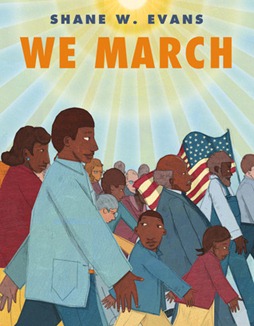
We March by Shane W. Evans

More than a quarter million people marched on Washington on August 28, 1963.  In simple prose and stirring images, Evans tells the story of one child whose family marched that day.  It is a day of working together, faith, and community that culminates with Martin Luther King Jr.’s “I Have a Dream” speech.  This picture book invites even the youngest of children to feel the power of that day, the message of racial harmony, and to understand how much more work there is yet to do.

The prose here is so simple that it just barely tells the story of the march.  With just a handful of words on each double-page spread, the words are very brief.  But the story being told here, is much more than those simple words.  Rather than obscuring the power of that day with too much exposition, this minimalist approach lets the transcendent moment in history shine.  The book does end with a page of information about the march for those looking for further details.

Evans’ illustrations are filled with strength.  He uses simple lines that he combines with a mix of painting and collage to get a layered effect in his art.  The colors are a mix of subtle and strong.  The illustrations focus on a single family that day, but also convey the size of the crowd and the diversity of the people marching.

A powerful, simple look at a historic moment, this book shines with its strong message of unity.  A great pick to share any time of the year, it’s one worth highlighting for February’s Black History Month.  Appropriate for ages 3-6.

Reviewed from copy received from Roaring Brook Press.