Review: I Will Come Back for You by Marisabina Russo

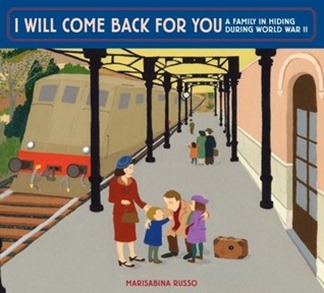
i will come back for you

I Will Come Back for You: A Family Hiding During World War II by Marisabina Russo

Based on real life stories from the author’s family, this is a story of survival during the years of the Holocaust.  A little girl tells the story of her family in Italy during World War II.  The book shows the transition from seeing soldiers around to the growing restrictions and imprisonment of Jewish families.  The story starts in Rome where the family has been living, but then their father is sent away into the mountains with the other Jewish men.  The family would travel into the mountains to see her father on the weekends.  Even this did not last long, because soon there was talk of concentration camps coming, so her father ran away to hide.  The Nazis then tried to take her mother, but through a series of skillful tricks, she was able to prevent being sent to a concentration camp.  This book takes a very challenging time in history and makes it accessible and understandable for children.

Russo successfully uses the lens of a small girl to explain the situations during World War II for Jewish people.   Focusing on the breaking apart of families rather than the atrocities of the Nazis, makes this book powerful on a different level.  The horrors of the Holocaust are evident in the story, but do not take center stage.  It is very skillfully written and conceived.

Russo’s art has a gentle simplicity to it.  The paintings have a flatness that works well and the images are clearly set in the past.  The story is compelling and fascinating, yet is definitely suitable for younger readers.

This picture book speaks to the horrors of World War II in a way that children can understand.  Appropriate for ages 6-8.

Reviewed from copy received from Schwartz & Wade.
Review: The Probability of Miracles by Wendy Wunder

probability of miracles

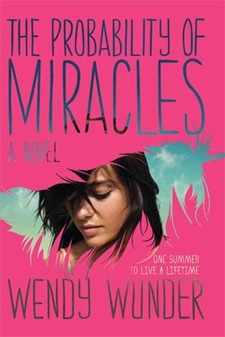
The Probability of Miracles by Wendy Wunder

Cam has been battling cancer for the last seven years.  At age 16, she has reached a point where nothing more can be done.  All she has left is acceptance and a lot of attitude.  But Cam’s mother and sister are not ready to give up hope, so they move the family north from their lives at Disney World in Florida to Promise, Maine.  Promise is a small community where miracles happen.  Cam certainly doesn’t believe in miracles or religion for that matter, but Cam feels the magic of Promise too.  Her blemishes from the disease fade, her hair grows long, and she feels better than ever.  Then there is her Flamingo List that she created at summer camp.  It’s a list of things that she wants to do before she dies.  Many of them seem very unlikely at first, but as the summer goes on, she ticks them off the list.  Cam has one final summer to reach her goals and even to exceed her own expectations.

This is not a weepy cancer book at all.  Rather it is the story of a sarcastic, brilliant girl battling a disease and finding a place to be herself and create the best days ever.  In Cam, Wunder has given us much more than a tragic story of the last days of a life.  Instead Cam seems more filled with life than the rest of us.  She shines, entrances and lives with abandon.  It is like watching a shooting star race past.

Wunder also creates an entire cast of impressive supporting characters.  They are often introduced as stereotypes, but then they become more fully realized as the reader gets to know and understand them.  We as readers get to discover the characters alongside Cam.  The setting of Promise, Maine is also beautifully rendered with the magical parts interwoven to create a dance of magical realism and realistic fiction.

Gorgeously written and realized, this is a powerful read with a great, flawed heroine.  Appropriate for ages 15-17.

Reviewed from copy received from Razor Bill.

Check out the book trailer:

Also reviewed by:

Review: Dream Something Big by Dianna Hutts Aston

dream something big

Dream Something Big: The Story of the Watts Towers by Dianna Hutts Aston, illustrated by Susan L. Roth

Told through the voice of a fictional child, this is a look at the building of the Watts Towers, a huge art piece that is outsider art and has been named a National Landmark.  Simon Rodia, called Uncle Simon in the book, built the towers from glass, pottery shards, seashells and a vision.  Each piece on the towers was selected by hand.  The book shows the careful selection and then the transformation from garbage to art.  This is about the artistic dream and the process more than the man himself.  Because the building of the towers took decades, the story shows the girl grown into a woman with her own children.  It is a story of an artist, his skill, and the strength and vision it took to make it happen.

Aston has written so simply here that her format speaks also to the simplicity yet complexity too of the art itself.  She writes in the first person, inviting people into the story.  As she explores the process of the art, it is broken into parts and becomes jewel like too.  These are small moments and decisions that contribute to the whole.  The moments of creation are exceptionally important to the feel of the entire book.  They are moments that are celebrated and savored.

Roth’s incredible collage illustrations also elevate this book.  They are bright, filled with motion, and there is a constant feel of confetti and celebration on the page.  The shards and small treasures slowly coalesce into the towers and the gates around them.  The art is so close to reality that when the final page is turned and one sees a photograph of the towers, there is no jilt to reality.  Roth captured the spirit of the art so completely that it just feels right to see the real work at that point.

This is a powerful picture book about the process and importance of art and the act of creation.  Appropriate for ages 5-8.

Reviewed from copy received from Dial Books for Young Readers.

Also reviewed by:

Review: The Gingerbread Girl Goes Animal Crackers by Lisa Campbell Ernst

gingerbread girl goes animal crackers

The Gingerbread Girl Goes Animal Crackers by Lisa Campbell Ernst

This second Gingerbread Girl book continues the story of the sister of the Gingerbread Boy who is much more clever than her poor brother.  She survived the fox and now has gotten a box of animal cracker pets for her birthday.  But before she can warn them about the dangers out in the world, they run off chanting: “We’re wild Animal Crackers, hear our fierce roar.  You can’t catch us, we’re off to explore!”  Soon enough, the animal crackers have attracted a parade of people and animals chasing after them.  Waiting near the river is the fox, who is eager to offer all of the crackers a ride across.  Luckily, the Gingerbread Girl is still clever and figures out a way for them to save the day.

Ernst’s story is a rousing success with clever rhymes, fast moving prose, and plenty of action and suspense.  The Gingerbread Girl is a sweet heroine who is creative and smart.  The update to the story is in keeping with the traditional tale, but fractures it just enough to be modern and fresh. 

Ernst’s art has a timeless feel to it.  With the gingham backgrounds to the textual pages, there is a country feel to the entire book that works well with its rural setting. 

A pleasing update to a traditional tale, this book calls for sharing animal crackers while reading.  But don’t save any for the fox!  Appropriate for ages 3-5.

Reviewed from copy received from Dutton Children’s Books.

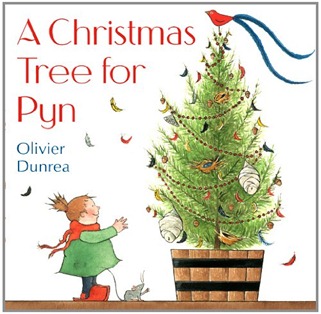
Review: A Christmas Tree for Pyn by Olivier Dunrea

christmas tree for pyn

A Christmas Tree for Pyn by Olivier Dunrea

Little Pyn dreams of having a Christmas tree of their own, but her gruff Papa (who insists that she call him Oother) refuses to have one.  While her father works outside in the woods all day, Pyn tidies up the house.  Through it all, she thinks about a Christmas tree.  When Oother continues to say no to a tree, Pyn decides to handle matters herself.  She waits until her father heads out to work and then dresses herself in warm clothes and takes a small hatchet along with her.  But before she gets far at all, she is up to her waist in snow with more tumbled down and burying her.  Oother rescues her at once, sweeping her up onto his shoulders.  Together the two of them find the perfect tree and bring it home, where Pyn decorates it with all sorts of natural treasures she has saved.  Oother too has something to add to the tree, that speaks to the memory of Pyn’s mother.

Dunrea has managed to create a gruff bear of a father who has trouble expressing his love for his tiny daughter, but that children will understand easily.  There is a palpable love between the two characters though both have trouble voicing it.  It is the warmth in the story, the glue of their small family.  Towards the end of the book, the sorrow of the loss of Pyn’s mother is tangible too.  It is almost achingly there, a physical presence that explains the strained relationship and the reason a Christmas tree is vitally important to them both.

Dunrea’s art is beautifully done with his signature white backgrounds upon which his characters build their lives.  The book is filled with small touches that show the snugness and warmth of their home.  The huge stone fireplace, the cozy slippers, and the steam rising from pots and bowls.  It all creates a family and home.

This book speaks to the heart of the Christmas season, where families grow closer, memories are shared, and a tree becomes more than it could ever seem to be.  Appropriate for ages 4-6.

Reviewed from copy received from Penguin Young Readers Group.

Review: Strega Nona’s Gift by Tomie dePaola

strega nonas gift

Strega Nona’s Gift by Tomie dePaola

In the small Italian village where Strega Nona lives, everyone is busy preparing for the holidays.  They stretch from December 6th and the Feast of San Nicola to January 6th and the Feast of Epifania.  This picture book looks at the various Italian feasts, focusing mostly on the Eve of Epifania where animals are said to be able to get the power of speech.  So all of the people in the village made delicious food for the animals to keep them happy.  However, when Big Anthony realizes that he is eating a simple meal of pasta and not the beautiful food Strega Nona has cooked for the animals, things start to go wrong.  Big Anthony eats the food that was meant for the goat, so she is left with just hay and oats.  Strega Nona uses her magic to send everyone dreams of food that night, but Big Anthony misses out because the goat ate his blanket and he cannot sleep.  In the end, Big Anthony makes everything right again but it takes some holiday luck to make that happen.

dePaola manages to weave the feasts into the storyline deftly, creating a book that shows how some cultures have an extended holiday filled with different sorts of celebrations.  The relationship between Big Anthony and Strega Nona is a large part of the success of this picture book.  Their unique ways with one another adds the spice to the holiday story that it needs.  There is a gentle humor about the story that works well.

As always, the illustrations are simple, humorous and completely appealing.  This is the Stega Nona we have all grown to love, showing her care for her village through her cooking and magic.  It is a quiet sort of Christmas book, one that shows the depth of the holiday season and speaks to more than Santa and gifts.

For families looking for a book that explores a different holiday tradition, this book will be great fun to share and informative too.  Appropriate for ages 4-6.

Reviewed from copy received from Penguin Young Readers Group.

Review: Secrets at Sea by Richard Peck

secrets at sea

Secrets at Sea by Richard Peck

A wonderful mix of Upstairs Downstairs and The Borrowers, this is the first animal story from the incredible Peck.  Helena is the eldest of the Cranston family of mice.  Her parents are both dead as are her older sisters.  It is 1887 and the human Cranston family is planning a trip to England to get their eldest daughter wed.  So the mouse family also has to decide.  Do they travel across the dangerous and deadly water with the family or stay behind in an empty house.  Helena hopes that the trip will help with some of the problems she has been fretting about.  Her younger brother is always getting into scrapes and needs some direction.  One of her younger sisters is far too attached to one of the human daughters.  So the family embarks on a trip where they discover the large impact a family of mice can have on their humans.

Peck writes with a sly humor here that takes on the establishment and the constraints of society in the late 1800s.  The same sort of tiers that make up the human society are found reflected with the mouse society as well.  It makes for a delight of a novel that has depth and a lot of heart.  Peck’s young heroine, Helena, is a mouse burdened with many cares but who also starts to see herself differently as her travels continue.  She is an engaging and richly drawn character.

Peck has also vividly created the setting of a Victorian ship at sea.  From the lavish parties to the lifeboat drills, the mice are involved throughout.  This is a world of privilege that is gloriously redrawn mouse sized complete with royalty and romance.

Highly recommended, this is a dazzling book that will find a place among other great animal stories.  Peck has amazed me once again.  Appropriate for ages 8-11.

Reviewed from ARC received from Penguin Young Readers Group.

Also reviewed by:

Review: The House Baba Built by Ed Young

house baba built

The House Baba Built: An Artist’s Childhood in China by Ed Young

Illustrator Ed Young grew up in Shanghai during World War II.  His father managed to get them a house that was safe because he built it himself.  He made a deal with the landowner that he would build a house and after 20 years, the landowner would get it free and clear.  But in those 20 years, Ed Young’s family lived there.  It was a huge home with a swimming pool, space to roller skate on the roof, staircases to slide down, and lots of other places to play.  This is the story of growing up in that house with the war raging around them, but also feeling very safe as a family because of the house.  It is the story of welcoming people beyond their family to stay with them, giving refuge and forming a larger family unit.  It is the story of years of playfulness and joy together despite the outside forces because his father thought brilliantly and quickly.

It will come as no surprise to those who know Young’s work that this is a beautifully designed book.  Young weaves together paper cutting, sketches, painting and photographs into a dreamlike world of his childhood where some things stand out crystal clear and others are fogged by time.  It is like looking into someone else’s memories along with them.  They are beautiful and mesmerizing.

This book may have trouble finding an audience.  While the illustrations are gorgeous, the story is told in vignettes rather than one large story.  This technique will resonate more with slightly older readers than usual picture book preschoolers.  On the other hand, teachers looking for a book to inspire telling a biography in more than words will delight in this book.  It will share aloud well and the illustrations will invite readers into Young’s world.

A book for older elementary school readers who may take some encouragement to pick it up.  Once they do, they will be transported to Shanghai in the 1930s and 40s.  Pair this with Drawing from Memory by Allen Say for two artist’s childhoods in Asia.  Appropriate for ages 7-10.

Reviewed from ARC received from Little, Brown.

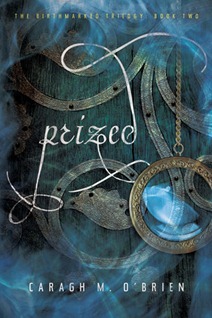
Review: Prized by Caragh M. O’Brien

prized

Prized by Caragh M. O’Brien

In this sequel to Birthmarked, Gaia has escaped into the wasteland with her infant sister, following a rumor to guide her.  Gaia is reaching the end of her strength and her baby sister is perishing when she is discovered by a rider from Sylum.  When she is brought into their matriarchal society, Gaia is forced to give up her sister into the society for care and must submit herself to their rules.  No man can speak to her first much less touch her, and a kiss can get you jailed.  Sylum is slowly dying, since there are many more male births than female.  But Sylum also cannot be escaped easily.  Newcomers get physically ill and then after that violent illness are unable to leave.  If they try to leave, they will die of an even more extreme illness.  So Gaia is trapped in Sylum without her sister, trying to follow their rules, when she discovers that Leon is also there, imprisoned.  In order to free him, Gaia has to give up the last of her will to the ruler of Sylum. 

I adored the first book in this series.  The Enclave was a skewed society that was fully rendered and well thought out.  O’Brien has done the impossible in a single series and created within her world another complete society that makes sense, surprises, and then displays its darker side.  Sylum is a world run by women, but also a decaying society where there are few rights especially for those who refuse to follow the rules.  It is a beautiful, green but dreadful place where the darkness is right below the lovely surface.  In short, it is immensely readable and a wonderful dystopian setting.

O’Brien introduces us to new characters just as we are getting reacquainted with those we enjoyed in the first book.  Gaia remains a fierce, independent force who is bright, inspiring and strong.  She is a character thrown into a society she does not understand, who makes waves with every step and friends too.  There are two brothers who serve as additional love interests in this complex society that forbids touching.  They are wonderfully similar but also very different, attractive in different ways to Gaia.  Still, there is also the angry and ever-frustrating yet fascinating Leon to consider.  As Gaia muses, it is actually a love square rather than a triangle.

This is a compulsively readable book, just like the first.  The world is well drawn, but it is the different societies that truly shine here.  I look forward to the rest of the series, because this book was very unexpected and I can’t guess what is going to happen next.  Appropriate for ages 14-17.

Reviewed from copy received from Roaring Brook Press.

Also reviewed by: