Anna Hibiscus Series Continues to Offer a Charming Glimpse into Africa

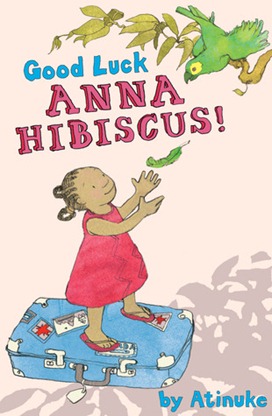
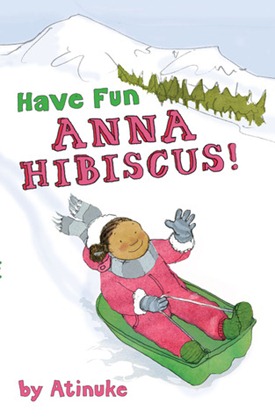
goodluckanna havefunanna

Good Luck Anna Hibiscus by Atinuke

Have Fun Anna Hibiscus by Atinuke

In the first two books about Anna Hibiscus, readers were treated to a glimpse into life in Africa among a large extended family.  But Anna Hibiscus has even more family, a grandmother who lives in Canada.  Book three in the series tells the story of Anna Hibiscus’ preparations for heading to Canada for the first time.  The first few stories reintroduce Anna Hibiscus’ family, including her baby brothers who get into all sorts of trouble.  The other stories tell of trying to find warm clothes suitable for a Canadian winter in Africa and how her family gives her a send off.  Book Four follows Anna Hibiscus to Canada starting with her plane trip.  Those of us in North America will see snow with fresh eyes, enjoy Anna Hibiscus’ first attempt at ice skating, and will enjoy getting to know her grandmother’s dog too.  This series continues to be a celebration of family, expanding now to far-flung families and new adventures.

Atinuke tells all of her stories with a storytellers structure and tone.  There is repetition that echoes throughout the series, tying them all together nicely.  At the same time, her structure remains easy and friendly, offering an inviting cadence to old and new readers alike. 

The entire series is illustrated by Lauren Tobia.  The illustrations weave throughout the book, creating a window into the cultures shown in the stories.  They make the book welcoming for newer readers who will find a great friend in Anna Hibiscus.

If you were a fan of the first two Anna Hibiscus books, make sure to check out these two as well.  They are just as lovely as the first.  Appropriate for ages 6-9.

Reviewed from copies received from Kane Miller.
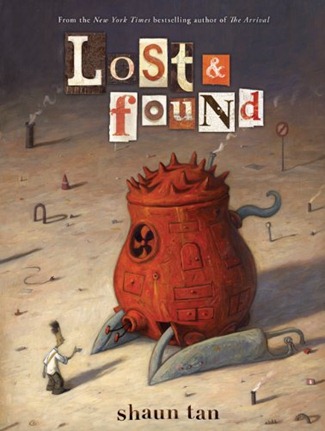
Book Review – Lost & Found: A Graphic Novel Wonderland

lostfoundtan

Lost & Found by Shaun Tan

This collection of three stories by Tan which were previously published in Australia as separate stories combine to create an incredible experience.  Tan wrote two of the stories himself and did the art for all three.  The three stories are unique and different, though they are all about loneliness, discovering what is right in front of us, and unexpected beauty. 

The Red Tree tells the story of a woman trapped in darkness, though if you look closely you will see a sign of hope that continues through the images.  The illustrations are filled with large urban buildings, strange mechanical beings, and empty curving landscapes.  Until finally, the red tree is found where you least expect it. 

The Lost Thing is the story of a man who discovers something strange on the beach.  It was something odd, unusual and completely out of place.  The man searches for where the lost thing belongs, eventually taking it home with him and figuring out what it eats.  But this is not a story of a lost and new pet.  It is a story of secret places, unusual beings, and discovering what you were once blind to.

The Rabbits is a story written by John Marsden, who is also from Australia.  The story takes a look at the colonization of Australia through the story of the rabbits entering and taking over the continent.  Marsden and Tan create a story that tells the tale of take over, theft and oppression through animals, at once making it a story that can be told clearly and coolly but also one that echoes with tragedy on a larger scale.  For me, this was the story in the book that resonated and continues to linger.

Tan pays close attention to details throughout the book.  The transitional pages between the stories create a unified feel to the book, tying the stories together as if they are hand-in-hand.  The effect of the three stories is one of uniqueness and universal themes. 

Beautifully created, these stories are a treasure for graphic novel fans who will find out that graphic novels can be artistic, deep, compassionate and amazing.  Appropriate for ages 12-15.

Reviewed from copy received from Scholastic.

Also reviewed by:

Birdsong: Get Ready to Make Some Noise

birdsong

Birdsong by Ellie Sandall

This book is a simple, bright invitation to make some noise during story time!  One bird lands on a tree branch and begins to sing “Kitcha kitcha Kee kee kee.”  Another bird flies to the same branch and begins its own song “Urrah!  Urrah! Rah rah ree.”  More birds come, including an owl and a parrot, until finally a very large bird with an enormous voice manages to clear the others from the branch with very humorous results.

Sandall keeps the concept clear and simple.  The narrative portion of the book is kept to an absolute minimum of just introducing the entering birds.  Her bird calls when read one after another form a rhythm and music.  The repetition makes this a great choice for toddlers as well as preschoolers.  The illustrations are a pleasing mix of the roughness of pencil in the branches and trees to the silkiness of watercolor for the birds.  The colors are bright and vibrant, filling the illustrations with color.  The illustrations are large enough to work well with a group.

Upon first reading the book, I thought it would work very well as a play for preschoolers to put on.  Each child as a unique bird with an interesting call that is the only line they have to learn.  And then a comic ending, to wrap the whole thing up.

A great addition to any story time about birds, children will enjoy helping make the musical noise in the book and could even be assigned instruments to match each bird and their call.  Think of the lovely cacophony!  Appropriate for ages 2-4.

Reviewed from copy received from Egmont.

Also reviewed by:

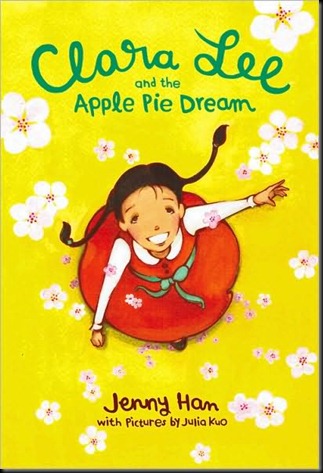
Clara Lee and the Apple Pie Dream: Diverse and Universal All-American Story

claralee

Clara Lee and the Apple Pie Dream by Jenny Han, illustrated by Julia Kuo

Clara Lee wants to be Little Miss Apple Pie in the upcoming Apple Blossom Festival parade.  But it requires that she gives a speech in front of the entire school and that worries her.  So when she has a dream that she thinks is a nightmare but her grandfather assures her is good luck, she discovers that she has an entire day of luck.  She gets the backseat on the bus, she climbs all the way to the top of the rope in gym class, and someone secretly gives her a candy necklace.  So she signs up to compete for Little Miss Apple Pie.  But before she can give her speech, her luck changes for the worse.  Will she be able to restore her good luck before the contest?

Han has created a book that is fresh and a delight to read.  Clara Lee is both all-American and beautifully Korean.  Her life with a foot in both worlds will easily be related to by anyone who has a strong cultural tie to another country.  There are some scenes that capture this especially well, like the meal where Clara Lee and her family eat fish soup, except for her little sister who gets to eat chicken wings instead.

That scene is refreshingly honest not only about the multiple cultures but about family relationships, especially with younger siblings.  The emotions that Clara Lee exhibits are real and tangible for the reader.  Clara Lee is not a perfect girl, instead it is her more human moments that make her the protagonist she is.

This chapter book is just right for young readers transitioning from easy readers to full chapter books.  There are friendly illustrations that make the reading easier and the writing is simple and forthright, ideal for transitional readers.  Get this in the hands of children who enjoy Ivy and Bean.  Appropriate for ages 6-8.

Reviewed from library copy.

Also reviewed by:

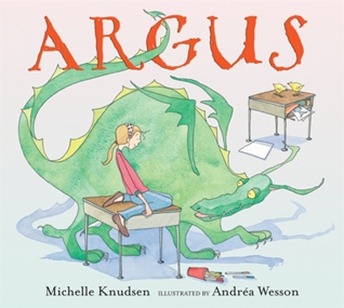
Argus: A Celebration of Being Different

argus

Argus by Michelle Knudsen, illustrated by Andrea Wesson

When her class at school does a science project with eggs, Sally’s egg looks very different from the regular white chicken eggs.  Hers is much larger and polka-dotted.  When the others eggs hatch, the fluffy yellow chicks emerge.  When Sally’s egg hatches, out comes something scaly and green.  Argus is completely different from the other chicks.  He doesn’t eat seeds, instead he’s rather eat the other chicks.  Perhaps even the students!  Sally finds herself longing for a yellow, fluffy, normal chick of her own.  But when Argus disappears, she realizes that he has become very special to her and that his own unique qualities are what make him himself.

Knudsen has created a picture book that is very funny.  She plays up the humor of a dragon emerging from an egg in a classroom.  I also enjoyed the role of the teacher, Mrs. Henshaw, who takes all of the differences and surprises in stride, managing all of the situations without getting flustered.  It is as matter-of-fact a book about a dragon as you are likely to find, which is a large part of its charm.

Wesson’s illustrations have a light touch and lots of details.  The yellow chicks are roly poly and jolly.  Argus is not.  Yet children will never be afraid of Argus because he wears a smile and has friendly yellow eyes.  Another touch from Wesson are the graphs and measurements that the class makes of their “chicks.”  Argus definitely does not conform.

A funny, wry book about differences and acceptance, this book will be welcome in libraries and classrooms as a way to discuss difficult subjects with humor.  Appropriate for ages 5-8.

Reviewed from library copy.

Also reviewed by:

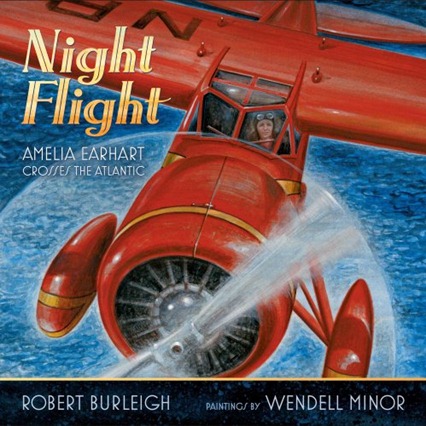
Night Flight: Amelia Earhart Crosses the Atlantic

nightflight

Night Flight: Amelia Earhart Crosses the Atlantic by Robert Burleigh, illustrated by Wendell Minor

This gorgeous and beautifully written picture book follows Amelia Earhart as she tries to be the first woman to pilot a plane across the Atlantic Ocean alone.  Beginning with Earhart rolling down the runway in Newfoundland on May 20, 1932, the book is not only about the trip but also about the beauty of flight, the moments of wonder, the fears, the dedication it takes, and the incredible feat that Amelia Earhart accomplished. 

Burleigh has written the book in paired lines that are filled with poetry and grace.  He uses words to capture the emotions and the events on the journey.  From the beauty of the star-filled sky to the drama of a storm out over the ocean, readers will thrill to this adventure.  As I look over the writing, I am caught up again and again by the words, the pacing, and the incredible Earhart.

Minor’s paintings add to the drama and beauty of the title.  When the book begins, readers can see the smiling face of Earhart peeking through the plane windows directly at them.  Minor manages to capture both the scale and expanse of the adventure and the personal story of Earhart.  He makes it both monumental and personal as does Burleigh in his text.

While there are many titles about Amelia Earhart out there, this is one of the best and would be a thrilling read for any class exploring women’s history.  Appropriate for ages 6-8.

Reviewed from library copy.

To see some of the beauty of the illustrations, take a look at the book trailer below:

Also reviewed by Bibliophile by the Sea.

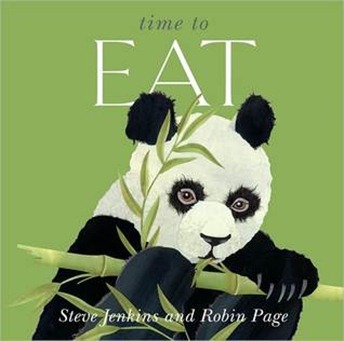
Time to Eat: Nature and Nibbles

timetoeat

Time to Eat by Steven Jenkins and Robin Page

Jenkins and Page continue their collaboration with a new series of nature books for young children.  The other two books in the series are Time for a Bath (coming in May) and Time to Sleep (just released).  In this book, readers learn about the many strange and different things that animals eat.  From the rocks that an ostrich has to eat to chew its food to the tapping thin fingers of an aye-aye looking for lunch, the facts are fascinating. 

Those facts are paired with Jenkins’ illustrations done in paper collage.  As always, his collage work captures the texture of fur, the softness of feathers, and the smoothness of skin.  They manage to be simple yet demonstrate the complexity of the animals. 

Make sure to turn to the end of the book for more details about the featured animals.  The facts included in the body of the book read aloud very well, offering just enough detail to be interesting and yet to move along quickly. 

This is a great book to add to any library’s nature section and to keep on hand for any nature or animal story times you will be doing.  The dung beetle alone is sure to get children intrigued!  Appropriate for ages 4-7.

Reviewed from library copy.

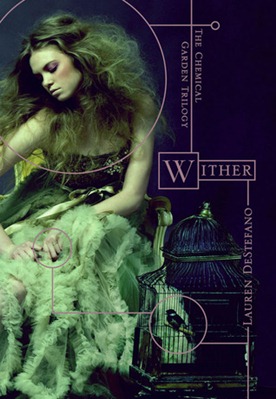
Wither: Surprising, Exceptional Dystopian

wither

Wither by Lauren DeStefano

In future America thanks to genetic manipulation that went wrong, people have a very short and specific lifetime.  Women live until they are 20, men until they are 25.  Society has collapsed with science turning toward trying to save the human race.  In this world, girls are stolen from the streets and kidnapped to become wives and keep the population up.  Rhine is a girl who is taken and survives the selection process.  Now she is forced into a polygamous marriage to a very wealthy man.  She is trapped with her sister wives in a mansion; her cage is beautiful and sumptuous but it is still a cage.  Rhine tries to think only of her escape, but it is made difficult as she begins to form relationships with her fellow prisoners, a handsome servant, and her husband.  This book explores uncertainty, love, desperation and strength.

DeStefano’s writing is what elevates this book above other dystopian fantasies.  Her phrasing is subtle and natural, occasionally turning poetic to make a stronger point or present an important event.  Her plotting is masterful.  In a book where much of the time is spent waiting for action, the story never lags or disappoints.  It is a book of quiet desperation not only for Rhine but for the entire society. 

The world building here is particularly exquisite.  There is just enough of the science background given to make the story work.  The real beauty is in the exploration of the effects of the situation, the revealing of a society in decay, the division of wealth and poverty, the allure of a life at ease in a world like this.  It all adds up to a very powerful statement about our current society.

The characterizations are also beautifully done.  From Rhine, the brave heroine who tells the story in first person present tense, allowing readers to figure out what is happening right along with her.  The sister wives are as different from one another as can be, each of them unique and human, each a character worthy of her own book.  Then there is the complexity of the husband, Linden, a man who could have been portrayed as a monster.  Instead he is a man with a background that formed him, a love for others, and who is haunted by loss. 

Ideal for fans of dystopian science fiction, this unique book will have readers unable to put it down and begging to know when the next book in the series is coming out.  Appropriate for ages 15-18.


Reviewed from copy received from Simon & Schuster.

Also reviewed by:

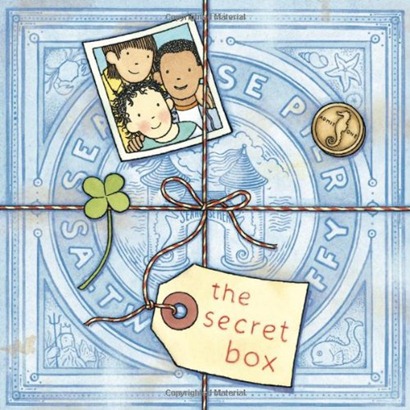
The Secret Box: A Wordless Treasure

secretbox

The Secret Box by Barbara Lehman

Lehman continues her wordless books with this treasure of a title.  Years ago, during the times of steam trains and horse-drawn carriages, a boy hides a box under the floorboards of a house.  Other buildings are built around that house, as the city grows.  Cars and a modern train show that time has passed.  Three children head to the high floor and discover the hidden box.  In the box are directions to the Seahorse Pier.  The children have to find the old landmarks that are almost hidden in the modern city.  They follow the map to the Seahorse Pier and to a surprise waiting for them at the end of their adventure.

Lehman’s books are delightful adventures, allowing readers to take travels along with the characters in the books.  Readers also get to puzzle out what is happening, as the book takes turns and twists like any great adventure should.  Told entirely through illustrations, the story is delicate yet strong.  Lehman uses a deft hand in this book, balancing the book exquisitely.

Although this is a wordless story, it will work best for slightly older preschoolers because the stories are not as straight forward as most wordless books.  Because of that, I see them as ideal picks for children having difficulty with reading.

Highly recommended, this book will be enjoyed by fans of Lehman’s previous work and will find new fans as well.  Appropriate for ages 4-6.

Reviewed from library copy.

Also reviewed by