A Garden for Pig

garden_for_pig (1)

A Garden for Pig by Kathryn K. Thurman, illustrated by Lindsay Ward

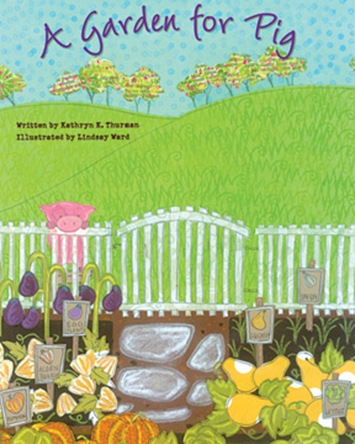
Pig lives on an apple farm where they grow lots and lots of apples.  And what does Pig get to eat?  Apples, apples, and more apples.  Mrs. Pippins owns the farm and she makes all sorts of apple dishes for pig to eat, but he is sick of apples all the time.  What he really wants to eat are vegetables!  So Pig breaks into the vegetable patch and begins gulping down squash, seeds and all.  When Mrs. Pippin finds him in the garden, she is not happy.  She ties Pig up.  When she catches him trying to break the rope, she shuts him in his pen.  Though Pig tries to escape, he can’t.  But he is determined not to eat any more apples!  Pig notices the next day that his pen looks a lot like a garden.  And after digesting the squash, he has the seeds he needs to make one.

Thurman’s words are simple and have a jaunty rhythm to them.  There are wonderful sounds woven into the book that children will enjoy mimicking.  Pig’s determination and tenacity as well as his creative solution to the problem add to the appeal.

Ward’s collage and cut paper illustrations have a warmth to them.  This is accentuated by the use of fabrics that offer a texture to the images.  In the apple orchard, there are words on the paper that make up the leaves: apple recipes.  The illustrations are large enough to read to a group.  And goodness knows, the poop event at the end will be a hit!

A friendly and warm introduction to gardening in an organic way, this book is a happy addition to gardening story times.  Appropriate for ages 3-5.

Reviewed from copy received from Kane Miller.

Also reviewed by:
Sweet Moon Baby: An Adoption Tale

9780375857096

Sweet Moon Baby: An Adoption Tale by Karen Henry Clark, illustrated by Patrice Barton

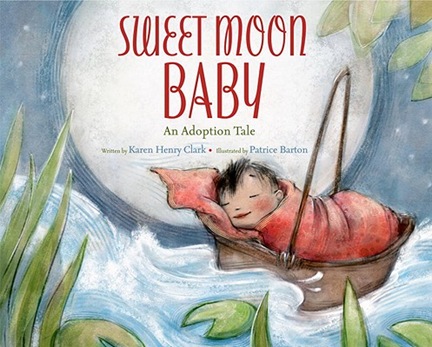
This is an adoption story that takes a more fairy tale approach.  In China, perfect baby is born.  However, her parents don’t have enough food for themselves and worry about the future of this tiny baby.  So they put trust in the moon and send their baby away down the river.  On the journey, several animals help that baby.  While she sleeps, she is carried by a turtle, flown high by a peacock, sheltered by a monkey, and guided by a panda.   On the other side of the world, a family is waiting for a child.  While they wait, they prepare for her.  They create a garden, plant trees, build her a room, and fill it with pretty things and lots of books.  They know she is there, but where?  They travel long distances following the moon’s path.  And when the moon paths of the baby and the family meet, so do they.

So often adoption books are about the concrete steps taken from one family to the next.  It is a pleasure to read a book that is whimsical and magical about adoption.  Clark’s writing celebrates the connection between child and new family while paying homage to the birth family as well.  The entire book is suffused in a gentle beauty that allows anyone reading to know immediately that this is a joyous tale. 

Barton’s illustrations are particularly fine.  From the first two-page spread of the new baby and her bright-eyed beauty, the illustrations are captivating.  They have a subtle humor to them as well as a soft touch that matches the tone of the book.  Done in sketches and then digitally, the images have interesting textures.

A very successful fairy-tale telling of the adoption story, this book may not answer the questions of how an adoption takes place, but it does speak to the magical nature of love.  Appropriate for ages 3-5.

Reviewed from copy received from Knopf Delacorte Dell.

Up and Down: High Flying Friendship

51szOCq8OnL

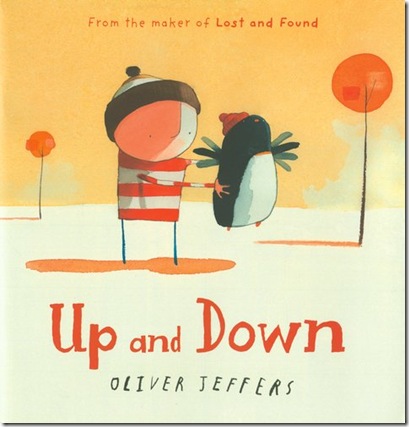
Up and Down by Oliver Jeffers

Jeffers continues his story of the friendship between a boy and penguin in this fourth book about the boy.  The boy and the penguin are great friends.  They do everything together.  But when the penguin decided that he had to learn to fly, he knew he had to do it on his own.  The boy tried to help, looking up information and trying to connect the penguin with flying experts.  But when the penguin figures out a solution, he heads off immediately to make it happen.   The boy had no idea where the penguin went.  The penguin finds himself alone and lost, unable to get in touch with his friend.  When the boy discovers where the penguin is, the question is whether he will be able to reach him in time to see his friend succeed or fall. 

This book is written with the same charming simplicity of the earlier books.  There is such a gentle and loving spirit to these books.  Yet they still have a spirit of adventure and surprise.  The friendship between the two characters is strong and true, supporting one another even if the other friend needs to do something on their own.  This is a touching story of real friendship.

Jeffers’ illustrations are done in the same style as the earlier books in the series.  They are done in a modern style that is infused with warmth from the charm of the characters and the bright colors. 

A fitting follow-up to Lost and Found, this book will appeal to fans of Jeffers and to new readers as well.  Appropriate for ages 4-6.

Reviewed from copy received from Philomel Books.

Enhanced by Zemanta

I Feel Better with a Frog in My Throat: Gross, Gruesome and Great Fun

tumblr_lb070qPLi51qcx2yno1_500

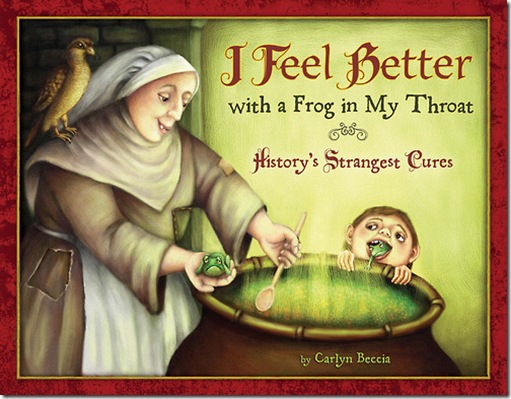
I Feel Better with a Frog in My Throat: History’s Strangest Cures by Carlyn Beccia

Have a symptom?  Look it up in this book, but beware!  Some of the cures listed just may not work.  It’s up to you to try to guess which ones would actually help and which might really hurt.   What would help a cough?  Caterpillar fungus used in ancient China?  Frog soup used in 16th century England?  Cherry bark used by ancient Native Americans?  Readers turn the page to discover which of the three would help.  The reasons behind the use of the cure and then the real results are offered, giving a readers a fascinating tour through medical history.  Happily, some of the cures are gross.  That and the way the information is presented as a guessing game make this book appealing to children, including reluctant readers.

Beccia has taken a cheerful approach to what could have been a very dark book.  Instead the tone stays rather merry, talking about the nutritional boost of frog soup, the healing power of spider webs, and much more.  Her illustrations add to the fun with images like maggots with smiling faces and stinky socks tied around the neck.  They have an interesting blend of macabre and silly.

There are some misses in the book.  At one point, a woman of the 19th century is shown in a short skirt, looking very modern except for her cap.  The book maintains a great pace and tone, but falls short at the end where the healing power of mother’s kisses takes on an overly sweet tone.  I also have concerns about the imagery of the mothers and children, because the only one with darker skin is prehistoric.  The only Asian faces are ancient.  It is a frustrating misstep in a book that is good overall.

Get this into the hands of reluctant readers who enjoy gross things and you too will get to talk about maggots at the dinner table!  Appropriate for ages 7-9.

Reviewed from library copy.

Across the Universe: Stellar Science Fiction

8235178

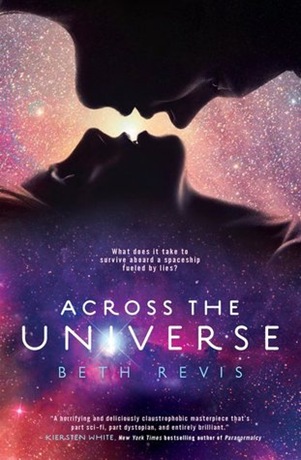
Across the Universe by Beth Revis

What a pleasure to read some great science fiction for teens!  At age 17, Amy joins her parents on the trip of a lifetime, or many lifetimes, as they are frozen for a voyage of 300 years to a colonize a new planet.   Flash ahead several hundred years and the ship Godspeed that carries the frozen bodies has created its own society over the centuries.  16-year-old Elder is the next leader of the ship, chosen from when he was an infant to lead.  He has been raised and taught by Eldest, the current leader.  But something is going wrong.  There are secrets everywhere he turns, and no one will give him the answers he needs to be the next Eldest.  To make things worse, someone has begun attacking the frozen people, and it just might be the people Elder trusts most.  This taut thriller of a novel marries mystery, science fiction and romance into a gripping read.

Revis has written a genre-bending novel that will attract many different types of readers.  Her building of the world inside the ship is amazing in its attention to detail.  The complexities of this small world flying through space are solid and fascinating.  Readers will slowly come to understand the secret horrors of life aboard the ship and are guaranteed feel claustrophobic as the metal walls seem to close in. 

Amy is a heroine with plenty of spunk and attitude.  Elder is a more subtle hero, filled with self-doubt and sometimes self-loathing, he is a complex character who has been living with lies entire life.  It is Elder that is the amazing creation in this novel.  A boy who is destined to lead but doesn’t see how. 

I do have one quibble with the book, but it comes so close to the end that I don’t want to ruin the novel for anyone.  It was one twist too many for me and a breaking of literary conventions.  I came away frustrated by the ending but blown away by the novel itself.

An enticing blend of genres, this book would be an ideal book talk choice for librarians looking for a title that will appeal to most teens.  It has an amazing opening chapter that makes it impossible to put down.  Appropriate for ages 14-17.

Reviewed from copy received from Penguin.

Tiny Little Fly: A Delight of a Book

9781406314557

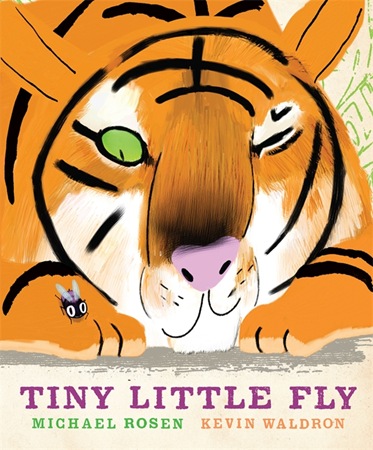
Tiny Little Fly by Michael Rosen, illustrated by Kevin Waldron

British Children’s Laureate Michael Rosen has created another delight of a picture book.  Readers follow the adventures of Tiny Little Fly as he buzzes past some impressive animals.  Great Big Elephant tries to catch the fly, but even with all of his tramping and crushing, the fly flies away.  When Tiny Little Fly lands on Great Big Hippo’s ear, the hippo tries to catch him by rolling and squashing.  But the fly flies away.  Even Great Big Tiger, who swoops and snatches at the fly with his pay cannot catch the fly.  Told in a wonderful rhyme with plenty of noise and fun, this book will be right at home in any toddler story time.

Rosen’s verse here is filled with a sense of fun and playfulness.  The repetition in the book gives it a wonderful pace and gait that is a pleasure to read aloud.  Each large animal takes two winks at the fly, then tries in their own way to catch it with plenty of ruckus.  Thanks to the simplicity of the story and the attraction of the large animals, I can see this being made into a felt board story very easily.  It would also convert well into a little play acting with parents or teachers.

Waldron’s illustrations are simple but sophisticated.  They have a mix of timelessness and modernism that is charming.  His use of a natural-feeling background rather than stark white makes for a warm feel throughout the book.  Waldron combines several techniques in these illustrations from ink drawings to paint.  For reading aloud to a group, Waldron’s illustrations work well thanks to their large size.  Additionally, he allows children to guess what the next large animal will be, adding to the pleasure of sharing the book aloud. 

An ideal story time pick, get this one for any insect, tiger, elephant or hippo story time you are planning.  Heck, it’s good enough to use time and again for any reason at all.  A guaranteed hit with the toddler and preschool set.  Appropriate for ages 2-5.

Reviewed from library copy.

Big Belching Bog: A Quiet Exploration

51k29LnkjvL

Big Belching Bog by Phyllis Root, illustrations by Betsy Bowen

Through this picture book, readers get to explore the wonders of a bog.  Root uses free verse to invite readers deeper into the bog, discovering the plants and creatures that live here.  Small moments of life in the bog are captured in the poetry, sights and sounds are shared and wondered at.  The book and the bog have a graceful slow pace that make one take ones time and savor.  And through it all, there is something coming, something to look forward to, something that only we might witness.  This small touch of foreboding makes the book all the more pleasurable to read.  A book for children who love nature, animals and plants, this is a rich look at the quiet bog.

Root’s verse works as if it is small poems on each double page spread rather than one long poem that runs the length of the book.  These small pieces of verse make the book more readable and allow the reader to see the tiny pieces of the bog which in turn make up the whole.  This is a book that encourages you to slow down, linger, listen and watch so that you really understand the place that you are.  The book ends with details about bogs and the animals and plants seen in the book.

Bowen’s illustrations are woodcut prints that have great deep colors and thick lines.  A hermit thrush travels through each page with the reader, often cocking its head in a thoughtful way.  The illustrations capture the beauty of the bog and also that swampy feeling, the tug on your boots, the dampness that surrounds you. 

Both verse and illustrations work as a celebration of the bog, inviting readers to visit and discover the surprise themselves.  Appropriate for ages 4-6.

Reviewed from library copy.

Rot & Ruin: Terrific Terror

Rot & Ruin by Jonathan Maberry

Are zombies the next big thing?  With this amazing novel, they just might be! 

Fifteen-year-old Benny has grown up in a zombie-infested world, where his town is fenced in to protect the living from hordes of undead.  Cared for by his older brother who Benny despises, Benny tries to find work in his small town.  Unable to find a job, Benny reluctantly agrees to be his brother’s apprentice, even though his brother is not nearly as cool as the other bounty hunters who head out into the wilderness to slay zombies.  As Benny begins to work with his brother, he discovers that there is much more to killing zombies than he thought.  There are also a lot more ways to be human too. 

Maberry has melded the zombie apocalypse world with a coming of age story.  The combination makes for a zombie book with plenty of action and blood, but also one with lots of heart.  Benny is a great lens to view this world through, allowing the reader to discover along with him the truth of the world he lives in.  Maberry’s writing is wonderfully varied.  At times pausing to linger on points, view the wildness of the landscape and storms, and at others rushing into battle scenes with a whipping pace that will have readers breathless. 

The characters here are well crafted, motivated in understandable ways, and have a variety of reactions to this world they have found themselves in.  The reactions are real, honest and believable.  The world building really works well too.  While there are many questions left unanswered about what brought about the zombies rising, those are questions that are deftly built into the story line.  It works well even with the questions.  We can look ahead to more books in the series that could begin to answer them. 

The cover alone will sell this book, but it is also a great choice for teen book talks.  Set the stage of the zombie world and you will have teens lining up to read this one.  Appropriate for ages 14-17.

Reviewed from copy received from Simon & Schuster.

Enhanced by Zemanta

Me, Frida: Intensely Beautiful

Me, Frida by Amy Novesky, illustrated by David Diaz

2011 Pura Belpre Honor Book for Illustration

Opening this book is like opening a treasure box filled with images that are deep, fiery, passionate and intensely beautiful.  This is the story of Frida Kahlo and her travel to San Francisco alongside her husband, artist Diego Rivera.  Rivera was hired to paint a mural for the city, but Frida was restless as he started work on it.  As Rivera spent longer and longer hours working, Frida was left alone in a a foreign country and big city.  She didn’t speak much English and knew almost no one.  So Frida began to explore the city on her own, allowing the things she loved to be the focus.  And in the process, she found her own voice and her own artistic vision.  She was no longer silent, but instead a vivacious beauty who would show the world what she was capable of.

Told in simple words by Novesky, this book captures the situation Frida found herself in with clarity.  The author also revels in Frida finding herself and her art, her explorations and her self awareness.  It is a celebration of more than Frida Kahlo.  It is a celebration of women artists of all sorts.  Diaz’s illustrations are done in acrylic, charcoal and varnish on linen.  The combination of media give the illustrations an amazing depth of color that is beautifully saturated at times and light and airy at others.  Just the use of drips in the illustrations is beautifully done.  The drips become age, emotions and trees.  They add a wild beauty to the images that suits the subject well.

A beautiful picture book about an amazing artist, this was surely worthy of the Pura Belpre Honor Award.  Appropriate for ages 7-9.

Reviewed from copy received from Abrams Books for Young Readers.

Also reviewed by TheHappyNappyBookseller.

Enhanced by Zemanta