Farm

Farm by Elisha Cooper

An  inviting mix of vistas across flat farmland and isolated bits of the farm on white backgrounds, Cooper has created a book that really captures the seasons on a farm.  From the family, animals, buildings and equipment to the everyday world of chores and work, this book is honest and accurate about farm life.  Children will delight in the small moments of the farm, especially those involving the tractors and the animals.  The book is laid out as a cycle, moving from spring through fall, encapsulating the growing season.  This is a great introduction to farm life for children, both rural and urban.

Cooper’s text gives small details constantly, seeding the book with facts large and small about farming in general and about this family farm in particular.  Simply telling the names of the different cats is time well spent and interesting.  Cooper’s art is done with simple lines and earthy colors.  His mix of landscape vistas with small images is dynamic and keeps the book fresh and interesting.  Because of the small size of many of the illustrations, this book will be best used by one child at a time who will take the time to wonder along with Cooper about what animals are thinking and whether they are deep in thought when not eating.

This is a book to linger with, turn the pages back and forth, breathe in the country air, and also take your time thinking deep thoughts.  Appropriate for ages 4-7.

Reviewed from copy received from Scholastic.

Also reviewed by Young Readers, Back to Books, and A Year of Reading.

Oh, Daddy!

Oh, Daddy! by Bob Shea

Told from the point of view of a very busy little boy, this book highlights the antics his father with undergo to get his son moving along.  In order to get him dressed, his father puts underwear on his head and asks if that is right.  Climbing in the car window, gets him to get into the car quickly.  Juggling carrots leads to the boy eating them eagerly.  This is inspiration for parents, especially fathers, to get silly to get things done.

This positive and silly parenting style is a pleasure to read about.  It got me thinking about the antics we would undergo when my sons were in preschool and Kindergarten.  Laughter is a great way to speed getting dressed along.  I always ended up with rabbit ears made out of sweatpants and my toes peeking out of tiny sleeves. 

It is also nice to see a father depicted as this involved with his child and the mother making appearances but not as a featured character.  There is no instance where the dad is not the one dealing confidently and positively with his son. Very refreshing to see. 

Shea is the author of several successful picture books.  His writing is filled with great short sentences that are simple but also filled with humor and a sense of fun.  His illustrations are bright colored, simple and modern.  This round blue family is sure to be a hit with preschoolers.

A perfect Father’s Day read, this is also a great book to read aloud just for laughs.  Guaranteed to get you and your audience giggling.  Appropriate for ages 3-5.

Reviewed from copy received from HarperCollins.

Dinosaur Mountain: Digging into the Jurassic Age

Dinosaur Mountain: Digging into the Jurassic Age by Deborah Kogan Ray

Ray returns with another great picture book biography.  This time she turns her talents to the story of Earl Douglass and the “Bone Wars” of the turn of the century where paleontologists competed to find the big dinosaur skeletons.  Though the biggest finds had been made in Colorado and Wyoming, Douglass followed his instincts and  headed to northeastern Utah.  The book chronicles his discoveries as he worked the site through prose as well as excerpts from his personal letters.  It also tells of the problems with protecting the area and funding that Douglass faced later in his career and that culminated in Woodrow Wilson creating the Dinosaur National Monument.

Ray’s writing is an invitation to learn more.  Filled with interesting and enticing facts, she tells the story of the person as well as the accomplishments.  Children will love the details about how a dig site works and the excitement of the big finds.  They will also learn about the importance of doing what you love and following your gut instinct. 

Ray’s art adds much to story, from detailed explanations of Jurassic strata and paleontology tools to her larger paintings that tell the story of discovery.  Her large vistas bring the setting clearly to life too.  The book ends with a listing of the dinosaurs found at the site, a map of the Monument, more information on Douglass and his benefactor Andrew Carnegie, a glossary, and a bibliography. 

Highly recommended, this book will be enjoyed by children who enjoy dinosaurs and history.  Ideal for reading before visiting the Dinosaur National Monument, this book can also be used to inspire children to make their own discoveries about the world around them.  Appropriate for ages 7-10.

Reviewed from copy received from Farrar Straus Giroux.


Reblog this post [with Zemanta]

The Books of Elsewhere: The Shadows

The Books of Elsewhere: The Shadows by Jacqueline West

Released June 2010.

A delightful romp of a book that combines mystery and fantasy, this book is filled with laughs, tension and plenty to discover.  After Old Ms. McMartin dies alone in her house, Olive and her mathematician parents move in.  The house is Victorian and filled with antiques and paintings.  Olive notices that the paintings are strange, but it isn’t until after she is warned of danger by a talking cat and finds some special spectacles that she learns the secret of the paintings.  By wearing the glasses, she can enter the world of the paintings.  But the mysteries go far deeper than that as does the pleasure of this read.  I will leave it to you to make your own discoveries in The Shadows.

Debut author, West, has written a book that is seasoned and tightly woven.  She has woven the tension of a good mystery with magical touches that make this book sparkle. West’s writing is something special.  She creates great images with her descriptions throughout the book.  One of my favorites is on page 20:

The basement of the old house was made mostly of stone, with some patches of packed dirt poking through, and other patches of crumbling cement trying to hide the dirt.  The effect was like an ancient, stale birthday cake frosted by a blindfolded five-year-old.

Sigh.  It captures so much not only about the basement it is describing, but also the atmosphere of the entire novel.  The above quote is from the advanced reader copy of the book.

Olive is a protagonist who is very human, often lonely, and at the same time clever, funny and just the type of person one would want for a friend.  The villains in the book are handsomely evil and thoroughly enjoy it.  The dangers are grippingly written, helping to add to pleasure of this light read that has wonderful dark moments too.  This is a book to be raced through and then read again to see all of the details and foreshadowing.

This book would work well as a classroom read aloud or a bedtime read with older children, but the best way to read it would be under the covers with a flashlight!  Get this into the hands of Coraline fans who will find a similar heroine to enjoy here.  Appropriate for ages 9-12.

Check out the trailer for the book:

Reviewed from ARC received from Penguin.

Reblog this post [with Zemanta]

Nobody

Nobody by Liz Rosenberg, illustrated by Julie Downing

Released May 25, 2010.

A charmer of a book about a boy and his imaginary friend, Nobody.  This allows for plenty of wordplay in the book with Nobody telling the boy to do anything, Nobody helping him, and Nobody cleaning up.  George woke up early in the morning and with Nobody’s advice decided to make a feast!  So he and Nobody raid the refrigerator, mix all sorts of things together including eggs, chocolate syrup and dog biscuits.  Not allowed the turn on the stove, the two friends had to wait.  So they played cards.  Nobody won.  George then invented his own game which he won.  When his parents woke up, they were surprised by the mess.  As they took the matter in hand, Nobody began to shrink and disappear until George called him back to help make pancakes for breakfast.

I’ve always loved wordplay and we don’t see enough of it in books for preschoolers.  Especially this kind of subtle playing where it can be ignored without losing the story, or enjoyed as another dimension of the book.  Rosenberg’s text is great fun to read aloud.  Children will love the concoction the two create together and will immediately understand that Nobody is imaginary.  I also appreciate the parents’ reaction to the morning mess.  They take it in stride and with humor. 

Downing’s illustrations have a soft quality that works well in this early morning story filled with imagination.  She uses sploshes and drips of paint to great effect as the kitchen becomes messier and messier.  George is quite a small child in the illustrations, which will make it inviting to young children to join in the adventure.

Recommended, this is a great book to share when doing story times on cooking or messes.  Nobody makes a mess quite like this one!  Appropriate for ages 2-5.

Reviewed from copy received from Roaring Brook Press.

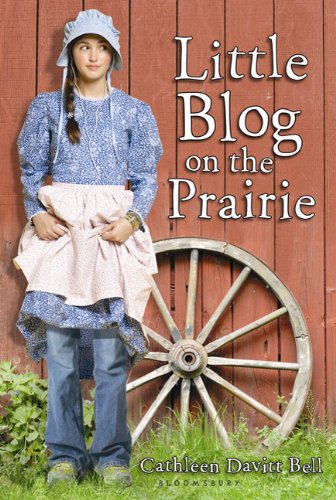
Little Blog on the Prairie

Little Blog on the Prairie by Cathleen Davitt Bell

When Gen’s mother signs the family up for Camp Frontier, they don’t know what they are getting into.  Now they must live like they are 1890s pioneers.  Which means wearing authentic clothing, cooking on a wood burning stove, milking cows, raising chickens, and living in a tiny cabin in the woods with an outhouse.  All of their electronics are confiscated when they enter camp, but Gen manages to sneak in her cell phone.  From there, she texts her best friends one of whom turns her texts into a blog for an assignment.  All is not dull work on the prairie, there is handsome Caleb who seems interested in Gen but might like Nora, the daughter of the owners better, and then there is the competition between the families and the drive to not keep being in last place.  Maybe this family bonding thing isn’t so bad after all.

Bell has created a book with a sharp wit and yet a homely warmth.  Gen is a great protagonist whose texts are fun to read.  Bell also has a feel for humor with the killer chickens and the cow milking scene.  Both are worth reading the novel for.  She writes best when dealing with modern teens juxtaposed with the world of 1890.  Bell’s writing is stilted in other scenes where there isn’t humor.  Her scenes with Nora and Caleb don’t flow with the same effortlessness as her humor.

Another issue is her characterization of the secondary characters.  Caleb, the love interest, is rather dull and quite normal though nice.  I don’t see why Gen who is bright, funny and complex would be entranced by this boy.  Nora, the homeschooled daughter of the proprietors, is also a disappointment.  Left to be rather cardboard and mean, she could have been a great example of a homeschooled kid.  Instead, she is envious and lonely.  What a missed opportunity she was a character!

One of the big successes of the book is that it never becomes a moral story about the dangers of modern technology and the isolation of modern family life.  Just as the book was approaching that, it veered into an unexpected direction that kept the novel fresh and interesting.

Despite the issues with the book, I could not put it down.  The humor and Gen kept me reading.  Recommended for readers who enjoyed Little House on the Prairie but also modern teens who wonder what would happen if their cell phones, iPods and computers were taken away.  Appropriate for ages 12-14.

Reviewed from ARC received from Bloomsbury.

Also reviewed by Semicolon.

Say Hello!

Say Hello! by Rachel Isadora

On her way to her Abuela Rose’s house, Carmelita greets her neighbors and learns how they say hello in their different languages.  Carmelita’s dog Manny is happy to greet everyone with a friendly “Woof” that translates easily into every language.  The book is set in a diverse urban neighborhood filled with friendly faces in a variety of skin tones.  How do you say hello in your family or neighborhood?

Isadora has again created a book for very young readers that is inviting and fresh.  The urban setting is depicted as colorful and friendly, something that young readers may not see in many picture books.  Isadora includes just enough text to keep the story moving with most of the book focusing on the various greetings in each language.  Her illustrations are done in cut-paper collage.  They have an interesting mix of painted papers and printed ones that come together in a dynamic way.  Signature Isadora style!

Recommended for toddler story times, this book will work well with young children who will be eager to repeat the unfamiliar greetings and to share those from their homes as well.  Appropriate for ages 2-4.

Reviewed from copy received from Putnam.

Sick Day for Amos McGee

A Sick Day for Amos McGee by Philip C. Stead, illustrated by Erin E. Stead.

I was utterly charmed by this book.  It has a gentle humor, a sweetness and an inherent loveliness that really makes it special.

Amos McGee got up early every morning, changed into his uniform, and headed to work at the City Zoo.  Even though he had a busy work schedule, he always had time to visit his friends.  He played chess with the elephant, ran races with the tortoise, sat quietly with the shy penguin, wiped the rhino’s runny nose, and read books to the owl who was afraid of the dark.  But one morning, Amos woke up and didn’t feel well enough to go to the zoo.  His friends waited for him, but when Amos didn’t come they set out to visit him instead.  The elephant played chess with him.  The turtle played hide and seek instead of running races.  The penguin kept Amos’ feet warm.  The rhino always had a handkerchief ready when Amos sneezed.  And at bedtime, the owl read them all a book.

The husband and wife team who created this book really worked well together.  Philip’s tone of writing has a gentle feel that matches his wife’s art perfectly.  Philip’s writing is very readable and works well aloud.  The small touches of detail make the world more convincing, including the elephant taking a lot of time to make his move in chess and the spoonfuls of sugar Amos uses at breakfast.  It is these little facts that really invite one to linger longer in the book.

Erin’s art is delightfully realistic for such a fantastical story.  The animals are very true to life except for their hobbies.  Her art uses delicate lines and subtle colors.  I especially enjoyed Erin’s two-page wordless spreads as the animals head to Amos’ home.  Again with her art, the small touches add so much: the elephant lining up his chess pieces while waiting for Amos and the socks on the feet of the penguin.  Small details but very important to the tone and feel of the book.

Highly recommended, this book will be embraced by all who read it.  Share it for units on zoos, colds or save it for a great bedtime read.  Now all I need to find is a shy penguin to keep my feet warm…

Appropriate for ages 3-6.

Reviewed from copy received from Roaring Brook Press.

Also reviewed by The Reading Tub.

How You Got So Smart

How You Got So Smart by David Milgrim

From infant to child, you have a come a long, long way!  This book reveals just how you got as smart as you are.  You watched and listened.  Chewed on things.  Explored and asked lots of questions.  You investigated, made friends, and were very brave.  Each and every step taught you something, and that is what made you so very smart.  This jolly book takes a humorous but sincere look at how babies grow into amazing children every day.

Milgrim’s success with this book is in its tone.  It is funny but really honest and truthful about what makes each of us smart.  The best part is that it is about normal children, who all grow in their own way, who all explore, who all invent.  Every child will see themselves here and relate effortlessly to the book.  Milgrim’s illustrations add to the humor.  They also bring the necessary bright colors and charm. 

Perfect spring reading for classes of children who are advancing to the next grade.  This reminds everyone that they are special and smart.  Appropriate for ages 4-7, older as a treat read-aloud around graduation time.

Reviewed from library copy.