Eternal Smile

The Eternal Smile by Gene Luen Yang and Derek Kirk Kim

Three amazingly different and yet cohesive stories create this graphic novel.  In the first, Duncan is on the way to winning the hand of the Princess.  He has a magical sword that can slice the heads off of the frog-people and a desire to win.  But soon he discovers that his story has an entirely different piece to it.  In the second story, Gran’pa Greenbax is a frog who wants enough money to be able to dive into it and never hit bottom.  He’s not afraid to sell anything to reach his goal.  He is even willing to profit from the smile that has appeared in the sky, if he can.  But soon, he too discovers that all is not what it may seem.  The final story features Janet, who is stuck in a cubicle/watercooler culture where she doesn’t get any respect.  When she is contacted by a Nigerian prince who needs money, she gets caught up in a scam.  The question is who ends up profiting by it.

Strange, beautiful tales about being an outsider and being true to yourself, these stories will resonate with teens.  The artwork is very different in each story, setting them distinctly apart from one another.  From the epic fantasy art in the first to vintage comic book in the second, and ending with modern style in the final story.  At the same time, the stories all work together as a collection.  They have similar story arcs as well as that overarching theme of identity.

Highly recommended, this book belongs in all teen graphic novel collections because it shows teens how great graphic novels can be.  And if you are an adult like me who enjoys them, make sure you get your hands on this one.

Reviewed from library copy.

Joe and Sparky Get New Wheels

Joe and Sparky Get New Wheels by Jamie Michalak, illustrated by Frank Remkiewicz

When Joe the Giraffe thinks he has won the grand prize in a contest he entered, he takes Sparky the turtle on a joyride in his brand new and very yellow car.  The fruit-covered hat in the front seat is seen as another prize, one definitely worth donning while driving.  The two have a series of great adventures from shopping at the mall to grabbing lunch at Tasty Burger.  Sparky would much rather just be home and safe in his pond while Joe is thrilled to be out and about on an adventure.  By the end of the story, the two are fast friends and both appreciate their differences.

Easy readers can be challenging.  Not the reading level, but the content.  It can so often fall flat.  This one, however, manages to set just the right tone of manic silliness and easy content.  The illustrations add to the zany fun, as the two animals careen around town merrily.  The bright colors will make the book very approachable for new readers.

Just the right mix of fun for young elementary readers, this is a good choice for easy reader shelves in both school and public libraries.

Reviewed from library copy.

Also reviewed by PlanetEsme and Young Readers.

Mama Says

Mama Says: a Book of Love for Mothers and Sons by Rob D. Walker, illustrated by Leo and Diane Dillon.

Move from one culture to the next with a brief stanza of the poem shared in both English and the language of the people being represented.

Mama says

Be good

Mama says

Be kind

Mama says

The rain will come

But still the sun will shine

That is the opening of the book, with the poem also written in Cherokee alongside.  The poem then moves through subjects like faith, hard work, dedication, endurance, inner peace, and courage.  All are universal and delivered in a way that children will understand.

The Dillon’s art is exquisite, representing the wide range of people on earth with boys who turn into men at the end.  It is a message that resonates deeply with all mothers who want their boys to turn into such men of composure and strength of purpose.  Walker’s poem is so simple but so powerful.  It is a perfect match to the strength of the illustrations.

Highly recommended for mothers and their young sons, this could also make a great gift for a graduate heading off to college.    This is a book that boys can draw strength from, learn from and see a path in.

Reviewed from library copy.

Also reviewed by PlanetEsme, A Year of Reading, and The Brown Bookshelf.

Leviathan

Leviathan by Scott Westerfeld

Released in October 2009.

The talented Westerfeld turns to steampunk in this first book in a new series.  Set in an alternate history on the eve of World War I, this book offers large walking mechs vs. man-made creatures that can be combined to form enormous flying and living blimps.  In this setting are two young people, Alek and Deryn.  Alek, son of Archduke Franz Ferdinand, is the sole surviving person in his family now that his parents have been killed.  He just may be considered the heir to the Austro-Hungarian throne if he can survive long enough.  Deryn is a girl who has always loved to fly, but in 1914 girls are not allowed to become pilots.  So Deryn becomes Dylan, a tall, lean boy and proves she is born to fly.  The reader experiences the action through the eyes of both characters living completely separate lives until history brings them violently together.

Gorgeously imagined and written with a flair for battle and a sense of wonder, this book is a winner.  The pacing is fast, the action whirling, and the history deftly placed so that even teens and youth unaware of World War I’s basic timeline will understand the implications and importance of what they are witnessing in this alternate history.  Westerfeld’s characters are caught in the vortex of history and war and spend little time offering deeper insights about their psyches, but that is part of the pleasure here.  This book is more about the incredible war machines and creatures, the awe of flying, the amazement of running in a mech, and the biological magnificence of an enormous flying creature.  As readers, we too are swept up in the imagination on the page, happily believing in the most incredible creations.

Teens will pick this novel up simply because it is a Westerfeld novel, and happily this book will also offer an entry point for younger readers to enjoy Westerfeld’s work.  While much of Westerfeld’s work is for teens, this book could be offered to 5th and 6th graders without concern.  It is a rip-roaring and gripping look at both the future and the past that readers of all ages will have trouble putting down.

Reviewed from an ARC received at ALA Annual Conference.

Also reviewed by Karin’s Book Nook.

The Ask and the Answer

The Ask and the Answer by Patrick Ness (Book 2 of Chaos Walking)

Released September 2009.

Starting up exactly where the first book, The Knife of Never Letting Go, left off, readers are once again launched directly into the story of Todd and Viola.  Todd has been captured by Mayor Prentiss and regains consciousness as he is being interrogated.  Viola has disappeared after being shot.  Todd finds himself in the city he fought the entire first book to find, but it has been overtaken and surrendered to Mayor Prentiss without a fight.  Now Todd and readers must navigate the ever-changing power of the community, heroes who are villains, villains who are heroes, and some who are both at the same time. 

The complexity of this novel is awe inspiring.  Yet the story manages to remain unencumbered and move forward at a brisk pace.  The tension of the novel will have readers either unable to put it down or forced to put it down with shaking hands.  It is truly a gripping piece of writing.  As with the first book, it is also a very dark story.  Here torture is explored very completely, not hidden from the reader.  A risky choice for a YA novel, but one that definitely pays off.

In the two main characters, Ness has created heroes with faults.  They are both wonderfully drawn and complete characters.  Even the villains of the story are complicated and well developed.  It is this complexity that makes the book work so well.  As more and more is revealed, the story shifts and ripples into something different and new. 

Set aside time when you start this novel.  It is impossible to not think about when you are not reading it and definitely could be devoured in a single sitting.  Enjoy!  And then join me in eagerly awaiting the third.  While you are waiting, check out the short story on BookTrust that is about Viola before she lands on the planet.

(Reviewed from galley copy received at ALA Annual Conference)

Mouse Was Mad

Mouse Was Mad by Linda Urban, illustrated by Henry Cole.

Mouse is hopping mad.  Until Hare tells him he looks “ridiculous.”  But when Mouse tries to hop like Hare, he tumbles into a mud puddle.  Mouse is now even angrier.  Stomping mad, in fact.  Bear arrives and shows him how he should be stomping.  But when Mouse tries, it doesn’t have the same earth shaking effects.  In fact, it’s much more Mouse-shaking and Mouse falls into another mud puddle.  Now Mouse is screaming mad.  Bobcat tries to show Mouse how to really scream, but Mouse, you guessed it, falls into another mud puddle.  The book resolves with Mouse being so angry he can’t even move.  Now the other animals are impressed and try to be just as still with limited success.  Is that a smile readers see on Mouse’s face?

The end papers of this book are great.  At the front, they show Mouse gripped by utter rage and in the end we can see him being oh-so happy.  Urban has created a wonderful mix of emotions, humor, and repetition that will be embraced by toddlers and preschoolers.  Her repeated dunking of Mouse in mud is great fun, offering the predictability that young children look for.  It is also very effective against the unpredictable emotion of anger.  The humor works well as a foil for that emotion.

Cole’s illustrations are very effective, showing Mouse really, really angry, tail twitching as he watches the others do demonstrations.  The facial expressions of the animals are very evocative of emotions.  Mouse seems to have an infinite number of angry looks that range from simmering peevishness to outright fury.  Cole cleverly builds the tension before each fall into the mud with a series of illustrations showing Mouse just before the fall, in mid-air, and finally and delightfully covered in mud.

Highly recommended for storytimes on emotions or mice, this book is a winner of a read aloud and will have all of the children in your group enthralled.  It can also be used as a book to get children moving, since you can have children stomp, hop, and yes, even scream.

(Reviewed from copy checked out from public library.)

This book has been well-covered by the kidslitosphere.  Too many places have mentioned it to list here!

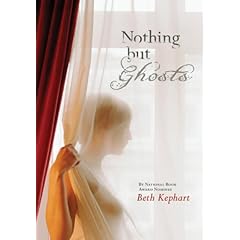
Nothing but Ghosts

Nothing but Ghosts by Beth Kephart

After her mother’s death, Katie lives alone in their big old house with her father who is a bit of a mad genius.  Her summer job is to work in the gardens at the estate of Miss Martine, a recluse who hasn’t been seen by the public in decades.  As the gardeners are told to dig for a new gazebo, Katie realizes that something else may be going on.  They just may be digging for something in particular.  She begins to do research at the local library, hoping to solve the mystery of why Miss Martine disappeared.  Just like her own mother disappeared after her death.  Will solving this mystery help Katie cope with the sorrow and loss of her mother?

There are many ghosts in this book, hovering at the edges of the story, never fully viewed, but felt in every line.  Kephart’s background as a poet shows through her exquisitely written prose.  She manages to create nuance, pain, grief and wonder through her writing, capturing emotions at their most poignant.  Here is one of my favorite lines of the novel, describing the estate they are working at:

Miss Martine’s is quiet as the stones down in the stream, quiet as the robin’s nest that Danny found the other day, which had been lived in, then abandoned.

What imagery, evoking a world unmoving in the river of life, empty, still and immovable.  Yet paired with the fragility and hope of a bird’s nest.  Just this one line offers multiple readings.  The entire novel is like this.

Kephart has also created a mystery that is not a mystery.  The mystery of Miss Maritine is not what this book is about.  It is instead about Katie herself, her personal loss, her mother, her father and how she will find a way to continue beyond her paralysis of grief.  So the mystery is secondary, another ghost in the story, that is useful to chase after but not the real reason we are here.

Katie is a great heroine.  A girl who works as hard as the men, unafraid of dirt, who flies down dark roads on her bike without incident, and who is as brave as anyone could be when surrounded by the past.  She breaks into unique territory as a heroine, a girl who is strong but not masculine, grief-stricken but not tragic.  As a character, she is a testament to the delicacy of Kephart’s writing.

Highly recommended, this book is exceptional.  It is one of the most well-written books of the year, worthy of National Book Award and Printz attention.  Appropriate for 15-18 year olds.

Also reviewed on Charlotte’s Library and The Compulsive Reader.

Al Capone Shines My Shoes

Al Capone Shines My Shoes by Gennifer Choldenko

Released September 2009.

Return to the world of Moose and his family and friends living on Alcatraz.  Moose’s sister Natalie is heading out to her special school that she got into after Moose asked Al Capone to help.  Now Moose finds a note in the pocket of his shirt after it has returned from the laundry.  The note says, “Your turn.”  Now Moose must decide whether to tell his parents what he did or to do exactly what Capone asks of him.  And where would the fun be in telling your parents?

Choldenko’s Al Capone Does My Shirts is used in classrooms across the country for historical fiction.  This sequel will make teachers across the country very happy, because it has all of the same things everyone loved about the first book.  This novel has the same strong voice of Moose as the first.  It is written with such a great tone and spirit as to make it unmistakably the continuing tale of Moose. The characters are vividly written and remain true to themselves even when they are developing and maturing.  As with the first novel, the setting of Alcatraz is integral to the story.  Choldenko has created another fine piece of historical fiction, expertly rendering a complex setting and large set of characters with such panache that she makes it seem simple.  Her writing is worthy of applause, especially with the challenge of a sequel.

Perfection for tweens, this book has a fleeting kiss but nothing more.  Great for historical fiction units and perfect to put right into kids’ hands without hesitation, this book will be gobbled up by anyone who opens it.

Also reviewed by Welcome to My Tweendom and Sarah Miller.

That’s Why We Don’t Eat Animals

That’s Why We Don’t Eat Animals: A Book about Vegans, Vegetarians, and All Living Things by Ruby Roth.

A friendly introduction to veganism and vegetarianism for elementary-age children, this book focuses more on the evils of factory farming than eating animals.  This slant makes it more appropriate for the young audience.  The animals are portrayed as whimsical characters.  The pigs have huge nostrils, the chickens stay round as an egg, and the cows are lanky with long-lashed eyes.  Animals are shown in family groups, demonstrating what their natural lives would be like.  This is contrasted with the misery they find on factory farms combined with the environmental toll as well.  The book makes a sound, green argument for reducing animal consumption as well as eliminating factory farms.

This book deserves a place in most public libraries alongside all of those farm animal books.  It offers another perspective that is missing from children’s sections in libraries.  As adults learn that vegetarian and vegan diets are healthier for people as well as animals, parents will turn to libraries to help explain this to their children.  It is a pleasure to find such a well-done book on the subject that provides information without the shocking images that would be too much for children.

Roth has done an admirable job of creating a book on a subject that could easily confuse and upset young readers.  This book instead talks about nature, the importance of kindness, and gives children a way to make a difference right now.  Her illustrations help to keep the subject from being too bleak with their cartoony feel.

Highly recommended for all public library collections, this book will be appreciated by vegetarians, vegans and others who are exploring their eating options.  Appropriate for ages 8-12.