A Polar Bear in the Snow by Mac Barnett

Cover image for A Polar Bear in the Snow

A Polar Bear in the Snow by Mac Barnett, illustrated by Shawn Harris (9781536203967)

A polar bear emerges from the snow, only appearing when he lifts his black nose to the air and opens his black eyes. He journeys across the snowy polar landscape. The narrator wonders where he is going. Maybe to visit the white seals also playing in the snow? No, he is not hungry. Maybe he will hide from the snowstorm in a cave? No, his fur protects him. He also won’t meet a man out on the ice, opening his mouth to growl loudly. It turns out, he is heading for the water to swim and play. After that, who knows where he is heading next.

Barnett uses so few words on the page here. His restraint and focus are masterful, keeping the word count low. His questions about what the bear is doing also invite young readers to ask questions about this book and others they read. To have plenty of curiosity and wonder about books and the world around them. The ending too allows for that curiosity to continue after the book is done.

Harris’ illustrations are subtle in their use of white and shades of white. He uses paper collage to create caves, subtle changes of angle and texture, mountains, and more. When blue is introduced as the bear reaches the sea, there is a tranquility from that color, a celebration that the bear enjoys too.

Restrained, gorgeous and full of amazing moments. Appropriate for ages 2-4.

Reviewed from e-galley provided by Candlewick.
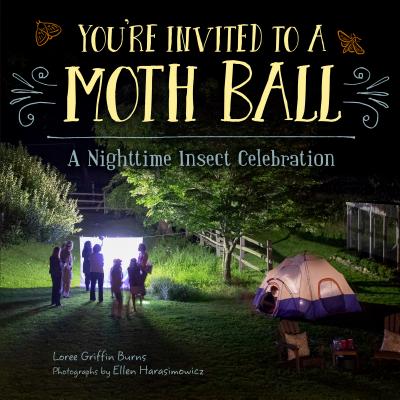
You’re Invited to a Moth Ball by Loree Griffin Burns

Cover image for You’re Invited to a Moth Ball

You’re Invited to a Moth Ball by Loree Griffin Burns, photographs by Ellen Harasimowicz (9781580896863)

Combining detailed instructions, plenty of encouragement and vivid photography, this book invites families and classes to create their own nighttime moth ball. The first steps are understanding moths and then putting together the supplies and tools you will need: including a sheet, rope, UV collecting light, and your own camera and flashlight. Prepare the screen and then also make sure you have a snack, one for the moths of course! Now you have two types of bait: light and nectar. Patience is part of the process, as more moths will come as the night gets later and darker. Take your time, be gentle, and marvel at these creatures that live all around us.

Burns offers such a merry invitation to readers in this book, making it feel like a true celebration of insects that we often take for granted or don’t even think about. Her encouragement to do research is appreciated, dedicating time in her set up of the moth ball to model reading books and learning about the creatures you are going to view. Her instructions are child-centered, creating a process that children can do themselves and participate in directly.

The photographs also center on the children managing the entire process themselves. When night falls, the magic in the photos happens as children carry their own lights, the moths arrive and the real party begins. The images of the moths themselves show their proboscis, furry bodies and amazing wings.

A grand project to immerse children and families into wildlife, insects and spending the night outside. Appropriate for ages 5-9.

Reviewed from library copy.

Mexique by María José Ferrada

Cover image for Mexique

Mexique by María José Ferrada, illustrated by Ana Penyas (9780802855459)

In a true story, over 400 children fled the violence of the Spanish Civil War. They were put on a boat and sent to Morelia, Mexico in 1937. Their families expected only to be separated from them for a few months, like an extended summer vacation, nothing more. Told from the point of view of one of the children, this book shows their time aboard the boat to their arrival in Mexico. The war was a hand that shook their lives apart, separated them and sent them adrift. But there were other hands too, hands of the older children who took care of the little ones. Not all of the older children were kind, sometimes stealing from the little kids. They arrived in Mexico, bringing the impact of the war with them, heading unknowingly into permanent exile.

Ferrada’s text is poetic and haunting. She writes of the hope of when the children embark, the bitter choice that their parents had to make in sending them to safety. She writes of the time aboard ship, of games played and small wars fought. She writes of long lonely nights at sea until the waving crowds welcome them to Mexico. The story stops there, continued in an afterword the explains what happened to the “Children of Morelia” and what history had in store for them.

The illustrations are just as haunting as the text. Done in a limited color palette with often jagged lines of ship railings and waves, they are sharp and unsettling. Showing the somber farewells, the crowds of children, they are sorrowful and foretell the longer refugee story ahead.

Somber, beautiful and timely. Appropriate for ages 5-7.

Reviewed from copy provided by Eerdman’s Books for Young Readers.

Watch Over Me by Nina LaCour

Cover image for Watch Over Me

Watch Over Me by Nina LaCour (9780593108970)

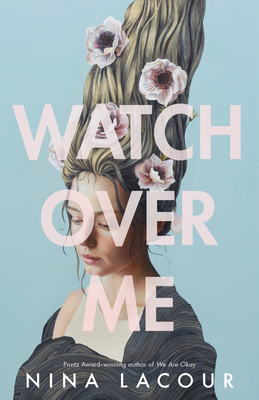
Mila has aged out of the foster care system and has found a job teaching at a remote farm in Northern California. The farm is owned by a couple who have taken in over 40 foster children over the years as well as offering internships, like the one Mila has gotten. Mila finds herself on a beautiful farm and warmly welcomed by the owners. She only has one pupil, 9-year-old Lee, who comes from a traumatized background just as Mila does. But no one told Mila about the ghosts on the farm, about how they would fill dance across the fields and play games together at night. As Mila gets more involved with helping on the farm, learning about the flowers and crops, and helping Lee face his trauma, she finds that her own memories are threatening to overwhelm her as her past continues to haunt her.

This new book from the Printz-award winner is another dynamite read. It’s a novel with such an unusual setting, haunting and remote. It echoes with elements of Jane Eyre and Rebecca while standing completely modern and unique. It may not be classically gothic with its warm and sunny rooms, merry meals together, and companionship, but other moments are pure gothic with the sea, the cliffs, and the ghosts. It’s a tantalizing mixture of sun and shadow.

Mila is a character to fall hard for. She is clearly traumatized by what happened to her before she entered the foster care system, setting herself apart from others even as she longs to be closer to people. She is careful, conscientious, and amazingly kind, everything that her past has her thinking she is not. She is a marvel of layers that the novel reveals with gothic precision at just the right times.

Gorgeously written and filled with icy darkness and glowing warmth, this novel is a triumph. Appropriate for ages 13-17.

Reviewed from library copy.

Me and the World: An Infographic Exploration by Mireia Trius

Cover image for Me and the World

Me and the World: An Infographic Exploration by Mireia Trius, illustrated by Joana Casals (9781452178875)

Through a series of eye-catching infographics, this book introduces readers to the world. The infographics focus on personal things like family structure, most popular names, living spaces, and breakfast foods. It also looks more broadly at things like world population, city populations, traffic in cities, schools and homework. There are more light hearted infographics too like most popular dog breeds, summer vacations, sports and birthdays.

This book is worth exploring closely. Each double-page spread offers an infographic with layered information and an intriguing look at what data can show us about ourselves and about our world. The infographics are done in a modern flat style that works well with the numbers that are designed into the images. The images and numbers are carefully selected to be of interest to children and also easily understood by them.

A fascinating glimpse into our world from a variety of points of data. Appropriate for ages 6-9.

Reviewed from copy provided by Chronicle Books.

Flamer by Mike Curato

Cover image for Flamer

Flamer by Mike Curato (9781250756145)

Aiden Navarro is fourteen and attending summer camp with his Boy Scout troop. He is leaving his Catholic Middle School and has decided to go to public high school, though he’s starting to dread what that means in terms of the bullying escalating even farther. After all, he doesn’t know how to dress himself since he’s been wearing a uniform to school for years. He also worries about how his sister is coping with his often abusive father now that Aiden is gone to camp. To make it all more complicated, Aiden is also gay and closeted. When he finds himself becoming attracted to one of his friends, Aiden has to decide whether to let him know or not. When things don’t go well, Aiden reaches a dark place that has him questioning how to go on.

Curato has created a graphic novel that really speaks to self discovery and learning how to survive. The setting of the summer camp really creates an atmosphere of freedom mixed with closely living with other boys his age. This can be a mix of exhilarating but also being unable to escape from bullying that targets Aiden’s sexuality. I applaud Curato for incorporating exactly the sorts of dirty jokes that boys in a group make together, all of them teasing about sexuality in a way that is damaging and hurtful.

The art in the book is done in black and white until the flames enter the pages. Those flames can be from bullying, from shame, from attraction, from rage. They all color Aiden’s life and therefore the pages. It’s highly effective, particularly as Aiden makes a decision about suicide.

A compelling look at a gay teen learning about himself and finding his core of fire. Appropriate for ages 12-15.

Reviewed from library copy.

Loretta Little Looks Back by Andrea Davis Pinkney

Cover image of Loretta Little Looks Back

Loretta Little Looks Back by Andrea Davis Pinkney, illustrated by Brian Pinkney (9780316536776)

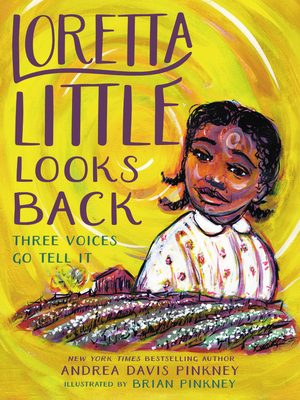
This novel offers first-person monologues from three generations of a Black family from Mississippi. They are a sharecropper family, caught in the aftermath of slavery and the cycle of poverty that resulted. Starting in 1927, Loretta tells the story of growing up picking cotton on land her family did not own. Her loving father died from exposure to the pesticides they sprayed in the fields. He gave her sapphire socks made with his own hands and she placed her other most valuable possession inside them, a marble that glowed like the sun. Loretta found Roly left outside as an infant. He grew into a boy who had a way with plants and animals. When the family got their own plot of land, they were attacked at night by someone who brutalized their animals, killing most of them, and poisoned their land. Roly slept out in the fields, hoping to draw the poison out and return the land to fertility. Then he caught the eye of Tess, a girl who he eventually married and had a daughter with. Aggie was that daughter, a girl who would not back down, much as her father would not make a hasty decision. Aggie fought for the right to vote even when she was not old enough to. She and Loretta worked together to pass the racist voting test and then to pay the toll tax. Beaten by police, Aggie finds comfort in the sapphire socks and the glow of the marble passed down to her. Just like the others in her family, she never stopped and never gave up.

Told in three distinct voices that speak directly to the reader, this novel takes a direct look at the systemic racism that has created such privilege for some and injustice for others. The use of monologues is brilliant, as the voices come through to the reader with real clarity, each speaking from their personal experience and from history. There is a sense of theater to the entire novel, helped by the introduction to each chapter that give stage directions and offers a visualization of how this would appear on stage. Often these are haunting images, transformative and full of magical realism.

The three characters are marvelously individual, each with their own approach to life, each facing daunting challenges and each ready to take those on, though in their own way. It is telling that as each new generation entered to become the new main narrator, I felt a sense of loss as the other moved off stage, since each was such a compelling character and each had more to share. I was pleased to see they stayed as part of one another’s stories all the way to the end of the novel.

Incredible writing, important civil right history, and a brilliant cast of characters make this novel glow. Appropriate for ages 9-12.

Reviewed from library copy.

I Am the Wind by Michael Karg

Cover image for I Am the Wind

I Am the Wind by Michael Karg, illustrated by Sophie Diao (9781624149221)

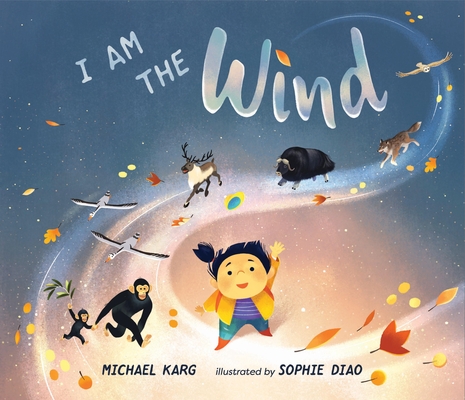
On a cold and damp autumn day, a little girl joins in the windy day. The wind can breathe frost and bring fog. It can be soft as a shadow or scale the highest peaks in the north. The wind can run like the wolves or hug and settle in with the musk ox as night. The wind joins in the beauty of the northern lights and whistles around rocks on a snow leopard ledge. The wind can create storms in the rainforests, give pestrels a lift on their long journey, and whisper in cloud forests. Then it returns to an autumn playground, listening for the call to rise up once more.

Told in poetic language, this picture book celebrates the way that the wind touches all parts our world. It speaks to the power of the wind to help birds on their migrations and to create weather patterns. That power is contrasted nicely by the quieter sorts of wind and breezes in the book, examples of the wind at its gentlest too. The writing is strong and reads aloud nicely. The different animals highlighted in the book are interesting choices, making turning pages very enjoyable.

The illustrations carry readers across the globe, showing various animals and creatures in each habitat. The wind is depicted as swirls of color, almost dreamy at times and other times whooshing appropriately across the page.

Perfect for reading on a blustery day in any season. Appropriate for ages 2-4.

Reviewed from copy provided by Page Street Kids.

Ten Ways to Hear Snow by Cathy Camper

Ten Ways to Hear Snow by Cathy Camper, illustrated by Kenard Pak (9780399186332)

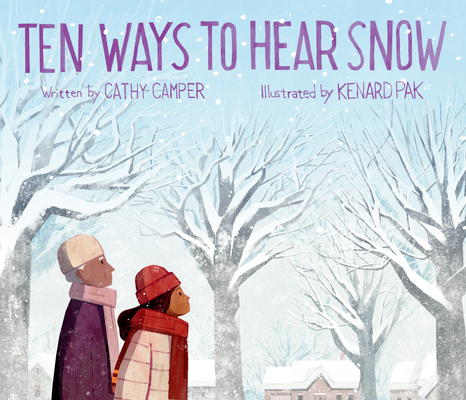
When Lina woke up in the morning, snow had fallen and the street was quiet and hushed. Despite the snow, Lina headed out to visit her grandmother. She loved helping her grandmother cook and today was grape leaf day, when they would make warak enab. As Lina walked to her grandma’s, she heard all sorts of noises. There was her neighbor scraping her shovel on the sidewalk. There was the crunch of her own boots in the snow. A blue jay knocked a soft ploompf of snow down from a branch, a quiet sound. People swept off their cars, others scritched past on skis. Mittens patted newly-built snowmen. Lina reached her Sitti’s apartment and the two worked together filling grape leaves with lamb and rice. Lina could hear the snow melting off her mittens and coat. Her grandmother showed her the tenth way to hear snow, one you had to slow down to notice.

This picture book is beautifully cozy and warm despite being mostly set in the outdoors on a snowy day. The sense of discovery as Lina hears the snow in various ways is great fun. The marriage of a weather event and the use of one specific sense adds to the fun and the curiosity as Lina walks to see her grandmother. The Lebanese family and food is front and center here too, warming the beginning and end of the book with a glow.

Pak’s art moves from the cozy home setting out into the cold and then back into a different warm home. His characters are diverse with their neighborhood filled with people of different races. The outdoor light, filled with blues and whites, contrasts with the yellows, reds and golds of the interior settings. It’s a celebration of the beauty and sounds of winter.

This book encourages us all to slow down and listen. Appropriate for ages 3-5.

Reviewed from e-galley provided by Kokila.