Review: Puma Dreams by Tony Johnston

Puma Dreams by Tony Johnston

Puma Dreams by Tony Johnston, illustrated by Jim Lamarche (9781534429796)

The narrator of this book, a young girl, longs to see a puma before they disappear entirely. There have been reports about sightings near her gram’s home. Puma kittens were found in a barn, pumas have stalked horses, and been seen dozing on a tree limb. But the girl has never seen one herself. So she spends her allowance on a fifty-pound salt lick that she put out in the field. Other animals visit the salt lick, including deer, cattle, elk, but no puma appears. The salt lick dwindles down. There are signs of a puma in the area, large paw marks left in wet dirt. Then one day at breakfast, the girl feels a prickle and looks behind her and there at the salt lick is a puma in the golden morning light.

Johnston writes in poetry in this picture book. She paints entire pictures with her words, sharing the delicate balance in nature where a species is on the decline. She shares the young narrator’s wistfulness and wonder at the puma, dreaming along with her about its life and what it is doing right then. The amazement and delight when the puma finally appears is so satisfying after the longing she has conveyed on all of the previous pages.

Lamarche’s illustrations are exceptional. They capture the landscape of grassland and mountains, illuminated by the time of day with the colors of dawn or the golden light of evening. The setting is depicted so clearly that one could almost walk to the salt lick from the house. He also shows the little girl and her gram in the images, living in connection with the land around them. The beauty of the hidden puma is also there, sometimes featured on the page and other times elusive but there.

A gorgeous picture book about dreams, plans and patience. Appropriate for ages 4-6.

Reviewed from copy provided by Simon & Schuster.

Review: Amy Wu and the Perfect Bao by Kat Zhang

Amy Wu and the Perfect Bao by Kat Zhang

Amy Wu and the Perfect Bao by Kat Zhang, illustrated by Charlene Chua (9781534411333)

Amy can do a lot of things like brush her teeth and tie her shoes. But the one thing she can’t do is make the perfect bao, a steamed dumpling. So she sets out one day to make the perfect bao. It’s an all-day effort by her entire family. Her father makes the bao dough, and Amy helps him pound the dough and let it rise. Her mother makes the filling, and Amy helps her too. Then everyone sits down at the table to form the bao, including Amy’s grandmother. When things don’t go right for Amy, everyone offers her advice on how to do it. That’s when Amy realizes that the dough has been cut for adult hands. When her grandmother cuts the dough into smaller pieces for Amy, suddenly she too can make perfect bao! In the end though, all of the bao, perfect or not, taste delicious.

Zhang takes the universal story of a young person not being as good at something as they want to be and wraps it in a delicious bao package. Readers are invited into Amy’s Chinese-American home and she leads readers through the process of making bao. The frustrations of learning and perfecting a process are openly shared. The discovery that Amy makes that solves the problem is nicely portrayed as well and I appreciate that the child is the one who realizes her own solution.

The art by Chua is wonderfully bright and vivacious. Amy is shown as an optimist throughout, even as she is trying to brush her teeth and tie her shoes at the same time. The backgrounds in the illustrations suit the mood of the moment, moving from gold to orange to blue.

A tasty treat of a book that will leave readers hungry for more. Appropriate for ages 3-5.

Reviewed from copy provided by Aladdin.

Review: The Book Rescuer by Sue Macy

The Book Rescuer by Sue Macy

The Book Rescuer: How a Mensch from Massachusetts Saved Yiddish Literature for Generations to Come by Sue Macy, illustrated by Stacy Innerst (9781481472203)

Aaron Lansky’s grandmother came to America from Eastern Europe. She brought with her precious books in Yiddish, which her brother threw into the sea along with her other possessions as a sign they must break with the past. Aaron grew up firmly American in Massachusetts. When he went to college he began to study Jewish scholars and had to learn to read Yiddish to be able to read what he needed to. But Yiddish books and the language were in serious trouble in the 1960s after the impact of World War II. Aaron found himself rescuing Yiddish books from destruction. He filled his apartment with books and asked the leaders of Jewish organizations across the country to help save the books. But they believed that Yiddish was no longer worth saving. So Aaron created his own space in an old factory building that he named the Yiddish Book Center. As word spread, he continued to save books from destruction and meet with people who handed their beloved books over to him. The Center continues its work to this day, having saved Yiddish books from destruction for decades.

Macy writes with a wonderful tone in this nonfiction picture book. She shares the importance of what Lansky accomplished with his work but also has a playful approach that works particularly well. The insertion of Yiddish words in the text adds to this effect. The story of Aaron Lansky’s work is one of finding a personal passion and getting swept up in it. It is a story of hard work, resilience and determination in the face of even those who should care not finding your work valuable at first.

The illustrations by Innerst move from playful in depicting things like running in pajamas at night to save books to dramatic when looking back at the Holocaust. They are done in acrylic and gouache with textures added digitally. The images suit the subject well with a feel of modern design combined with connections to the past.

A fascinating biography of a little-known man who saved a written history of his people. Appropriate for ages 6-9.

Reviewed from copy provided by Simon & Schuster.

Review: Sulwe by Lupita Nyong’o

Sulwe by Lupita Nyong’o

Sulwe by Lupita Nyong’o, illustrated by Vashti Harrison (9781534425361)

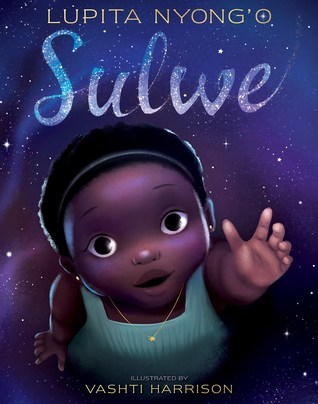
Sulwe is a little girl with skin as dark as midnight. She doesn’t look like anyone else in her family and no one in her school has skin as dark as hers either. At school when the children are given nicknames, the only ones Sulwe is given refer to her dark skin and aren’t nice, like Blackie. Sulwe tries to make her skin lighter by using an eraser and eating light-colored foods only. But nothing changes it. Her mother explains that she is beautiful just as she is and needs to know that beauty is about how Sulwe sees herself not how others see her. That night, Sulwe has a dream where a star comes into her room and tells her a story about Day and Night. Day was celebrated by everyone but Night was not. So Night decided to leave and it was daytime all the time. No one was able to rest and the plants couldn’t grow. Day convinced Night that she was needed and just as beautiful at her darkest as Day was at her brightest. Night returned to much celebration and the two sisters never left each other’s sides again. With that inspiration, Sulwe was able to see the beauty of her own dark skin and her confidence grew.

The writing of this picture book is straightforward when it needs to be. It doesn’t hide the racism that Sulwe faces every day, the judgement she receives based solely on her skin color and the way that she in turn judges her own beauty and worth. The folktale part of the book works well, taking the story on a new path and demonstrating using Night, the importance of diversity and the impact we all have on one another.

The art by Harrison is so beautiful. Sulwe glows on the page, her dark skin always lit dramatically showing the slide of a silver tear on her cheek or the glow of city lights on her face. When the story moves to Day and Night, the beauty of both characters is clear. The depiction of Night plays with black and dark, never allowing her to disappear into that deepness.

Dramatic and important, this picture book deals directly in self-esteem and racism.

Reviewed from copy provided by Simon & Schuster.
Review: The Fountains of Silence by Ruta Sepetys

The Fountains of Silence by Ruta Sepetys

The Fountains of Silence by Ruta Sepetys (9780399160318)

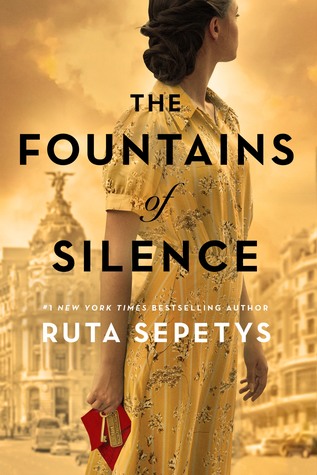
Daniel and his parents travel to Madrid for his father to complete an oil deal with the dictator, Franco. Daniel’s mother is from Spain and he speaks fluent Spanish. A budding photojournalist, Daniel is competing for a prestigious photography award, one that will allow him to go to journalism school even if his father won’t pay for it. But Spain is not the country he expected to find, particularly when he starts to photograph it. A single photo of a nun with a dead baby gets the attention of Franco’s police as well as of the man who is developing Daniel’s film. As Daniel looks more closely at the real story of Spain under Franco, he discovers a deep connection with Ana, the maid assigned to his family’s rooms. He meets Ana’s brother, who is helping his friend become a matador, something usually not done by those living in poverty. Ana’s entire family is working to keep a roof over their heads and dream of eventually moving out of the slums of Madrid. All is complicated by politics, violence, threats and power, where survival may be all they can hope for.

A simply amazing book that will take readers deep into Madrid in the 1950’s and 1960’s where Franco’s dictatorship makes rules for everyone to live under, suppressing ideas and freedoms. Madrid herself plays a large role in the story, captivating even with such a smothering society. Pleasures are found, such as photographs, candies and dinners out but they are hauntingly contrasted with the poverty in Spain. Ana and Daniel’s existences are vastly different with the American simply expecting things that are only available to the wealthiest in Madrid.

The romance between Ana and David is pure bliss. Naturally building and hemmed in by the strict societal rules, it has the deliciousness of a Victorian romance. The two characters are different in so many ways, and yet also have a strong ethical code, a willingness to stand up for others, and an ability to sacrifice themselves that pulls them together along with their physical attraction for one another.

Skillful and haunting, this look at Spain’s history is vivid and unflinching. Appropriate for ages 14-18.

Reviewed from ARC provided by Philomel.

Review: Mother Goose of Pudding Lane by Chris Raschka

Mother Goose of Pudding Lane by Chris Raschka

Mother Goose of Pudding Lane by Chris Raschka, illustrated by Vladimir Radunsky (9780763675233)

The story of the real Mother Goose frames a selection of her rhymes in this biographical picture book. The book begins by explaining that Mother Goose was actually Elizabeth Foster who married Isaac Goose in 1692. He was a widower with 10 children and the two had four more children together! So she was very like the Old Woman Who Lived in a Shoe. She raised this large family with her husband, filling the house with rhymes which are still shared in homes today.

The framework of Mother Goose’s own story is told in brief poetic lines that rhyme across the pages, forming their own nursery rhyme of sorts. The highlight here is seeing the nursery rhymes themselves, all returned to the more original versions that were a little rougher and reflected Mother Goose’s time period. It would have been good to have an author’s note with more details about her life as well as a bibliography.

Radunsky’s illustrations are funny and clever. They range from paintings to rougher pencil sketches that appear on the page together. The mix is dynamic and interesting, reflecting the mix of rhymes and story on the page.

Not your regular picture book biography, which makes it all the more interesting. Appropriate for ages 3-6.

Reviewed from copy  provided by Candlewick Press.


Review: Home in the Woods by Eliza Wheeler

Home in the Woods by Eliza Wheeler

Home in the Woods by Eliza Wheeler (9780399162909)

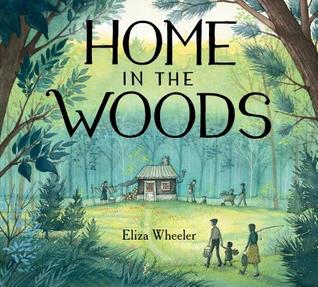
After her father dies, a girl, her mother and seven siblings move into a tar-paper shack in the woods. The shack is worn but inside they discover a root cellar with a pump that offers clean water. The family plants a garden with seeds they brought with them and find a large berry patch too. In autumn, Mum walks to town to get work doing chores and all of the children pitch in at home. They can their harvest so that it will last through the winter. In winter, the boys go hunting and often return home empty handed. But when they get a turkey, the family feasts. When spring arrives, the family starts to trade baked goods for eggs and milk from neighbors and the little shack looks like home now.

Wheeler takes a story from her own family history during the Great Depression and turns it into this heartwarming story of determination and resilience in the face of incredible poverty. The focus here is on how the entire family worked together to meet the challenge, each sibling taking on duties and roles that suited their age and ability. The stalwart mother is also shown as an incredible cook, a source of hope and the reason the family survived.

Wheeler’s illustrations ensure that hope is the focus of this picture book. While drab and dirty at first, the little shack is transformed just by the people who inhabit it. Games are simple and done without any real toys, even the baby finding leaves and sticks the perfect things to play with. The jewel-like canned foods enliven the darkness of the root cellar, promising safety in the cold.

A brilliant historical picture book. Appropriate for ages 5-8.

Reviewed from e-galley provided by Nancy Paulsen Books.

Review: Gravity by Sarah Deming

Gravity by Sarah Deming

Gravity by Sarah Deming (9780525581031)

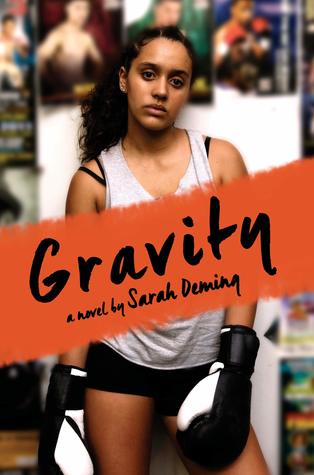
Once Gravity found her way to the Cops ‘n Kids gym, a place with no address, she couldn’t stop going. There was a smell the gym of boys and sweat, and it gave her a real reason to hit something and hit it hard. As Gravity got older, she got better at boxing, quickly becoming a young boxer to watch in the circuit. She headed undefeated into meets that could lead her to the Olympics, but her home life was a mess. Her mother was an abusive alcoholic who was best when she was ignoring Gravity and her little brother. Her father had left, returned and then disappeared again. Now Gravity had a way forward, a way to create a future for herself and her brother separate from her mother. All she had to do was win, and she worked hard and wanted it badly. But nothing comes easily, especially in boxing.

I must admit that I’m not usually a fan of sports novels, but Deming’s novel of Gravity and her battles to make it out of poverty and abuse caught me and held me in its sweaty arms. Deming herself has personal knowledge of boxing as a New York City Golden Gloves champion and boxing journalist. She takes that knowledge and allows readers to see beyond the physicality and violence of boxing into the art and skill of the sport. Her writing is fast paced and the bouts themselves are readable, understandable, and sometimes bloody.

Gravity is a fantastic heroine, someone who is resilient and strong both in her heart and her body. She is confident but not overly so, someone that readers will relate to and understand deeply as she is shown so clearly and vividly in this novel. Gravity is also someone who loves deeply, including family and her coach. This novel doesn’t shrink away from sex either, nicely never shaming the participants either.

A gripping, feminist sports novel that will grab readers and not let them go. Appropriate for ages 15-18.

Reviewed from e-galley provided by Random House. 

Review: The Wolf Will Not Come by Myriam Ouyessad

The Wolf Will Not Come by Myriam Ouyessad

The Wolf Will Not Come by Myriam Ouyessad, illustrated by Ronan Badel (9780764357800)

A little bunny is going to bed, but he has lots of questions for his mother about wolves. She reassures him that a wolf will not come that night. Still he isn’t satisfied. She explains that wolves are not as common anymore due to hunting. She explains that they live in woods. But there is a small woods near their house. Perhaps the wolf is a very good hider too, plus he looks like a big dog. It sounds like he might be able to get to the rabbits’ house after all. Still, he has to cross traffic, find the right address, sneak inside without the door code, and take the elevator. But the little rabbit has answers for all of these obstacles. So will the wolf arrive?

The story is cleverly told with one page reflecting the little rabbit’s quiet bedroom and the other the wolf steadily making his way closer and closer through the obstacles the mother rabbit is describing. There is a great tension and expectation to the book, but I doubt that anyone will see the twist of the ending coming. It’s a wonderful surprise even as one sees the wolf heading towards the rabbits.

The illustrations play a huge role in the book, showing the wolf as the mother rabbit describes things. The book uses shadows, light and dark very effectively to show danger and safety, fears and expectations.

Funny and surprising with just the right touch of danger. Appropriate for ages 4-6.

Reviewed from library copy.