Somos como las nubes / We Are Like the Clouds by Jorge Argueta

we-are-like-the-clouds-by-jorge-argueta

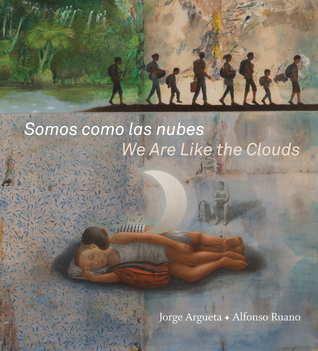
Somos como las nubes / We Are Like the Clouds by Jorge Argueta, illustrated by Alfonso Ruano (InfoSoup)

This stunning book of poetry looks at the flood of children from Central America who are making their way to the United States. 100,000 of them have walked to our country, escaping to safety and what they hope is fresh opportunities. The book opens with a few poems that show the beauty of Central America and then swiftly moves to the problems and the gangs that are in control. Then begins the long march north, the trust placed in coyotes that lead them, the dangers they face, the rough conditions and the courage it takes to head towards the unknown. The book ends with poems of Los Angeles and hope.

Written by a Salvadoran poet, this book’s poetry soars and lifts even when speaking of dark and dangerous subjects. Throughout there is a focus on hope and the distant wonder of the United States. There are poems of the journey that are aching with loss. There are poems of strong parents who carry children and others of the children alone and fearful. It is a book that captures the range of immigrants coming to the United States, particularly children from Central America whose story is shared with such poignancy on these pages.

The art by Ruano is startling and beautiful. He has surreal moments in the art that capture a little touch of playfulness at first. That moves quickly to sense of isolation at times, of being alone in a stark landscape. Towards the end, there is one painting of a child afloat in the air on a blue, cloud-like sleeping bag who is finally heading home with his parents. It is a picture of such tenderness and captures the youth and dreams of these children.

An important book that shows the plight of Central American children as they walk to the United States, this is a challenging book of poetry that demands attention. Appropriate for ages 8-12.

Reviewed from library copy.

10 Great Books for Older Children on Bullying

While my “10 Great” series so far has focused only on picture books, I want to share some great books for older children as well. Here are some wonderful books about bullies and bullying to share in classrooms and families:

Better Nate Than Ever Cartwheeling in Thunderstorms

Better Nate Than Ever by Tim Federle

Cartwheeling in Thunderstorms by Katherine Rundell

Friends for Life Garvey's Choice

Friends for Life by Andrew Norriss

Garvey’s Choice by Nikki Grimes

Maxi's Secrets: (or what you can learn from a dog) My Heart Is Laughing

Maxi’s Secrets by Lynn Plourde

My Heart Is Laughing by Rose Lagercrantz, illustrated by Eva Eriksson

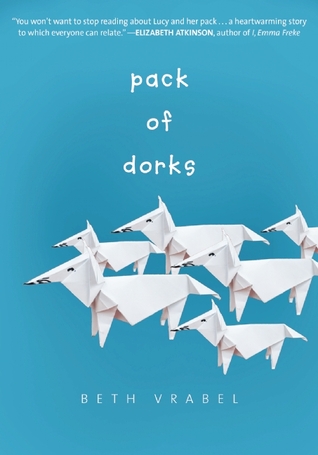
Pack of Dorks (Pack of Dorks #1) Wolf Hollow

Pack of Dorks by Beth Vrabel

Wolf Hollow by Lauren Wolk

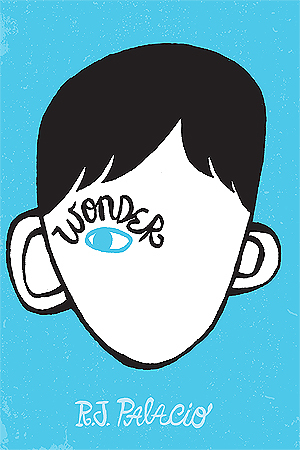
Wonder Words in the Dust

Wonder by R.J. Palacio

Words in the Dust by Trent Reedy


Gertie’s Leap to Greatness by Kate Beasley

gerties-leap-to-greatness-by-kate-beasley

Gertie’s Leap to Greatness by Kate Beasley (InfoSoup)

Gertie doesn’t know her mother at all, since she left Gertie and her father behind. Gertie lives with her aunt and father, who is often gone working on an oil rig. But when a For Sale sign goes up on her mother’s home and she expects to leave town soon, Gertie discovers that she wants to prove to her mother that she should never have left. So Gertie goes on a mission to become the best fifth-grader in the universe. When school starts though, there is a new student in her class, Mary Sue Spivey, who seems to be a lot more likely to be the best. She gets perfect grades, their teacher loves her, and even Gertie’s best friend befriends Mary Sue. When tryouts for the play come though, Gertie is selected as the lead, but can she actually become the perfect fifth grader and get her mother to witness it?

Beasley has created a story filled with characters who are vastly human. Gertie herself struggles with success, has trouble keeping her strong personality under wraps, sets herself immense goals through her missions, and yet has a huge heart and a desire to do the right thing. That right thing though is often warped under her reasoning into something that many people might see as overtly wrong.

The book has plenty of twists and turns, all based on Gertie herself and what she is creating around her. Sometimes that is good things and other times it is pure trouble. She also discovers that young people can be “fickle” and uses that word to keep herself from being too overly concerned when they turn against her and also too caught up in when they like her again.

Ideal for children who enjoyed Clementine, this book has humor, pizzazz and one great heroine. Appropriate for ages 7-10.

Reviewed from e-galley received from Edelweiss and Farrar, Straus and Giroux.


Things Too Huge to Fix by Saying Sorry by Susan Vaught

things-too-huge-to-fix-by-saying-sorry-by-susan-vaught

Things Too Huge to Fix by Saying Sorry by Susan Vaught (InfoSoup)

Dani’s grandmother suffers from Alzheimer’s and is slowly reaching the end of her life cared for by Dani and her parents. So when her grandmother sends Dani on a mission to find a letter and key, Dani isn’t sure that it’s real. She discovers both the letter and key, then has to follow the trail of clues her grandmother left in her writing to discover the truth of a feud that her grandmother had with Avadelle Richardson, a novelist who wrote about a riot that happened at Ole Miss. It’s a riot that both Dani’s grandmother and Avadelle actually were caught up in. As Dani gets closer to the end of the trail, she finds more and more secrets and history and modern life begin to collide.

Vaught has written a taut novel that takes readers on a journey through Civil Rights history in Mississippi. Told through the eyes of Dani, the book is accessible to modern children and shows that racism is far from over. With our recent election, it is also a timely book that speaks to the deep-seated racism still at work in our country today. Vaught uses excerpts from Avadelle’s fictitious novel to show the historical context that the riot took place in. It does show how far we have come, but also speaks to how far we have to go.

The complex friendships of middle grade children are captured here, with Dani and her best-friend Indri sharing the adventure while her “not-friend” Mac, grandson of Avadelle continues to also be a part of it though at times the two are not speaking, just like their grandmothers. This modern division is a clever way to show how friendships change, shift and fall apart, something that mirrors what is seen in the novel and in the grandparents’ relationship.

A rich look at Civil Rights, racism and the decisions too big to be unmade, this novel is a timely look at today and our shared past. Appropriate for ages 9-12.

Reviewed from copy received from Simon & Schuster.


Benny and Penny in How to Say Goodbye by Geoffrey Hayes

benny-and-penny-in-how-to-say-goodbye-by-geoffrey-hayes

Benny and Penny in How to Say Goodbye by Geoffrey Hayes (InfoSoup)

Benny and Penny return in another graphic novel perfect for new readers. In this story, the two mouse siblings start the story by jumping in piles of leaves. Penny worries that Benny will hurt the leaves, but Benny explains that the leaves are already dead. Then Penny discovers a dead salamander in the yard. Penny wants to bury the salamander but Benny gets angry and tries to stop her over and over again. As Penny moves ahead with burying the salamander with the help of another friend, Benny listens in and then starts feeling sad rather than angry about the little dead creature.

Hayes speaks to the experience of death for young children in a gentle and understanding way. He captures the movement from anger at loss to grief in a way that is organic and natural, allowing Benny the ability to feel his emotions and contrasting those with the way his sister is reacting. Both reactions are supported by the book, allowing children to think about their own emotions.

Hayes sets the book in autumn, showing seasonal aspects throughout the story. There are fallen leaves, bare trees, and a sense of change throughout the book. As always, Hayes beautifully illustrates his graphic novels, allowing them to be an ideal bridge between picture book and chapter book.

A lovely look at a child’s first experience with death, this graphic novel is gentle and filled with kind understanding. Appropriate for ages 5-7.

Reviewed from copy received from TOON Books.


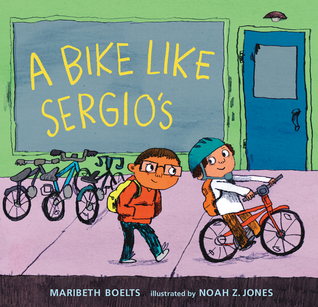
A Bike Like Sergio’s by Maribeth Boelts

a-bike-like-sergios-by-maribeth-boelts

A Bike Like Sergio’s by Maribeth Boelts, illustrated by Noah Z. Jones (InfoSoup)

Ruben would love to have a bike like his friend Sergio has. Even though his birthday is coming, Ruben knows that he doesn’t get presents like bicycles. His family is large and there’s not enough money even for all of the groceries they need some weeks. One day when he is at the store for his mother, a lady in front of him drops a dollar bill. Ruben picks it up and puts it in his pocket, but when he looks at it later he discovers it’s actually a one-hundred dollar bill! That’s enough for him to get the bike he’s always wanted. Now Sergio has a dilemma, does he give the money to his family for groceries? Does he give it back to the woman? Or does he buy the bike of his dreams?

Boelts has created a story that is much more than a lesson in morals. This story is about ethical choices yes, but also about economic disparity and families living on the edge. It is a story told with real subtlety and offering an understanding of what would drive a child who is good at heart to steal what they thought was a dollar. It’s a book about the stories we tell ourselves to make our decisions “right” and the way that doing the right thing may not always be easy or clear.

The illustrations by Jones are modern and rather quirky. They fill the page with the vividness of the urban setting. The love and caring of Ruben’s family are also celebrated in the illustrations.

Subtle and smart, this book about decisions and doing the right thing asks all the right questions. Appropriate for ages 5-7.

Reviewed from library copy.

The Secret Horses of Briar Hill by Megan Shepherd

the-secret-horses-of-briar-hill-by-megan-shepherd

The Secret Horses of Briar Hill by Megan Shepherd (InfoSoup)

Emmaline lives at a hospital that used to be a grand house. The gardens still exist, but they are overgrown and in shambles. When Emmaline looks into the mirrors in the hospital, she sees winged horses living in the world in the reflection. Then one day when she climbs into a walled garden on the grounds, she discovers a wounded winged horse named Foxfire who is unable to fly and seems to have entered Emmaline’s world. On the sundial, Emmaline discovers a letter from the Horse Lord that gives her a quest to surround Foxfire with all of the colors from the rainbow to protect her from a dark horse who is hunting her. But where is Emmaline going to find bright colors in her world of World War II gray?

Shepherd has crafted a novel for young readers that offers a glimpse into another world where mirrors are filled with wild winged horses. It is a world with a kind Horse Lord who needs a child’s help and also one filled with the hoof and wing beats of a huge Black Horse. Beautifully, she allows readers to wonder if Emmaline is entirely imagining the horses, and keeps that question up until the end and beyond. Yet readers who believe will adore this book filled with mirror magic and dreams.

The “still waters” that Emmaline fights are tuberculosis. Shepherd makes sure that readers know that this can kill when Emmaline loses her closest friend at the hospital. Emmaline’s own tragic past is also revealed late in the book. Though Emmaline is fighting for her life, she is also filled with determination to save the horses and fight back against darkness. As the still waters rise in her, so does the full moon which is the deadline of when she must find all of the colors.

Beautifully written, this novel takes readers to World War II England and the battles fought on the homefront. Appropriate for ages 9-12.

Reviewed from e-galley received from Edelweiss and Delacorte Books for Young Readers.

The Singing Bones by Shaun Tan

the-singing-bones-by-shaun-tan

The Singing Bones by Shaun Tan (InfoSoup)

I’m not really sure how to best review this work. It has a brilliant foreword by Neil Gaiman, who says, “Shaun Tan makes me want to hold these tales close, to rub them with my fingers, to feel the cracks and the creases and the edges of them.” The introduction by fairy-tale expert Jack Zipes states, “…Tan has transformed the Grimms’ tales into miraculous artworks that will move and speak for themselves.” I can only echo this sentiment, because the sculptures that Tan has created bring the Brothers Grimm stories into reality, make the solid and strange in a way that reading them doesn’t.

The sculptures are brilliant, showing aspects of familiar stories that bring new meaning to the tales but also revealing new and less familiar stories to readers and inviting them to indulge in more darkness and wonder. Turning the pages in this book is like a journey filled with gasps of disbelief and realization. New images are revealed on each page and so are the intimate hearts of the tales.

A stunning and brilliant series of sculptures with glimpses into the tales they represent. This book shows older children that the darkness of Grimm tales will still call to them. Appropriate for ages 9-13.

Reviewed from ARC received from Arthur A. Levine Books.


Some Writer! by Melissa Sweet

some-writer-by-melissa-sweet

Some Writer!: The Story of E. B. White by Melissa Sweet (InfoSoup)

The life of E. B. White, author of several beloved children’s books, is shown here in a children’s biography from a two-time Caldecott Honor winner. White’s upbringing as a child with his summers spent on a lake in Maine shows the impact of childhood experiences. He won several writing awards as a teenager, knowing exactly what he wanted to do. His work for The New Yorker and other publications as a column author and poet is shown as well as Sweet spends much of the book on the author’s adult life. The strong connection he had with water, nature and Maine shines on the page just as it does in his work. Issues with Stuart Little being accepted in libraries and other moments of note are wonderfully portrayed in original wording of letters. A writer who lived away from the fame he was garnering, White continued to do farm work, sail his boats, and enjoy the simple life he adored.

Sweet has written a simply incredible biography. Her writing flows with that of White. Hers has a frankness and an honesty that is particularly important in biography. Sweet intersperses White’s writing throughout the book, sometimes in clippings from magazines or newspapers and other times clearly typed using a typewriter to get the right feel. Unlike many children’s biographies, Sweet depicts White’s childhood and then moves on to his work and his adult life. While his childhood informs his work, it is not the sole focus of the biography, which honors young readers will plenty of information on his full life.

Sweet’s illustrations are equally amazing. She uses physical items on the page, weathered wood, screws, rope, typewriter keys, and leaves. She incorporates photographs and then her own art as well, creating a world of found objects, drawn Wilburs and Templetons, photos and actual documents that is rich and wondrous. It is like opening a drawer and discovering a treasure trove, a book you want to curl up with and read just as you did those beloved childhood books.

In short, this is a masterpiece. A book with just the right tone, style and organic nature. Terrific! Appropriate for ages 8-12.

Reviewed from library copy.