Finding Wonders by Jeannine Atkins

finding-wonders-by-jeannine-atkins

Finding Wonders: Three Girls Who Changed Science by Jeannine Atkins (InfoSoup)

This compelling verse novel tells the story of three girls who grew up to be women who made their own personal mark on science. There is Maria Merian, a girl born in 1647 who loved nature. Through careful observation, she discovered the metamorphosis of butterflies. Her artistic talents also helped document the life cycles of insects. Born in 1799, Mary Anning helped her father collect stone curiosities in England. When she saw a huge creature in the rocks, she discovered the first of the many fossils and dinosaurs she would uncover during her life. Born in 1818, Maria Mitchell grew up helping her mapmaker father in Nantucket. Exploring the night sky together, she spent years looking through her father’s telescope before discovering a new comet. All of these women battled societal expectations and familial pressures to become the scientists they were.

Atkins uses verse to directly tell the stories of these girls, the way they were raised and how they grew to become scientists. Readers unfamiliar with them will be amazed that they were able to reach such prominence in the time periods they lived and that their fathers were the ones who allowed them the freedom to learn and explore. These women demonstrate that through tenacity and determination one can become exactly who they were meant to be, despite almost everyone disapproving. The tales are inspiring and insightful.

Atkins has chosen three women whose stories work particularly well together. There are commonalities between them even though they span more than a century and involve different types of scientific endeavors.  The strong focus on faith in all of the stories shows the way that scientists even today must reconcile their religious beliefs with scientific truths. Faith is handled with a frank sincerity here, an important part of family and life, but also something that can be personal to an individual.

Beautifully written, these brief glimpses of amazing women in science will introduce new sources of inspiration to young readers. Appropriate for ages 9-12.

Reviewed from copy received from Atheneum Books for Young Readers.

Garvey’s Choice by Nikki Grimes

garveys-choice-by-nikki-grimes

Garvey’s Choice by Nikki Grimes (InfoSoup)

All Garvey seems to do is disappoint his father. His father would like him to play sports and to enjoy them too, but Garvey isn’t athletic. He’d much rather read science fiction and learn about science. Feeling bad about himself, Garvey consoles himself with food and starts to gain weight. He has one friend, who encourages him to join the school chorus. Soon Garvey is making new friends and displaying his talent. He becomes the new soloist for the chorus and his interest in music starts to build a bridge to his father via a new route.

Told in verse, this book of poetry is brief and powerful. Garvey’s situation with his father reads a organic and volatile, the desperation to connect creating even more of a distance between father and son as the failures continue. Garvey’s use of food as a solace is intelligently done, offering hope that he can find his footing again but also not seeing weight loss as the ultimate solution or weight as the real problem. Verse allows Grimes to cut right to the heart of these situations, revealing the layers of issues at play.

Garvey is a bright, funny character. He is shown as a good friend, supportive and also accepting. As Garvey begins to reach out and try new things, he is rewarded by the chorus also reaching out to him. Again, the progress is done in a natural way. Nothing is perfect and there is no magical solution here. It is hard work, talent and slow progress towards a better place.

A shining look at loneliness, bullying and the ability of music to break down barriers. Appropriate for ages 8-12.

Reviewed from library copy.


Pond by Jim LaMarche

pond-by-jim-lamarche

Pond by Jim LaMarche (InfoSoup)

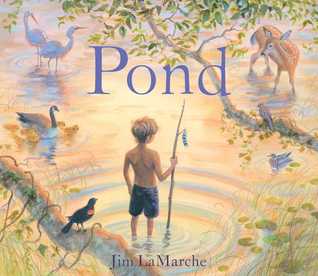
Out walking in the late winter, Matt realized the the place that they had always called “the Pit” used to be a pond. So he and his friends decided to recreate the pond that had been there. They cleaned up the junk and built a new dam. As they worked, Pablo discovered a blue stone shaped like a heart in the sand. Katie started to research the birds, insects and stones as the pond started to slowly fill. They found an old wooden boat and repaired it, naming it Dragonfly. Summer ended with them floating on the newly filled pond, camping nearby. In fall, the geese discovered the pond and flocked to it. Winter brought ice skating on the pond with lots of friends. In the spring, the three friends run to the top of a hill overlooking the pond and there they see how the heart stone is connected to the pond itself.

LaMarche offers a perspective on nature that shows children that they too can do things to restore natural areas. The amount of work that the children do is not minimized at all nor is the slow return to a pond from a pit. This focus on effort, hard work and a slow pay off is vital when working with nature. The book embraces a sort of natural time, a patience while birds and bugs return. Then it picks up, swooping with changes and demonstrating how an ecosystem changes throughout the seasons and serves different animals.

LaMarche grew up in Wisconsin and you can see Wisconsin on each page of this book. From the bombardment of mosquitoes in the summer to the spotted fawns to the woods and marshes. The illustrations are superb, showing the shimmering light of water and woods, the moon rising over a pond, and again that slow transformation into natural beauty.

A testament to the power of restoration for natural areas and how children can help, this picture book is a pleasure. Appropriate for ages 5-8.

Reviewed from copy received from Simon & Schuster.


The Creepy Case Files of Margo Maloo by Drew Weing

the-creepy-case-files-of-margo-maloo-by-drew-weing

The Creepy Case Files of Margo Maloo by Drew Weing (InfoSoup)

Charles and his parents have just moved to Echo City where they are going to be living in The Bellwether, an apartment building that used to be a hotel. Charles is worried by the state of the building, knowing immediately that it must be haunted. When Charles tries to sleep in his bedroom for the first time, he discovers he is right and there is something in his closet. Luckily, a neighbor gives him a card for Margo Maloo, Monster Mediator. Charles considers himself a journalist and wants to interview Margo, but she is having none of it though she lets him join her in negotiating with the troll who lives in the basement. Charles finds himself in a parallel world to his own, where there are trolls, goblins, ogres and many more monsters than he could ever have dreamed.

Weing’s graphic novel tosses readers into a new world that is strongly based in our own. With Margo as an expert guide, this book is much less about battling monsters. It is more about how monsters can get along and live alongside humans in a urban setting. Weing has created a complete monster society and ensures with his stories that the monsters are not the bad guys, just easily misunderstood. The writing is clever, the dialogue solid and the pacing is fast.

The art of the graphic novel is modern and filled with plenty of action. The city and characters are filled with diversity that includes humans and monsters in different skin tones. Weing uses the real estate of his panels in smart ways, lengthening them to share more scenic detail, focusing the scope closely when necessary and broadening them for large buildings.

Just the right book for Halloween, expect this and future books to be popular thanks to a wise mix of humor and shivers. Appropriate for ages 8-11.

Reviewed from library copy.


Coyote Moon by Maria Gianferrari

coyote-moon-by-maria-gianferrari

Coyote Moon by Maria Gianferrari, illustrated by Bagram Ibatoulline (InfoSoup)

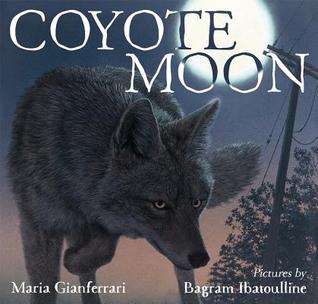
Coyote wakes and heads out of her den to find food for her pups. She walks the roads past houses and fences. She finds a mouse but doesn’t manage to catch it. There are geese on the golf course, but Coyote can’t get close enough to steal an egg without the geese attacking her. There is a rabbit on a lawn, but the rabbit is faster than Coyote. Soon dawn arrives and Coyote still has not caught any food for her family. Then there are turkeys walking nearby and Coyote manages to capture one. She heads home but not before a child spies her from a window when Coyote stops to sing to the morning.

This book is a beautiful dance between illustrations and text. Gianferrari’s prose is extremely poetic, using phrasing that almost turns it into verse particularly when read aloud. The pacing of the book is dynamic and picks up with a sense of near desperation as one prey animal after another escapes. Sympathy for the coyotes, which may not have been high in the beginning of the book, is skillfully built throughout the story until readers will be near cheering when the turkey is caught. The book finishes with information on coyotes.

Ibatoulline’s illustrations are incredibly detailed. Dark and light play on the page, from the electric outdoor lights from human buildings to the moonlight shining on fur. The darkness has dimension, subtle colors, and textures. There is a sense of near hyper-realism as well as readers get closer to these animals in the illustrations than they ever could in life.

This picture book blends nonfiction with great writing to create a realistic view of urban coyotes. Appropriate for ages 5-7.

Reviewed from library copy.


Unbound by Ann E. Burg

Unbound by Ann E Burg

Unbound by Ann E. Burg (InfoSoup)

This novel-in-verse tells the story of Grace, a girl living as a slave on a plantation. Grace is selected to start work in the Big House, leaving her mother, stepfather and two little brothers behind. Grace is warned by everyone that she has to keep her eyes down and her opinions to herself, not even allowing them to show on her face or in her eyes. But Grace realizes that things are very unfair on the plantation where some people work in the fields from dawn to dusk and white people aren’t even expected to dress themselves. Grace finds it impossible to keep these thoughts deep inside her, and puts her family at risk. So they all flee to try to find freedom, heading deep into the Great Dismal Swamp where the men and dogs hunting them can’t track them.

The author of All the Broken Pieces returns with another verse novel just as stunning as her previous ones. Here she shares a piece of history that many don’t know about, slaves who found freedom by living deep in the Great Dismal Swamp in Virginia and North Carolina. The entire book is fraught with dangers from whippings and punishments as a slave to the dangers of reaching possible freedom to the real dangers of the swamp itself.

Told in verse, the poems are in Grace’s voice and it rings with authenticity but also a righteous anger at what is being done to people because of the color of their skin. Readers hearing Grace’s voice will understand her situation and spirit on a deep level. That is the power of poetry, to cut past exposition right to the heart of the person speaking. Burg does this with a simplicity that adds to that power, cutting right through to the core.

Beautifully written, this powerful story tells of the importance of freedom for all people. Appropriate for ages 9-12.

Reviewed from ARC received from Scholastic.


The Inquisitor’s Tale by Adam Gidwitz

The Inquisitors Tale by Adam Gidwitz

The Inquisitor’s Tale: Or, The Three Magical Children and Their Holy Dog by Adam Gidwitz (InfoSoup)

Released September 27, 2016.

The author of the A Tale Dark and Grimm series returns with a medieval tale set in the year 1242. It is a tale told by an inn full of strangers, who each know a piece of the miraculous stories of these children. There is William, the huge boy who is an oblate in the monastery but doesn’t mind using his fists. There is Jacob, a Jewish boy who had to flee his village when it was set on fire by some Christian boys. There is Jeanne, a peasant girl who has fits and sees visions that come true. Finally, there is Gwenforte, Jeanne’s greyhound who died and then returned from the dead. These children and the dog traverse France looking for safety and along the way they change hearts, create miracles, heal the sick (even a farting dragon) and build faith.

Immediately upon opening the book, I tumbled headlong in love with it. After all, it has the format of Chaucer and his Canterbury Tales, though it is far less bawdy! I also enjoyed that all of the stories happen right in the inn rather than on a pilgrimage. Gidwitz notes with a wryness that some of the narration includes more details than any observer would have, but my goodness it makes for a better telling of the tale. The medieval setting is beautifully captured through the rich prose.

This is a book that tackles big issues with gusto. It is a book steeped in faith, one where children perform miracles and a dog returns from the dead. But this is a book that looks beyond Christianity as well to the Jewish faith and thus becomes more inclusive in the way it speaks about faith. Religion itself is at the heart of one of the largest moments in the book, protecting Jewish Talmuds from being burned. It’s a powerful moment, a statement about the importance of the written word, and a purely medieval view of the value of illuminated books.

Brilliant, medieval and funny at just the right moments, this book is a lush look at medieval times for young readers. Appropriate for ages 9-12.

Reviewed from ARC received from Dutton.

Juana & Lucas by Juana Medina

juana-and-lucas-by-juana-medina

Juana & Lucas by Juana Medina (InfoSoup)

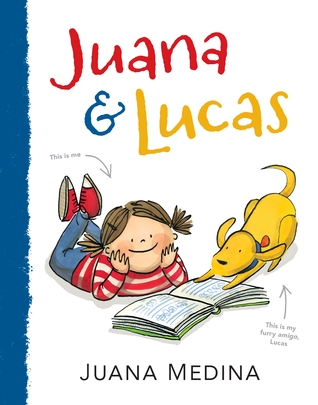
Juana lives in Bogotá, Colombia with her family. She loves things like reading, drawing, Brussels sprouts, and Astroman. She also loves living in Bogotá and in particular having a best friend like Lucas, her dog. Still, there are some things she doesn’t like. She doesn’t like the school uniform she has to wear, doing classwork, and in particular she doesn’t like learning “the English.” When Juana complains about having to learn English and how hard it is, the adults around her encourage her to keep trying. She is also told about a special trip that her grandparents are planning to the United States and Juana will get to meet Astroman there! But in order to be allowed to go, Juana has to do better in her classes, particularly English.

Filled with lots of pictures and even some infographics, this book is particularly approachable for children. With the same humor and heart as series like Clementine, this picture book offers a glimpse into another culture as well as a smart and independent heroine. Spanish words are sprinkled throughout the text, making it just challenging enough that readers will understand how hard it is to decode a different language and yet how rewarding it is too.

The illustrations are bright and cheery. The infographics, used to label different characters with their unique characteristics are funny and nicely designed for clarity. The city of Bogotá and the people in Juana’s life are shown in bright colors with lovely humorous touches.

The first book in a new series that offers diversity, Spanish and lots of heart. Appropriate for ages 6-9.

Reviewed from copy received from Chronicle Books.

The Best Man by Richard Peck

The Best Man by Richard Peck

The Best Man by Richard Peck (InfoSoup)

Released September 20, 2016.

Archer recounts the two weddings that he has been in, one really bad and the other really good and all of the time in between. The first was a wedding where he was in first grade and the ring bearer. He tried hiding in the bushes and only managed to get his outfit full of mud and to rip a hole in the too-tight cloth. The best that can be said is that it made a popular YouTube clip. Archer also managed to make a new friend that day, a friendship that would carry through his grade school years. As grade school progresses, Archer tries to figure out what type of person he wants to be. He knows that he wants to be like his grandfather, his father and his uncle. He also wants to be like his fifth-grade student teacher too, a handsome veteran who turns school into a media frenzy. It is the wedding of his uncle to his teacher that is the best wedding ever. As Archer matures, he shows the men around him what means to be the best kind of man too.

Peck is a Newbery Medalist and this one of his best ever. Peck takes the hot topic of gay marriage and makes it immensely approachable and personal. Archer is a wonderfully naive narrator, someone who isn’t the first in the room to figure things out. That gives readers space to see things first and to come to their own opinions on things. Then the book offers insight into being human whether gay or straight. There is no pretense here, just a family living their lives together and inspiring one another to be better than they are.

Peck’s lightness throughout the book is to be applauded. This is not a “problem” novel that grapples with the idea of gay marriage and debates it at length. Instead it is a book filled with laugh-out-loud humor and lots of delight. Alongside that is a great deal of poignancy with aging grandparents, the ins and outs of love, and the growth of characters throughout.

Entirely engaging and immensely readable, this is one of the best of the year. Appropriate for ages 9-12.

Reviewed from ARC received from Dial Books.