I Am the Subway by Kim Hyo-eun

Cover image for I Am the Subway.

I Am the Subway by Kim Hyo-eun, translated by Deborah Smith (9781950354658)

Told from the point of view of the Seoul subway itself, this picture book takes readers deep into the city and introduces them to the various people who use the subway. With a steady ba-dum ba-dum, the subway rattles and rumbles over its tracks reaching stop after stop. At each stop a different character enters the story, from the business man running to make his train to a mother with two children who is also late to a man who repairs shoes for a living to a student so tired she is almost falling asleep. Each person offers their story, glimpses of their past and plans. As the train car fills up, the light shines in showing the beauty of each person and their journey.

This Korean import is beautifully written with a dazzling combination of simple prose that moves to a poem for each of the people entering the train. The poems are set apart from the prose, offering a full story of that person in just a few lines. The bustling urban setting is brought to a personal level as each human is highlighted and given space to shine. There is space here for transformation in each person’s life, the subway used as a huge metaphor for life and growth.

The illustrations are done in ink and watercolor. The humans are shown as more faceless at first but as they are introduced to the reader, they are shown in brighter colors in the crowd rather than the gray people around them. Each person’s story and poem are shown with the bright colors from the bluest of sea water to the bustle of the city itself.

A gorgeous celebration of Seoul and its people. Appropriate for ages 4-7.

Reviewed from copy provided by Scribble.

Make Meatballs Sing: The Life and Art of Sister Corita Kent by Matthew Burgess

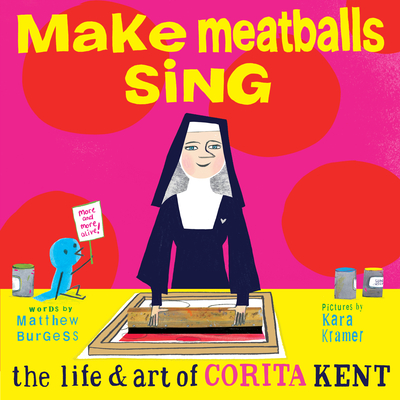
Cover image for Make Meatballs Sing.

Make Meatballs Sing: The Life and Art of Sister Corita Kent by Matthew Burgess, illustrated by Kara Kramer (9781592703166)

Corita Kent was a remarkable pop-artist who was also a nun, a teacher and an activist. From a small child, Corita showed kindness and empathy for others and also a love of art and creativity. Her father wanted her to do something original, and Corita certainly did. She surprised her family by becoming a nun, discovering a love of teaching and training new teachers. She joined the art faculty at Immaculate Heart College, where she discovered a love of silkscreen printing. Soon her art was winning competitions. Corita continued to teach classes and make her own art, which spoke to social justice and against poverty and war. She transformed a rather formal celebration into one of bright colors and activity. Not everyone approved of what Corita was doing, and she surprised the people around her once again, asking to be released from her religious vows. She found places for her largest work, painted on a gigantic tank, and her smallest, a rainbow postage stamp.

While Kent may not be a household name, many of us have seen her work on the iconic postage stamp. This picture book embraces her unusual life, celebrating the decisions she made, the art she created and her voice for social change. The book cleverly pulls out elements of how Kent taught and created her art, offering unique perspectives gained by seeing the world in a fresh way. The writing here is engaging and offers a tone of delight as Kent continues to surprise and amaze.

The bright and vibrant art in the book shares elements of Kent’s own work. Her play with lettering and words appear throughout the illustrations of the book, filling tree trunks, coloring margins, and as posters on the walls. The entire book is a delight of collage, typography and riotous color.

A positive and affirming look at an artist who should be better known. Appropriate for ages 6-9.

Reviewed from copy provided by Enchanted Lion.

Harry Versus the First 100 Days of School by Emily Jenkins

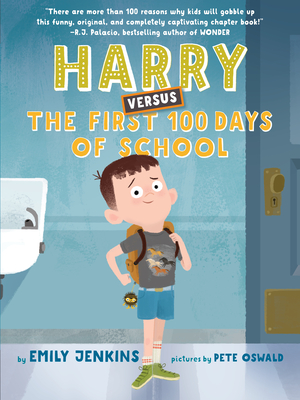
Cover image for Harry Versus the First 100 Days of School.

Harry Versus the First 100 Days of School by Emily Jenkins, illustrated by Pete Oswald (9780525644712)

This chapter book invites readers to experience the first 100 days of school alongside Harry. Harry has worries about his first day of school, helped quite a bit by his older sister showing him the way things work. He has a real fear of guinea pigs, a creature he believes is much more like a wild pig than the small furry rodent it actually is. Harry decides that his goal is to become an expert on something, though he isn’t sure what. Perhaps an expert on Fluff Monsters, a video game he loves. Harry quickly makes friends at school, surprising himself by who he actually gets closer to. He learns to set healthy boundaries with classmates who like to play jokes and also finds himself overcoming a lot of his fears along the way. In fact, he turns out to be an expert on quite a lot!

Award-winning author Jenkins sets exactly the right tone here. Throughout the book, there is humor that will have children immediately engaged and that is layered beautifully with empathy for Harry and the others in his class. Harry and his classmates are multidimensional characters who reveal themselves over the course of the book. Readers will laugh out loud at the humor here and be drawn deeply into the story of how Harry survives first grade.

The illustrations by Oswald work well to break up the text and make this a more approachable book for young readers. Oswald captures the diversity of Harry’s class and community. The urban setting is vibrant and colorful while the classroom is warm and inviting.

Funny and clever, this is just the right book for first graders and any others who may need a good giggle about school starting. Appropriate for ages 5-7.

Reviewed from e-galley provided by Random House Children’s Books.

The Story of Bodri by Hédi Fried

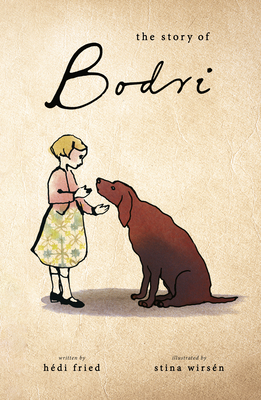
Cover image for The Story of Bodri

The Story of Bodri by Hédi Fried, illustrated by Stina Wirsen (9780802855657)

Inspired by the author’s experiences during the Holocaust, this picture book takes a child’s view of the horrors of that time. Hédi grew up in Romania. She loved her dog Bodri, and he loved her most of all. She had a best friend who lived nearby. They had all sorts of things in common, except Hédi was Jewish and her friend went to church. When Adolf Hitler shouted on the radio, Hédi’s parents assured her that he would never come there. But his soldiers did come and Hédi was forbidden to play with her Christian friend. Soon the family was told to pack their belongings. They went to the train station, followed by Bodri, who had to be left behind. Hédi’s parents disappeared in the concentration camps but Hédi and her little sister survived. She went back home and found Bodri still waiting for her.

Fried survived several Nazi labor camps, including Auschwitz and Bergen-Belsen. She lives in Sweden and continues to be an expert voice for democracy and anti-racism. This book was inspired by a question she received at one of her presentations about what happened to her dog. The book translates the larger racism and hatred of the Nazis into a personal story of the impact of the Nazis. Fried writes through a child’s eyes, a child watching her parents to gauge what is happening. Using her dog as an anchor as time passes is very moving as he continued his vigil through the seasons.

Wirsen’s art is haunting. There is an ethereal nature to it throughout the book even as the girls play in the park full of pinks and greens. The colors change to more somber as the Nazis arrive. Wirsen uses watercolors and prints to create her images. The juxtaposition of the girls after they are liberated from the camp to before they went in is both startling and heartrending.

A powerful look at the Holocaust through the eyes of a survivor and her dog. Appropriate for ages 7-9.

Reviewed from copy provided by Eerdman’s Books for Young Readers.

The Capybaras by Alfredo Soderguit

Cover image.

The Capybaras by Alfredo Soderguit (9781771647823)

The farm was a safe place where life was comfortable and everyone knew their role. There were chickens who had plenty of food and a rather vicious dog who guarded them. Then one day, the capybaras emerged from the swampy part of the pen. There was no room for them there and they were not expected. The hens found them too big, too hairy and too wet. But the capybaras couldn’t go home because the hunting season had started. So the hens set some rules where they would not share food, or their dry pen, or tolerate any noise. Then one day after a chick had a misadventure, everything changed. The capybaras had saved the chick and now they were allowed to sleep in the chicken coop, share food and live together. Then hunting season ended and the capybaras prepared to leave. What were the new friends to do?

This picture book was originally published in Spanish in Latin America. Soderguit has a marvelous gift for wry understatement or in fact just stating the opposite of what is actually happening in the illustrations. This contributes to a sense that horrible things are happening off the page and the characters live in real denial, even before the capybaras arrive. The entire book works beautifully as a statement about refugees, tolerance and building a community.

The illustrations are a marvel of quiet moments with a lot of the power of the book being the things in the illustrations that go unremarked upon in the text. The illustrations are done in pen and ink with pops of orange color and the deep browns of the capybaras. The wide-eyed capybaras contrast impressively with the white chickens and their delicate life balance.

Profound and remarkable. Appropriate for ages 5-8.

Reviewed from e-galley provided by Greystone Kids.

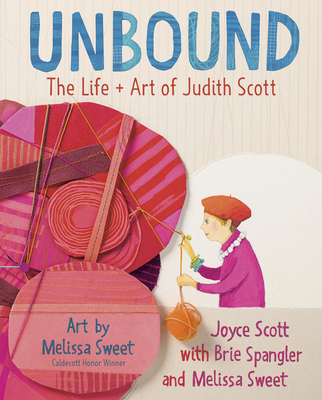
Unbound: The Life & Art of Judith Scott by Joyce Scott

Cover image for Unbound.

Unbound: The Life & Art of Judith Scott by Joyce Scott with Brie Spangler and Melissa Sweet, illustrated by Melissa Sweet (9780525648116)

Told by Joyce Scott, the twin sister of Judith, this picture book explores the closeness of the sisters as small children until they are separated for years. The two sisters shared everything with one another, playing together all the time. Then Joyce is sent to kindergarten and Judith is left behind. Judith has Down syndrome and has never spoken. Then her parents send Judith to a special school where she will live and learn to talk. They don’t visit for a long time and when they do, the school isn’t like other schools. There is no playground, no desks, no books. As they grow older, Joyce gets married and has children. She continues to think of Judith as being at her side all the time. Eventually, she is able to bring Judith out of the institution and to live with her. Joyce finds Judith an art program to be part of. Judith attends but won’t participate at all. Months go by until her teachers give her some natural materials and fabric. Suddenly, Judith is creating unique pieces of sculpture and is celebrated as an artist.

Full of sorrow and loss, this picture book examines the destructive nature of the systematic institutionalization of people with special needs to both the person institutionalized and their loved ones. Having Joyce herself narrate the book is powerful. The beautiful connection the sisters have in their young childhood forms a foundation of connection that allows her to rescue her sister decades later. Even as the book moves to when Judith finds her artistic voice, there is a melancholy to the years lost and the muting of her voice for so long.

Sweet’s illustrations are incredible and moving. She incorporates collage and also builds sculptures to pay homage to Scott’s work. Built with string, textiles, wire and wood, there is a celebratory nature to them of an art newly found. In other moments, Sweet captures wistfulness, longing and connection with light, shadow and color.

An extraordinary look at an artist who was almost lost. Appropriate for ages 6-9.

Reviewed from e-galley provided by Alfred A. Knopf.

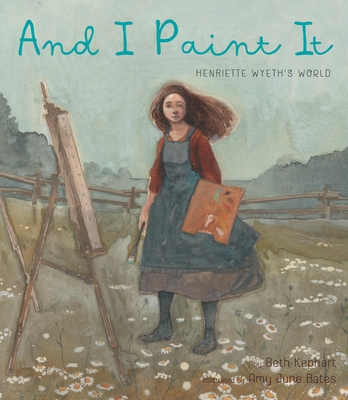
And I Paint It: Henriette Wyeth’s World by Beth Kephart

Cover image for And I Paint It.

And I Paint It: Henriette Wyeth’s World by Beth Kephart, illustrated by Amy June Bates (9781951836047)

This picture book biography looks at the country life of N.C. Wyeth and his family through the eyes of his artist daughter, Henriette. Henriette joins her father as he heads out into the countryside to paint. The two quietly go out, avoiding her talkative sister who is in the henhouse and her brother who is in his workshop building things. Her father greets the flowers along the way, finally stopping to paint the landscape before them. The two sense the world around them, draw the details they see, and smell the earth and plants, painting the sky. They paint together until it is time to head home, and even then Henriette stays behind to paint even more.

The author first discovered Henriette through N.C. Wyeth’s letters and then went on to learn more about her. The statements that the book has Wyeth say to his daughter are taken from his writing about art. The language in the book is poetic and rich, showing all of us how to look more deeply at the world around us and celebrate the small things we see and the large landscape and sky as well.

Bates was also taught art by her own father and notes in her Illustrator’s note that this book pays homage to the Wyeth’s and also to her own experience as she grew up. The illustrations are an engaging mix of watercolor landscapes and then also smaller drawings and paintings that Henriette would have made as they wandered from things she dreamt up and details she noticed.

A lovely look at the Wyeth family, the talented Henriette and how the artistic eye is taught. Appropriate for ages 6-9.

Reviewed from copy provided by Cameron Kids.

Mars Is by Suzanne Slade

Cover image for Mars Is.

Mars Is: Stark Slopes, Silvery Snow, and Startling Surprises by Suzanne Slade (9781682631881)

Taking photos from the HiRISE (High Resolution Imaging Science Experiment) that began orbiting Mars in 2006, this nonfiction picture book gives an intimate look at the planet. The large text in the book continues the Mars is… from the title while smaller text offers scientific details about what the image is revealing about Mars. While the images are all of the surface of Mars, they are unique and different from one another, each showing elements of wind, rock, dunes and craters that tell an even greater history of what has formed the planet.

Slade harnesses the incredible photographs from the HiRISE project with huge impact. The design of the book uses the images as the background for the entire page, allowing readers to get the most out of every image. The variety of images is remarkable too, from the paleness of the sand dunes to the dark drama of the slopes and craters.

Slade’s text allows readers to really understand what each image is showing about Mars and what it reveals about how the planet’s surface has formed and continues to evolve and change. She uses technical terms and explains them clearly, taking readers through the image and inviting them to look at it even more closely. At the end of the book, the HiRISE project is explained.

A fantastic science book that children will love to explore. Appropriate for ages 5-8.

Reviewed from ARC provided by Peachtree.

Shaped by Her Hands: Potter Maria Martinez by Anna Harber Freeman

Cover image for Shaped by Her Hands.

Shaped by Her Hands: Potter Maria Martinez by Anna Harber Freeman and Barbara Gonzales, illustrated by Aphelandra (9780807575994)

Maria played in the fields while her parents worked, making clay bowls. When all of them cracked in the sun, she sought help from her Aunt Nicolasa who showed her the ancient Tewa way of making pots using clay mixed with volcanic ash and thanking Mother Earth for sharing clay with them. Maria practiced making pots for months before she was ready to have one fired with her aunt’s. Some pots don’t survive firing, so Maria was pleased when hers came out perfectly from the blaze. Maria grew up, married and had children, never stopping working with clay and pots. In 1908 an archaeologist asked if she could create a pot based on an ancient shard of pottery. Though Maria had never seen such a polished and black pot, she decided to try. After many attempts, her pot came out shiny and black. Maria was able to sell her pottery for the first time and soon they were selling as many as they could create, employing her entire family.

This picture book biography tells the story of an important Native American artist who served as a vital ambassador for the Tewa people and the ancient ways of making pottery. The book is written by one of Maria’s great grandchildren and an art teacher author. Their deep knowledge of Maria and art are evident on the pages with the details shared and the homage to Maria’s dedication for learning and teaching.

The illustrations glow with the sun of New Mexico, combined with deep blue skies and green plants. The illustrations are a stirring combination of the characters and beautiful landscapes full of sunset pinks, purples and oranges.

A lovely tribute to an important Native woman artist. Appropriate for ages 5-9.

Reviewed from e-galley provided by Albert Whitman & Company.