Review: My Wilderness by Claudia McGehee

My Wilderness by Claudia McGehee

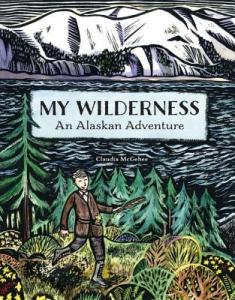
My Wilderness: An Alaskan Adventure by Claudia McGehee

This nonfiction picture book tells the story of Rocky and his father, painter Rockwell Kent, who spent a winter in 1918-1919 on Fox Island, just off the coast of Alaska. Rocky was nine years old at the time. He and his father repaired an old shed and turned it into their cabin. While his father spent time painting, Rocky drew a bit and explored the island a lot. He saw wildlife in the woods, collected shells and stones and the beach. Evenings were spent in the cabin, eating dinner and sharing stories. When the winter came, days filled with different activities like taking snow baths, making snow houses. They took trips to a larger island in their dory, rowing when the weather was good. They faced one large storm when returning home, barely making it to land. All too soon, their time in the wilderness was done. It was a time that Rocky always felt was the best in his life.

McGehee takes readers along on an epic journey to Alaska. The mountains are huge, the water freezing, the woods thick and the animals are everywhere. Told from the point of view of Rocky, the book allows young readers to see Alaska through his eyes and marvel along with him at the wonder of nature. As he walks the woods and explores the shore, he dreams that there may be monsters or pirates around, but looking again he always sees something that fits into the natural scene. The days are filled with exploration and evenings spent together, one gets the sense that there was more than enough adventure to fill their days.

The illustrations are done on scratchboard giving the feel almost of woodcut prints on the page. The result is a very organic feel with thick lines and an interplay of bright colors and deep black. The more natural feel works very well with this Alaskan subject matter, creating an old fashioned feel that enhances the book as well. McGehee captures nature with an ease that makes one want to enter the deep green woods alongside Rocky.

Explore the Alaskan wilderness in all of its wonder in this historical picture book. Appropriate for ages 5-7.

Reviewed from library copy.

Review: Piper Green and the Fairy Tree by Ellen Potter

Piper Green and the Fairy Tree by Ellen Potter

Piper Green and the Fairy Tree by Ellen Potter, illustrated by Qin Leng (InfoSoup)

Released August 4, 2015

Piper is heading off to her first day of second grade. She looks forward to much of it, from riding the boat to school from the tiny island where they live to the donuts and other treats they get each morning on the way. But she is also desperately missing her older brother Erik. So she puts on his earmuffs and refuses to take them off. She’s sure that her teacher will understand, however when she gets to school she has a new teacher who looks like a princess but can also be awfully grumpy about things like earmuffs. The next day, after promising everyone that she would take the earmuffs  off when she got to school, Piper decides that it’s best not to go. Unfortunately, sirens go off and she is stuck up in a tree waiting for everything to calm down. Everything is getting worse and worse until Piper discovers the treasure in the fairy tree outside her house.

Potter writes consistently wonderful books no matter what age she is writing for, so it should be no surprise that she also excels at writing for elementary-aged children. These simple chapter books offer a charming mix of reality and a dash of magic in the form of the fairy tree and the treasure it offers. In Piper, Potter has created a great girl character who is determined and wonderfully creative in the way she solves problems. This of course is what lands her in all kids of trouble, much to the delight of the reader.

Leng’s illustrations are simple and friendly. They capture both the dynamic Piper and her family as well as the unique island they live on. The adult characters too are wonderfully warm and human. I particularly enjoy the neighbor Mrs. Pennypocket in her overalls and her boots, the one who introduces Piper to the magic tree.

A strong new series for elementary-aged kids, this book and the second book in the series will be enjoyed by fans of Clementine and Judy Moody.

Reviewed from digital galley received from Knopf Books for Young Readers and Edelweiss.

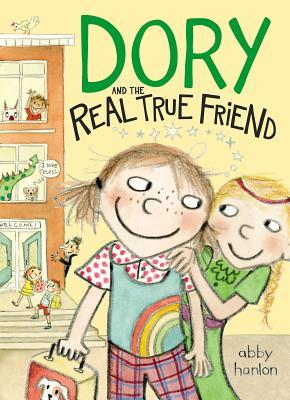
Review: Dory and the Real True Friend by Abby Hanlon

Dory and the Real True Friend
This is the second book featuring Dory, better known as Rascal by her family. In this book, Dory is headed to school. Her older siblings insist that she leave her best friend, Mary, who happens to be a monster that only Dory can see, at home. Dory agrees, since Mary had caused so much trouble at school the year before. Dory is going to try instead to be a regular girl and not get into trouble, but that’s not very easy when a new adventure comes her way. She also meets a girl in her class who appears to be a princess and talks about the castle she lives in and her pet dragon. Her siblings don’t believe that Rosabelle isn’t imaginary though. As Dory figures out that this may be a new real friend, thanks to their shared huge imaginations, she may also need help rescuing Mr. Nuggy, her fairy godmother, from the clutches of Mrs. Gobble Gracker.
I adored the first book in this series thanks to its embracing of a character who is wonderfully quirky and entirely unique. Dory is a girl with a huge imagination and also one who does not bow to social conventions easily. From wearing her nightgown all of the time at home to packing salami for lunch and then eating it like cookies, Dory does what makes her happy and doesn’t care for what others think. That is tested when she tries to befriend Rosabelle and while Dory works to make friends she still doesn’t change herself for it. Instead the two create a great synergy of imaginative play together where fairy godmothers with beards, evil sharp toothed women, dragons, monsters, and knights fight an amazing battle.
The illustrations are in the same style as the first book, drawn as if Dory herself was doing them as she tells her story. The entire book bursts with energy and funny moments. I particularly enjoyed seeing favorite characters from the first book return and the consistency of Dory’s imaginative play. While Dory may be entering a new year in school, all of the wild characters she invented in the first book are back in the second.
Fans of the first book will love this second one. Dory is exactly who I’d love as a friend! Appropriate for ages 6-8.
Reviewed from copy received from Dial Books.

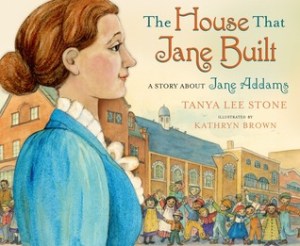
Review: The House That Jane Built by Tanya Lee Stone

House That Jane Built by Tanya Lee Stone

The House That Jane Built: A Story about Jane Addams by Tanya Lee Stone, illustrated by Kathryn Brown

Jane Addams was a girl born into comfort and wealth, but even as a child she noticed that not everyone lived like that. In a time when most women were not educated, Addams went to Seminary. When traveling with her friends in Europe she saw real poverty and then also saw a unique solution in London that she brought home with her. In Chicago, she started the first settlement house, a huge house that worked to help the poor right in the most destitute part of town. Hull House helped the poor find jobs and offered them resources. Addams also created a public bath which helped convince the city that more public baths were needed. She also found a way to have children play safely by creating the first public playground. Children were often home alone as their parents worked long hours, so she created before and after school programs for them to attend and even had evening classes for older students who had to work during the day. By the 1920s, Hull House as serving 9000 people a week! It had grown to several buildings and was the precursor to community centers.

Jane Addams was a remarkable woman. While this picture book biography looks specifically at Hull House, she also was active in the peace movement and labeled by the FBI as “the most dangerous woman in America.” In 1931, she became the first American woman to win the Nobel Peace Prize. She wrote hundreds of articles and eleven books, she worked for women’s suffrage, and was a founding member of both the ACLU and the NAACP. At the turn of the century she was one of the most famous women in the world. The beauty of her story is that she saw a need and met it with her own tenacity and resources. She asked others to contribute, but did not step back and just fund the efforts, instead keeping on working and living right in that part of Chicago. Her story is a message of hope and a tale of a life well lived in service to others.

Brown’s illustrations depict the neighborhood around Hull House in all of its gritty color. Laundry flies in the breeze, litter fills the alleys, and children are in patched clothes and often barefoot. Through both the illustrations and the text, readers will see the kindness of Jane Addams shining on the page. Her gentleness shows as does her determination to make a difference.

This biography is a glimpse of an incredible woman whose legacy lives on in the United States and will serve as inspiration for those children looking to make a difference in the world around them. Appropriate for ages 6-9.

Reviewed from copy received from Henry Holt and Co.

Review: George by Alex Gino

George by Alex Gino

George by Alex Gino

Released August 25, 2015.

George was born with the body of a boy but knows that she is really a girl. Her fourth grade classroom is doing a production of Charlotte’s Web and George wants to be Charlotte more than anything. But when she tries out for Charlotte instead of a boy’s part, George’s teacher stops her. George is offered the role of Wilbur, but that is not the character she wants to be since she’s not a boy! As George struggles with the bullies in her class, she also finds allies who embrace her gender. Once her best friend knows about her being transgender, she and George come up with a plan that will let George appear on stage as Charlotte after all. It will also let everyone know exactly who she is.

This book is so crucial. As the mother of a transgender teen, I know that she considered herself a girl from a very young age. Books like this will help young transgender children start to figure out what they are feeling inside and realize that they are not alone. The book focuses on a fourth grader, but trans children of all elementary ages will love this look at their struggles. I also must admit that I cried on page one. Gino does something I have not seen in other books about trans kids. He uses George’s given name combined with the gender pronouns she identifies with. That alone is so powerful and so important and so poignant. Another important moment comes later in the book when George’s best friend is helping her dress as a girl for the first time in public. Gino changes George’s name to her chosen female one once that happens. Another subtle but powerful statement about identity.

George herself is a beautiful protagonist. She represents so much of the struggle of trans kids and yet her own youth doesn’t get lost in the message. George is resilient, funny, and strong. I love the process of George’s mother in coming to terms with her daughter being transgender. It is so real, the denial, the rejection, and eventually the acceptance and importantly, looking for additional help. I also appreciated the school principal being the one who understands trans issues and offers a haven for George in the future. Another important piece in supporting trans kids in our communities.

Important and life-saving for some children, this book demonstrates the acceptance that trans kids need and the power of family and friendship. Appropriate for ages 8-11.

Reviewed from ARC received from Scholastic Press.

Review: The Curious World of Calpurnia Tate by Jacqueline Kelly

Curious World of Calpurnia Tate by Jacqueline Kelly

The Curious World of Calpurnia Tate by Jacqueline Kelly (InfoSoup)

Callie returns in triumphant fashion in this second Calpurnia Tate book following the Newbery Honor-winning first novel. Calpurnia continues to study science and nature at her grandfather’s side. Together they begin to dissect worms and insects, moving upwards towards vertebrates. Callie develops several scientific devices to measure latitude and barometric pressure. When the barometric pressure drops seriously low and an unusual gull shows up in the yard, Granddaddy heads to the telegraph office to sound the alarm for coastal areas, but there is little to do in places like Galveston Texas where tens of thousands of lives are lost. Meanwhile, Callie’s brother Travis is continuing to bring home stray animals like armadillos and raccoon, leaving Callie to help hide the evidence. Their cousin who survived the hurricane in Galveston comes to live with them, moving into Callie’s room and bearing secrets of her own. Through it all, Callie struggles with the expectations for girls around the turn of the century, trying to find a way forward towards education rather than marriage.

Kelly writes of science in a way that will have any reader eager to start looking at the writings of Charles Darwin, reading about health issues of cows and horses, dissecting their own grasshoppers, and heading outside to find the North Star. She turns it all into an adventure, filled with outdoor excursions, smelly animals, and rivers to explore. At the same time, it is also a look at the expectations of a girl from a good family and the difference between her future and that of her brothers. Callie’s struggle with this inequity speaks to her courage and her tenacity, two parts of her character that are evident throughout the book. This dual nature of the novel adds lots of depth to the story, allowing fans of nature and fans or strong heroines a shared novel to rejoice about.

Kelly’s characters are wonderfully well rounded. Callie is not perfect and is far more interesting and human for that. She is not patient, hates to play the piano and sew, and speaks up at times that would be unseemly. At the same time she is wonderfully wild, brazen at times, and heroic at others. She stands by those who support her and thwarts those who oppose her. She cunningly uses people’s self interests to promote her own and is constantly learning from those around her. Even the secondary characters are well drawn and have depth. From Granddaddy to Callie’s mother to her cousin Aggie, all can surprise because they are crafted as full human beings.

This romping novel is a fitting and fabulous follow-up to the first. Appropriate for ages 8-12.

Reviewed from copy received from Henry Holt and Co.

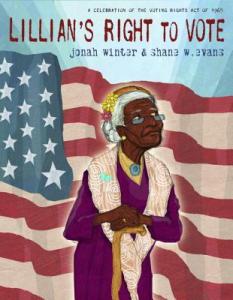
Review: Lillian’s Right to Vote by Jonah Winter

Lillians Right to Vote by Jonah Winter

Lillian’s Right to Vote by Jonah Winter, illustrated by Shane W. Evans (InfoSoup)

This picture book celebrates the 50th anniversary of the Voting Rights Act of 1965. Lillian is a 100-year-old African-American woman who has lived through all of the problems with African Americans voting in the United States. As she climbs the steep hill to her polling place, she remembers all of the steps that led from slavery to being able to openly vote today. She thinks about her great-grandfather who labored as a slave but also lived to see the Civil War come and allow him to vote for the first time.  She remembers her grandfather being charged a poll tax and her uncle being asked unanswerable questions before would be allowed to vote. She remembers running from an angry mob of neighbors who didn’t want women voting. She will never forget the cross burning in their yard. She remembers the people who fought for civil rights, who died for civil rights, who marched for everyone’s rights. She climbs that hill, slowly and steadily, until she reaches her polling place where she can vote without fear of being attacked or turned away.

Winter’s prose is musical and passionate. He draws us all close together and then speaks to us of history and voting and America. He tells us of shameful things that must not be forgotten, of heroes who fell and those who were able to keep marching. He tells us all of our duty in subtle ways that are stirring and moving; that we must vote each and every time, even when it is difficult or there is a steep hill to climb. Winter tells a personal story of voting history in the United States, giving us rich robust story telling rather than dry facts. It is a stirring and noteworthy tale.

Evans’ illustrations are superb. His fine lined illustrations show the determination of Lillian, the horrors of slavery, the dangers of voting, and the courage of many to make changes for the better. His pages swirl with color and texture, fill with sunlight, and dazzle with blue sky. The golden page of the cross burning is disturbing in its vividness, the wash of gold not allowing anywhere to hide.

A gorgeous story accompanied by equally lovely illustrations, this historical picture book is one that should be embraced by elementary teachers during any national election. Appropriate for ages 7-10.

Reviewed from digital galley received from Schwartz & Wade and Edelweiss.

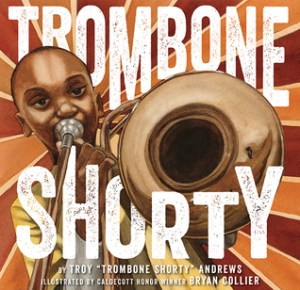
Review: Trombone Shorty by Troy Andrews

Trombone Shorty by Troy Andrews

Trombone Shorty by Troy Andrews, illustrated by Bryan Collier

This autobiographical picture book is about a young boy growing up in the Tremé neighborhood in New Orleans where music was a simple part of everyday life and was always in the air. Tony particularly loved the music and energy of Mardi Gras where he could see brass bands play every day. Troy first played an imaginary instrument and then found a broken trombone that didn’t sound perfect but at least it was something he could play. Troy started to teach himself to play the trombone, an instrument that was almost as tall as he was, which is how he got the nickname of Trombone Shorty. He even slept with his horn in his hands. When Troy gains the attention of Bo Diddley for his playing in the crowd at his concert, Trombone Shorty knows it’s time to form his own band. And he still has his own band today!

Andrews is a Grammy-nominated trombone player and runs the Trombone Shorty Foundation committed to preserving the musical heritage of New Orleans. Andrews writes like a master on these pages which read like music is in the air between them too, just like the air in New Orleans. He shows children how an inspiration to play an instrument can become a lifelong calling. He also shows exactly how music empowers people in a place, gives them strength, creates a united culture, and unifies them. It’s a narrative about the power of music.

Collier’s illustrations are strong and dynamic. He creates motion on the page with his collage illustrations with patterns and textures that weave together. His paintings are a zingy mix of softly rendered closeups filled with detail and personality and then images of people farther away that are rougher but add even more energy to the art.

An inspiring picture book filled with music and vivaciousness, this autobiography celebrates New Orleans and the music in its veins and in one boy specifically. Appropriate for ages 7-10.

Reviewed from copy received from Abrams.

Review: Changes by Charlotte Zolotow

Changes by Charlotte Zolotow

Changes: A Child’s First Poetry Collection by Charlotte Zolotow, illustrated by Tiphanie Beeke (InfoSoup)

Celebrate the changing of the seasons with this collection of poetry from master children’s poet, Charlotte Zolotow. The 28 poems move from the joy of the change from one season to the next and then start with a focus on spring. The poems speak of the joy of spring breezes, snow melting, rainfall, violets, and green grass. Summer poems shine with sun, seaside sand, lights at night, and the buzz of insects. Autumn comes next with the joy of fallen leaves, classrooms, firelight, and Halloween. The book finishes with winter and its snow and ice that dazzle in their own way.

The poems here create a whole, a deep look not only at the seasons but also in the power of connecting with nature throughout the year. Zolotow’s mastery shows in each one, her ability to look closely at a small thing, find the immense beauty in it, speak to that and then create a universal experience in words on the page. Everyone will respond to these poems, as they capture those moments in time where we can all connect with nature and with one another.

The illustrations frame each poem, and capture the natural hues of each season. Spring is filled with the brightness of the flowers and grass. Summer is yellow and bright with the sun. Autumn turns golden and orange while winter is blues and whites. There are just enough details to invite readers into the poems and allow the words to really be the focus of the book.

A gorgeous addition to children’s poetry collections, this is one to get into teacher’s hands so they can start using it immediately. Appropriate for ages 4-7.

Reviewed from library copy.