Review: Ophelia and the Marvelous Boy by Karen Foxlee

ophelia and the marvelous boy

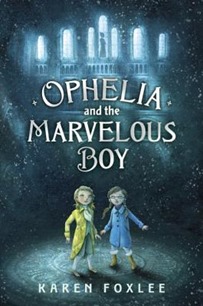
Ophelia and the Marvelous Boy by Karen Foxlee

Released January 28, 2014.

Ophelia knows that everything worth knowing can be proven with science.  Her father is an expert in swords and is helping a museum set up an exhibit.  She and her older sister Alice come along, the entire family still aching with the loss of Ophelia and Alice’s mother.  As Ophelia wanders the museum in the city where it always snows, she discovers all sorts of amazing things.   But by far the most interesting thing she discovers is a boy locked behind a door.  He is a prisoner who claims to have lived for centuries though he looks like a boy.  And he believes that Ophelia is the person who can save him.  So Ophelia starts to help, and along the way, she has to give in to the magic that is around her and discover her own bravery.

A large part of the pleasure of this book is discovering all of the twists and turns of the plot.  This retelling of the Snow Queen fairy tale takes an entirely new approach to the story.  Foxlee has created a novel that is filled with frightening creatures, dangerous situations, and daring feats.  She has incorporated a clock that is counting down to the day that the Snow Queen can finally kill the marvelous boy, so that alone creates a great deal of time pressure.  Yet Ophelia is also struggling to keep her family happy and not concerned with her.  As the book goes on, the tension is tangible on each page.

Ophelia is a wonderful young protagonist.  While she does believe in science and fights against believing in magic, she is also on the adventure of a lifetime.  Her mother was a novelist and serves as the voice of courage in her head.  Ophelia has a great mix of deep courage and vulnerability.  Readers will figure out who the Snow Queen is long before Ophelia does, something that Foxlee uses to continue to crank up the tension.

Magical, frightening and beautifully written, this book is pure warmth and friendship in the face of icy brutality.  Appropriate for ages 9-12.

Reviewed from digital galley received from Edelweiss.

God Got a Dog by Cynthia Rylant

god got a dog

God Got a Dog by Cynthia Rylant, illustrated by Marla Frazee

Taken from Rylant’s previous book of poetry, God Went to Beauty School, this smaller collection is completely disarming and dazzling.  Repackaged for a younger audience, this book celebrates God in a wonderfully homely and down-to-earth way that manages at the same time to make Him/Her all the more wondrous.  In a series of poems, God goes to beauty school because he loves hands so much.  She goes for a ride in a boat for the first time and gets an entirely new perspective on water.  He goes to the doctor.  She tries out a desk job for awhile.  He visits India.  She writes a book.  They are small moments, small things to do, but in the end they are all profound and beautiful.

As someone who is trying to slow down and enjoy the small things in life, this book truly speaks to me.  It is about God himself doing exactly the same thing.  Rylant injects each of the poems with a lovely quiet humor and a softness that enriches each moment.  Her poems are completely relatable, understandable by elementary children but also deep enough to be appreciated by adults.

Frazee was the ideal person to illustrate this book.  With her soft colors and natural humor, Frazee captures these moments in God’s day.  Each is beautifully set up, but also simple and honest.  They are singular but also create a lovely whole.

Smart, funny and above all kind and radiant, this book will make a great holiday gift for all ages as well as a wonderful way to start talking about spirituality.  Appropriate for all ages.

Reviewed from library copy.

Review: The Tree Lady by H. Joseph Hopkins

tree lady

The Tree Lady by H. Joseph Hopkins, illustrated by Jill McElmurry

Kate Sessions is the woman who made San Diego into the green city that it is today.  She was a pioneering female scientist who grew up in the forests of Northern California.  After becoming the first woman to graduate with a degree in science from the University of California, she moved to San Diego to be a teacher.  San Diego was a desert town with almost no trees at all.  So Kate decided to change all of that and began to hunt for trees that survive and thrive in a desert.  Soon trees were being planted all over San Diego, but that was not enough for Kate who then worked to fill entire parks with her trees and gardens.  Kate Sessions was a remarkable woman who helped San Diego become the great city it is today.

Hopkins takes a playful approach to this picture book biography.  From the beginning he uses a format that ends each new event in Kate Session’s life with “But Kate did.”  Not only does this create a strong structure for the story, but it shows Session’s determination to not be swayed by what others thought was possible.  From the beginning, she was a unique person with a unique vision.  It is that vision and her strength in the face of societal opposition that made her so successful.

McElmurry’s illustrations add a beauty to the book.  She captures the lush green of the California forests and then allows readers to experience the transformation of San Diego from a barren desert to the lush green of Session’s many trees.  She also shows all of the hard work that it took to make that transformation possible.

Sessions will be a newly found historical figure for most of us, and what an inspiration she is!  Appropriate for ages 4-6.

Reviewed from copy received from Beach Lane Books.

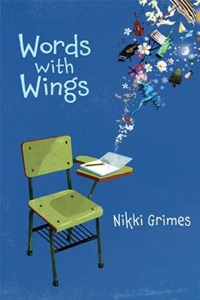
Review: Words with Wings by Nikki Grimes

words with wings

Words with Wings by Nikki Grimes

Gabby has always been a daydreamer, but when her parents started fighting and then separated, she started retreating into her daydreams more and more.  Now Gabby lives with just her mother, who is not a daydreaming type at all.  So the two of them clash.  Gabby also gets in trouble at school due to her dreamy ways and not paying attention to what is happening in class.  But along the way, readers will see that Gabby is much more than a daydreamer, she is a poet.  Eventually, her mother will come to terms with her way of thinking and she will find that she has a teacher who not only supports Gabby’s daydreaming but makes it part of his curriculum. 

Grimes writes in short free verse, some of the poems only a handful of lines long.  Yet because these are poems written by a master poet, they each speak truth.  There are poems that talk about moving and autumn, others that celebrate family members, and at the heart of the book are the many poems that celebrate dreaming, lingering and Gabby herself.  Grimes was clearly the sort of child who also daydreamed, since she captures it so well. 

I deeply appreciate that this book does not “fix” Gabby’s daydreaming.  Instead it is the adults who adopt a new attitude towards her once they realize that she is thinking and processing and writing in her head.  Gabby is expected to change some of her behaviors in class and is supported in doing this by a very engaged and kind teacher who promises that she will have time to dream and to record those dreams she has.  Gabby is the sort of heroine that one loves immediately, and she is also one that readers will cheer to see succeeding on her own terms.

Beautiful and strong poems support a world where imagination and creativity is accepted and poets survive their childhood intact.  Appropriate for ages 9-12.

Reviewed from library copy.

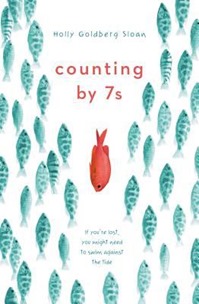
Review: Counting by 7s by Holly Goldberg Sloan

counting by 7s

Counting by 7s by Holly Goldberg Sloan

Willow Chance didn’t fit in well at her elementary school, so she is attending a middle school across town which none of her previous classmates will be attending.  But Willow is just not made to fit in with others.  She does fine with her adoptive parents who are accepting of her obsession with gardening and medical conditions as long as she doesn’t tell them everything since that would make them worry.  And one of the things she doesn’t tell them is that the middle school thinks that she cheated on a major standardized test because she got a perfect score.  So she is sent to counseling though Dell, the school counselor has no idea what to do to help her.  Two siblings who also go to see Dell have their own ideas though and that is how Willow comes to be out driving with Dell and the others when she finds out that her parents have been killed in a car accident.  Now Willow has lost her parents, her home, her garden and her will to explore.  This is a story that is about community, building your family one person at a time, and the wonder of what having people in your life that care can do.  It is the story of the amazing Willow Chase.

Sloan’s writing verges on verse at times with its short lines, lined up neatly and speaking profoundly and honestly.  It is writing that examines and explores but also moves the story forward at speed.  It is imminently readable with plenty of white space and few if any dense paragraphs of text.  Rather it has a wonderful lightness about it, even when describing tragedy.  And this book is filled with loss and grief that is handled with a gentle depth.  Yet it is also a book filled with joy and overcoming odds and inspiration. 

Sloan creates not just one incredible character in this novel but an entire group of them.  At first the book seems disjointed with the various perspectives shown, since we get to see things not only from Willow’s point of view, from the other teens, but also from the adults as well.  But those disparate parts come together in a way that a book from just Willow’s point of view never could have.  They add an understanding of Willow’s appeal to others that would not have been possible without it.

This is a tragic story with an indomitable heroine that will leave you smiling through the tears.  Appropriate for ages 9-12.

Reviewed from library copy.

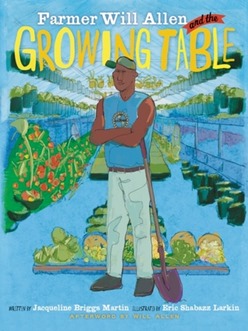
Review: Farmer Will Allen and the Growing Table by Jacqueline Briggs Martin

farmer will allen

Farmer Will Allen and the Growing Table by Jacqueline Briggs Martin, illustrated by Eric-Shabazz Larkin

Will Allen is a farmer who can see the potential where others can’t.  When he sees a vacant lot, he sees a farm with enough to feed everyone.  When he was a boy, he grew up helping care for a large garden that kept their family fed.  But Allen did not want to spend his life weeding and digging in the dirt, so he decided to become a basketball player, and he did.  But then living in Milwaukee, he saw empty greenhouses standing vacant and realized that he could feed people who had never eaten a fresh vegetable.  First though, he had to clear the land and then figure out how to improve his soil so that something could grow there.  That was the first time that the neighborhood kids helped out, bringing compost items to feed the worms.  Slowly and steadily, a community garden emerged and Will Allen taught others to be farmers too.  His Milwaukee farm now gets 20,000 visitors a year so that others can learn to grow gardens where there had only been concrete. 

I had seen the documentary, Fresh that includes Will Allen as part of the film about new thinking about food.  So I was eager to see a picture book about this inspiring figure.  It did not disappoint.  Martin captures the natural progression of Allen’s life from child eating from the garden to farmer giving other children that same experience and spreading the word about what is possible in an urban setting.  Martin’s tone throughout has a sense of celebration of Allen and his accomplishments.  She captures his own inherent enthusiasm on the page.

Larkin’s illustrations are striking.  Each could be a poster for farming and urban gardens on their own.  Combined into a book, they become a celebration of this large man with an even larger dream.  The colors are bright, the textures interesting and the image backgrounds evoke farming and nature.

This picture book biography is a visual feast that invites everyone to its community table.  Librarians and teachers in Wisconsin should be particularly interested in adding this to their collection, but it will hold interest in urban and farming areas across the country.  Appropriate for ages 6-9.

Reviewed from copy received from Readers to Eaters.

Review: Year of the Jungle by Suzanne Collins

year of the jungle

Year of the Jungle by Suzanne Collins, illustrated by James Proimos

Collins, author of The Hunger Games series, takes on a completely different writing challenge in this autobiographical picture book.  Suzy’s father is sent to fight in Vietnam when she is a little girl.  He will be gone for a year, but Suzy isn’t sure exactly how long a year is.  At first, her father sends lots of friendly postcards, but over time they change.  He even mixes up her birthday with her sister’s something he would never have done if he was home.  The the postcards stop altogether and Suzy catches a glimpse of the war on TV.  She starts to forget what her father looks like and is scared of many things.  Then suddenly, her father is home.  But he doesn’t look the same and doesn’t act quite the same either.

This book is so timely for children dealing with deployments in their own family.  Collins writes directly from her childhood persona, delving right into the fears that haunt children, the loss of control and the lack of contact.  It is her writing that makes this book work, her honesty about her emotions and the frankness with which she grapples with the challenges of having a parent fighting overseas.

Proimos’ illustrations are cartoony and rough.  The most successful are double-spreads that take on Suzy’s fears directly, placing them on a black landscape that is filled with tanks, animals, helicopters, and more.  They emanate danger and contrast directly with the more colorful other pages.

Though the book is about Vietnam, it has a universal message for children left behind worried about a deployed parent.  Timely and honest, this is a book that belongs in every public library.  Appropriate for ages 6-9.

Reviewed from copy received from Scholastic Press.

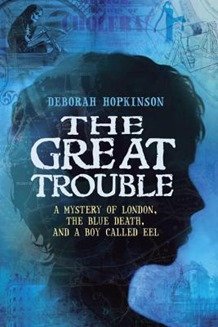
Review: The Great Trouble by Deborah Hopkinson

great trouble

The Great Trouble: A Mystery of London, the Blue Death, and a Boy Called Eel by Deborah Hopkinson

Things have been a lot worse for Eel in the past, he now has a place off of the streets where he can sleep safely and he only goes to the River Thames to dig for things to sell to make ends meet.  He has serious responsibilities that he keeps entirely private.  It helps that he faked his own death to get Fisheye Bill Tyler off of his trail.  But Eel still keeps his street smarts and listens, so he knows that Fisheye is back after him.  Then in the summer of 1854, his entire world turns upside down and the Great Trouble begins as the Blue Death of cholera comes right into his neighborhood in London.  Everyone knows that it is spread through the air, but one doctor, that Eel does small chores for, thinks differently.  Now it is up to Eel to help the doctor prove that it is the water that carries the disease before hundreds more die.

Celebrating the visionary Dr. John Snow on the 200th anniversary of his birth, this book successfully mixes historical fact with historical fiction resulting in a dynamic book with engaging characters.  At the outset of the book, Hopkinson takes care to make sure that readers understand what living in poverty and parentless was like in Victorian England.  She shows the filth, the danger, the loneliness and the skill that it took to survive. 

Eel is a wonderful protagonist.  He is incredibly smart, driven to help those he cares for, and a mixture of brave and desperate, something that keeps him at the center of this medical mystery.  Hopkinson does a great job of keeping all of her characters true to the time period, offering no modern sensibilities into the equation, but presenting it just as it would have been. 

This is a dark and thrilling novel that will not let you escape until the epidemic is over and the mystery solved.  Appropriate for ages 9-12.

Reviewed from copy received from Random House Children’s Books.

Review: Parrots Over Puerto Rico by Susan L. Roth

parrots over puerto rico

Parrots Over Puerto Rico by Susan L. Roth and Cindy Trumbore

This exceptional nonfiction picture book tells the story of the Puerto Rican parrot.  It is a bird that has flown over Puerto Rico for millions of years but almost became extinct in the 1960s.  The book tells of the changes that came to Puerto Rico and its environment thanks to settlers, wars, hunting, and foreign invasive species.  Forests began to disappear too, so the parrots were limited to living in just one place.  By 1967, only 24 parrots lived in Puerto Rico.  With them almost extinct, people started trying to save the parrots.  The book tells the story of rescued parrots, storms and the dedicated scientists who figured out how to save this species from disappearing entirely.

Roth and Trumbore tell this story deftly.  They focus on what was almost lost, a sky crowded with these blue and green birds.  The book explores the history of Puerto Rico, tying it closely and innately into the story of the parrots themselves.  The entire book is fascinating and becomes even more compelling when the story turns to the rescue efforts.  Small victories such as saving a young parrot’s wings are celebrated, while the larger effort is also looked at in detail. 

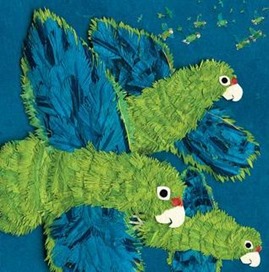
Roth’s collages are exquisite.  She captures the beauty of the birds, as you can see from the cover image above, but also the beauty of Puerto Rico itself with all of its lush greens.  The book is beautifully designed as well.

A dazzling nonfiction book that will be welcome in classroom discussions and units about conservation and environment.  Appropriate for ages 7-9.

Reviewed from digital copy received from Lee & Low and Edelweiss.