Review: Where Do We Go When We Disappear? by Isabel Minhos Martins

where do we go when we disappear

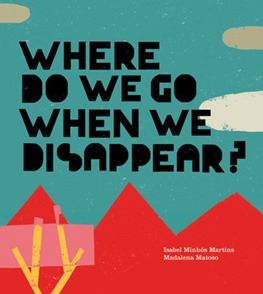
Where Do We Go When We Disappear? by Isabel Minhos Martins and Madalena Matoso

I recently reviewed My Neighbor Is a Dog, another new book by this author and illustrator duo.  In this book, the question of where people and things go when they disappear is explored thoroughly.  The result is a book that asks big questions and attempts to answer them or at least provide a framework to answer them.  The book begins with people disappearing and the idea that you must be missed in order to disappear, so disappearing takes two.  Then it moves on to other things that disappear like sunshine and clouds, socks and puddles, snow and noise.  It ends with the fact that everything disappears, even the most solid things like rocks over time will disappear. 

Translated from the Portuguese original, this book is thought provoking and fascinating.  Martins manages to right a book about big questions that answers them in a way that is exploratory and insightful and doesn’t turn quickly to a religious answer.  Instead she stays in the questioning place, allowing different ideas to surface and be discussed.  She does not provide any easy answers, meeting children right where they want the discussion to stay, where it leads to more and more questions.

Matoso’s illustrations are vibrantly colored and filled with strong shapes.  They appear to be block printed which adds to the organic feel.  She uses negative space brilliantly.  One example is her snow image with the background white and the flakes cut out circles that merge directly into the white and stand out against the other bright objects.

Challenging, thought-provoking and a book that will inspire discussion and help children find their own answers.  Appropriate for ages 5-7.

Reviewed from library copy.
Review: Fortunately, the Milk by Neil Gaiman

fortunately the milk

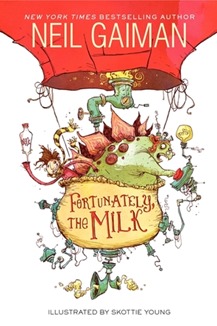
Fortunately, the Milk by Neil Gaiman, illustrated by Skottie Young

When Mum left to give a presentation on lizards, she made sure that Dad knew just what he had to do.  One item on the list was getting milk, but that didn’t happen.  So when the family woke to dry cereal and no milk for tea, Dad headed out to get the milk.  He didn’t return for a long, long time.  But when he came back he had quite a story about why he was late.  It involved time travel, a brilliant dinosaur, pirates who don’t have a plank to walk, wumpires with long teeth, and lots and lots of silliness.

Gaiman is a chameleon of an author, keeping us guessing what his next book will be like because one never knows what style he will try next.  Here he is in pure farce mode, something that will enchant young readers even as they can’t read because they are giggling too much.  The humor here is nonstop, one maniac moment after another until you can’t quite tell which way is up.  It’s a grand adventure filled with outright one-liners and puns.

Young’s illustrations are such a part of this book, it is like Gaiman illustrated it himself.  The results are wacky and purely funny.  The father character seems to me to be a marvelous mix of several Dr. Who characters with his dangling striped scarf, wild hair and rather dapper approach to things. 

Hilarious, wacky and wonderful, get this into the hands of elementary aged kids now.  Appropriate for ages 6-8.

Reviewed from library copy.

Review: Volcano Rising by Elizabeth Rusch

volcano rising

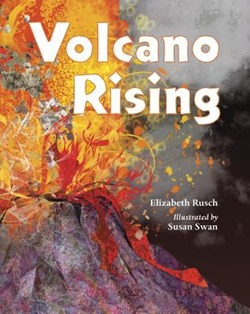
Volcano Rising by Elizabeth Rusch, illustrated by Susan Swan

Volcanoes can seem destructive, but in this nonfiction picture book they are shown to be sources of creation as well.  The process of eruption and magma is described and the book looks at the fact that different volcanoes move at different speeds.  The book is written in two levels, one for more of a picture book audience and the other for elementary students ready for detailed information.  While the simpler part stays general, the more detailed information includes specific volcanoes and stories of their eruptions.  The book makes volcanoes interesting rather than frightening, looking at how ash restores fields and how most creative eruptions can be out-walked by people.

Rusch’s two levels of text really stand apart from one another.  The simpler version really reads as a playful picture book complete with sounds.  It does still offer facts and information, but the deeper text is filled with those.  That longer text loses the playfulness of the shorter but is a wealth of information on volcanoes that even young enthusiasts will find fascinating.

Swan’s illustrations are done in cut paper and have a vivid color that really makes the volcanoes pop.  She shows various volcanoes in her art, contrasting them with one another nicely.  It is the images of eruptions that really explode on the page and will delight readers.

A double-layered book that can be shared in a storytime or in a science classroom.  Appropriate for ages 3-8.

Reviewed from copy received from Charlesbridge.

Review: Electrical Wizard by Elizabeth Rusch

electrical wizard

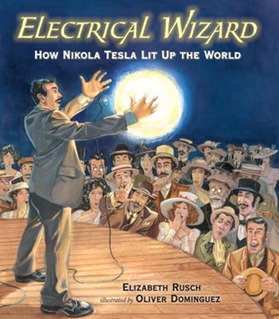
Electrical Wizard: How Nikola Tesla Lit Up the World by Elizabeth Rusch, illustrated by Oliver Dominguez

Nikola Tesla was born in Serbia during a lightning storm, something that would portend his future interest in electricity.  At a young age, Tesla became fascinated by the invisible energy everywhere around him, in the water, the wind and the insect that flew.  In college Tesla grew interested in alternating current though his professor thought it was impossible.  Tesla studied and invented and eventually figured out how to make alternating current work, but he needed help.  He headed to America to meet with Thomas Edison, someone he knew would be interested.  But Edison was not, insisting that direct current was the only electricity he would work with.  Soon Tesla and Edison were rivals in the “war of the currents.”  This first picture book biography will introduce young readers to one of the great scientific inventors of all time and his greatest rival too.

Rusch tells the compelling story of Tesla and his inventions.  She shows Tesla as a complicated person, eager to pursue his own ideas and willing to stand up for them in the face of great opposition.  She also tells the story of the rivalry of the two men in a very engaging way and Tesla’s ultimate victory and how he reached it.  Her writing is engaging, detailed and impressive.

Dominguez’s illustrations are filled with period details that help ground this picture book directly in the time in which it is set.  Scientific instruments are often in the forefront of the images, showing their structures in detail.  This is a true celebration of the science of invention.

An electric read, this book shines light on a great man.  Appropriate for ages 7-9.

Reviewed from copy received from Candlewick Press.

Review: The Real Boy by Anne Ursu

real boy

The Real Boy by Anne Ursu

The author of Breadcrumbs has returned with another beautiful fairy tale.  Oscar was taken in by the last known magician, Master Caleb, and in return works for him as his hand.  That means that Oscar manages the harvesting and preparation of the many herbs and plants Master Caleb uses in his magic.  Oscar is very happy with his life below the shop, accompanied only by the cats that live there too.  The only problem is Wolf, Master Caleb’s apprentice, who brutally teases Oscar any chance he gets.  But the world around Oscar is quickly changing.  The Barrow, the forest of ancient wizard wood trees that encircles the city, has also begun to be affected.  It may be that the very magic itself is changing too. 

Ursu weaves such beauty into her books.  She lingers over small things, taking the time to build a world in which her characters live.  One examples of this is her description of the Barrow early in the book:

The trees had magic in their leaves, their berries, and their bark.  Plants and shrubs and flowers grew everywhere; purplish-greenish moss crawled on the rocks; improbable mushrooms sprang from the soil in tiny little groves of their own.

The entire book is infused with a sense of rich detail and layering.  Oscar’s own small world below stairs is just as lovingly described and detailed until one longs to be the hand of a magician too and have cats for friends.

Oscar himself is an amazing character.  Because the book is told from his point of view, readers will understand him easily, but Oscar struggles with human beings, emotions and understanding what is meant.  When he is forced out from his snug workspace, the world becomes confusing.  He holds himself stiffly, hates looking people in the eye, and struggles to be social.  Clearly on the autism spectrum, Oscar has unique abilities too, allowing him to see what others do not by paying close attention. 

This amazing fantasy novel is one of the best reads for middle graders this year.  Get your hands on this one!  Appropriate for ages 11-13.

Reviewed from digital galley received from Edelweiss and Walden Pond Press.

Review: Lifetime by Lola M. Schaefer

lifetime

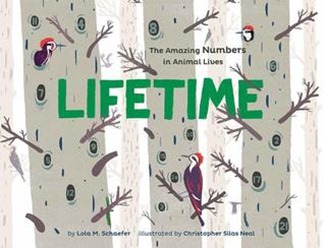
Lifetime: The Amazing Numbers in Animal Lives by Lola M. Schaefer

Take a unique look at what animals will do in a single lifetime in this book that combines counting, math and fascinating scientific facts.  The book focuses on how many times a single animal will do a behavior during their life.  The facts are based on estimations and opens with a description of how the numbers were figured out and explaining that each individual animal will be different than the estimate.  The book opens with one spider’s egg sac, the sole one she will create in a lifetime.  It then goes to the ten antlers that a caribou will grow and shed and moves on by tens.  The book ends with one thousand tiny baby seahorses, the number a single male seahorse will carry and birth. 

This is a spectacular way to introduce averages to children and estimation.  It is a celebration of the information that mathematics can provide to us about nature.  Schaefer has selected a wide variety of animals and intriguing facts about each of them.  Readers can find more in-depth information on the animals at the back of the book.  They will also find more information on averages and math there. 

Schaefer’s art adds to the appeal of this book.  Her illustrations have a boldness to them, a graphic quality that really works.  They are flat and vibrant, clearly laying items on the page for counting.  The book is a joy to page through since each page offers a new animal, a new habitat to see.

One of the most visually stimulating and smart concepts for a nonfiction picture book, this one is sure to beat the averages and be read more than once.  Appropriate for ages 4-6.

Reviewed from copy received from Chronicle Books.

Review: The Misadventures of Salem Hyde by Frank Cammuso

misadventures of salem hyde

The Misadventures of Salem Hyde: Spelling Trouble by Frank Cammuso

This is the first book in an upcoming graphic novel series for children in elementary school.  Salem Hyde is a witch, so sometimes she misunderstands what the other kids at school are talking about.  She insists she is a good speller and goes on to prove it by casting a spell.  Unfortunately, the spell turned a teacher into an enormous dinosaur.  After that, Salem’s family decide that she needs an animal companion.  Salem thinks a unicorn would be perfect, but she gets a cat instead: a cat named Percival J. Whamsford III.  As his name indicates, he has a very different personality than Salem.  Let the fun begin!

Done in black and white illustrations, this graphic novel has the feel of a traditional comic strip rather than a graphic novel.  That is not a complaint, in fact I enjoyed the more Calvin and Hobbes feel to the book with moments that stood on their own and the whole telling a full story.  Cammuso’s art has a traditional vibe to it, one that will have mass appeal.  The humor is slick, funny and age appropriate offering silly moments galore.

A strong beginning to a new series, Salem Hyde should be welcome at all libraries as long as she doesn’t try to “spell.”  Appropriate for ages 7-9.

Reviewed from ARC received from Amulet Books.

Review: This Is the Rope by Jacqueline Woodson

this is the rope

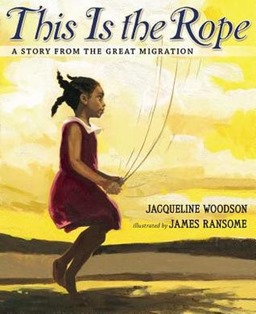
This Is the Rope: A Story from the Great Migration by Jacqueline Woodson, illustrated by James Ransome

Based on Woodson’s own family, this is the story of how one piece of rope serves as a symbol for the changes that came during the Great Migration of African Americans from the rural south to northern cities.  One little girl tells the story of how her grandparents moved to New York City, using the rope to tie their things to the top of the car.  The rope was used to tie up the drying flowers from their window boxes that reminded them of home.  It was used by the little girl’s mother to tug her toys and play jump rope.  It tied her mother’s belongings to another car when she went off to college.  Then it was used for more jump rope with the little girl and in the end to support the banner for their family reunion.  In the end, it was returned to the original grandmother in exchange for a new rope to jump with. 

Woodson adheres to a strict structure in this book that really makes it feel like folklore, connecting it verbally to other histories, other migrations, other families.  Each page begins with “This is the rope…” and then moves on to tell the next thing that the rope was used for in this changing family.  Turning the pages, readers can see the time change and the opportunities progress. 

Ransome’s illustrations are lovely.  His paintings capture light and its movement as well as the family as they change.  Most of them catch those fleeting moments of life, each connected by the symbol of rope.  The result is a rich and warm series of memories.

Beautifully written and illustrated, this book captures a period of time not seen in most picture books and a story of one family’s history.  Appropriate for ages 5-7.

Reviewed from copy received from Nancy Paulsen Books.

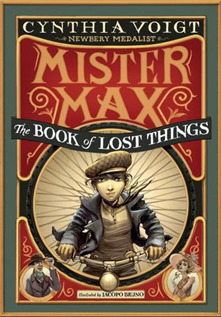
Review: The Book of Lost Things by Cynthia Voigt

book of lost things

The Book of Lost Things by Cynthia Voigt

  Max’s parents who were both well-known actors had been invited to Kashmir, India to start a theater troupe there.  They planned to take Max along with them but then they disappear.  The ship they were meant to take does not exist and they are simply gone.  That left Max with just his grandmother to care for him, but Max knew that if he was well-cared for, his grief would be too much to bear.  Instead he moved back to his family home, across the garden from his grandmother, and had to find a way to earn his keep.  It was through that that he stumbled upon a job at which he was exceptionally good:  being a detective or as Max preferred, a “solutioneer.” 

Set around the turn of the 20th century, this novel has a strong, brisk pace that is invigorating.  Max is a character who is bright, curious and always thinking.  Voigt populates his life with many other interesting characters, including is wonderful librarian grandmother, the various people he helps find solutions for, and even one demanding baby.  The entire book is a vibrant historical fiction that will have great appeal. 

One of my favorite aspects of the novel is the use of painting and creativity as a way to allow your brain space to think and figure things out.  Max is a painter, creating watercolors of the sky during different seasons.  It is this artistic outlet that is a big key to his success and creative thinking.  Voigt ties the two together clearly and also gives other characters creative outlets that make them even more well-rounded.

The first book in a new series, this book is a delight of mysteries, solutions, theater and historical fiction.  Appropriate for ages 10-12.

Reviewed from ARC received from Knopf Books for Young Readers.