Review: The Mouse with the Question Mark Tail by Richard Peck

mouse with the question mark tail

The Mouse with the Question Mark Tail by Richard Peck

I thoroughly enjoyed Peck’s first mouse characters in Secrets at Sea, so I looked forward to meeting more whiskered characters in this new book.  The two books are unrelated except for Peck’s elaborate mouse society which has the same charm as The Borrowers or The Littles.  In this book, we meet a little mouse who really doesn’t even have a name.  He has no idea where he came from, but he is now cared for by his Aunt Marigold who is the Head Needlemouse in the Royal Mews in London.  He is sent to school at the Royal Mews Mouse Academy, where he is quickly bullied by bigger mice.  Finally, he ruins all of his prospects by appearing in front of a human wearing clothing.  Now he has to find his own way, his destiny and his past. 

Peck weaves a fine adventure in this book.  The romp of mishaps and close scrapes make for fun reading as does the mystery of this little mouse’s past.  Add to that the appeal of being near royalty, even speaking directly with Queen Victoria herself, and you have a book where you never know what is going to happen next. 

The writing is skilled and detailed.  Peck offers action enough for any book but also builds a wonderful second, shadow society with the mice too.  There is just enough detail to tantalize and clearly visualize the world, but not so much that the story slows.  In fact, the pacing here is superb.

Fans of Stuart Little and The Borrowers will enjoy discovering life in the Royal Mews and a little nameless mouse with a big destiny.  Appropriate for ages 7-10.

Reviewed from ARC received from Dial.
Review: The Life of Ty: Penguin Problems by Lauren Myracle

life of ty

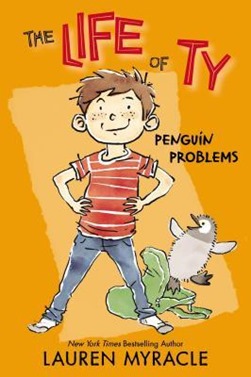
The Life of Ty: Penguin Problems by Lauren Myracle, illustrated by Jed Henry

Ty is seven years old and has a pretty complicated life.  He has a new baby sister who is taking all of his mom’s time and attention.  His older sisters won’t walk him into school like his mom used to, insisting that he can do it all on his own.  His best friend is in the hospital battling cancer, and Ty’s other friends can be confusing and even alarming.  Ty keeps getting into trouble at home for things like chasing the cat with a Dustbuster.  Then on the school trip to the aquarium, Ty takes a baby penguin home with him.  This is one wild boy who is also big hearted and caring, just not sure how best to show it. 

Myracle, who writes teen books primarily, has created a truly exceptional book for younger readers.  Ty is a character who is easily relatable, even when he does some extremely unusual things, like stealing a penguin.  His home life will be familiar to many children, who will have older siblings and babies in their families too.  Add to that the universal feelings of being asked to do big-kid things too early and also being treated like a baby, and you get a book that is universally appealing.

Myracle’s writing has an outstanding humor throughout.  In the more dramatic moments, children will understand that things will be alright in the end.  The black and white illustrations by Henry convey that humor and lightness as well. 

Perfect for both reading aloud and for a child reading on their own, this book will be enjoyed by fans of the Stink series as well as those who like Clementine.  This book would pair well with The Year of Billy Miller by Kevin Henkes.  Appropriate for ages 5-7.

Reviewed from copy received from Dutton.

Review: The Year of Billy Miller by Kevin Henkes

year of billy miller

The Year of Billy Miller by Kevin Henkes

After getting a big lump on his head from a fall during their family vacation, Billy is worried that he’s not going to be smart enough for 2nd grade.  And when he starts 2nd grade, he still has a lump on his head!  The year doesn’t start easily with Billy accidentally insulting his new teacher on the very first day.  He has to figure out how to fix the misunderstanding before she gets the wrong idea about him.  Then Billy’s father who is a stay-at-home dad and an artist is trying to find his next breakthrough in his art.  It is Billy who has to learn how to deal with a grumpy father but along the way he also serves as inspiration for his dad.  When his parents go to his father’s gallery show, Billy tries to stay up all night, keeping his little sister up with him for as long as he can.  Finally, he selects his mother as the person he wants to write a poem about.  But it’s not that easy, since he has to make sure he doesn’t insult anyone with his choice and then has to read his poem aloud in front of an audience.  Along the way, Billy learns a lot about how to act in a family, how to support one another but mostly how to love each other.

Henkes has written a book about a boy that will be perfect for fans of Clementine and Ramona.  Happily, he does not resort to grossness, bodily functions, farting or any of the other plot devices so often used in books about boys.  Here instead we have a real boy, one who makes mistakes but also tries to do what is right for his family.  Broken into chapters that are focused on a single relationship: teacher, father, sister, and mother, this book is welcoming to young readers thanks to its logical structure and clear focus.

The black and white art in the book is done by Henkes.  Unfortunately, the digital galley I read did not include much of the art.  What was in the galley adds much to the book, nicely breaking the text into more manageable parts.

A tip top chapter book, this one is destined to be a classic.  I’d think that sharing it would be a great way to start any 2nd grade school year.  Appropriate for ages 5-7.

Reviewed from digital galley received from Edelweiss and Greenwillow Books.

Review: The Boy Who Loved Math by Deborah Heiligman

boy who loved math

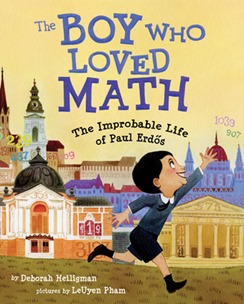
The Boy Who Loved Math: The Improbable Life of Paul Erdos by Deborah Heiligman, illustrated by LeUyen Pham

Paul Erdos grew up loving math from a very young age.  Growing up in Budapest, Hungary, Paul loved to think about numbers.  Unfortunately, he didn’t love school with all of its rules, so he was homeschooled by Fraulein, his nanny, until he went to high school.  Paul grew famous for his math but he still could not take care of himself and do his own laundry, cook his meals or even butter his own bread.  So when at age 21 he was invited to go to England to work on his math, he was worried about whether he could do it.  It turned out that buttering bread was not that difficult and that he would follow his own sort of lifestyle that ignored the rules.  So he traveled and did math around the world, staying with fellow mathematicians and relying on them to take care of him and his laundry and his meals.  He was the furthest thing from a stereotypical solitary mathematician to the point that people now have an “Erdos number” that shows how closely they worked with the amazing mathematician Paul Erdos.

This is such a wonderful biography.  It is a breath of fresh air in so many ways.  First, it plays against the stereotype of introverted and shy mathematicians working in solitude on formulas and instead shows Erdos as a vivacious man who didn’t just work with others, but depended on them.  Second, it shows mathematics as ever changing and new, something that is enticing and exciting.  Heiligman uses a light tone throughout as well as an obvious respect for Erdos’ brilliance and accomplishments. 

The illustrations share the same playful feel of the text.  Done in bold colors and dynamic motion, they have a humor that is welcome as well.  The look on Erdos’ face as he tries to butter his own bread for the first time is priceless and wonderful.  Children will be amazed that such a bright man would struggle with basic tasks.

A pleasure to read, this is an unusual biography that will make a welcome addition to nonfiction shelves.  Appropriate for ages 6-9.

Reviewed from library copy.

Review: Listening for Lucca by Suzanne LaFleur

listening for lucca

Listening for Lucca by Suzanne LaFleur

Siena and her family move to Maine from Brooklyn to help her little brother Lucca.  He doesn’t speak, using only gestures to communicate with them.  Siena isn’t sad to move, since she didn’t have lots of friends to leave behind.  Maine should be a new start for all of them.  When they arrive at their big old house on the beach, the family gets to work fixing it up.  But both Lucca and Siena believe that the house is haunted by a family that used to live there.  Siena finds a pen on a high shelf in her closet that seems to connect her to a young girl who used to live in the house.  She also dreams about the girl’s brother Joshua as he fights in World War II.  The stories of the two families have striking similarities that give Siena the idea that she may be able to not only fix the present but also the past.

I adored this book.  LaFleur tells a story of mystery and ghosts where the past is just as alive and changeable as the present.  Throughout the book has a sweetness and wistfulness to it that makes it a pleasure to read.  I also appreciated the way that Siena has a tie to the past through her collection of lost items.  LaFleur builds her story carefully, so that each element makes an innate sense as it happens.  Beautifully done.

The characters are strongly written.  Siena is a heroine who can be prickly at times, but has the courage and talents to make a difference.  She is an incredible older sister, loving and attentive, but is much more critical of herself.  Her parents and younger brother are just as fully realized in the story.  The friends that Siena makes in town all also have touches that make them whole as people.

This lovely book transcends genres with its mix of mystery, historical fiction, and fantasy.  It’s a winning combination.  Appropriate for ages 9-12.

Reviewed from digital galley received from Edelweiss and Wendy Lamb Books.

Review: Papa’s Mechanical Fish by Candace Fleming

papas mechanical fish

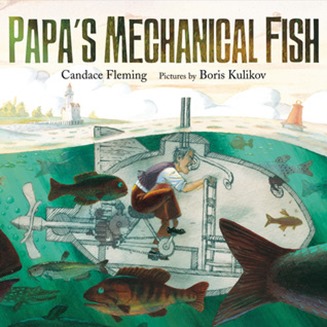
Papa’s Mechanical Fish by Candace Fleming, illustrations by Boris Kulikov

Based on a true story, this picture book reads more like a far-fetched fantasy.  Papa is an inventor but has never made anything that works.  All he needs is one incredible idea, but they don’t come easily.  So the family takes a trip to the lake where one of the children, the narrator of the book, asks what it is like to be a fish.  That gives Papa the incredible idea he was looking for.  The first version of his mechanical fish is so small that Papa himself can barely fit into it.  It almost works.  The second version is bigger and has a fin and a propeller and seats two people.  It almost works.  Whitefish III is even bigger, seats three, and is covered in copper.  It almost works too.  The fourth version is huge, fits the entire family, and…  Well, you just have to read the story to see how it ends.

The whimsy of these inventions is a large part of what makes this book so successful.  From the slow progress of the machines from one version to the next to the joy of seeing them tried out in the story, this is a book where you must find out what happens next.  Fleming has also written a charming story of a family that supports the inventor.  There is a rhythm to the story that makes it a pleasure, each attempt and failure met with similar satisfying responses from his family.  This makes the book work for a larger age range and makes reading it all the more fun.

Kulikov’s illustrations are a mix of realistic illustrations, huge fish that float past as inspiration in the water, and blueprints that let you glimpse the inside of each version of the submarine.  The entire book has a wonderful frantic quality to it, engaging the reader right in the moment of Aha! and then through the different trials. 

A treat of a book, this book will be inspiring to young engineers and inventors.  Appropriate for ages 5-8.

Reviewed from library copy.

Review: Becoming Babe Ruth by Matt Tavares

becoming babe ruth

Becoming Babe Ruth by Matt Tavares

This biographical picture book takes a look at Babe Ruth’s formative years.  It is the story of a small boy named George Herman Ruth who gets into lots of trouble, so much that his father puts him into Saint Mary’s Industrial School for Boys.  There he has to follow the rules and work hard.  Happily, there is also baseball and George gets to play it almost every day.  Best of all, there is Brother Matthias who serves as an inspiration and mentor for George’s baseball game and life.  As George gets better and better, he is finally whisked into the world of major league baseball, but he never forgot the school and the man who got him there. 

Tavares writes in such an engaging way that the pages fly by.  The sudden sternness of the school is told in short, abrupt sentences that enforce the martial feel of the establishment.  That contrasts directly with the long sentences that talk about the beauty of baseball.  Readers can almost feel themselves taking a big gulp of freedom on those pages. 

The joy Tavares feels about his subject is also palpable.  From eating ice cream with the boys from the school, to tipping his hat to them as he walks on the field, to the pleasure of hitting a ball, all are captured with a fondness and pleasure in the paintings that are the illustrations in the book. 

This is a baseball biography that children will find accessible and fascinating.  Play ball!  Appropriate for ages 6-9.

Reviewed from library copy.

Review: The Apprentices by Maile Meloy

apprentices

The Apprentices by Maile Meloy

This sequel to The Apothecary continues the story of Janie, Benjamin and Pip.  It takes place three years after the first book and the three friends are all separated.  Janie is attending a private boarding school in the U.S. and working on a science project to desalinate water quickly and inexpensively.  But the closer she gets to a solution, the more danger she seems to be in.  Benjamin is traveling with his father, the apothecary, in the jungles of Vietnam, helping to heal the wounded in the war.  Benjamin has developed a powder that will allow him to communicate with Janie across the world, but it may reveal more than he is prepared to see.  Pip is now a television star in Britain, living a cushy life of fame.  But he is getting bored, and so is willing to head out to help his friends.  The three young people are up against a force that is ruthless, cruel and determined in this dynamic sequel in a great series.

Meloy writes with a great sense of pacing and plot.  She manages to keep so many different strands of the story active and interesting, allowing the story space to work itself out with a natural feel.  At the same time though, the pacing is tight and controlled, making the book readable and fun.  Her writing is both action packed and also intelligent, there are villains and heroes but they are nuanced and their motivations complex.  All of this creates a great read for fantasy fans.

A fabulous sequel in a very strong series, this series belongs in all public libraries.  Get it into the hands of children who enjoy fantasy mixed with adventure.  Appropriate for ages 10-13.

Reviewed from copy received from Putnam.

Review: The Thing about Luck by Cynthia Kadohata

thing about luck

The Thing about Luck by Cynthia Kadohata

Summer Miyamoto is positive that her family is completely out of luck.  Nothing is going right for them at all.  Her parents had to return to Japan because of a family emergency, leaving her behind with her grandparents and little brother, Jaz.  Now the four of them are heading out to do harvest season for the first time without her parents.  Summer and Jaz have to get all of their homework assignments, so they really don’t have the time off.  Summer is also expected to help her grandmother cook for the others working on the harvest, so she is very busy.  But she isn’t so busy that she doesn’t notice the very cute son of the people they work for or the problems that her brother has making friends.  She is also worried about her grandparents from the pain in her grandmother’s back that incapacitates her at times to the exhaustion that her grandfather seems to be suffering from.  All of this weighs on Summer who just wants the bad luck to end but it may take Summer being something her grandmother would not approve of to save the family in the end. 

Kadohata has created a very compelling story of a family who travels the United States harvesting wheat with giant combines.  She offers just enough details about the machinery and the process for readers to understand it which helps make the work much more understandable.  But this book is far more about this particular family and its dynamics.  The grandparents offer a unique mix of sage advice and confusing world views.  Jaz, the younger brother, is a great example of a very smart child who has almost no social skills.  All of these characters are written as complete people, not ever stereotypical.

Summer herself is equally well drawn.  She is at a confusing time in life in general, being a pre-teen who is starting to notice boys.  That is complicated by her grandmother’s old-fashioned take on boys and girls as well as her own responsibility for her family that puts her in situations that require her to be more adult and less child. 

A beautiful and intense look at a Japanese-American family struggling with an interesting lifestyle and just surviving a year of bad luck.  Appropriate for ages 9-12.

Reviewed from copy received from Atheneum Books for Young Readers.