Review: Stardines by Jack Prelutsky

stardines

Stardines: Swim High across the Sky and Other Poems by Jack Prelutsky, illustrated by Carin Berger

This poetry book takes the wit of Prelutsky and combines it with equally amazing illustrations.  Prelutsky tells of unusual creatures in his poems here.  He writes of creatures who are a mix of animal and inanimate objects.  For example, there are the Slobsters who are very messy lobsters who love being crude and dirty.  There are Plandas who are pandas that sit around and make elaborate plans but never do anything.  Tattlesnakes are snakes who are nosy and always tattling on others.  This menagerie of incredible creatures will be enjoyed by children who love puns and humor.

Prelutsky excels at creating poetry that both of interest to children but will also make them stretch their vocabulary a bit.  He throws in words like “slovenly,” “pretension” and even “lachrymose.”  Thanks to his rhythm and rhymes, these words slide by almost effortlessly and usually the definition can be figured out in the context.  He also has woven puns and humor into all of the poems, nicely creating creatures that speak more to the human condition than to the animal. 

It is Berger’s art that really makes this book an incredible read.  Thanks to her dioramas that show the creatures in collages and boxes, the book is a true exploration of the intriguing.  She has deftly incorporated pins and labels that make the illustrations look like lab specimens, but without hampering all of the action in the images by pinning down the animals themselves. 

Thrilling illustrations and superb children’s poetry create a poetry book that is wild, funny and a delight to read.  Appropriate for ages 7-10.

Reviewed from copy received from Greenwillow Books.
Review: The Matchbox Diary by Paul Fleischman

matchbox diary

The Matchbox Diary by Paul Fleischman, illustrated by Bagram Ibatoulline

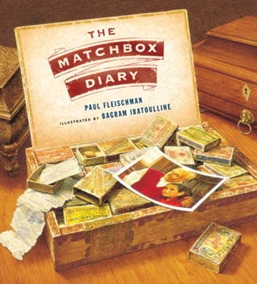
A great-grandfather shares his life’s story with his great-granddaughter who picks out a cigar box filled with matchboxes to find out more about.  He has been collecting matchboxes that are filled with small items documenting his life, a diary of objects.  They tell of his poor childhood in Italy where he’d be given an olive pit to suck on to make him less hungry.  There is a picture of his father who went to work in America and sent money home.  His story then turns into one of an immigrant with a trip to the port and then aboard a large ship.  He tells of arriving at Ellis Island, of the terror of possibly being denied entrance, and the eventual reunion with his father.  The entire family, including the children, worked to earn enough money to survive.  Life became better and he learned to read until he started in the printing industry and opened a bookstore. 

Fleischman writes of the tentative relationship of a young child and her great-grandfather who are just getting to know one another for the first time.  This is a story filled with small gems, treasures of stories that the two of them explore side by side.  The small matchboxes are a wonderful device to add surprise and delight to the story.  Fleischman has created an entire picture book told only in dialogue, making it a pleasure but challenge to read aloud. 

Ibatoulline’s illustrations are precise and detailed.  The matchboxes are shown up close and just opened, as if the reader had been the one exploring them.  The stories are shown in sepia tones with modern day in full color.  They are filled with a beautiful warmth in both cases.

A distinguished picture book, this is a brilliant combination of historical story and vivid illustrations.  Appropriate for ages 6-9.

Reviewed from library copy.

Review: Clementine and the Spring Trip by Sara Pennypacker

clementine and the spring trip

Clementine and the Spring Trip by Sara Pennypacker

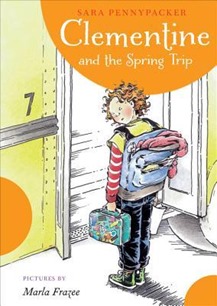
In the latest installment of the Clementine series, which happens to be one of my all-time favorite series, Clementine is taking a spring field trip with her class to Plimoth Plantation.  Clementine has agreed to be partners with her friend Margaret on the trip, mostly because the fourth graders have a rule that you have to eat without making any noise.  Margaret wants to partner with Clementine too, since Clementine doesn’t mind dirty things at all and Margaret most definitely does.  Then a new classmate comes along and complicates things.  Olive has her own language that she teaches everyone and is well on her way to being very popular, when she is paired with Clementine for the field trip.  With all of their plans in disarray, what will happen on the field trip?

Just as with all of the Clementine books, Pennypacker has created a modern girl living in a modern family.  She merrily inserts levity throughout the book from the cleaning of the statues in the park to the stinky bus they have to take on the field trip.  The character of Clementine continues to be complex, artistic and monumentally creative.   This of course can lead to getting into trouble, but what jolly trouble it is!

This series belongs in every school and public library.  Get it into the hands of creative kids and those who want a good giggle.  Appropriate for ages 7-9.

Reviewed from library copy.

Review: When I Was Eight by Christy Jordan-Fenton

when i was eight

When I Was Eight by Christy Jordan-Fenton and Margaret Pokiak-Fenton, illustrated by Gabrielle Grimard

This is a lovely new picture book version of Fatty Legs that will share Olemaun’s story with younger readers than the original chapter book.  It follows Olemaun from her time with her nomadic family through her attending the “outsider’s school.”  There her hair is chopped short and her warm parka is replaced with thin and scratchy clothing.  Her name is even changed to Margaret.  Margaret wants most to learn to read, but the school is much more interested in getting the children to work hard rather than teaching them.  Margaret has a difficult relationship with one nun in particular who makes a point of humiliating her regularly.  In the end though, Margaret does learn to read all on her own.

This is a story that works really well as a picture book.  I really enjoyed both Fatty Legs and A Stranger at Home that were chapter books, but this younger version simplifies the story and keeps its quiet power.  As with the earlier books, I remain in awe at the strength that it took for Margaret to survive in the school and also the courage it takes to keep on telling her story.

Grimard’s illustrations echo the beauty of the Arctic but also capture the dullness and darkness of the school.  The nun character radiates scorn and anger on every page she appears in.  Margaret is shown usually isolated, but also as radiant in her resiliency.

A powerful look at residential schools on Native populations, this picture book version belongs in most libraries.  Appropriate for ages 6-9.

Reviewed from digital galley received from Netgalley and Annick Press.

Review: Wild Boy by Mary Losure

wild boy

Wild Boy: The Real Life of the Savage of Aveyron by Mary Losure, illustrated by Timothy Basil Ering

Losure’s latest is another compelling true story this time focusing on the boy found in the woods in southern France in 1789.  The boy was not a tiny child, but rather a young boy who had obviously been surviving on his own for some time, his body covered in scars.  Quickly, the boy was taken for study and observation, his life curtailed and limited because he always attempted to run away.  There was very little attempt to actually reach him until he was sent to the Institute for Deaf-Mutes where he was put into the care of Dr. Itard.  Itard decided to make the boy, who he named Victor, happy before trying to teach him to speak.  So Victor joined the family of the housekeeper and quickly became attached to them.  But civilizing a wild boy is not simple, as this book shows with historical details, engaging humor, and a narrative that shows an immense empathy for this wild child.

Losure, author of The Fairy Ring, has once again taken a complicated situation and made it understandable for young readers.  Young readers will immediately relate more closely with the intriguing Victor.  Through his eyes and Losure’s exquisite writing, readers understand his ties to nature (Page 72):

But when rain pattered on the roof and everyone else went inside, the wild boy often crept out into the garden, to the tiny, formal reflecting pond that sat among the flower beds.  He would circle the pond several times, then sit by its edge and rock himself back and forth as the rain dimpled the surface of the pond.  He’d gaze into the water, toss in a handful of dead leaves, and watch them drift.

The digital galley I read did not have the completed art available, so I cannot comment on the illustrations.  Throughout the book, Losure makes the Wild Boy come to life as a very unique and resilient boy.  The story is told during his time, through the eyes of those who knew him best, using reports written at the time.  Only in her Author’s Note does Losure speculate on whether Victor was autistic.  There she also notes the importance of Victor on educational attitudes like Montessori.

An engaging, wrenching read that brings history to life in the form on one amazing person.  Appropriate for ages 9-12. 

Reviewed from digital galley received from Netgalley and Candlewick Press.

Review: A Splash of Red by Jen Bryant

splash of red

A Splash of Red: The Life and Art of Horace Pippin by Jen Bryant, illustrated by Melissa Sweet

Born in 1888, Horace Pippin loved to draw from the time he was a small child.  He would draw on scrap paper using charcoal, he would draw for his friends, and he would even draw on his spelling tests though his teacher did not appreciate that.  As he grew, he had to quit school in 8th grade.  He worked hard with his hands in different ways, but continued to draw and paint.  Then Horace went to war and was wounded in his right arm.  Now he could no longer draw, or so he thought.  He started trying again with a poker and using his other hand to steady himself.  As he grew stronger, he drew more and more.  Eventually, he gained the attention of people like N. C. Wyeth, who helped put together his first art show.  Pippin’s life that was filled with hardships and obstacles serves as inspiration for young artists.

Bryant and Sweet  collaborated before with Caldecott Honor results.  This picture book biography of an important but lesser known African-American artist shows the power of art in one’s life and how it is impossible to stop seeing and communicating the world through art once you begin.  Bryant writes with a solidity that is lovely.  Incorporating Pippin’s own words from letters, she captures the life of this artist and how he came to be recognized for his work.

Sweet too weaves Pippin’s words into her art.  Her use of collage truly builds Pippin’s world before readers’ eyes.  My favorite image in the book is Pippin as a young boy sitting and drawing on piles of papers.  It captures the intensity with which he created art even at such a young age.  This intensity continues through his story to after he is wounded and the determination that is apparent in just his hands. 

Another very successful collaboration of these two masters, this biographical picture book should serve as its own splash of red on every library’s shelves.  Appropriate for ages 6-9.

Reviewed from copy received from Random House Children’s Books.

Review: Hold Fast by Blue Balliett

hold fast

Hold Fast by Blue Balliett

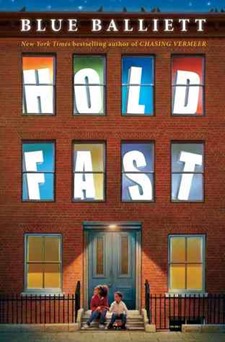
Early lives in a warm and loving family.  Her father Dash is a lover of words and word games.  Her mother Sum and little brother Jubie make up the total of four in their family.  But when Dash gets involved in something shady, their loving family becomes three.  Then people raid their home, breaking down the door and they are forced to head to a shelter without knowing where Dash is or how he will find them again in the big city of Chicago.  Early finds she has to be the strong one as her mother begins to falter and her brother is so little.  Shelter life is difficult and it takes Early some time to realize that she is in the middle of a mystery that she can help solve. 

Balliett demonstrates her own love of words and wordplay throughout this novel.  Told in beautiful prose, she writes poetically about the city she loves, the beauty of snow, and the power of family.  She incorporates wordplay through her protagonist, who looks at words the way her father taught her to.  Many times words sound like what they are, points out Balliett, and just reading this book will have readers seeing words in a new way.

Balliett also introduces young readers to the poetry of Langston Hughes.  One of his books is at the heart of not only the mystery of the book but at the heart of the family.  As Hughes muses on dreams and their importance, both Early and the reader are able to see his words and understand them deeply. 

The aspect of the homeless shelter and the difficulties the family and Early face there is an important one.  Balliett is obviously making a point with her book, sometimes too obviously.  There are also some issues with plotting, with the book dragging at points and struggling to move forward.  That aside, the writing is stellar and the characters strong. 

Another fine offering from Balliett, get this one into the hands of her fans.  It will also be great choice for reading aloud in classrooms with its wordplay and strong African-American characters and family.  Appropriate for ages 9-12.

Reviewed from ARC received from Scholastic.

Review: Starring Jules (As Herself) by Beth Ain

starring jules

Starring Jules (As Herself) by Beth Ain

When Jules is singing her new jingle for a fizzy ice-cream cone to her little brother and making lots of bubbles in their milk glasses, she is discovered and invited to audition for a mouthwash commercial.  But even for a girl with lots of “pizzazz” there are difficulties to overcome.  First, Jules finds out that the mouthwash is orange flavored, a flavor that makes her want to puke.  Second, the only one she can see who can help her is her old best-friend Charlotte Stinkerton Pinkerton.  Third, there’s a new girl in Jules’ class who may just be the perfect best friend ever, but Jules has to get to her first, before she joins the new clique that Charlotte has formed.  It’s a complicated situation for Jules and the question is whether it will be just too much for this girl who is fizzy and filled with pizzazz.

Ain has created a character that reads like an older Clementine.  Jules is wonderfully and innately quirky, obviously happy in her own skin.  All of the small details and Jules’ unique view of the world serve to make her a beautifully human character.  Happily, the same is true for the secondary characters as well.  They are all richly drawn and complex.  Friendship is shown in all of its miscommunication and mistakes.

Written with a light hand and a jaunty pace, this book will appeal to readers who have grown up with Clementine and are looking for a new heroine with plenty of individuality.  Appropriate for ages 7-9.

Reviewed from ARC received from Scholastic.

Review: Odette’s Secrets by Maryann Macdonald

odettes secrets

Odette’s Secrets by Maryann Macdonald

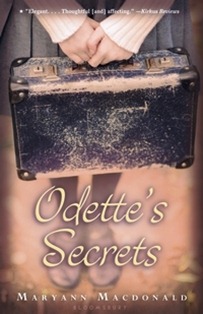
This true story of a young Jewish girl growing up in Nazi-occupied Paris is told in verse.  Odette’s father is sent to a Nazi work camp and her mother works hard to protect Odette.  As the Jews in Paris are steadily more badly treated, Odette has to wear a yellow star on her clothing and is unwelcome in many places in the city.  Even at school, Odette is bullied for being Jewish.  When their apartment is raided in the middle of the night, Odette and her mother hide in their landlady’s cupboard.  After that, Odette is sent to the country to live.  There she learns to pretend to be Christian so that she isn’t discovered.  When her mother is forced to flee Paris, the two of them move together to live in the French countryside as peasants, but Nazis and bigotry are never far behind.  Odette learns that sometimes secrets are vital to survival and just as hard to stop keeping as they are to keep.

Macdonald writes in her author’s note about the inspiration for creating a children’s book that tells the story of the real Odette.  It is interesting to learn about the transition from straight nonfiction to a verse novel.  I’m so pleased that the end result was this novel in free verse, because Macdonald writes verse with a wonderful eye to both the story she is telling and the poetry itself.  She truly creates the scenes of Paris and the French countryside in her poems, making each place special and amazing. 

Perhaps most amazing is Odette herself, a protagonist living in a brutal and complicated time, forced to lie to stay alive.  Odette has to learn to deal with the fear she lives in every day, something that no one should have to get used to.  There was the fear of slipping and telling the secrets she held but also the fear that someone could figure out they were Jewish without any slip from Odette.  Macdonald creates quite a dramatic series of events that point out that Odette was terrified for very good reason.

Beautiful verse combined with a true story of a young girl World War II France makes this a very successful book that cuts right to the heart and lays all its secrets bare.  Appropriate for ages 9-12.

Reviewed from copy received from Bloomsbury.