Review: Little White Duck by Na Liu

little white duck

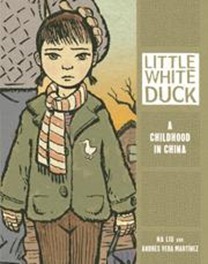
Little White Duck: A Childhood in China by Na Liu, illustrated by Andres Vera Martinez

This graphic novel takes a look at the changes in China during the 1970s through the eyes of a young girl.  Da Qin lives in Wahun with her family, including a younger sister.  The book opens with the death of Chairman Mao in 1976 and shows a way of life that was disappearing.  In eight chapters, Liu reveals this transitional and fleeting time in China through experiences in her own childhood.  Along with the main character, readers get to celebrate New Year, capture pests, learn the value of rice, and visit a rural Chinese village.  Throughout, it is a remarkable view into a closed society that is just starting to open itself to the outside.

Liu writes her stories with a wonderful frankness about the playfulness of childhood filled with dreams of riding on cranes, but also tied down to the earth by the everyday nature of the tales.  There is a focus on the small moments of life in China.  Some are amazing to those of us who didn’t live them, like everyone participating in catching the four pests by bringing in a certain number of rat tails. 

Martinez’s art is a study in sepia toned memories made brilliant by the colors of childhood.  Against a gray background, the bright dragon dances at New Year’s.  Orange and yellow flames cook green and brown food.  And even after the drab poverty of the rural village, there are dreams of flying on a crane high in the sky.

Informative and remarkable, this graphic novel takes a fresh and frank look at a childhood in China.  Appropriate for ages 8-10.

Reviewed from library copy.
Review: Kel Gilligan’s Daredevil Stunt Show by Michael Buckley

kel gilligan

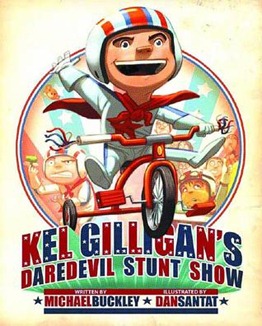
Kel Gilligan’s Daredevil Stunt Show by Michael Buckley, illustrated by Dan Santat

Kel is a daredevil, willing to take on enormous challenges and risk his own safety!  He took on the challenge of eating broccoli and survived without a scratch.  He had the courage to face down “The Potty of Doom” though it did take longer than he expected.  He even managed to get dressed by himself without a net.  He has tested his underwater skills by taking a bath with only one assistant.  And has even survived his mother being on the phone without interrupting, though it was close.  When Kel faces his final challenge of the day, you may have to avert your eyes, because he will be trying to go to bed without checking for monsters first!  This is one picture book only for the bravest of readers.

Buckley’s language is over the top in the best possible way.  Kel speaks as if he is announcing his challenges to a large crowd, all rooting for him.  Buckley even gives that crowd a voice, interjecting amazement at this brave young man and what he is trying to do.  The language alone is enough to get you laughing.

Combined with Santat’s illustrations, this book will actually make you laugh out loud.  The incredulous faces of those in the crowd, the bare buttocks that you glimpse occasionally, and the pride of Kel as he defeats another obstacle, all add to the humor here. 

Give this one to kids a little older, since they will appreciate looking back on their own accomplishments in a humorous way.  Expect a cacophony of laughter when the The Potty of Doom appears.  Appropriate for ages 5-7.

Reviewed from copy received from Abrams.

Review: The Wild Book by Margarita Engle

wild book

The Wild Book by Margarita Engle

Told in poems, this is the story of Engle’s maternal grandmother and her struggle with dyslexia.  Known as Fefa, her grandmother was diagnosed with “word blindness” and told she would never read or write.  Luckily, Fefa’s mother has an idea.  She gives her daughter a blank book to fill with words, as if she is scattering wildflower seeds on the ground.  At first Fefa’s words are hesitant and stilted, like seedlings.  But steadily her writing and reading improve as she learns to take her time and gains confidence.  And that reading is what saves her and her siblings from being kidnapped in the chaos following Cuba’s fight for independence.

Engle writes a gripping series of poems that range from celebrating the written word to the difficulties of dyslexia to the triumph of overcoming.  Over the entire book the threat of violence and kidnappings hangs low and dark.  It is clear that this is not a modern story from the very beginning and Engle cleverly reveals the extent of the chaos the family is living in the midst of through Fefa herself and her own growing knowledge.

As always, Engle’s verse is exceptional.  Often her individual poems could be read one their own.  Yet it is as one complete story that they really show their beauty.  There are many exceptional stanzas to share, but one of my favorites comes early in the novel:

Frog Fear


My little brothers love

to frighten me

by hiding lizards,

bugs, and spiders

in my bloomers.


Today it’s a frog,

but they tell me it’s a snake,

so I scream and tremble

until I can clearly see

that the little creature

jumps around

like jittery letters

on a blinding

page.


The skin of a frog

feels just as slippery

and tricky as a wild

inky word.

Engle traces the love of words and poetry Fefa’s own mother, who shares poems with her family.  It’s a beautiful celebration of that history and those words.

This novel in verse is a powerful look at Cuba’s history and also at dyslexia and overcoming challenges.  Appropriate for ages 9-12.

Reviewed from library copy.

Review: Seed by Seed by Esme Raji Codell

seed by seed

Seed by Seed: The Legend and Legacy of John “Appleseed” Chapman by Esme Raji Codell, illustrated by Lynne Rae Perkins

Two modern children are transported back in time from the busy highways filled with cars to the quiet woods of the late 1700s.  From there, the story of Johnny Appleseed, really named John Chapman, is told.  The differences between the world back then and our modern world are explored.  Then the way of life that Johnny Appleseed embraced that of using what you have, respecting nature, sharing, making peace, and reaching your destination in small steps is tied back to how important those things are still for us today.  His planting of seeds changed the landscape of our country.  The book ends asking what seed you will plant.

Codell writes with a wonderful lyricism paired with a directness.  It makes for a book that is straight-forward but also written with care to create a specific mood.  Chapman’s story is filled with legend, especially in his relationship with nature and animals.  While some of it may be tall tales, it contributes to the wonder that surrounds this man.  Codell made a choice to have some of that in her book and it works very well, distinctly noted as legend rather than fact.

Perkins’ illustrations vary from page to page.  Most of the art is done in watercolor and gouache, creating bright colored images that embrace the natural and feel clear and crisp.  Other pages incorporate burlap bags and needlework.  It’s a clever use of materials of the period that really add another dimension to the illustrations.

A beautiful look at a man who stand for much of what we are seeking in modern society.  This book reaches beyond the legend and finds the real Johnny Appleseed.  Appropriate for ages 6-8.

Reviewed from library copy.

Review: Twelve Kinds of Ice by Ellen Bryan Obed

twelve kinds of ice

Twelve Kinds of Ice by Ellen Bryan Obed, illustrated by Barbara McClintock

Oh my.  There are few books that leave me with tears standing in my eyes at the end, especially books of a spare 64 pages.  This one did. 

I suppose I could leave my review at that, but here are some details for those who need more.  This tightly written and beautifully illustrated small book looks at the twelve kinds of ice that happen in the course of a winter.  It all starts with the first ice which is the thin ice on top of a bucket in the barn that breaks when you touch it.  From there excitement builds as slowly the ice gets thicker and more able to be skated on.  Some ice like field ice and stream ice can be skated on, but it’s tricky.  Garden ice is the ice rink that the Bryan family created in their garden, made by packing the snow very firm and then spraying it with the garden hose.  It is that family skating rink that is really celebrated in the book, showing a strong family and their mutual connection through ice skating.  Even the ice skaters and hockey players get along.  Most of the time!

Obed is telling the story of her own family and their love of skating.  Her writing is so beautiful and strong.  She tells a story with depth and feeling, celebrating winter, ice and the thrill of skating.  Seeing how short the book is, one wonders how she managed to tell so much in so few pages.  Her prose invites us into her family and onto ice skates.  Alongside her, we don’t so much as wobble but instead skim across the ice at her side.  It’s an exhilarating and intensely personal read.

McClintock’s illustrations are entirely black and white in the book.  She captures a timelessness in her images, celebrating the family and natural surroundings.  She also shows the movement of skating and its thrill.

This is a quiet book, one that will need some push to get it into children’s hands.  I can see it being part of anyone’s holiday and also a great gateway to talking about your own memories of childhood and special things your family does together.  Quiet but powerful and immensely satisfying.  Appropriate for ages 6-9.

Reviewed from library copy.

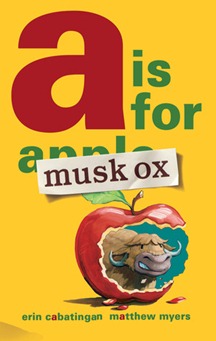
Review: A Is for Musk Ox by Erin Cabatingan

a is for musk ox

A Is for Musk Ox by Erin Cabatingan, illustrated by Matthew Myers

The story begins right at the cover with Musk Ox chomping on the apple that would have been what “A” stands for.  Instead, he insists that A is really for musk ox.  Zebra argues with him, after all there isn’t even a single letter A in musk ox.  Musk Ox explains using lots of words that start with “A” that musk oxen are Awesome; they live in the Artic and even Alaska.  Turn the page and you will see that B is also for musk ox, rather than baby.  Again, Musk Ox has plenty of explanations for exactly why.  This silliness continues through the book, forming a pattern until you reach the letter M.  And I don’t want to spoil the surprise, but I bet you won’t guess what M stands for.  This zany book is filled with humor, pure cheer and a jolly spirit.

This is not an alphabet book for those first learning their letters.  Instead, children who know how the alphabet works and who are veterans of ABC books will enjoy it most.  They will get the jokes that are being poked at more normal alphabet books as well as the more pointed humor of the storyline.  Cabatingan’s writing, done entirely in dialogue, is a pleasure to read aloud.  It has a natural flow and a great sense of timing.

Myers’ illustrations are simple and quite silly when called for.  The personalities of the two characters come across in their body language. 

A hilarious alphabet book that is guaranteed to get kids giggling.  Appropriate for ages 5-7.

Reviewed from library copy.

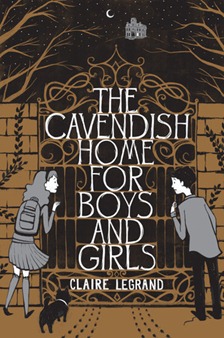
Review: The Cavendish Home for Boys and Girls by Claire Legrand

cavendish home

The Cavendish Home for Boys and Girls by Claire Legrand

Victoria has always tried to be the best that she can be with her perfect hair, great grades and neat room.  So when she gets a B in music, she is distraught and refuses to show her parents her report card.  Lawrence, her one and only friend, doesn’t have the same appreciation for perfection.  He’s a musician who is often untidy and has a habit of humming constantly.  As Victoria obsesses about her grades, she starts to notice that strange things are happening around town.  Some of the students at her school have disappeared and no one seems to care.  When Lawrence disappears and his parents are unconcerned, Victoria realizes that there is something horribly wrong.  She knows it must have to do with the Cavendish Home for Boys and Girls, an orphanage which never seems to have any children around.  In Mrs. Cavendish, Victoria finds another person with a will for order and perfection.  In Victoria though, Mrs. Cavendish may have met her match.  As this book turns from mystery to horror, readers will taken on a frightening ride.

From the endpaper that is designed with bugs to the bugs scattered along randomly inside the book, readers will realize that this is a little darker than most mysteries.  It begins as a classic story of a girl who is top of her class and fairly self-centered.  She is likeable despite these faults thanks to her natural inquisitiveness and bravery.  As the book becomes more dark and creepy, Victoria rises to the challenge, turning into a heroine before your eyes.  It’s a credible and impressive transformation.

Legrand slowly builds the tension in the book, creating a story that you can never quite relax into.  A great example of this is on page 83:

Outside, the streets glistened. Storm clouds sat fat, black, and heavy all along the sickly yellow sky. Victoria wondered if they would ever break or if they would just keep spitting bits of rain forever when no one was looking. She tightened her grip on the umbrella beneath her raincoat and tried not to think about how it felt like the trees were watching her.

It’s a book that twists and turns, becoming the unexpected. At several moments, I thought I had figured it out and the doubted that that would be the outcome in a children’s book.  Children will delight though in realizing that Legrand does not shy away from the horrid, the frightening and the disgusting. 

This is a wild ride of a book clothed in a classic mystery disguise.  Get it into the hands of children who enjoy a good shivery read.  It’s perfect for reading at night under the covers, if you are brave enough.  Appropriate for ages 11-13.

Reviewed from copy received from Simon & Schuster.

Review: Binky Takes Charge by Ashley Spires

binky takes charge

Binky Takes Charge by Ashley Spires

Binky has now been promoted to lieutenant in first against the aliens.  It means that he is now in charge of training new recruits.  But his first recruit is definitely not what he had been expecting.  To start with, he isn’t a cat!  He’s a dog!  Binky sets out to train the new cadet anyway, trying to ignore the fact that he pees on the floor, won’t use the litter box, doesn’t respect the idea of a cat nap, and is unable to pounce a fake alien on a string. Soon Binky is questioning more than his cadet’s skills, perhaps he’s really a spy for the aliens!  Now Binky sets out to prove what he suspects, but he’s in for a few surprises along the way.

The Binky series is one of my favorite graphic novel series for children.  It is a treat to see our alien-fighting (actually insect fighting) hero reach new ranks here.  The addition of a dog into the series is brilliant, especially one who may be a spy for the flies.  Add in the farting and the physical humor, and you have a series that is bound to appeal to reluctant readers as well as eager readers.

Spires’ art is done in a limited color palette.  Her black and white cat lives in a sepia-toned world that has bursts of color.  This palette could read as vintage, but here the modern lines and modern story keep it up-to-date and great fun.

This is another strong book in a great series.  It’s a must-have for all children’s graphic novel collections.  Appropriate for ages 5-8.

Reviewed from copy received from Kids Can Press.

Review: The Second Life of Abigail Walker by Frances O’Roark Dowell

second life of abigaiil walker

The Second Life of Abigail Walker by Frances O’Roark Dowell

Abby has always been on the outskirts of her group of friends, considered the fat one who could be teased endlessly about her weight.  She has to be careful not to give her real opinion and to always toe the line set by the group leader.  Privately, she considers them to be “medium girls” and nothing special, but they are her friends.  As Abby starts to investigate the abandoned lot across from her house, she gets gently bitten by a fox.  It is from that point on that she is no longer content to be a medium girl herself.  Following the fox and then a dog, Abby discovers a creek she never knew was in her neighborhood and then a farm on the other side.  A boy lives there with his grandmother and his father who is recovering from battle in Afghanistan.  As their friendship grows, Abby gains self confidence and is able to give a lot back too. 

This book had me from the very first page.  Told from the point of view of the fox, the first short chapter invites readers to speaks to the power of story, the role of fabled characters in our lives, and moments when the real world and myths intertwine.  It sets the stage perfectly for what is to come.  This is a realistic story that has magic and myth moments.  The writing is outstanding, bringing magic into our world through empty lots filled with weeds, foxes who live in urban settings, edges of suburbs, and newfound friends.

Abby is a great character.  She is chubby and ridiculed for it by not only her friends but her parents.  Yet she has a quiet strength, an underlying confidence, that allows her to withstand those opinions and grow into the person she really is.  She is a wonderfully normal child, not the brightest, not the strongest, but one who is willing to see beyond the weeds to the flowers.

This is a radiant book that celebrates the quiet, the mythical, the connections that are too often missed in our rush.  Appropriate for ages 9-12.

Reviewed from copy received from Atheneum Books for Young Readers.