Review: Just Behave Pablo Picasso! by Jonah Winter

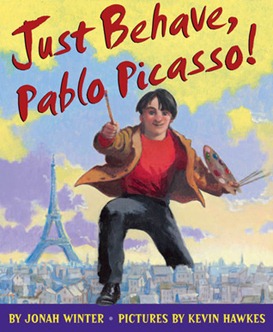
JUST BEHAVE, PABLO PICASSO!

Just Behave, Pablo Picasso! by Jonah Winter, illustrated by Kevin Hawkes

Pablo Picasso started out painting just like everyone else, but when he started to paint his moods in colors, things started to change.  The gallery owners wanted more pictures in just the same style, and suddenly Picasso became wealthy and well know.  But Picasso was not interested in painting the same rose colored paintings again and again.  Instead, he becomes inspired by African masks and does a new painting that breaks all of the rules.  When it is unveiled, the reaction is strongly negative and it is called “ugly” by the critics.  When the entire world starts doubting him, Picasso works even harder, coming out with another painting that is the birth of modernism.  This book displays the strength needed to stay true to yourself all through the lens of the incredible Pablo Picasso.

Winter has not written a conventional picture book biography here.  Instead, he plays with the format.  He uses comic book techniques like BLAM! and has pages that range from just a sentence or two to ones that are lengthier and provide more information and insight into Picasso.  This biography is less about the details of his life and much more about his art and its inspiration and evolving style.  We learn nothing of his family, but much about his process and his drive.

Hawkes’ illustrations carry that same playful feeling forward.  He toys with perspective, enjoys depicting the close quarters in Paris with see-through walls.  It takes a certain amount of playfulness to take on a book about Picasso and not imitate his style in the illustrations.  Hawkes’ style remains true to himself, underlining the overall message of the book by doing so.

A creative and fun picture book biography about a vibrant and rebellious artist, this book should find a place in children’s nonfiction collections.  Appropriate for ages 6-8.

Reviewed from library copy.

Review: Mr. and Mrs. Bunny–Detectives Extraordinaire by Polly Horvath

mr and mrs bunny detectives

Mr. and Mrs. Bunny – Detectives Extraordinaire! by Polly Horvath

Madeline has always taken care of her parents rather than the other way around.  She knows they won’t come to her school events, not even the graduation ceremony that Prince Charles will be attending!  Because they aren’t interested, she has to find a way herself to get the required white shoes for the ceremony.  But when she returns home after waitressing, she discovers that her parents have been kidnapped by foxes!  The only one who can help them is Madeline, who will also need help.  She finds it in Mr. and Mrs. Bunny who have just become detectives, having purchased the necessary fedoras for that sort of work.  The three set out to solve the mystery and rescue Madeline’s parents.  On the way, they have to consort with garlic-bread munching marmots, stand up to the Bunny Council, learn to drive a car wearing disco shoes, and become fast friends.

Horvath takes a clever premise and allows it to twist and turn in her hands, creating a book that is quirky and ultimately lovable.  Her writing is uproariously funny, taking modern culture and making wonderful fun of it along the way.  At the same time, this remains a talking animal book, retaining all of the warmth and charm of that sort of tale.  So there is also plenty of tea, hot soup, and even prune cake to go around.  Think of it as a cozy mystery for children.

Blackall’s illustrations add to the warm but quirky feel of the book.  Scattered nicely throughout the book to encourage young readers, the illustrations have a modern edge but also pay homage to old-fashioned children’s books.  She was the perfect pick for the book.

An ideal read aloud for elementary classes, this book also makes a cozy read all on your own.  Appropriate for ages 8-11.

Reviewed from copy received from Schwartz & Wade Books.

Review: Kindred Souls by Patricia MacLachlan

kindred souls

Kindred Souls by Patricia MacLachlan

Billy has lived on the farm his entire life.  He was raised in the sod house that is now tumbled down and covered by weeds.  Billy is the center of his grandson Jake’s world, especially their walks around the farm together.  Jake gets to see the farm through Billy’s eyes and spend time as his kindred soul.  When Billy gets sick, Jake isn’t worried.  He knows that Billy will live forever.  There’s only one wish that Billy has ever spoken about and that is having another sod house built on the farm.  As Billy recuperates in the hospital, Jake and his older brother and sister decide to build a house for him.  But the job is huge and Billy is coming home soon.  Can they pull off the special surprise?

MacLachlan excels at creating great depth in small packages.  This is another of her very short books that plunges readers into a family and immediately takes up space in your heart.  There is the beauty of a long life lived on a farm that is almost spiritual.  There is a young family that has an elder as their center.  And then there are the small moments that create their days and weave together a story that is bittersweet in the best way.

This small book looks at the role of grandparents in the lives of children in a quiet yet powerful way.  Billy is the center of the book, since he is the center of Jake’s world.  The book, told in the first person by Jake, also explores connections between generations that are strong and true.  The sense of kindred spirits is strong but never overplayed.  This entire book exudes a quiet strength that makes for a compelling read.

A strong book that would make a great read-aloud (especially by grandparents), this book is a beauty.  Appropriate for ages 7-9.

Reviewed from library copy.

Review: The One and Only Ivan by Katherine Applegate

one and only ivan

The One and Only Ivan by Katherine Applegate

Ivan is the gorilla that is part of the Exit 8 Big Top Mall and Video Arcade.  The big billboard outside the mall shows Ivan as a ferocious beast, but he’s really a very easygoing guy.  He doesn’t remember anything about his life before he came to live with humans.  He was raised in Mack’s house as long as he was little and cute, but when he got bigger he was put into his domain: a glassed-in room.  He watches TV, lots of Westerns, and hangs out with his friends: an old elephant named Stella and a stray dog named Bob.  He also does art, scribbles that Mack sells in the mall gift shop.  Things change at the circus as money gets tighter until Mack purchases a baby elephant for the Big Top.  Ruby has been taken from her family and is full of lots of questions.  She makes Ivan look at his small, enclosed world more closely and inspires him to make promises that he will probably never be able to keep. 

I read this book in one long gulp, unable to get Ivan and his tiny, limited world out of my head.  The book is written from Ivan’s point of view, one that is distinctly gorilla and wonderfully familiar and foreign at the same time.  Applegate manages to give us a taste of being animal while never imbuing Ivan with human sensibilities, yet he is entirely relatable for readers.

The use of art to bridge the language gap between humans and gorillas is equally effective.  Ivan’s ruminations about art and how to capture taste and feel on paper is lovely.  Ivan’s world may be small and enclosed, but through art and his relationships with others, it grows larger and larger. 

This is a book that captivates.  It is compelling readers, bubbling with humor, yet addresses issues that are deep and complex.  It is a book that is memorable, rich and simply marvelous.  Appropriate for ages 9-12.

Reviewed from library copy.

Review: Chitty Chitty Bang Bang Flies Again by Frank Cottrell Boyce

chitty chitty bang bang flies again

Chitty Chitty Bang Bang Flies Again by Frank Cottrell Boyce, illustrated by Joe Berger

Take a lively ride in the first follow-up to the original Chitty Chitty Bang Bang book by Ian Fleming.  The Tooting family have hit hard times, Mr. Tooting has lost his job.  But they don’t stay down hearted for long, deciding that they should take a trip around the world.  Mrs. Tooting brings home a very old and worn camping van that Mr. Tooting and Jem slowly rebuild together after taking it entirely apart.  When they go looking for parts at a local junkyard, they discover an amazing racing engine and mount it on the camping van.  The engine, of course, belonged to the original Chitty Chitty Bang Bang and now Chitty wants to get the rest of herself back together.  So the family and Chitty are off on an adventure around the world to find all of her parts.  This adventure will take them to the top of the Eiffel Tower and the depths of the ocean.

Boyce has moved the story into the modern age with cell phones and a contemporary family.  The story pay homage to the original in many ways, foremost being the search for the parts of the original Chitty.  Also, the story arc is very similar with wonderful villains who pop into the story with menacing jelly baby phones and the moment when the children are separated from their parents and have to fend for themselves.  The book also has a real spirit of the first, incorporating humor throughout.

Berger’s illustrations enliven the book, showing a multi-ethnic family and making the book more approachable for young readers.   They have a wonderful humor about them too, carrying the jolliness of the story into images.

The old-fashioned yet modern mix of this book is extremely appealing.  The book reads quickly and is completely entertaining.  Ideal for fans of the first book and sure to win new fans as well.  Appropriate for ages 8-11.

Reviewed from library copy.

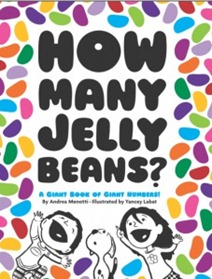
Review: How Many Jelly Beans? by Andrea Menotti

how many jelly beans

How Many Jelly Beans? by Andrea Menotti, illustrated by Yancey Labat

Released in April 2012.

I cannot count how many dismal number and math books I have read over the years.  I’m lucky enough to have a mathematical kid, but finding books that he would enjoy was painful.  Many math books are a lot more about concept than about being fun to read.  Well, not this one!  This one winningly mixes math with candy, so that even non-mathematical kids will give it a try.  Aiden and Emma are just like most siblings, they are trying to get more than each other.  So when Emma asks for 10 jelly beans, Aiden asks for 20!  And the number just keep climbing from there.  Soon, they are up to 500 jelly beans, which may be way too many to eat.  But how about 1000 or 5000 or 10,000 in a year?  The jelly beans get smaller and smaller until the final number of 1 million is reached only be an enormous fold-out page. 

This visual sweet treat will get children able to truly visualize what the difference between thousands, tens of thousands, hundreds of thousands and a million are.  The art by Labat done in black and white with only the jelly beans for tantalizing color really works.  The focus is on the candy and the number.  Menotti nicely inserts division into the conversation too, when the children debate how many jelly beans they could eat in a year. 

I can see this over-sized book inspiring lots of counting, adding, dividing and multiplying in families, or it is also a very sweet book to share with your number-loving kid.  Appropriate for ages 5-7. 

An aside just for librarians, please don’t put this in the remoteness of the nonfiction section with your math books.  Let it enjoy being taken home as a yummy picture book with a jelly bean and math center.

Reviewed from copy received from Chronicle Books.

Review: North: The Amazing Story of Arctic Migration by Nick Dowson

north

North: The Amazing Story of Arctic Migration by Nick Dowson, illustrated by Patrick Benson

This poetic look at the amazing Arctic starts with the deep winter and the few animals who survive there year round.  Then spring comes to the Arctic and the sun comes back along with some warmth.  Plants start to appear from under the snow.  Soon more animals will arrive.  The first to head out on their journey are the gray whales, that swim from Mexico to the Arctic Circle.  Birds head north too in flocks.  Herds of pregnant caribou journey north, followed closely by the gray wolves looking for weakness.  Walrus, narwhal, schools of fish, all of this life crowds the Arctic summer until the weather turns cold and brutal again, and once more they head back around the world.

Dowson’s words are poetry in this book.  Not only written in verse form, they also speak to the soul of the Arctic, the beauty of the place and the glory of the creatures who live there.  At the same time, the words are scientific and filled with information about the place and the animals.  It is an elegant combination of poem and fact.

Benson’s art is striking.  He created paintings that are both natural and accurate but also have a sense of artistry.  Much of the art is about the landscape, the place itself and the grand amount of space there.  The illustrations of bitter winter are cold and bleak with dim, gray light.  Then the reader turns the page and it is spring with its lemony light and sprigs of green.  The change is striking to the reader and beautifully captured.  There are moments like this throughout the book.

A striking mix of poetry, art and science, this book will speak to a range of different children looking to understand their world a little better.  Appropriate for ages 5-7.

Reviewed from library copy.

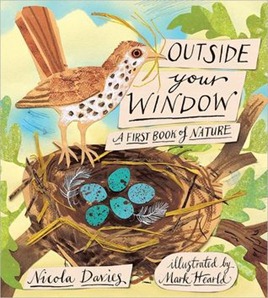
Review: Outside Your Window by Nicola Davies

outside your window

Outside Your Window: A First Book of Nature by Nicola Davies, illustrated by Mark Hearld (InfoSoup link)

Explore nature through the seasons in this lush book of poetry that starts with the first moments of spring with melting icicles and the green shoots of bulbs.  Summer is filled with butterflies, chickens, baby birds and bees.  Autumn comes with leaves, wind, geese and acorns.  And winter ends the year filled with snow, deer and ducks.  The poems range from merry verse with lighter tones to atmospheric pieces that make you stop and think.  It is this range of moods and depth that makes the book so very readable and enjoyable. 

Davies’ poems are all very child friendly, offering new perspectives on familiar things.  Her poem, “Night”, is one of my favorites of the book, though there are many to choose from that are incredible reads.  It capture the movement of the night, the feel of the quiet, and the sense of the world turning beneath you.  It’s quiet, beautiful, and captivating.

Add to these dynamic poems the art of Hearld and you have a real jewel of a book.  Illustrated with collage that combines paper cutout work, layers of texture, and realistic depiction of nature.  This realism emphasizes the beauty of nature, its diversity, and our own place in the world.  These are images that make you dream but also put your feet squarely on the earth and your connection to it.

Gorgeous illustrations combine with vibrant poems, creating a book to treasure.  Appropriate for ages 7-10.

Reviewed from library copy.

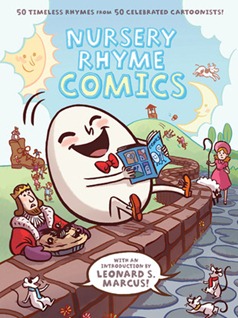
Review: Nursery Rhyme Comics

nursery rhyme comics

Nursery Rhyme Comics

Take 50 classic nursery rhymes and put them in the hands of 50 of the top cartoonists of the day, and you get a nursery rhyme book that will delight all ages!  As you turn the pages, the styles change too.   While the text stays true to the nursery rhyme, comic asides and comments merrily twist the meaning at times.  There are also plenty of modern twists on the old tales, like There Was an Old Woman Who Lived in a Shoe is a the owner of a daycare who also happens have a rock and roll band.  This is a book that embraces the humor, quirkiness and outright strangeness of nursery rhymes and takes them to another level.

When I first opened the book, I thought I might list my favorite rhymes and illustrations, but then I realized turning the pages that the real impact of this book is because there are so many diverse rhymes and illustration styles.  I tip my hat to the skill of Chris Duffy in matching illustrators to the ideal nursery rhymes.  This is really what makes the book sing.  I also appreciate the creative freedom given to the artists, making the result all the more intense and beautiful.

Highly recommended, this would be a great way to get nursery rhymes in the hands of older children who may have missed out on them when they were younger.  It’s also a delight if you know the rhymes already.  Appropriate for ages 6-10.

Reviewed from library copy.